Week 4: Theoretical Approaches to Psychological Interventions
Introduction
Psychological interventions aim to alleviate distress, improve functioning, and foster resilience.
These interventions are based on different theoretical frameworks that offer insights into human thoughts, emotions, and behaviors.
The choice of intervention depends on factors such as the client’s issues, cultural background, personal preferences, and the therapist’s theoretical orientation.
The module focuses on Cognitive Behaviour Therapy (CBT), Interpersonal Therapy (IPT), and Narrative Therapy.
Cognitive Behaviour Therapy (CBT)
CBT is a widely used and empirically supported psychological intervention for mental health conditions like depression, anxiety, and trauma.
Developed by Aaron Beck in the 1960s, influenced by Albert Ellis’ Rational Emotive Behavior Therapy (REBT).
Grounded in the cognitive model, which posits that thoughts, emotions, and behaviors are interconnected.
Psychological distress arises from how individuals interpret and respond to life events.
CBT seeks to identify and modify maladaptive thought patterns, helping individuals develop more balanced and constructive ways of thinking.
Cognitive shifts influence emotional regulation and behavioral responses, leading to improvements in mental well-being.
CBT is structured, goal-oriented, and time-limited, typically delivered over a series of sessions with active collaboration between therapist and client.
Its strength lies in its practical, evidence-based approach.
Research has demonstrated its efficacy across diverse populations.
Adapted for various formats, including individual therapy, group therapy, online interventions, and self-help programs.
Cultural adaptations may be required to ensure relevance to clients from different backgrounds, considering language, belief systems, and societal norms.
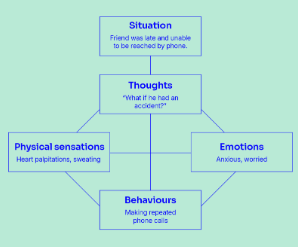
Figure 1 illustrates the relationship between thoughts, emotions, behaviors, and physical sensations.
Example:
Situation: Friend was late and unable to be reached by phone.
Thoughts: "What if he had an accident?"
Emotions: Anxious, worried.
Behaviours: Making repeated phone calls.
Physical sensations: Heart palpitations, sweating.
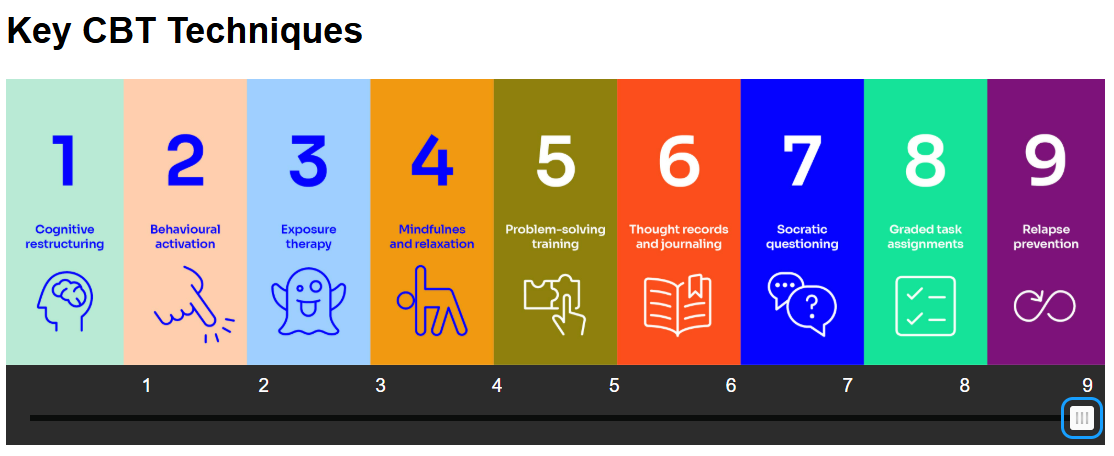
Key CBT Techniques
Key techniques used in cognitive behavioural therapy (CBT)
There are a few techniques most often used in CBT. Here are the most commonly relied on ways therapists work with their clients in this psychological intervention.
Interpersonal Therapy (IPT)
IPT is based on the premise that interpersonal relationships significantly impact mental health.
First developed as a short-term intervention to treat Major Depressive Disorder.
The core idea of IPT is to reduce distress by improving interpersonal functioning.
IPT is a time-limited treatment, usually 12-16 weeks.
IPT is less directive than CBT but still has a structured framework.
The core techniques of IPT address four key problem areas:
Interpersonal role transitions (e.g., becoming a new parent or transitioning careers).
Grief and loss (e.g., the death of a loved one).
Interpersonal disputes (e.g., disagreement with your partner).
Interpersonal sensitivity (e.g., being overly attuned to others' emotions).
Clients experiencing significant life changes benefit from structured discussions and strategies to manage role shifts.
Individuals struggling with complicated grief are supported in processing emotions and maintaining meaningful connections.
For those experiencing relational conflict, IPT develops assertive communication and conflict-resolution skills.
Clients with social difficulties can enhance their ability to engage in and sustain relationships.
When working with an interpersonal therapist, the client is able to determine which of the four main problem areas are contributing the most to their depression and shift towards healing the identified area.
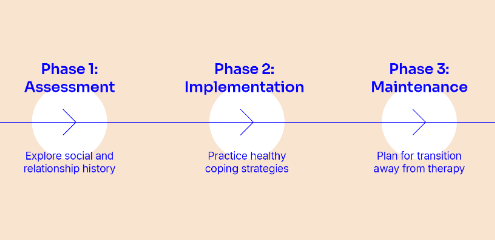
The structure of IPT involves:
The opening sessions (1-3): focus on collecting information and making decisions about the focus of therapy. The therapist helps the patient create a list of all the key relationships in the patientʼs life (interpersonal inventory).
The middle sessions (4-14): concentrate on trying to improve the chosen problem area or areas with the support of the therapist. The patient and therapist work to develop solutions to the problems, and the patient tries to implement the solutions between sessions.
The final sessions (15-16): focus on dealing with any sense of loss associated with the end of therapy. They also review the issues that were identified in the interpersonal inventory and the progress made in dealing with them.
Narrative Therapy
Narrative Therapy emphasises the role of storytelling in shaping personal identity and meaning-making.
This approach honors the lived experiences of clients and empowers them to take an active role in shaping their identities.
Narrative Therapy offers a way of working that respects peopleʼs knowledge, values, and stories, helping them to separate themselves from problems and create alternative, more empowering narratives.
Developed by Michael White and David Epston, it is based on the idea that peopleʼs identities and experiences are shaped by the stories they tell about themselves.
Culture and relationships influence these stories.
Problems arise when people become ‘stuckʼ in problem-saturated narratives, leading to feelings of helplessness or limitation.
Narrative Therapy operates on the principle that problems are separate from individuals, meaning that a person is not defined by their struggles but rather by their strengths, skills, and lived experiences.
Key steps include:
Putting together the narrative
Externalising the problem
Deconstruction
Unique outcomes
A key technique in Narrative Therapy is externalisation, where problems are conceptualised as external entities rather than intrinsic aspects of the self. This allows clients to gain perspective, reducing self-blame and increasing their ability to take action against challenges.
Re-authoring conversations helps clients identify strengths and moments of resilience that contradict negative self-narratives, reinforcing an alternative, more empowering story.
Therapists often use written documents, so individuals can re- author their stories, highlighting strengths, resilience, and preferred ways of being.
Tutorial activity
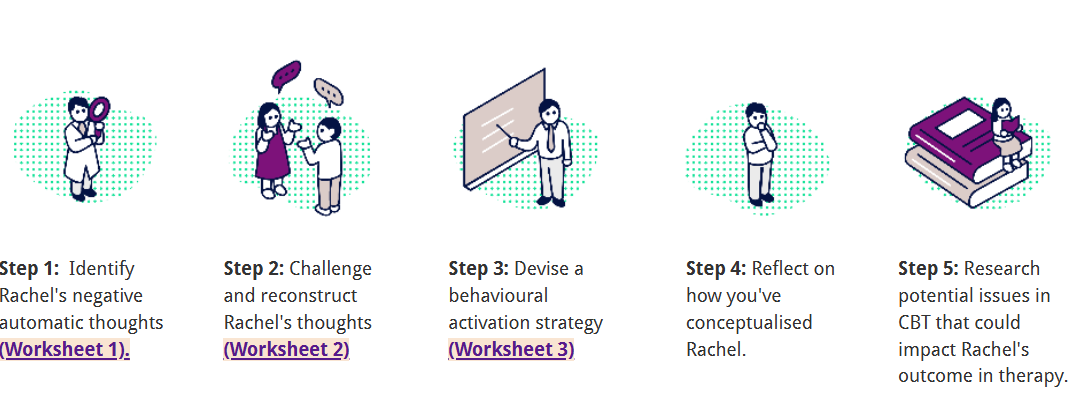
Case Study: Rachel, the Assistant School Principal.
This case study provides a concrete example of how the CBT approach can be applied in practice.
By identifying negative thoughts, challenging them, and incorporating behavioural activation, Rachel is able to begin reshaping her perceptions and behaviours, which can lead to significant improvements in her emotional state and overall well-being.
Practice Questions
What is the primary goal of Narrative Therapy?
How does Interpersonal Psychotherapy (IPT) address the role of social relationships in mental health, and how might this approach differ from other therapeutic models you have studied?