Cell Cycle and Cell Division Notes
Cell Division and Reproduction
In unicellular organisms, cell division reproduces the entire organism.
Multicellular organisms rely on cell division for:
Development from a fertilized cell
Growth
Repair
Cell division is integral to the cell cycle: the life of a cell from formation to division.
Bacterial Cell Division
Bacteria divide via binary fission.
A single, circular bacterial chromosome replicates.
Replication starts at the origin and proceeds bidirectionally to termination.
New chromosomes are partitioned to opposite ends.
A septum forms to divide the cell into two.
Eukaryotic Chromosomes
The genome comprises all of a cell's DNA.
Eukaryotic genomes consist of multiple DNA molecules, packaged into chromosomes.
Humans have 46 chromosomes in 23 pairs.
Chromosomes consist of DNA wrapped around histone proteins, forming nucleosomes.
Histones are positively charged and bind to negatively charged DNA phosphate groups.
Nucleosomes coil into solenoids forming chromatin in interphase cells.
During mitosis, chromatin condenses via protein scaffolds.
Karyotype
A karyotype is an array of an organism's chromosomes, arranged by size and properties.
Humans are diploid, possessing two sets of homologous chromosomes (46 total).
Cell Cycle Phases
The cell cycle includes:
Mitotic (M) phase: mitosis and cytokinesis.
Interphase: cell growth and chromosome copying in preparation for division.
Interphase
Interphase (90% of cell cycle) includes:
G1 phase ("first gap")
S phase ("synthesis")
G2 phase ("second gap")
The cell grows in all phases; chromosomes duplicate only in the S phase.
M Phase: Mitosis
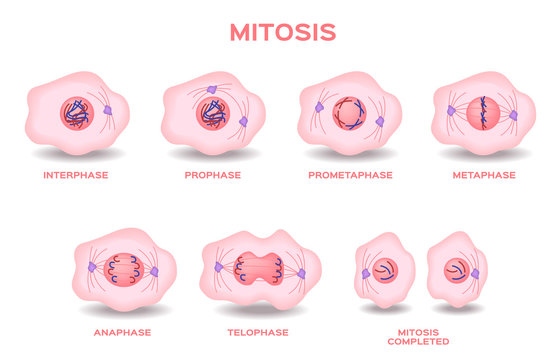
Mitosis comprises 5 phases:
Prophase
Prometaphase
Metaphase
Anaphase
Telophase
Mitosis Stages
Prophase: Chromosomes condense, the spindle apparatus assembles from microtubules, and the nuclear envelope breaks down.
Prometaphase: Microtubules attach to chromosomes at kinetochores, and chromosomes move toward the cell center.
Metaphase: Chromosomes align along the metaphase plate.
Anaphase: Centromeres split, cohesin proteins are removed, and sister chromatids are pulled to opposite poles.
Telophase: The spindle disassembles, nuclear envelopes form around each set of chromosomes, and chromosomes uncoil.
Cytokinesis
Cytokinesis is the division of the cytoplasm.
In animal cells, actin filaments constrict to form a cleavage furrow.
In plant cells, a cell plate forms between nuclei.
Cell Cycle Control
Cell cycle has two irreversible points:
Replication of genetic material (DNA)
Separation of sister chromatids
Checkpoints halt the cell cycle to check for accuracy and respond to signals.
Key Checkpoints
G1/S checkpoint: The cell decides to divide; influenced by external signals.
G2/M checkpoint: The cell commits to mitosis and assesses DNA replication success.
Spindle checkpoint: Occurs in late metaphase, ensures all chromosomes are attached to the spindle.
Cyclin-Dependent Kinases (Cdks)
Cdks are enzymes that phosphorylate proteins, controlling the cell cycle.
Cdks partner with different cyclins at different stages.
Cancer and Cell Cycle Disruption
Cancer involves unrestrained cell growth due to cell cycle control failure.
Mutations in tumor-suppressor genes and proto-oncogenes can disrupt the cycle.
Tumor-Suppressor Genes
p53 plays a key role in the G1 checkpoint by monitoring DNA integrity.
If DNA is damaged, p53 halts division and stimulates repair enzymes; if irreparable, it triggers apoptosis.
p53 is often absent or damaged in cancerous cells.
Proto-oncogenes
Normal cellular genes that can mutate into oncogenes, causing cancer.
Only one copy of a proto-oncogene needs to mutate for uncontrolled division.
Some encode receptors for growth factors, overriding cell cycle checkpoints.