glycolysis U.2 L.3
glycolysis is the first stage in cellular respiration and it is a ten step process
what we already know about glycolysis
glyco- sugar, and lysis - break apart
first step in anaerobic/aerobic respiration
occurs in the cytosol of the cell
each step is catalysed by a specific enzyme
energy (2 ATP) is required to start this process, and 4 ATP is produced
Net 2 ATP
glucose broken down into 2 pyruvate molecules
Steps of glycolysis :
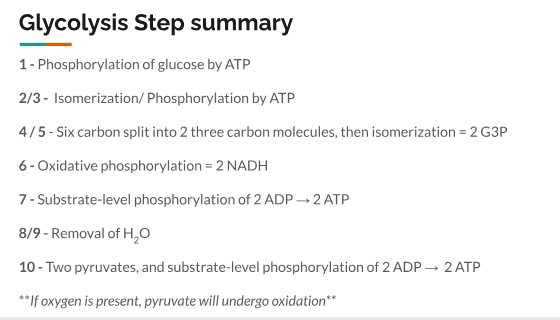
phosphorylation of glucose by ATP (glucose results in glucose 6-phosphate)
rearrangement (glucose 6 phosphate results in fructose 6-phosphate)
fructose 6-phosphate results in fructose 1, 6-biphosphate
fructose 1, 6-biphosphate results in dihydroxyacetone phosphate (DHAP) and glyceraldehyde 3-phosphate (G3P)
DHAP results in a second G3P molecule
G3P results in 1, 3-diphosphoglycerate
1, 3-diphosphoglycerate results in 3-phosphoglycerate (FIRST ATP IS MADE)
3-phosphoglycerate results in 2-phosphoglycerates
2 phosphoglycerate results in phosphoenolpyruvate
phosphoenolpyruvate results in the final pyrute (note : two are created since we split two G3P early in the process, and we result in two pyruvate molecules)
glycolysis is investment/activation
during the first 4 steps of glycolysis, 2 phosphate groups are transferred to glucose via phosphorylation, where ATP is converted to ADP, the end product is fructose 1, 6-biphosphate
sugar splitting happens when fructose 1, 6-biphosphate gets split into 2 fragments : dihydroxyacetone phosphate (DHAP) and glyceradlehyde 3-phosphate (G3P). DHAP then gets cinverted into G3P
oxidation : both molecules of G3P become oxidized using NAD+ which becomes NADH, this process releases energy which is used to attach phosphates to the sugars, making them 1, 3-biphosphoglycerate
pay off : the formation of ATP, during the last 4 steps of glycolysis the phosphate groups of the molecules are transferred to ADP creating ATP, this is done via the process of substrate-level phosphorylation
in glycolysis we use 2 ATP, and made 4 ATP, therefore the net gain is 4-2 = 2 ATP