Storage & Retrieval
Forgetting
Why does it happen?
Memories fade over time
Time, alone, is not the only reason to forget information
Are memories permanent; do they degrade; is it a matter of having the memory and a lack of accessing them…
Many factors can inhibit or provoke memory formation, recall, and loss
Storage
Dual observation of contradiction: we forget quicky, but remember for a long time
Naturalistically Learned Material (NLM): exposure to information in a natural environment can be learned/retained for great periods of time
Difficult to attribute NLM, as other confounding variables may prompt memory and recall
Name recognition, picture recognition, picture matching, name matching, free recall
Naturalistic Learning, Why?
Involves repeated exposure over several years of stimuli; often occurs with numerous spaced repetitions of exposure
Knowledge learned in school: repeated testing and information exposure
Memory for TV shows: episodic and emotional engagement
Memory for public events: newsworth events and celebrities
Nature of Storage
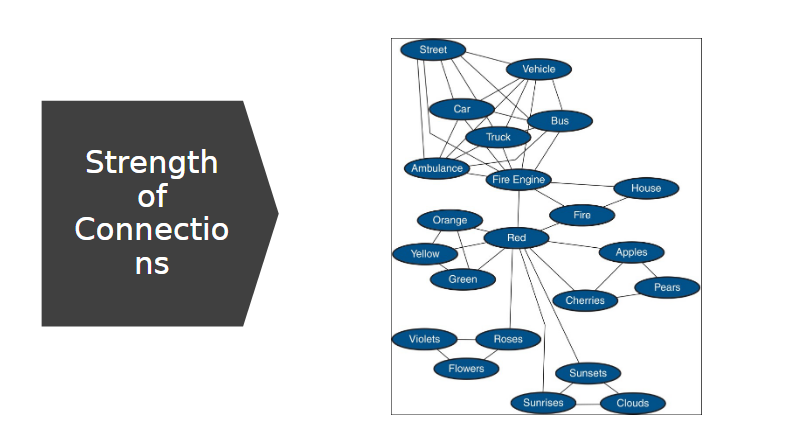
Semantic network theories: items of knowledge are interconnected via associations, relationships or pathways
Connections vary in strength
The closer the connection, the stronger the connection
The more distance separating one item from another, the weaker the connection
Table and chair are strongly related, table and aardvark are not
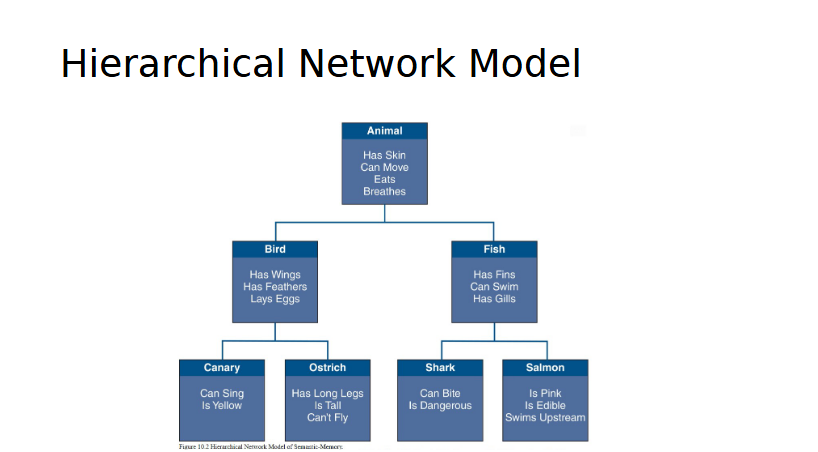
Hierarchical arrangement of superordinate to subordinate knowledge
Animal category (superordinate) has subcategories of Fish and Bird
Knowledge deemed general to the entire category is stored at a higher level in the hierarchy
Information that is limited or restricted is stored within subordinate levels
Examples: the animal node includes information general to animals; the bird node contains facts about birds- have wings, lay eggs, etc.
Hierarchical Network Model
Spreading activation: activation of one item in memory spreads to adjacent items, causing relative knowledge to be activated
Priming, for example, tasks an individual to rapidly decide if a random string of letters forms a word
Immediately before the to-be-identified item, a related word is flashed on the screen
Dog (priming stimulus) → Collie (to-be-identified word)
Fan effect: activation spreading from an item with many associations will be divided across the many connections, resulting in weaker activation of each
Strength of Connections
Neuropsychological Dissociations: Semantic encoding happens in multiple neural areas; certain categories of words are stored separately in semantic memory
Biological Substrates: Engram - the neural representation of memory in the brain; neuronal synapses; activation of one cell triggers another, or many other cells
Consolidation: the formation of stable and permanent long-term memories
Consolidation theory: memories are first encoded in a temporary form (STM) or an unstable form of LTM; over time consolidates into a permanent form
Reconsolidation
Reconsolidation hypothesis: when a memory is retrieved it changes from a permanent state to a changeable state
Memories become mutable when retrieved, allowing the memory to get “updated” before being consolidated one again
Retrieval of Memories
Forgetting may be that memories simply are not there - they have faded or decayed; were not consolidated; replaced by new memory
Retrieval failure is an alternative explanation for forgetting - breakdowns in learning, recall cues, emotional interruptions, etc.
Memory recall often requires explicit requires to recall the information
Sometimes remembering also just happens, without intention, direction, or searching - spontaneous recall
Retrieval from Episodic Memory
The distinctiveness of the memory
The practice at retrieving the memory
The presence of effective retrieval cues
Distinctiveness
Events that are distinctive are generally well remembered
Might be retrieved better because their retrieval cues uniquely target a single memory
[last 3 slides of part 1]
Prospective Memory
Prospective memory: remembering to perform future actions
Planning for retrieval at the time of encoding
This is the premise of trying to set reminders to do the laundry, go shopping, pick up that friend from that one place you will end up forgetting about
Often, this depends on internal cues and “remembering to remember”
While rehearsing or imaging the to-be-remembered item, plans for how to retrieve the encoded material later also occur
Metamemory & Partial Retrieval
Retrieval can produce incorrect memories, such as partial, incomplete, inaccurate, or just plan wrong memories
What we know about memory can also affect retrieval:
Feeling of knowing
Tip-of-the-tongue
Feeling of Knowing
Feeling of Knowing (FOK): an irritating mixture of surety (that you know the information) and bafflement (the inability to recall the information)
Related to TOT
Tip-of-the-tongue (TOT): a more intense feeling that not only do we know the sought-after word, but additionally feeling very close to recalling it
This is applicable for words, data points, names etc. (think semantic memory)
How do we know our feelings are correct if we cannot recall them?
False Retrieval
False memory: the mistaken recall of some stimulus or event that had not actually occurred
False recall and false memory are used to label mistake recollection
Example: Bed, rest, awake, snooze, slumber, snore → when later asked to recall words, study participants “recall” the world sleep
False memories are robust- they linger in the memory about as long as correct items
How do they occur? Spreading activation is one theory; cumulative effect of activation is another; the more associations exist, the higher the likelihood a false retrieval becomes
Generality of False Recall
Amnesics show false recall - individuals with amnesia remember fewer words from lists, thus increase the potential for false recall
Children are susceptible to false recall - due to changes and increase vocabulary throughout childhood and adolescence, the increased general knowledge makes children more susceptible to false recall
Experts falsely remember - the more one knows on a subject, the more frequently they may pull in words or remembrances not originally present
False recall crosses language - multiple languages can lend to cross-word contamination when recalling terms and meanings
Source Memory
Source memory: distinguishing between an actually experienced event and one that was imagines, thought of, or dreamed
Distinguishing between externally and internally derived memories utilizes making judgements about the qualitative components of the memory
Is the memory more firmly set in time, setting, place, events; or ambiguous, lacking sensory detail, schematic
Mistakes in source memory can lead to false belief
Collaborative recall tasks lead to source memory challenges - whose memory is it?
Post-event Information Recall
After to-be-remembered information is presented, other contradicting information occurs
For example, asking a misleading question following observing an event, such as:
Following a video of a car accident, the researcher asks about a stop sign that was not in the film- How fast was the car going when it passed the stop sign?
Misinformation effect: remembering incorrect information instead of remembering the previously presented correct information
Countering Misinformation
If misinformation occurs and is now remembered as “fact”, how do we attend to this phenomenon
Primary tactic - present correct information; however, this is not as easy as it seems
Primacy effect: misinformation is presented first, and the corrective information come later
Wrong information has already been incorporated into memory
Misinformation could be related to a reliable source
Tendency to accept familiar information as true
Misinformation is too-often believed, debunking has minimal benefits, and misinformation effects are greater than debunking effects
Recovered Memory
Recovered memory looks at the relationship between the repression of memory and sudden recovery of that/those memories
Can memories be repressed, can they spontaneously recover, can individuals repress some memories and not others, etc.
Amnesia occurs after many sorts of trauma; it can be assumed that abuse can result in trauma, thus the amnesiac loss of memory
How can memories be unremembered; the mind suppresses recall of painful memories; memories may not have adequate retrieval cues
Memories formed during intense emotional experience could remain unrecalled s long as the unique emotional state does not reoccur