Paraphilias
Historical
Unconventional sex was considered a “sin” governed by priests or religious courts.
Civil law came into effect to “control” unacceptable behaviours.
19th century used the medical model to transform ‘sins’ or ‘crimes’ into pathologies.
Presently, we use the DSM-5 categorical approach to define pathology
This text does not clarify what ’ healthy ’ sexual behaviour is, which is defined by the clinician.
Richard von Kraft-Ebing (1886)
Psychopathia Sexualis
Scientific study of sexual pathology
Some categorizef pathologies remian but others have been remove.
Masturbating, oral sex, anal sex, homosexuality.
What is Sexual Behaviour Abnormal?
Statistical definition - abnormal sexual behaviour is one that is rare or not practiced by many people
Sociological approach - sexual behaviour that violates the norms of society
Psychological approach - criteria of abnormality include discomfort, inefficiency, and bizarreness.
DSM-V Criteria
Paraphilia (Criterion A): any intense and persistent sexual interest other than sexual interest in genital stimulation or prepartory fondling with phenotypically normal, physically mature, consenting human partners.
Specifies the qualitative nature.
Paraphilic Disorder (Criterion B): a paraphilia is currently causing distress or impairment to the individual or a paraphilia whose satisfaction has entailed personal harm, or is of harm, to others
Specifies the negative consequences of the paraphilia.
A diagnosis should only be reserved when individuals meet both Criteria A and B.
CLASSIFICATION SCHEMES
Anomalous Activity Preferences
Courtship Disorders
Voyeurism, Exhibitionism, Frotterism
Algolagnic Disorders: involving pain/suffering
Sexual Sadism & Sexual Masochism
Anomalous Target Preferences
Directed at humans: pedophilic disorder
Directed elsewhere: fetishism, transvestism
Paraphilias
Some recent researchers believe Paraphilias are unscientific, severly flawed and should be removed.
Homosexuality was until 1973 considered abnormal and listen in the DSM-III
Previous ‘normal’ behaviours are now considered ‘abnormal’ (e.g., sexual aversion disorder, female orgasmic disorder, hypoactive sexual desire).
Most common: (Baier’s Swiss Stufy in 2024):
Sadism and Masochism most widespreasd
Followed by various fetishes
Partialism
Transvestic etc…
Amongst younferr generation, pornography is correlated (positve)
Pedophilia, Voyeurism, Exhibitionism
Approx. 50% of perpetrators are married
Age of one's set: critical period in adolescence.
Transvestic fetishsm: 13.6
Fetishism: 16
Voyeurism: 17.4
Sadism: 19.4
Paraphlias: Gender Differences
Males commit the majority of sexual crimes
The only reliable prevalence among women is sexual masochism.
Ratio is still (20 males: 1 female)
Female incidents still occur.
Commonly, there is conorbidity amongst paraphilias.
Pedophilia, sexual sadism, and exhibitionism are the most common.
Paraphilias: Gender Differences
Paul Fedoroff (U. of Ottawa) Case Report
She described a ritual of undressing herself and masturbating in front of the window, approximately 5 times a month. While she was aroused by the idea of being seen by male strangers, she denied any wish to engage in sex with anyone who saw her. Unless she was involved in some “really bizarre situations,” she had primary anorgasmia even while masturbating.
At one point she began driving her truck through unfamiliar neighbourhoods with pet food in an attempt to befriend cats and dogs which she would “abduct”. She would coax the cats to lick her genitals by placing honey on her vaginal area. She would perform oral sex on male dogs
She also described sexual fantasies about having sex with boys and girls between the ages of 8 and 10. On one occasion, she had “punished” an 8-yr-old boy she was babysitting by squeezing his penis and “physically smacked him around”.
Three years prior to psychological assessment she had become involved in unique form of prostitution wherein she would flag down taxis from her truck and then proceed to talk the driver into paying to have sex with her. She did the same for men she met on “phone sex lines”.
Moser & Kleinplatz
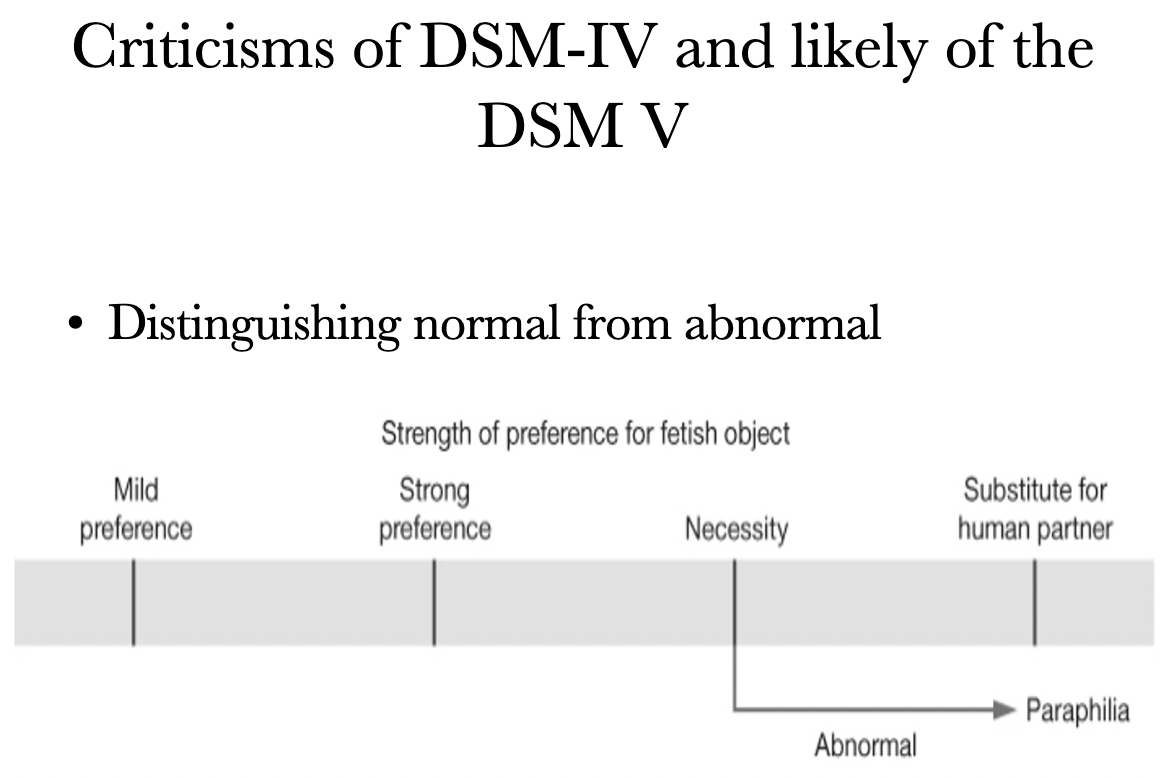
Paraphilia should be replaced by Sexual Interest Disorder (SID)
Eliminate specific sexual interest (e.g., shoe fetish) and focus on what is causing distress and dysfunction (e.g., obsessive fixation and compulsive behaviour).
Further Consideration Ahlers et al. (2009) study
German 367 males studied from a community sample of 1,915 males
Aged 40-79
17% were single
90% heterosexual, 2% homosexual and 8% bi.
Anomalous Activity Disorders (Courtship Disorders)
Vouerurism: Watching someone without them knowing
Winnipeg
Resturatnt owner installed a camera aboce women’s washroom.
Peterbourugh
A man hid in a tank of an outhouse where he was covered in excrement so that he could watch women urinating and defecating
A man used two-way mirror at a KFC to watch female co-workers change into uniforms.
“Would you watch an attractive person undressing if you would not be caught"?”
84% males
74%
“Would you watch attractive poeple having sex if you would not be caught?”
70% males
40% females
Voyeruism
Tornonto study found that 12% of university males and 23% of community males reported having masturbated while wacthing a female who was unaware of their presence.
Socptophilia: secual pleasure is derived from observing sexual acts and the genitals (pornographic imagery, as opposed to actual act).
National surevey in Sweden found that 11.5% (males) and 4% (females) reported beign sexually aroused by spying on others having sex.
Troilism: individual views their significant other engaged in intercourse with someone else for loan or hire.
Voyeruristic coprophilia: observign others defecating or eliminatin without their knwoledge.
Voyeurism:
2005, the Canadian Parliament passed legislation makign ia a crime to secretly observe or record a person in situations where privacy is expected.
Most common of law-breaking paraphilias
Fear of getting caught is critical.
Approx. 1/3 voyeurs had their first voyeuristic experience before puberty, and 50% knew before age 15.
Rarely leads to more intrusive sexual activities.
More likely to abuse substances, report lower life satisfaction and greater sexual interest.
Less likely to engage in heterosexual petting and began sex later in life, and had unusual fantasies (including bestiality and sadomasochism) (Smith, 1976)
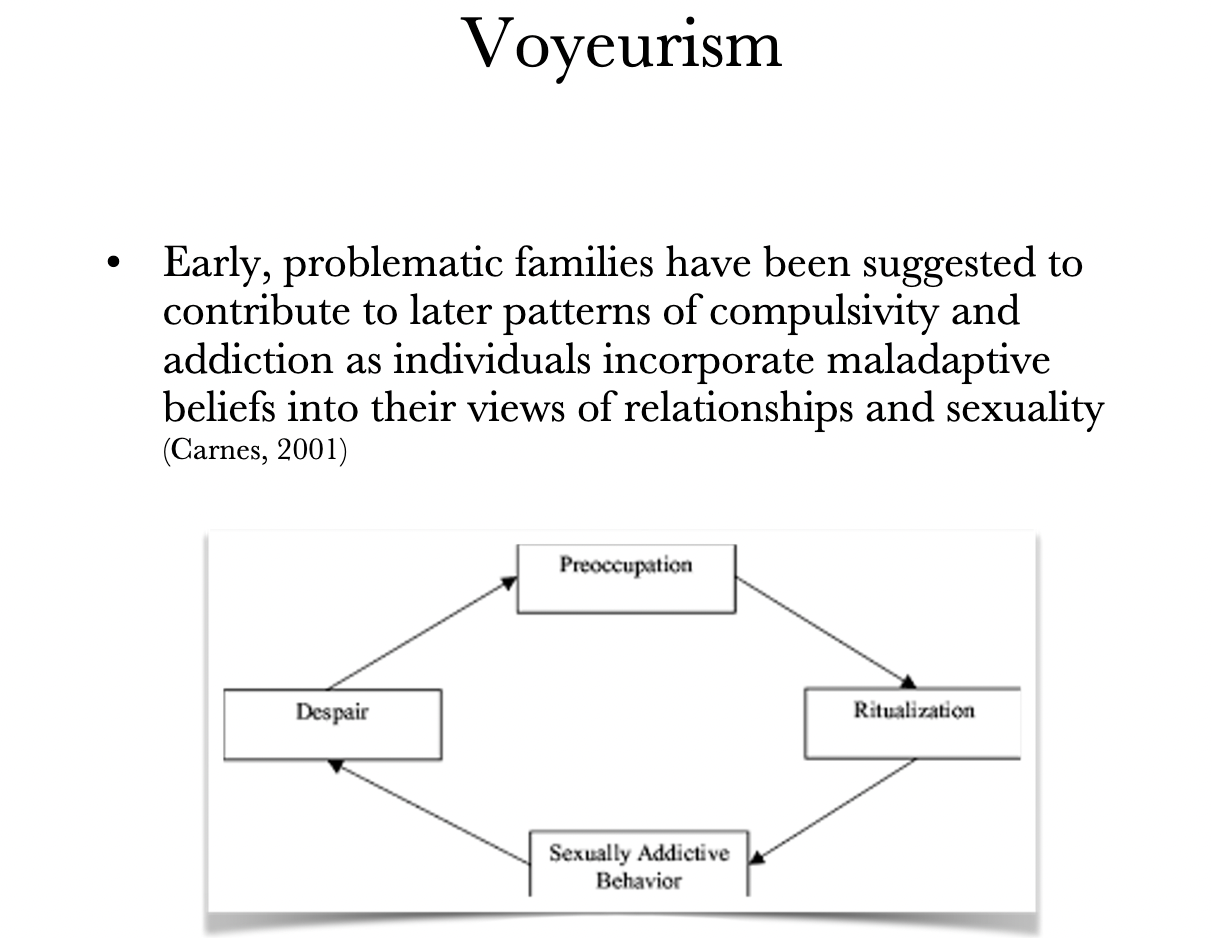
Some report negative relationships with fathers and over-protective mothers and wives (Dwyer, 1988)
Others report positive relationships with parents, but observed a poor relationship between the parents (Smith,1976)
Voyeurism: Evolutionary Theory
Voyeurism is an overextension of an evolutionary trait, where visual stimuli are used in the reproductive selection process (Kaplan & Kreuger, 1997)
Sexual Courtship Progression (Freund & Watson, 1990)
• Visual selection (voyeurism)
• Nonphysical exchange (exhibitionism)
• Physical touching
• Intercourse
Voyeurism: Treatment
Although Cognitive Behavioural Therapy (CBT) is often reported, there were no English-language published papers empirically supporting this (O’Dononhue, 2008)
Recommended: start with the least restrictive (e.g.,
behavioural treatment (CBT) and then progress
to more restrictive (e.g., pharmacological: SSRIs, anti-androgens)
Exhibitonsim
Definition: Period over 6 months, recurrent, intense sexual arousal from exposing one’s genitals to others in inappropriate situations to an unsuspecting other
Research is limited
Prevalence unknown, but estimates range: 2-4% in males (females?).
Not a benign act:
1/3 of men went on to commit a sexual (12%) or violent (17%) offence.
Although a typical exhibitionist does not attempt further sexual contact with the same victim, the psychological consequences still occur.
• 15% of men had exposed themselves to others by age 15
Social learning theory proposed that parents may have modelled such behaviour
Childhoods characterized by:
inconsistent discipline
lack of affection
little training in appropriate social behaviour
Way of asserting masculinity by evoking fear (Langevin et al., 1979)
Many report that they hoped women would enjoy the experience and be impressed with their penis (Langevin et al., 1979)
Other studies suggest shy, dependent, passive, lacking in social skills and inhibited (Dwyer, 1988)
• May have been reinforced* by “getting attention”
as an adult.
Exhibitionism: Motives
Preference for girls/young women
Study ( n = 130) 50% reported nearly always having an erection at exposure (Langevin et al., 1979)
After victim registers fear/disgust/surprise they typically cover up and flee
• Study (n = 238) most reported masturbating to
orgasm while exposing or shortly afterward
while fantasizing about the incident.Study of 62 British female sex offenders found that 5 had history of exhibitionism.
All women had a history of unusual behaviour
diagnosed with alcohol or psychiatric problems
Exhibitionism: Treatment:
Learning theory approach
Match scene that typically elicit exposure with unpleasent odor.
After 11-19 (twice weekly) sessions all but one male managed to avoid flashing.
Often accompanied with cognitive restuctering (e.g., congtions of “many girls find this amusing” and “olde women are not harmed byt this”).
Frotterurims: “mashing” or “groping”
Definition: rubbing against or
touching a non-consenting person. A
diagnosis requires that someone act or be
distressed by thoughts of these urgesreported exclusively among males,
Characteristic difficulty in forming relationships with women. Handicapped by fears of rejection.
Frotterurism
Prevalence
• 4 - 10% of American children
• ~30% of general population
• 6-19% of juvenile sex offenders
• 70% of offenders having been sexually victimized
• Age of Onset: approx. 20 years old
• Frequency: * avg of 3 ... range: 1 - 849
• Escalation: not typical ... though small proportion of convicted rapists (18%) reported frotteurism.Theoretical Explanation
Social Incompetence Hypothesis
Rational-Chocice Perspective
Treatment
Verify differential dianoses (DSM-IV)
e.g., study of 445 people with TBI, 6.5% had comitted min. 1 sexually aberrant beh, and 65% of these were frotteruism.
Assess for co-mrobid disorders.