BIO
8/19/26 - 1.1
Atoms are the building block of molecules
Protons (+), electrons (-), neutrons (0)
Covalent bonding
One way atoms interact
Co = sharing
Some electron rules for covalent bonding:
1. Neutral atoms have equal electrons and protons
2. Electrons live in "shells"
3. The first shell can hold 2 electrons
4. The second shell can hold 8 electrons
5. The first shell must be filled first
6. Shells like to have their full complement of electrons
7. An electron can live in the shells of two atoms that are
covalently bonded

Carbons are implied and not shown in a chain or ring where lines join/bend and not already labeled with another element
Hydrogens off carbon are often omitted
Single, double, and triple covalent bonds are indicated by 1, 2, or 3 lines
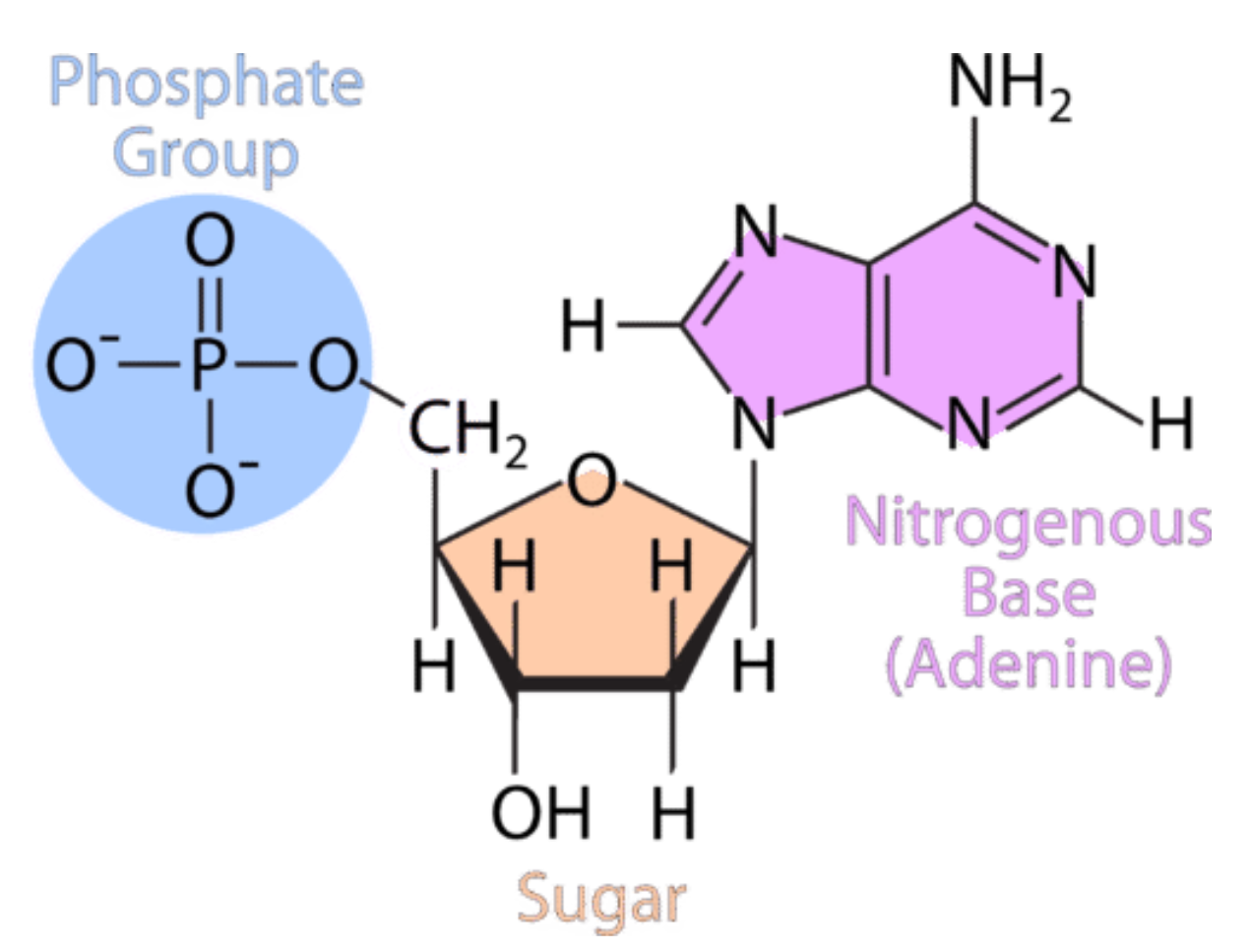
The base has 5 carbons
The sugar has 5 carbons
The O- is because it was an OH- but the H left
NEED TO MEMORIZE ON TEST! O>N>C=H
Electronegativity is how closely a nucleus holds on to its electrons
Partial charges
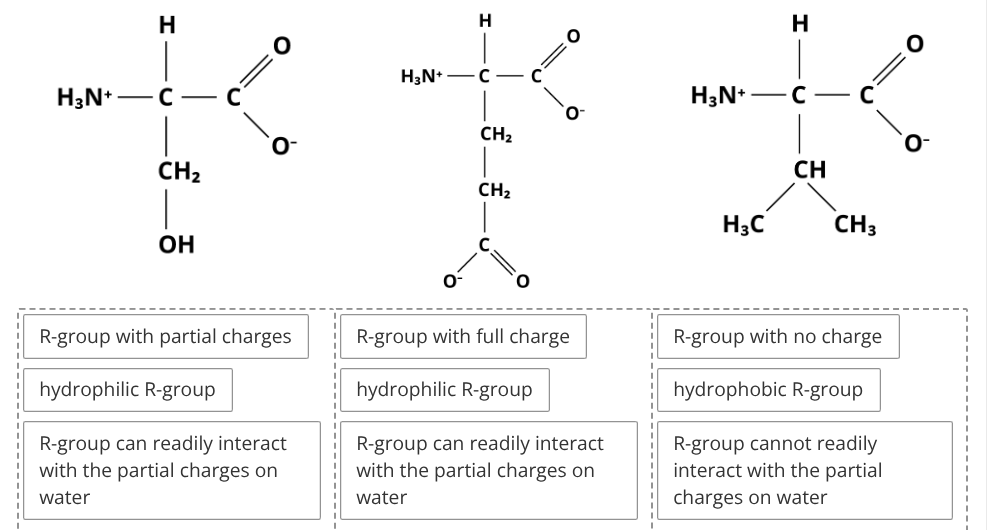
Polar hydrophilic heads
Non-polar hydrophobic tails
The phospholipid bilayer contains heads on the outside and tails on the inside
Amphipathic means both hydrophilic and hydrophobic parts
Hydrogen bonds are between different molecules
Anything that has a hydrogen attached to a nitrogen, oxygen, or flourine
Covalent bonds are between the same molecules
Molecules are the groups of elements (H2O, CH4, NH3, etc)
8/21/26 - 1.1 and 1.2
Full charges are hydrophilic and can interact with the partial charges on water
Partial charges are when electrons do not equal protons
Covalent bonds take lots of energy to break
Non-covalent bonds take a lot less energy to break
Non-covalent bonds
Hydrogen bonds
Hydrophobic interactions
Ionic bonds
Van der Waals forces - weakest force but keep hydrophobic interactions together
Bonds are easy to break so therefore easy to change
Dynamics (change) determines structure

Nucleic acids
Information storage. Primarily DNA
Information transfer. Using information to create structure and therefore function. Primarily RNA
Imagine DNA as the book / instruction manual for carpentry. RNA is the actual tools
Produced by bonding various smaller molecules together in chains
Monomers together form a polymer
Nucleotides
Monomers of nucleic acids are called nucleotides
Phosphate group, small pentose sugar, nitrogenous base
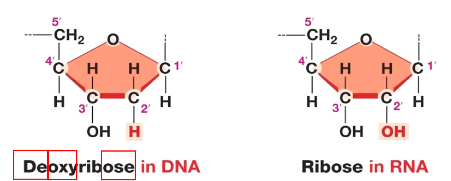
Count the primes like a clock
Deoxyribose vs ribose
“Deoxy” means no oxygen
Pyrimidines C and T
Purines A and G
The short name purines is the bigger structure and the pyrimidines are the bigger structure. Reversed
Curvy C and G pair. Straight A and T pair
U pairs with A for RNA
CUT pyrimidines. Like the pentagon was cut off of a purine

Nucleic acids are always constructed by adding a new nucleotide to the 3’ end
5’ to 3’
Primary structure is just a sequence of nucleotides

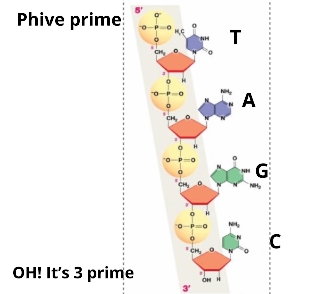
Ph. Phosphorus side. 5’
OH. OH side. 3’
Double helix. Secondary structure. Forms hydrogen bonds between the base pairs
G and C form 3 hydrogen bonds. Rhyme
A and T form 2 hydrogen bonds
Hydrogen bonds parallel. Based on charges. Hydrogen bonds with O and N
RNA can catalyze chemical reactions like a protein while DNA cannot.
RNA has an OH group on the 2′ carbon of its 5-carbon sugar while DNA has a H on the 2′ carbon of its 5-carbon sugar.
8/24/26 - 1.3

Functions of proteins
Can be antibodies
Enzymes/catalysts speeding up reactions
Transport moving things across membranes or the body
Communication signaling
Immune system
Structure like hair, collagen, etc
Movement like actin and myacin
Monomers make up polymers
Each amino acid has a central carbon attached to an amino group, carboxyl group, hydrogen, and R group

Lots of amino acids but only 20 that are common
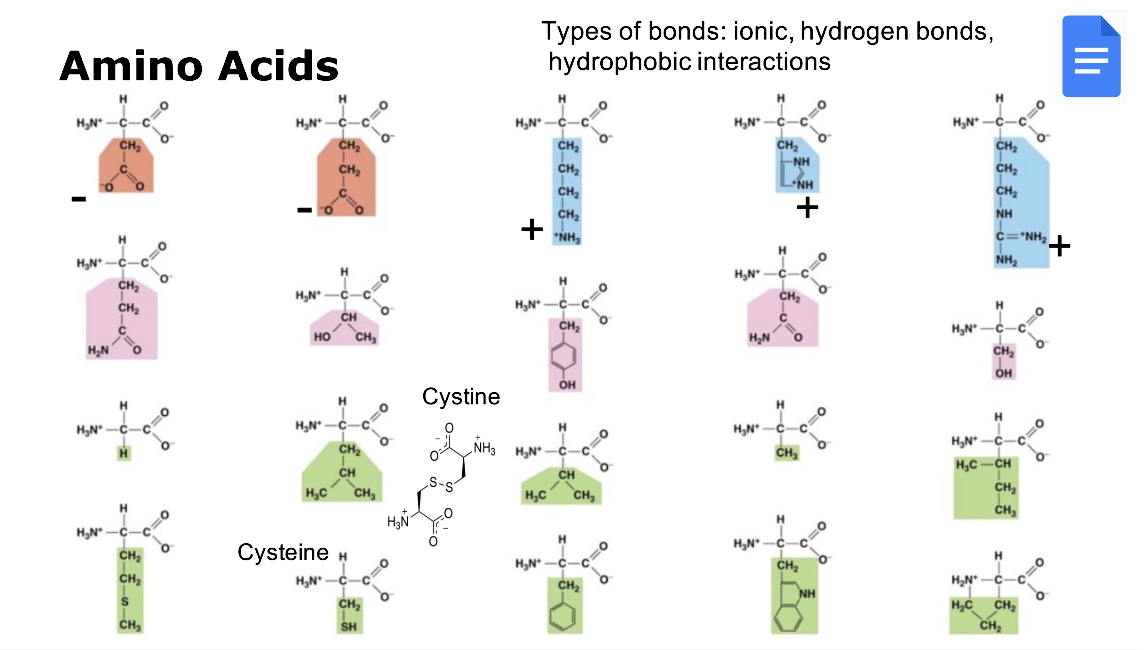
Green is hydrophobic because composed of mostly CH bonds that are equal in electronegativity
Pink has hydrogen bonds because the Ns and Os can hydrogen bond with other molecules
Orange and blue have ionic bonds because they have full charges
Cysteine is the singular
Cystine is the one that forms a disulfide bond (Sistine Chapel fingers connecting)
Polypeptide chains
The carboxyl group of one amino acid can react with the amino group of another to form a peptide bond
New amino acids are always added to the carboxyl end
There is no 3’ and 5’ end for proteins. That is DNA
Bonds around central carbon can rotate like a wheel so R group can kind of spin around
H cannot rotate and is on the opposite side as the O
Proteins fold into four structures
Primary - long string
Secondary - alpha helix (loops) or beta sheet (2 or more rows) held together by hydrogen bonds
Tertiary - 3d folded interactions between R groups
Quaternary - 2 or more polypeptides often come together to make 1 functional proteins
Not required to memorize amino acid names
Read/written as N amino group to C carboxyl group
All amino acids have a carboxyl group and amino group that are capable of bonding, but not all do bond
Beta sheets can be either parallel or anti-parallel
The same bonds that determine tertiary also determine quaternary structure
All based on how R groups interact with each other, the backbone, and the order of the protein
Every higher level of structure builds on the levels below it