Basic Economic Concepts
Economics
Economics is the study of how man allocates scarce resources, to satisfy their unlimited wants. It is considered a social science because it studies human behavior, in the case where societies and individuals make decisions to allocates unlimited resources to meet unlimited wants.
The Scope of Economics
The Economy
The economy is the mechanism through which scarce resources are used to produce goods and services. These goods and services are used to satisfy the needs and wants of the three groups in the economy:
Households - They are the decision-making unit of the economy. There are two assumptions about households. First, they consume goods and services. Second, they own the factors of production aka factor input (land, labour, capital and entrepreneurship).
Firms - They are also the decision-making unit of the economy. They are responsible for the production of goods and services to be consumed. They do this be buying the factors of production from the household.
Governments - The government sets out rules/laws the household and firm must operate within, and in some cases the government is involved in the production process.
Needs and Wants
Every individual has both needs and wants. Needs are goods/services that are essential to ones life, e.g. basic clothing. Wants are the desires of a good/service to improve the quality of life, but not essential for one life. e.g. a designer jeans pants.
Scarcity and Choice
Individuals will forever have unlimited wants, but resources are always limited. This means that although the goods/services, and the resources used to make them may be plentiful, it is not enough to satisfy every individuals’ wants. This is scarcity, having unlimited wants but limited resources. This is caused by the demand for a good/service, the more people want a good/service is the more resources taken to make it. This make the resource scarce.
All three groups in the economy experience scarcity:
Household - They might want to buys two products (e.g. Plastic cup and a glass cup), but money is scarce. They will have to choose to buy only one instead.
Firm - They might want to produce two products (e.g. Potato chips and Potato salad), but resources (potato) are scarce. The firm will have to choose one instead.
Government - They might want to built two infrastructures (Hospital and a school) but both money and resources to make the infrastructures are scarce. The government will have to build only one project instead.
With unlimited wants and limited resources (scarcity), a choice must be made.
Choice is the range of options available to the individual household, firm or government when making a decision.
Opportunity Cost
A chose has to be made, by household, firm and government and a good or service must be given up. The householder has to do without the glass cup, if he chooses to buy the plastic cup. The firm will have to give up producing potato chips, if it chooses to produce potato salads. The government might choose to build the school and not the hospital. In each of the above cases, a choice has to be made and the alternative or next best option has to be forgone.
Opportunity Cost - The next best alternative forgone. As resources are scarce, choices must be made as to what to produce and consume. When making a choice, the producer and consumer has to do without – or forgo – some good or service or course of action. This is the opportunity cost. In purchasing the plastic cup, the householder incurs an opportunity cost. The opportunity cost of the plastic cup is the glass cup the householder has to forgo. He has to sacrifice the glass cup. In doing without it, he bears a cost, an opportunity cost.
Money Cost - This involves what was actually paid for the inputs used to produce a given good or service. For instance, a garment factory produces a shirt. The money cost of the shirt is the actual cost of the fabric and the labour, among other inputs, used to produce the shirt.
Production Possibility Frontier
The production possibility frontier (also called a production possibility ‘curve’ or ‘boundary’) is a graph showing the various combinations of two goods that an economy is able to produce with fixed resources. It is drawn assuming:
The economy produces only two goods
The amount of resources is fixed
Each of the goods can be produced using changing ratios of the factors of
production. This is called ‘variable factor proportions’.
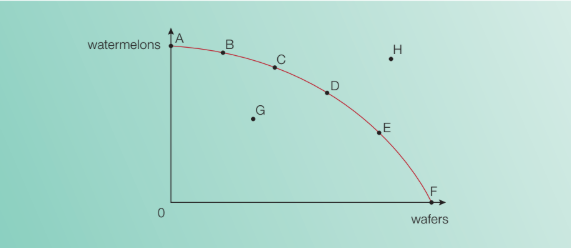
Observing the production possibility frontier, we see that it is downward sloping from left to right. This indicates that it is only possible to produce more of one good by giving up some units of the other good. The production possibility frontier is bowed out or concave to the origin. As resources are moved away from wafer production, more and more wafers must be foregone to grow the extra watermelons. Point B is an attainable combination that the economy can produce. Any combination within the frontier, such as point G, is also attainable. However, once an economy is operating inside the boundary, this indicates that there are idle resources, or that resources are being used inefficiently. Points outside the frontier, such as point H, are unattainable. For instance, the economy cannot move from point C to point H, where the economy is producing more of both goods. However, if the production possibility frontier shifts or pivots outwards, the economy can move from point C to point H.
Factors that could cause the production possibility frontier to move outwards
are:
• economic growth;
• discovery of new natural resources;
• growth in population;
• technological progress;
• improvements in labour productivity.
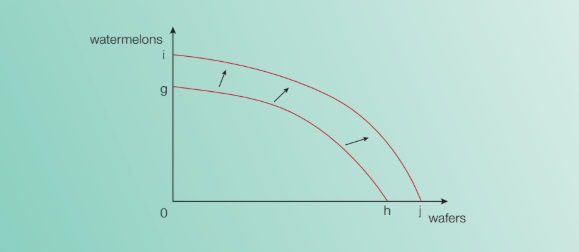
Production possibility frontiers are sometimes named by labelling the x and y intercepts. In the figure the initial production possibility frontier is gh. Any of the above factors can cause the production possibility frontier to shift outwards from gh to ij, as shown in the figure below a pivot in the production possibility frontier from ab to ac. Assume that the industry for good Y uses a high proportion of labour (labour intensive industry) and the industry for good X uses a high proportion of capital (capital intensive industry). What could have caused a pivot from ab to ac in the figure below? Notice that the industry producing good X can now produce more of good X.
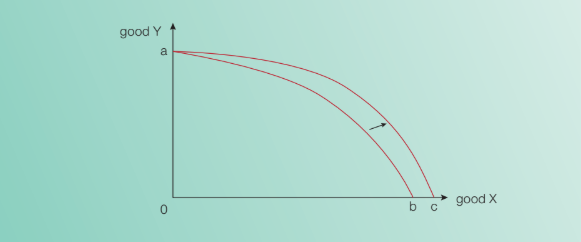
There is an improvement in technology and this benefits the capital intensive industry more than it does the labour intensive industry. The production possibility frontier illustrates the concepts of scarcity, choice and opportunity cost. In the figure below, the economy cannot produce more of both goods – say, move from A to D. Therefore, scarcity exists. The economy cannot produce all combinations on the frontier – say, both A and B. It must choose one combination. It can choose A and produce 0i watermelons and 0g wafers.
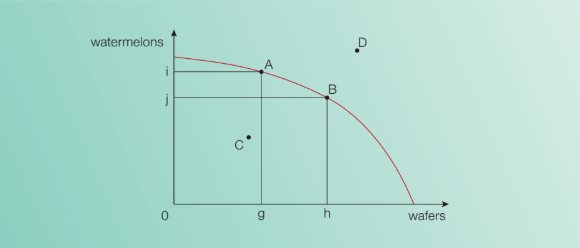
Now assume that consumers in this economy demand more wafers. To obtain more wafers, the economy must produce fewer watermelons. Production will move from A to B. To gain gh more wafers, ij watermelons have to be given up, assuming that nothing changes. The opportunity cost of obtaining gh more wafers is the ij watermelons that must be forgone.
Economic Efficiency
When an economy is producing on its production possibility frontier, that economy is said to be efficient. All resources available in the economy are being used to produce one of the maximum possible combinations of goods. In graph showing scarcity, whether the economy produces combination A or combination B, it is producing efficiently. However, if it produces combination C, it is not producing efficiently.