Mastering Rhetorical Strategies in ACT English
Topic Development and Relevance
In the ACT English section, Production of Writing questions (which make up approximately 29–32% of the test) do not ask about grammar or punctuation. Instead, they ask about the logic, flow, and effectiveness of the essay. The first major pillar of this category is understanding Topic Development — identifying the main idea and ensuring every part of the passage supports it.
Identifying the Purpose of a Text
To succeed on these questions, you must think like an editor. Every passage has a Main Idea (the central argument or narrative) and a Purpose (what the author wants to achieve, e.g., to inform, to persuade, to entertain).
- The Topic Sentence: Usually the first sentence of a paragraph. It indicates what the specific paragraph is about.
- The Thesis Statement: Usually found in the introduction. It controls the focus of the entire passage.
Evaluating Whether a Text Achieves Its Goal
A distinct type of ACT question asks: "Suppose the writer's primary goal was to [specific goal]. Does this essay fulfill that goal?"
To answer this, ignore your personal opinion on the essay's quality. Instead, perform a strict Goal-Content Match check:
- Identify the Specific Goal stated in the question stem (e.g., "describe the history of jazz").
- Analyze the Content of the essay (e.g., "discusses instruments used in jazz").
- Determine if they match.
Note: Often, the essay is well-written but fails the specific goal asked in the question. If the goal is to explain why bees dance, but the essay describes how honey is made, the answer is No.
Adding, Revising, or Deleting Material
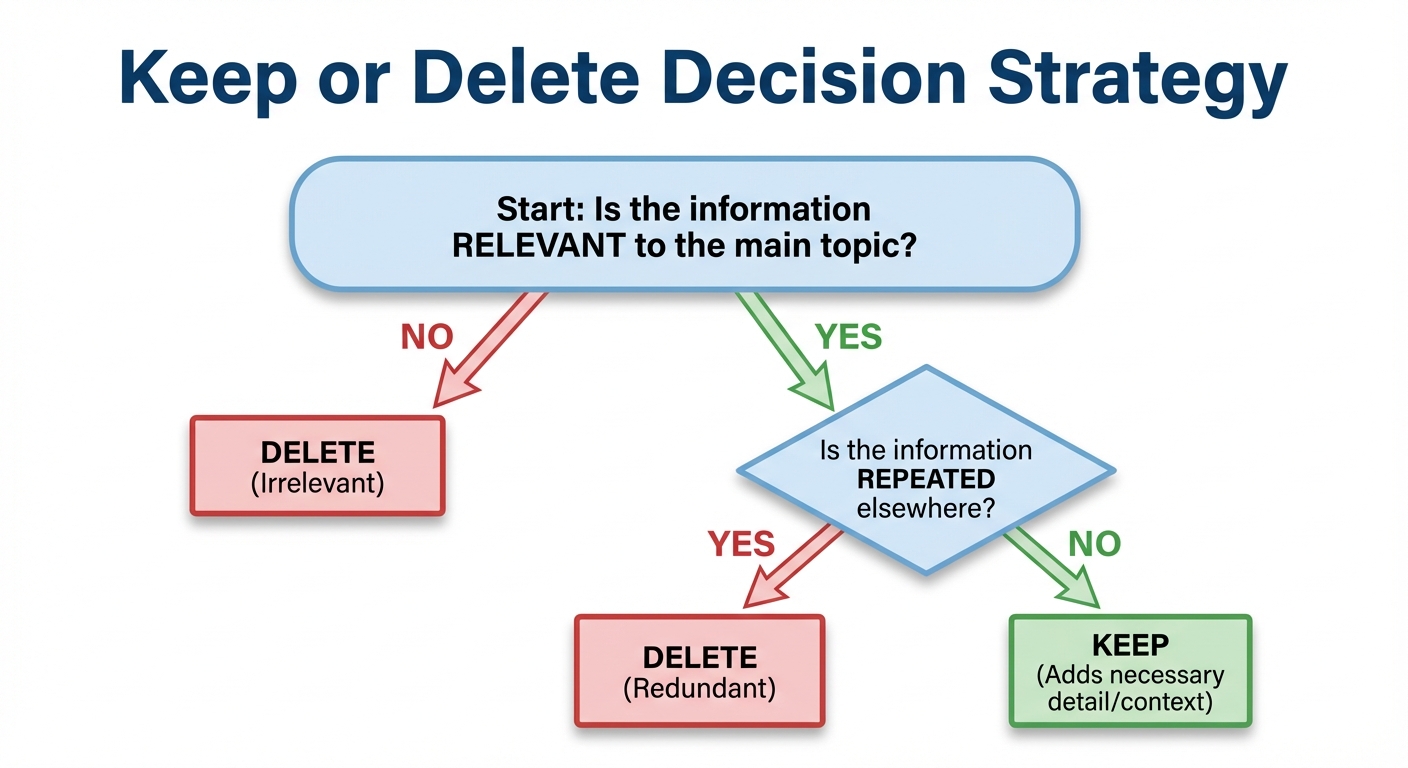
These questions often present a sentence and ask whether the writer should keep it or delete it. This decision relies entirely on Relevance and Redundancy.
The Relevance Test
Does the information provide essential context, specific details, or necessary definitions? If yes, keep it. If the information is loosely related but distracts from the paragraph's main focus (tangential information), delete it.
The Redundancy Test
Even if a sentence is relevant, it must be deleted if it repeats information already conveyed earlier or later in the text.
Decision Matrix for Keep/Delete Questions:
| Option | Reasoning Look-fors |
|---|---|
| Yes, Keep it | It provides a transition, defines a critical term, or offers a specific example supporting the claim. |
| No, Delete it | It blurs the focus of the paragraph, contradicts the main idea, or repeats information. |
Logical Organization and Sequencing
The ACT tests your ability to order ideas logically. You may be asked to reorder sentences within a paragraph or reorder paragraphs within a passage.
Sequencing Sentences
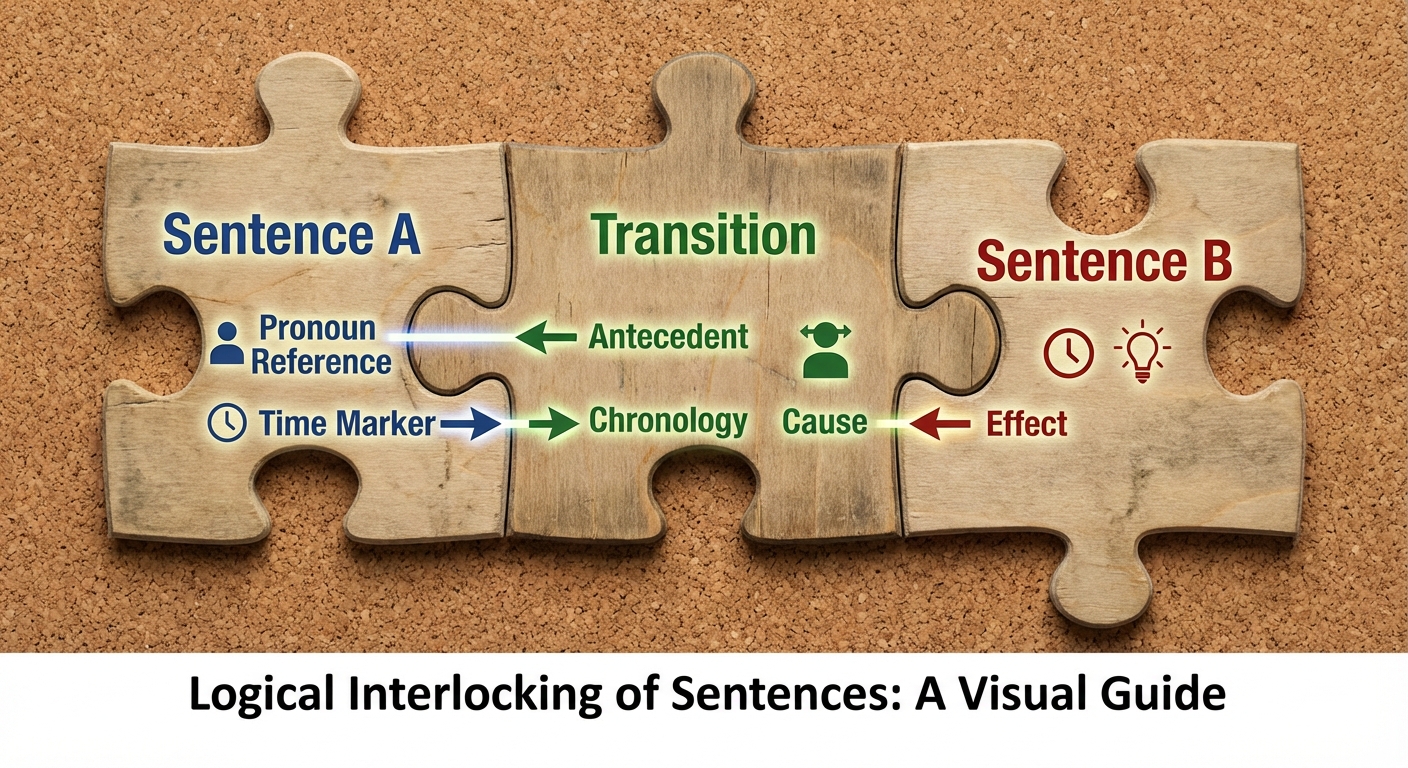
These questions usually bracket sentences with numbers (e.g., [1], [2]) and ask where a specific sentence implies it belongs. Use the Sandwich Method by looking for clues that link a sentence to the one before and the one after.
Three Key Sequencing Clues:
- Chronology: Look for time markers (first, then, finally, in 1999).
- Pronouns: An antecedent must appear before the pronoun. If Sentence 3 says "These results were surprising," it must follow a sentence that lists strict results.
- Topic Flow: General ideas usually precede specific examples.
Sequencing Paragraphs
If a question asks where Paragraph 4 should be placed, look for the topic sentence of that paragraph and the concluding sentence of the others. The paragraphs should flow like a chain: the end of one link connects to the beginning of the next.
Transitions, Unity, and Cohesion
Cohesion refers to how well the text flows. Unity refers to how well the text sticks to the main topic. Transitions are the bridges that ensure both.
Transitions Between Sentences and Paragraphs
Transitions signal the relationship between two ideas. On the ACT, selecting the correct transition requires identifying the logical relationship.
| Relationship Type | Common Transition Words | Logical Function |
|---|---|---|
| Continuation/Addition | Furthermore, Moreover, Additionally, Also | Adds information in the same direction. |
| Contrast/Contradiction | However, Nevertheless, Although, Conversely | Changes direction or introduces a conflict. |
| Causation/Effect | Therefore, Consequently, Thus, As a result | Shows that A caused B. |
| Sequence/Chronology | Initially, Subsequently, Finally, Meanwhile | Establishes order of events. |
Example:
- Incorrect: I studied all night; however, I got an A on the test.
- Correct: I studied all night; therefore, I got an A on the test.
Effective Introductions and Conclusions
- Introductions: Must hook the reader and establish the topic. A question might ask which opening sentence best sets up the information that follows. Look at the rest of the paragraph to decide.
- Conclusions: Must summarize the main point or provide a sense of closure. Avoid conclusions that introduce brand new, unrelated arguments or are overly repetitive.
Common Mistakes & Pitfalls
- Choosing the "Sound Good" Option: Students often pick an answer because it sounds sophisticated. In Production of Writing, the correct answer is the one that is most logical, not the most poetic.
- Misinterpreting "Delete" Questions: Students hesitate to select "Delete the underlined portion" because they feel the text needs to be there. About 20% of the time, the best option is OMIT/DELETE because the text is redundant or irrelevant.
- Ignoring the Title: The title of the passage often gives away the main focus. If you are stuck on a "Goal" question, re-read the title.
- Overlooking Context: You cannot answer a transition question by reading just the sentence it is in. You must read the sentence before and the sentence after to understand the relationship.
- Confusing "Specific" with "Good": In "Goal" questions, just because a detail is specific (e.g., "14.5 million tons of wheat") doesn't mean it's the right answer if the question asked for a general overview.