1001 WaveEnergy Part1
Defining a Regular Wave
Parameters:
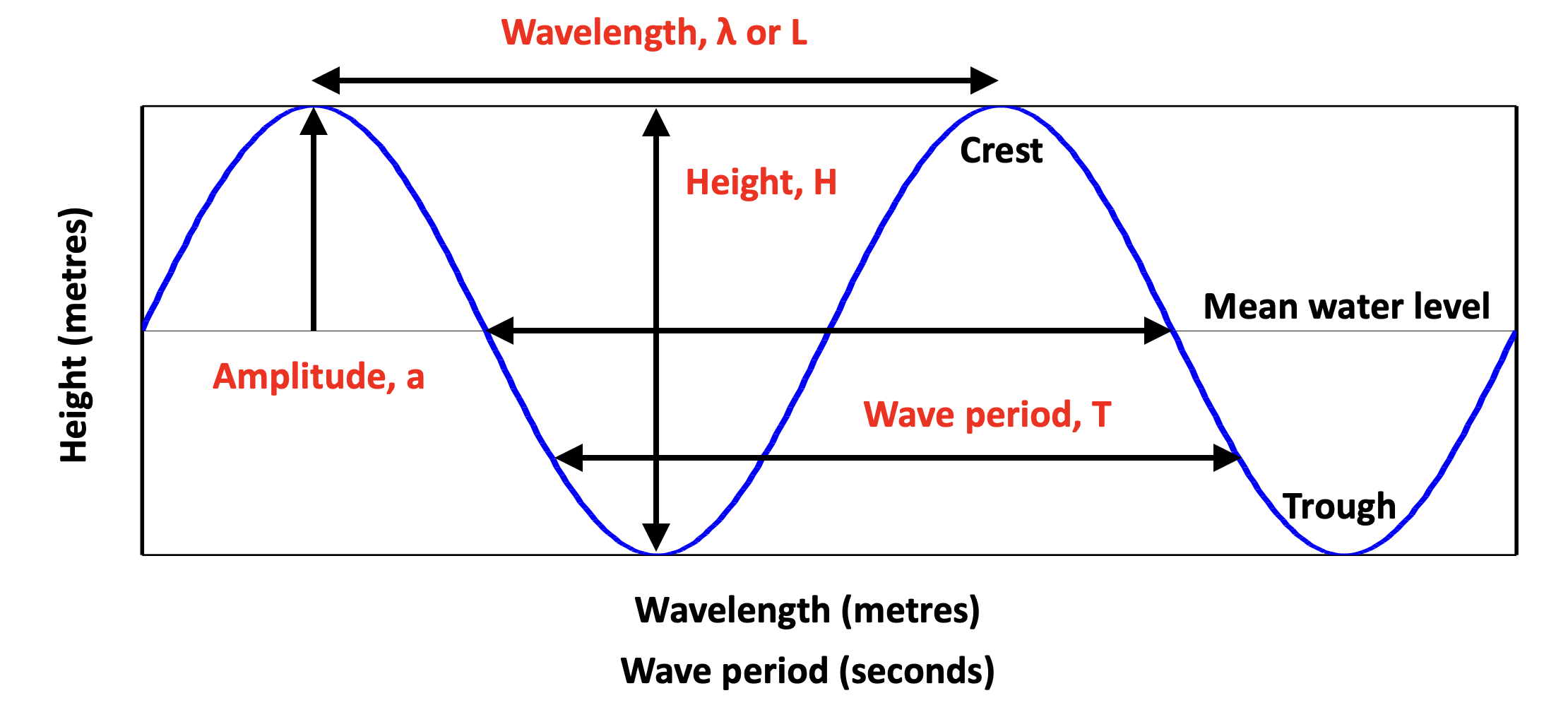
Height (H): 2 x amplitude
Wavelength (λ or L)
Wave period (T)
Frequency (Hz): 1 / period
Wave Particle Motions
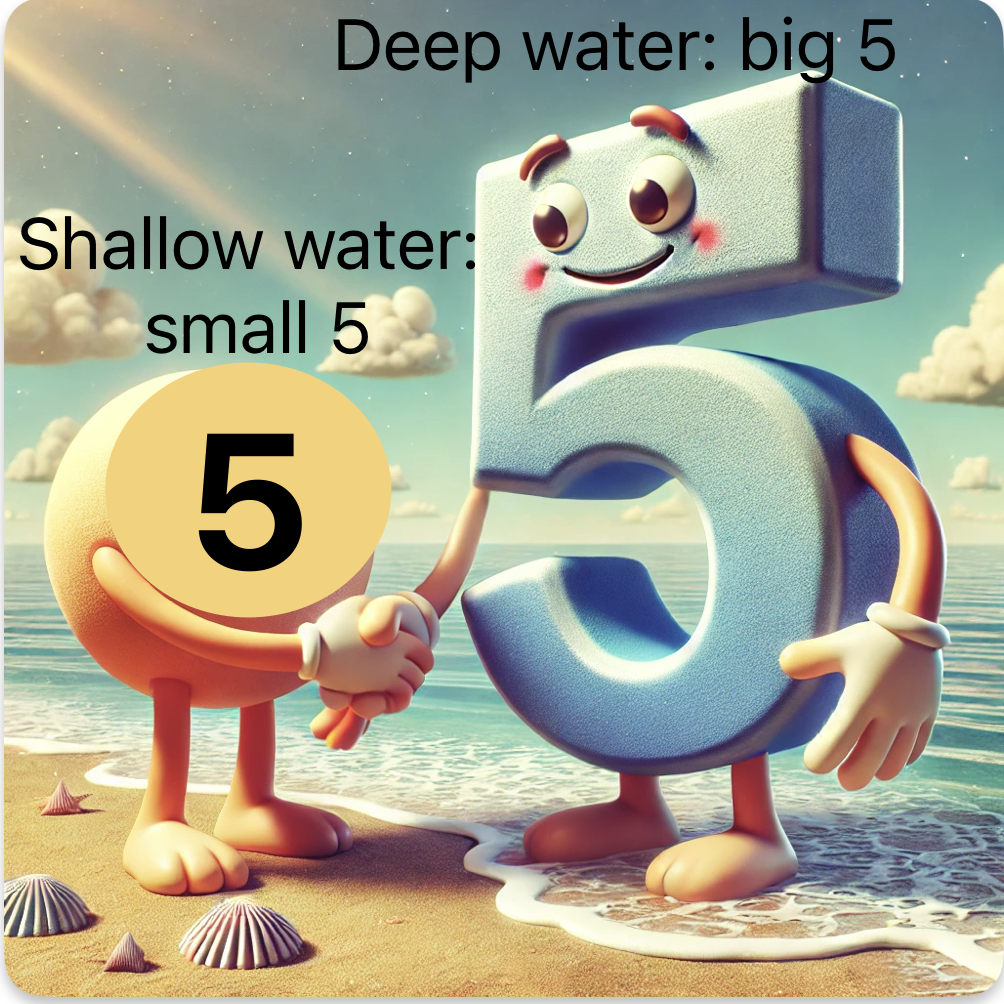
Strategy to remember:
Deep-water and shallow-water waves are the 5 decimal brothers
Deep-Water Waves
Requirement: h/λ > 0.5
propagation: as if there was no bottom (friction)
Shallow-Water Waves
Requirement: h/λ < 0.05
propagation: largely influenced by the shallow seabed.
Growth of Water Waves
Process of energy transfer from wind leading to wave growth
Limiting factors include:
Length over which the wind blows
Duration of the wind as it blows
Energy loss mechanisms
Propagation of Water Waves
Wave Behaviour: Longer period waves travel faster
Swell Waves: Cleaner waves further from the fetch
Interference: Constructive and destructive interference leading to wave groups
Deep and Shallow Water Concepts
Distinctions based on water depth to wavelength ratio (h/λ)
Definitions given for deep, intermediate, and shallow water
Wave Velocity types
Phase Velocity (c or cp): Speed of individual waves
Group Velocity (cg): speed of multiple waves that merge together.
Regular Wave Equations
Deep Water:
Phase velocity (c):
c = sqrt(gλ / 2π) = (gT) / (2π)Group velocity (cg):
cg = c / 2Wavelength (λ):
λ = (gT²) / (2π)Energy (E):
E = (1/8) ρgH²
Shallow Water:
Phase velocity (c):
c = sqrt(gh)Group velocity (cg):
cg = cWavelength (λ):
λ = T * sqrt(gh)Power (kW/m)
P = H²T
The relationship involves lots of constants but they multiply up to a number close to 1000. Therefore, it can be ignored by dividing W/m by 1000 to get kW/m, leaving a much simpler equation.
Energy wave density (E):
E = (1/8) ρgH²
E is the amount of energy per unit of area from a wave. It’s measured in J/m².
EXAM TECHNIQUE: they may refer to this as energy in exams. Be careful because this is a different type of measurement of energy to the one found through a power matrix. To avoid doing the wrong thing, check the units they want:
Energy wave density: J/m²
Energy from wave power: kWh/m
Why m²? (DO NOT ASSESS THIS SECTION)

The m² is for the surface area that the wave covers between the length of wave and it’s width (usually measured along the wave front). This is not assessed in the exam. It’s just for context
Calculating energy yield
Scatter digrams
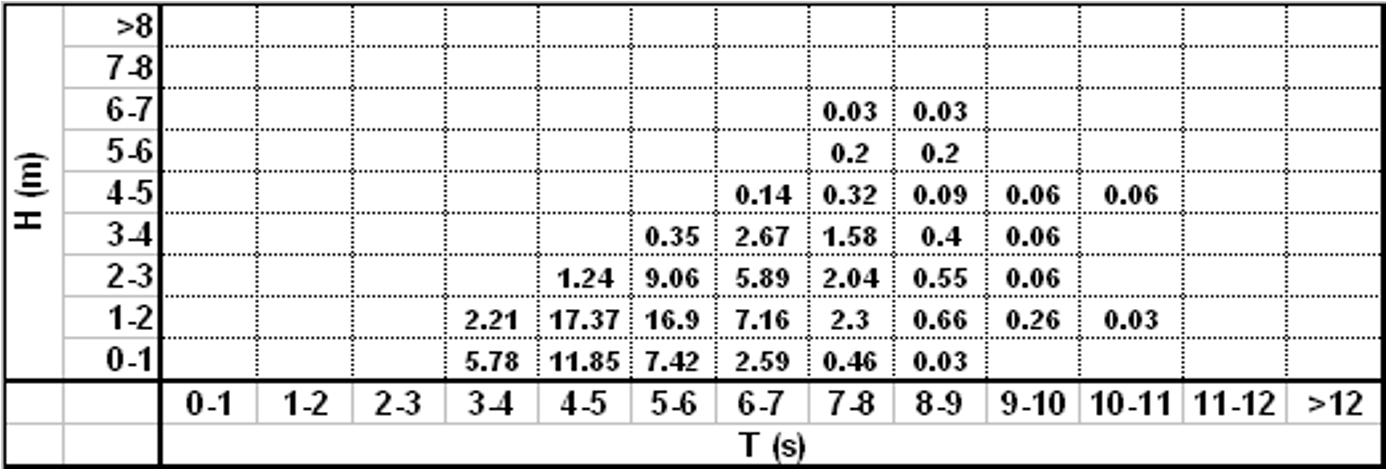
Each cell represents the percentage occurance of waves of certain heights and periods over the course of a year.
Power matrix
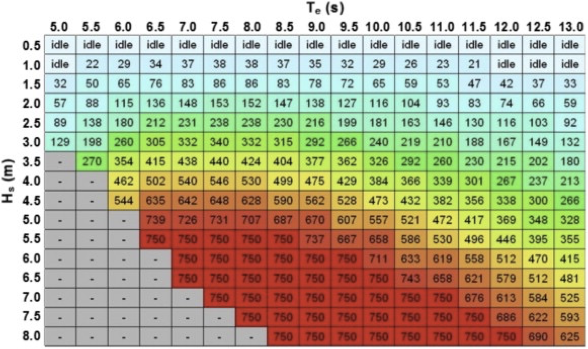
Each cell represents the number of occurrences (or sea states).
total theoretical energy
Pick a cell in power matrix → divide by the total amount of sea states to get % occurence in scatter diagram → multiply by the hours in a year (8760) to get the hours that cell’s category is present → use the power equation (H²T in kW/m) → multiply by the hours in a year that it occurs to get the energy produced in that cell’s category of wave → repeat for ALL cells → sum them up to obtain the TOTAL ENERGY