Intro to Virology
Complete Protein synthesis machinery
Obligate intercellular (no gene to encode proteins involved in energy production and membrane biosynthesis)
Resistant to antibiotics!
*Inhibited by” Interferon and antiviral agents
Interferon: proteins part of natural defeses; interferes with viruses and keeps them from multiplying; activated IFN gene
* The only taxa used in classifying viruses: Order, Suborder, Family, Subfamily, Genus, Subgenus, and Species.
Missing: Domain, Kingdom, Phylum, Class
Order: Virales
Family: Viridae
Subfamily: Virinae
Genus: Virus
Species (generally the desease virus): e.g. SARS COvv2, Varicella zoster virus, measles virus
What do you call an entire infectious unit? VIRION
What are the 2 types of Virions?
Naked nucleocapsid virions
capsid covering
nucleic acid genome
Enveloped virions
Capsid covering
Nucleic acid genome
*ENVELOPE - protruding spike on its surface
Phospholipid bilayer
contains inserted Viral proteins called PEPLOMERS
For attachment, induction of productive immunity
Hemagglutinin (HA) = Attachment of virus to RBC receptor (specifically the glycan chain)
Neuramidase (NA)
Spike protein = attach to ACE2 receptor (in SARCOV1 and SARVOC2)
specific binding ; facillitate viral entry; made up of Glycoproteins
E.g. Gp 120 spikes (attaches to CD4+ receptor of host cell)
*HIV patients have decreased CD4+ receptor.
Coreceptors of Gp 120 spike: CCR5 and CXCR 4
Derived from host cell membrane during Cell maturation
NOTE: except herpes, its envelope is derived from the nuclear membrane.
Majority of human viruses are ENVELOPED EXCEPT:
Parvoviridae
Papillomaviridae
Polyomaviridae
Adenoviridae
Picornaviridae
Reoviridae
Calciviridae
Hepeviridae

RNA VIRUSES
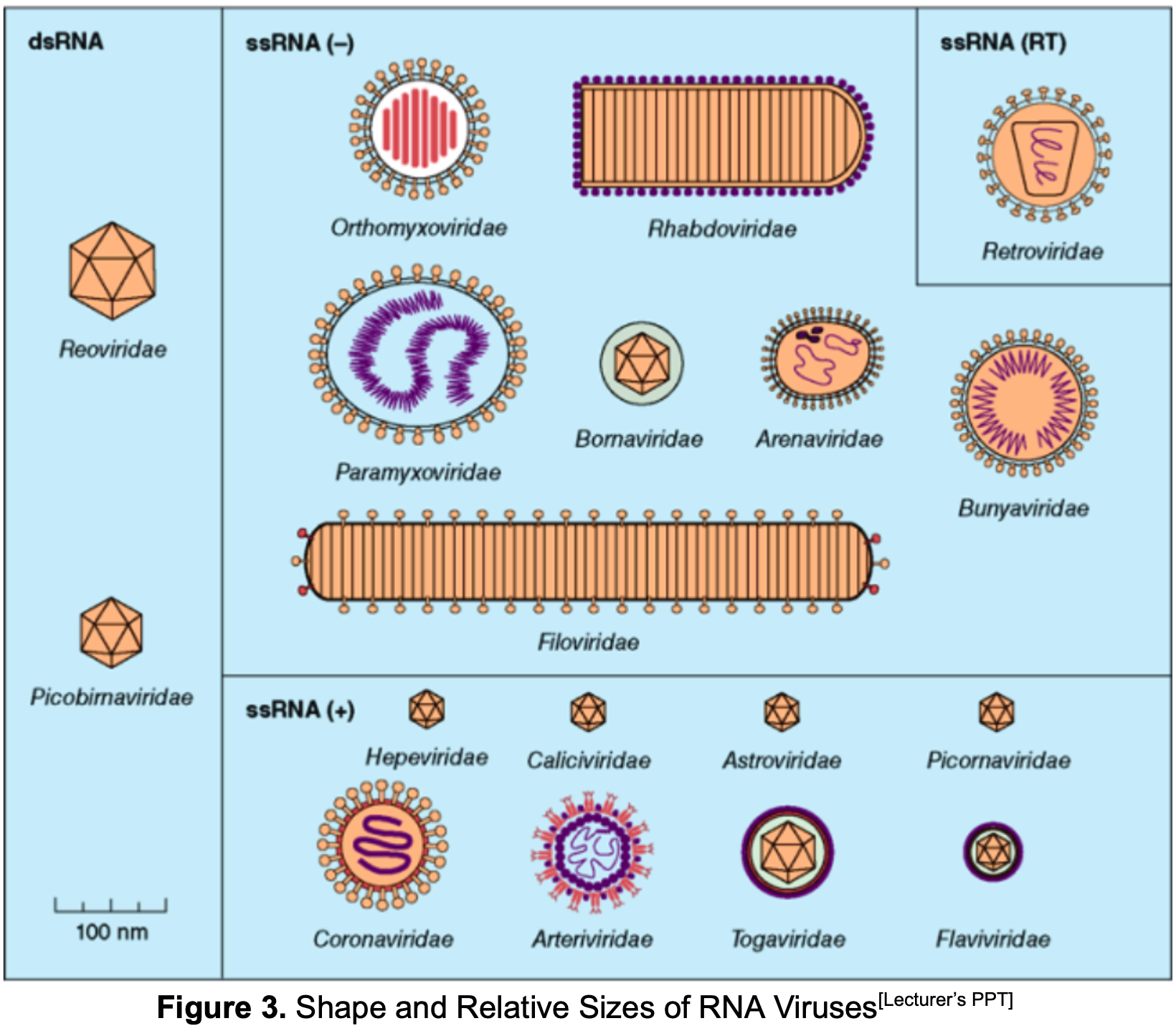
Image Above^
take note of types and examples:
Double stranded RNA (DsRNA)
Single stranded Negative strand RNA (ssRNA-)
Single stranded Positive strand RNA (ssRNA+)
Single stranded Single RNA Retrovirus (RT)
DNA VIRUSES

Image Above^
take note of types and examples:
Double stranded DNA (dsDNA)
Single stranded POSITIVE DNA (ssDNA+)
dsDNA (RT)
Capsid ( 3 types according to symmetry)
Icosahedral
Helical
Complex
* Icosahedral and Helical have enveloped and naked.
Icosahedral
20 flat sides
DNA
(+) sense strand RNA
Helical
(-) sense strand RNA
Complex
No symmetrical features
E.g. Pox and Rabies
Pox = dumbbell shaped
Rabies = bullet shaped
Kaposis Sarcoma ass. herpes virus ( KSHV or Herpesvirus 8)
Spike proteins: gB & gHgL
Human receptor: CD98
Summary of Viral proteins and their functions
VIRAL PROTEIN | FUNCTION |
Structural protein | Attachment to host cell receptor |
Enzymes | E.g. DNA/RNA polymerase |
Matrix Protein | Interaction between nucleocapsid & envelope |
Antigenic variants | Serotyping of different strains |
Capsid | Provide structural symmetry for the virus particle |
Protein in the envelope | Protect the viral genome against inactivation of nucleases |
Function of RNA polymerase? helps viral transduction, translation and replication
Function of RNA transcriptase? 1) Found in retroviruses 2) Make DNA copy of viral RNA
Matrix protein is found inbetween?
Viral antigens of Hepatitis B?
HBsAg (acute)
HBcAg (chronic)
HBeAg
How do determine antigens of Hep B? check antibodies produced by PTs
Genome
Strands
Linear: Pico, Pox, Parvo
Circular:
single: Herpes D
double: Papillomavirus **

Segmented: “B-O-A-R”
orthomyxoviridae
Arenaviridae
Bunyviridae
Reovirus **

MUST REMEMBERS
ALL DNA VIRUSES ARE: linear & DS
EXCEPT: ssDNA (Parvoviridae) & Circular DNA (Papilloviridae, Polyomaviridae, Hepadnaviridae)
DS DNA VIRUSES HAVE BOTH: (+) and (-) strand
IF SS? only (+) strand!!!!! ***
ALL RNA VIRUSES ARE: linear and SS
EXCEPT: BOAR
dsRNA (Reoviridae)
ssRNA segmented genomes (Orthomyxoviridae, Bunyaviridae, Arenaviridae)
Circular RNA (Delta virus)
SS RNA only have: (-) strand
must transcribe first (-) then (+) strand
own RNA dependent polymerase **
memorize: Negative strand RNA viruses
Always Bring Polymerase Or Fail Replication
Arena
Bunya
Paramyxo
Filo
Rhabdo
mRNA polarity matches the host cell = (-) to (-)
Polarity
Viral RNA Polarity describes whether a viral single-stranded RNA genome can be read directly by host ribosomes to make protein, or if it must be converted first.
1. Positive-Sense (+) ssRNA
Mechanism: The viral RNA strand is identical in polarity to host mRNA ("sense" strand).
Process: Host ribosomes directly bind the viral genome and translate it immediately into viral proteins (+ RNA → Protein).
Key Feature: Pure, naked (+) RNA is infectious on its own because it requires no pre-packaged viral enzymes to begin protein synthesis.
Examples: Picornavirus, Togavirus, Coronavirus (Baltimore Group IV).

2. Negative-Sense (−) ssRNA
Mechanism: The viral RNA strand is complementary (antisense) to host mRNA. Ribosomes cannot read it.
Process: The virus brings its own pre-packaged enzyme, RNA-dependent RNA polymerase (RdRP). This polymerase uses the (-) strand as a template to transcribe (+) viral mRNA, which the host ribosome then translates (- RNA → + mRNA → Protein).
Key Feature: Naked (−) RNA is not infectious alone because human host cells do not possess an RdRP enzyme.
Examples: Rhabdovirus, Orthomyxovirus (Baltimore Group V).
3. Ambisense (+ and −)
Mechanism: A single RNA segment contains both (+) sense and (−) sense coding regions on the same strand.
Composition: The genome is mostly composed of (−) polarity regions interspersed with (+) polarity regions.
Process: The (+) portion and (−) portion are transcribed and translated at different stages of the viral replication cycle, typically requiring the viral RdRP.
Examples: Arenaviridae (Lassa fever virus) and Bunyaviridae (Hantavirus).
Baltimore classification groups
I. Group 1 dsDNA
Direct central dogma; follows conventional host pathway
dsDNA → mRNA → Protein
NO reverse transcriptase or intermediate RNA steps
Enzyme for protein expression: DNA-dependent RNA polymerase
transcribes DNA template directly into (+) viral mRNA
Enzyme for Genome replication: DNA-dependent RNA polymerase
duplicates BOTH (+) and (-) strands
Cellular compatibility
same double stranded format as host genome
same polarity as host genome
Classic Examples (Clinical High-Yield): Herpesviridae, Adenoviridae, Papillomaviridae, Polyomaviridae, and Poxviridae (Poxvirus replicates exceptionally in the cytoplasm using its own carried enzymes)
II. Group 2 ssDNA
Mostly (+) polarity
Cannot transcribe directly!
Host RNA polymerase can only recognize dsDNA templates
High-Yield Medical Example!
Parvoviridae (Parvovirus B19):
Smallest DNA virus.
Non-enveloped, icosahedral capsid.
Clinically causes Erythema infectiosum (Fifth disease / "slapped-cheek" rash) in children, aplastic crisis in patients with sickle cell/chronic hemolytic anemia, and hydrops fetalis in pregnant women.
III. Group 3 dsRNA (+ and -)
Only 1 Family
Reoviridae (e.g., Rotavirus – common cause of infantile diarrhea, non-enveloped, segmented genome, triple-layered capsid).
Cannot Translate Directly
The (+) strand is hydrogen-bonded to the (−) strand, so it cannot act directly as mRNA.
Key Enzyme: own RNA-dependent RNA polymerase (RdRP)
Acts as both a transcriptase (transcribes (−) strand into (+) mRNA) and a replicase (copies both strands to reproduce dsRNA).
IV. Group 4: (+) ssRNA
Direct Translation: The genome acts directly as mRNA and is translated immediately upon entry by host ribosomes.
Infectious Genome: Pure, naked (+) ssRNA is infectious on its own.
Replication Cycle:
Translates viral RdRP (replicase) first.
Uses (+) strand to make a (−) ssRNA intermediate.
Uses the (−) template to generate new (+) ssRNA strands.
Examples: Caliciviridae (Norwalk), Coronaviridae (SARS, MERS), Hepeviridae (Hepatitis E), Picornaviridae (Polio), Togaviridae (Rubella), Flaviviridae (Dengue).
V. Group 4: (−) ssRNA
Not Directly Readable / Not Infectious Alone: Cannot be translated by host ribosomes; naked RNA is non-infectious.
Must Pre-Package Enzyme: Virion must carry RdRP inside its capsid.
Replication Cycle:
RNA dependent RNA Polymerase (RdRP) transcribes (−) ssRNA into (+) mRNA → translated to protein.
RdRP synthesizes a (+) ssRNA template intermediate to replicate new (−) ssRNA genomes.
Mnemonic ("Always Bring Polymerase Or Fail Replication"):
Arenaviruses (Lassa fever)
Bunyaviruses (Hantaan virus)
Paramyxoviruses (Mumps, Measles)
Orthomyxoviruses (Influenza)
Filoviruses (Ebola, Marburg)
Rhabdoviruses (Rabies)
Delta virus (Hepatitis D – subviral agent under Group V)
VI. Group 6: (+) ssRNA Retroviruses
Unique Pathway: Despite having (+) ssRNA, it is NOT used directly as mRNA.
Key Enzymes:
Reverse Transcriptase (RNA-dependent DNA polymerase)
Transcribes (+) ssRNA → ssDNA → dsDNA.
Integrase
Integrates viral dsDNA (provirus) into the host cell chromosomes.
Protein Synthesis: Host RNA polymerase transcribes integrated proviral DNA into mRNA.
Examples: Retroviridae (HIV, HTLV; enveloped, icosahedral, replicates in nucleus).
VII. Group 7: dsDNA (+/−) "Gapped DNA" Retrovirus
Structure: Circular, partially double-stranded "gapped" DNA (segments of single-stranded DNA).
Replication Intermediate
Replicates via an ssRNA intermediate (pregenomic RNA) using reverse transcriptase to convert RNA back into gapped dsDNA.
Example: Hepadnaviridae (Hepatitis B; enveloped, icosahedral, replicates in nucleus).
Viral Replication Cycle
MEMORIZE: “APUSAR”
Attachment - via capsid or phospholipid envelope (i.e. Spikes)
Penetration
Direct Fusion w/ host cell membrane
Viroprexis (receptor mediated endocytosis) ; used by several enveloped and ALL NAKED viruses
Uncoating - degredation or removal of capsid = release of nucleic acid/ genome
Start of Eclipse Phase in the Viral Growth curve (?)
Period when the infectious particles cannot be recovered from the collected
specimen
Synthesis
DNA viruses replicates in the nucleus
→ Except: poxviruses
RNA viruses replicates in the cytoplasm
→ Except: Orthomyxoviruses (influenza) & Retroviruses (HIV, HTLV, Hep B)
Production of nucleic acid and protein polymers
Assembly
structural proteins, genomes and viral enzymes are assembled into virus particles
Enclosing of the viral genome in protein coat (capsid)
Release
Last step of replication cycle
Released through:
Budding: creating enveloped viruses from the host cell membrane
Lysis: most naked viruses
Can sometimes result to APOPTOSIS: release by lysis of naked viruses results in host cell death
Viral Growth Curve

Phase 0: Entry
Phase1:Decline
→ Virus decreases in number but continues to function
Phase 2: Eclipse Period
→ No virus is detectable inside the cell
→ Viral component synthesis occurs
→ Virus are preparing by synthesizing their proteins and genome
Phase 3: Exponential/Rise Period
→ Period where they replicate exponentially
→ Progeny virus increases exponentially for a period of time (8-72 hours)
Phase 4: Latent Period
→ No additional increase in virus yield occurs
After reaching their certain number, there is plateau where there is no additional viruses
→ May yield of 100-10,000 virions per cell
→ Can be intracellular or extracellular
When released extracellularly, they try to look for other host cell to infect
Phase 5: CytoplasmicEffect
→ Mark derangement of cell function leading to lysis and cell death ▪ Changes in cell size and shape (elongation, ballooning)
▪ Can sometimes lead to cell lysis or death of the infected host cell
→ Virus replicate and produce progeny
→ Nucleic acid synthesis leading to host cell death and cytopathic effects
(CPE)
→ Inhibition of cellular protein and nitric acid (NA) synthesis
Patterns of Viral Infections & Cytopathology
Abortive
e.g. Hepatitis D (cannot replicate w/o Hepatitis B)
Aka Viruzoid or Satellite
Lytic
Virus replicates and produce Progeny
Leads to cell death and Cytopathic effects (CPE)
Inhibits cellular protein and nucleic acid synthesis
Evidence:
Thickening / Swelling
Presence of Inclusion bodies
Syncytial bodies (cell fusion of infected Host cell)

Persistent
Small # of virus particles are produced w/ little to no CPE
infected cells survice the effects of viral replication
3 types:
viral transformation → caused by oncogenic viruses
chronic infection → low level or viral production w/o immune clearance (e.g. Hep B or C)
latent infection → Viral genetic material remain in host cell, activated in the later time.
Types of Culture for Viruses
which one is used for vaccine production? Primary culture
which one is transfered from primary cells and is also used for vaccine prodcution? Semicontinuous culture
Which one is used for the production of serologic antigens (e.g. HeLa culture)? Continuous culture

What is used to detect specific nucleic acids in viruses? PCR
What 3 processes happens during PCR? D-A-E; Denaturing, Annealing and Extending
Development of Cytopathic Effects (CPE)
Syncytial formation
Ballooning of cells
Syncytial formation (or a Multi-nucleated enlarged cell)
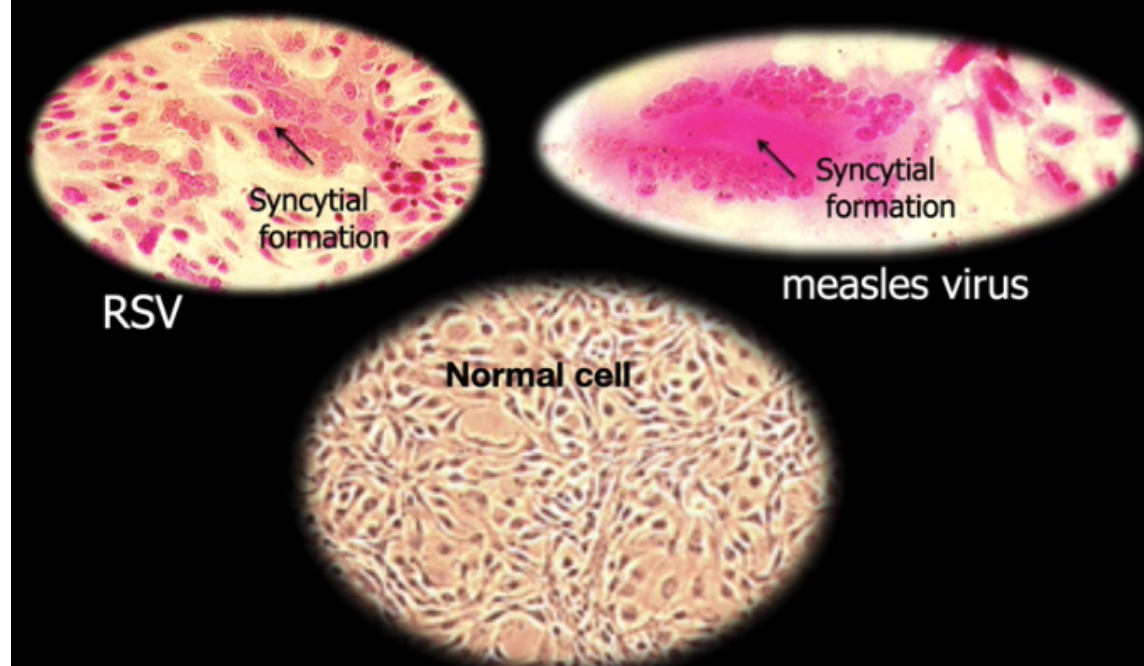
Middle cell with the infected virus fuses with neighboring cell to produce syncytium.
E.g. Respiratory Virus (RSV) and Measles Virus
Balloon Formation

Original shape of cell is not present anymore ; Infected cell becomes round/balloon
E.g. Enterovirus and HSV
*Viral growth in Chick Embryo detects the presence of? (1) Pocks on CAM (2) Hemagglutination (3) Inclusion bodies (negribodies)


