Week 13- Population and Urbanization, Contemporary Korea
Population and Urbanization
Lecture Outline
- Introduction
- World Population
- Views of Population Growth
- Population in Korea
- Urbanization
- Types of Urban Settlements
- Urbanization in Korea
- Characteristics & Problems fo Urbanization in Korea
- Comparison of Urbanization in the West and Korea
Introduction
- It took all of human history to add the first billion people to our planet, a number that was reached only two centuries ago, in around 1804
- By November 2022 the human population increased to over 8 billion
- The widely accepted prediction for the global population in 2050 is 9-10 billion
- It is difficult to predict with any precision the rate at which the world population will rise, but UN researchers have produced several scenarios
- Their most likely estimate assumed “medium” levels of fertility
- I.e. roughly 2 children being born, on average, to women throughout the world (obviously some women will have more children and some fewer, this is an average figure, based on current trends)
- According to this scenario, the world population will reach 9.8 billion by 2050 before stabilising at 11.2 billion by the end of the century
- Population change is an important source of other changes in society, especially the economy, urbanization and the environment
- It is thus important to examine the complex ways in which population growth, urbanization, and our planet’s fragile environment go hand in hand, particularly against the backdrop of rapid industrialization
- The study of population is so significant that occupies a special subfield within sociology called demography
- Demography- is the study of changes in size and composition of population, including birth rates, mortality rates and migration
- Questions we talk about today
- How have the world population and Korean population changed?
- What have been the views on population growth?
- How has urbanization progressed in Korea?
- What are the characteristics and problems of urbanization in Korea?
World Population
- One of the most important changes regarding population has been the rapid growth of the world population
- In the dawn of agriculture around 8000 BCE the world population was estimated at about 5 million
- Whereas it had taken all of human history until around 1800 (1804) for the world population to reach 1 billion,
- 2nd billion was added only in 123 years in 1927
- 3rd billion- 33 years (1960)
- 4th billion: 14 years (1974)
- 5th billion: 13 years (1987)
- 6th billion: 12 years (1999)
- 7th billion: 12 years (2011)
- 8th billion: 11 years (2022)
- 9th billion: 15 years (2037)
- The world population today is 8.04 billion
- World population forecasts:
- 2057- 10 billion
- 2100- 11.2 billion
- World Population: Past, Present and Future
- 8,000 BCE- 5 million
- 600 CE- 200 million
- 1000- 275 million
- 1400- 350 million
- 1804: 1 billion
- 1927: 2 billion
- 1974: 4 billion
- 1999: 6 billion
- 2022: 8 billon
- 2057: 10 billion
- As far as the rapid growth of world population is concered, a tremendous change occurred with the Industrial Revolution (from about 1760 to 1840)
- High population growth during this period was facilitate by, among other things:
- Increase in food production
- Better sanitation and hygiene
- Improved medicine
World population milestones
- Between 1804- 2011 (207 years) the world population increased 7x jumping from 1 billion to 7 billion
- The World population has doubled (100% increase) in 40 years from 1959 (3 billion) to 1999 (6 billion)
- During the 20th century the population in the world has grown from 1.65 billion to 6 billion
- And between 800 BCE and 2023, the world population jumped more than 1,600 times
Views on Population growth
There are 4 views
- Malthusian Theory
- Zero population growth
- Cornucopian Theory
- Demographic Transition Theory
1. Malthusian Theory (1798)
- English economist Thomas Malthus said that:
- Population increases geometrically (2,4,8,16, 32, 64
- While food production only increases arithmetically (1,2,3, 4, 5, 6)
- If left unchecked the population would exceed the available food supply, leading to mass starvation
- Was proven wrong- this never happened
2. Zero Population Growth
- A neo-Malthusian view calls for a goal of zero population growth (ZPG)
- Malthusian as it is almost on if population growth is left unchecked (alarmist)
- The view argues that it is the environment not food shortage of food suply, that will play a crucial role in the continued health of the planet’s population
- That is, large human population, and their meat-based diet is having a devastating impact on the environment, using up and polluting resources, such as water and air
- The preponderance of meat-based diet by humans is indicated by the sheer number of farm animals
- Indeed humans are easily outnumbered by farm animals
- As of 2019 there were combined total of chickens (19 billion) cows (1.5 billion), sheep (1 billion) and pigs (1 billion) living at one time is 3x higher than the number of people (2019)
- Out of all the world’s crops (grain, fruit, vegetables, etc):
- Only 55% are actually directly eaten by people
- 36% used for animal feed
- 9% goes towards biofuels and other industrial uses
- Also one-thirds (33%) of agricultural land worldwide is solely used for livestock feed production (UN food and Agriculture organisation)
- Global meat production is responsible for more greenhouse gas emissions than all of the trains, cars and airplanes in the world combined
- Increased meat production and consumption are intimately related to rapid population growth which is in turn linked to climate change and global warming
- That is, large human population, and their meat-based diet is having a devastating impact on the environment, using up and polluting resources, such as water and air
3.Cornucopian Theory
- Cornucopian theory scoffs at the idea of humans wiping themselves out
- E.g. Food supply: if we need more food, agricultural scientists will figure out how to grow it, as they have already been doing for centuries
- The term comes from cornucopia, ‘the horn of plenty’ of Greek mythology which magically supplied its owners with endless food and drinks
- Cornucopianism is the idea that continued progress and provision of material items for mankind can be met by similarly continued advances in technology
- It relies on the belief that there is enough matter and energy on the Earth to provide for the population of the world, which appears adequate to give humanity almost unlimited room for growth
4.Demographic Translation theory
- Demographic Transition theory suggests that future population growth will develop along a predictable 5-stage model
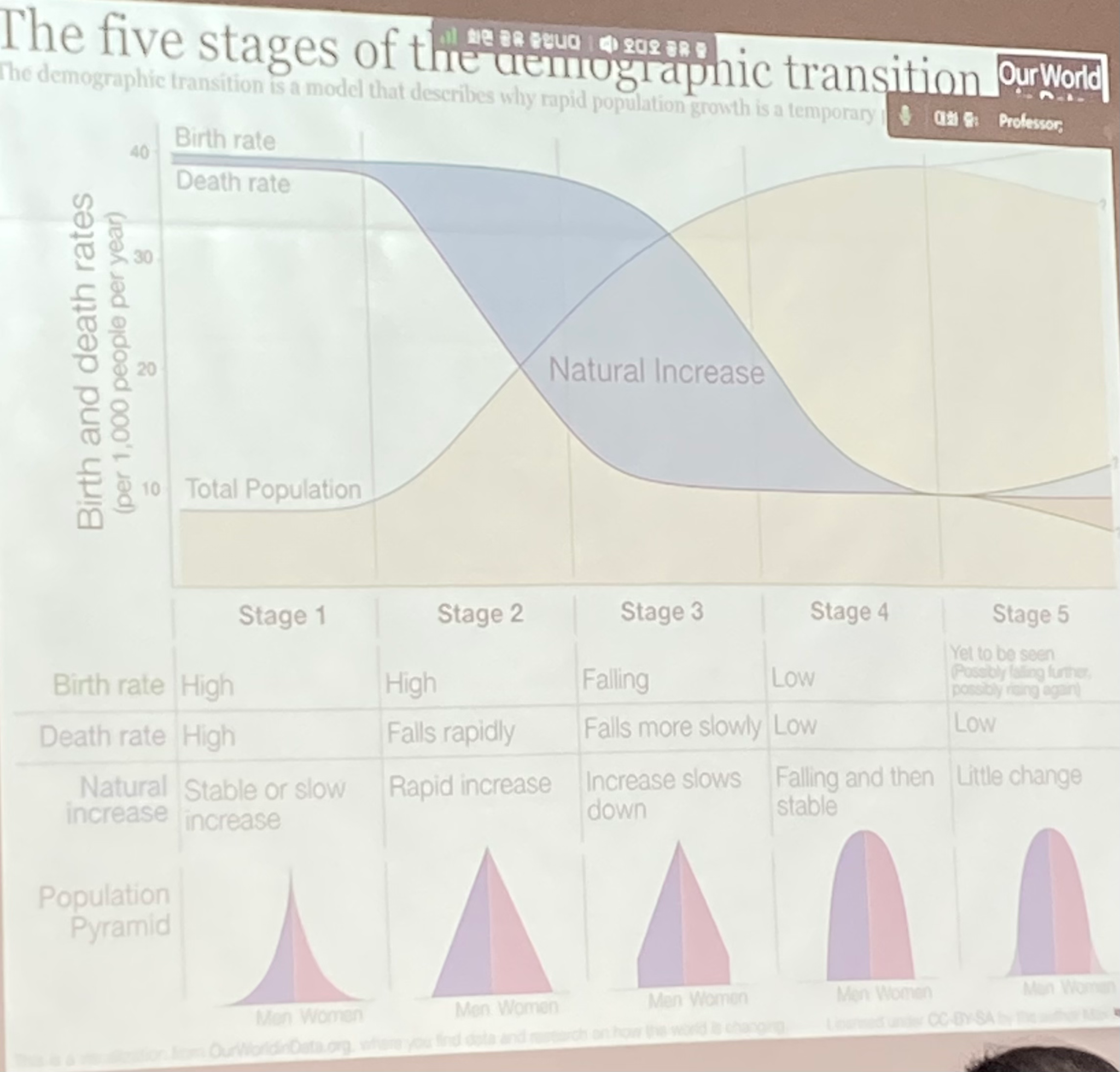
- Curerntly Stage 3
- Developed and economically dtorng country at stage 4 & 5
- Some developing countries still at Stage 2
- If we can hope whole world having high living standards then the world will eventually reach stage 5 and will ahve lwoer population than what it is now
Population in Korea
Facts
- The current population is 51, 628, 117 as of 2022
- South Korea’s population ranks as the 28th largest in the world
- Population density: 512 per km² (24th in the world, 2022)
Population Decline in Korea
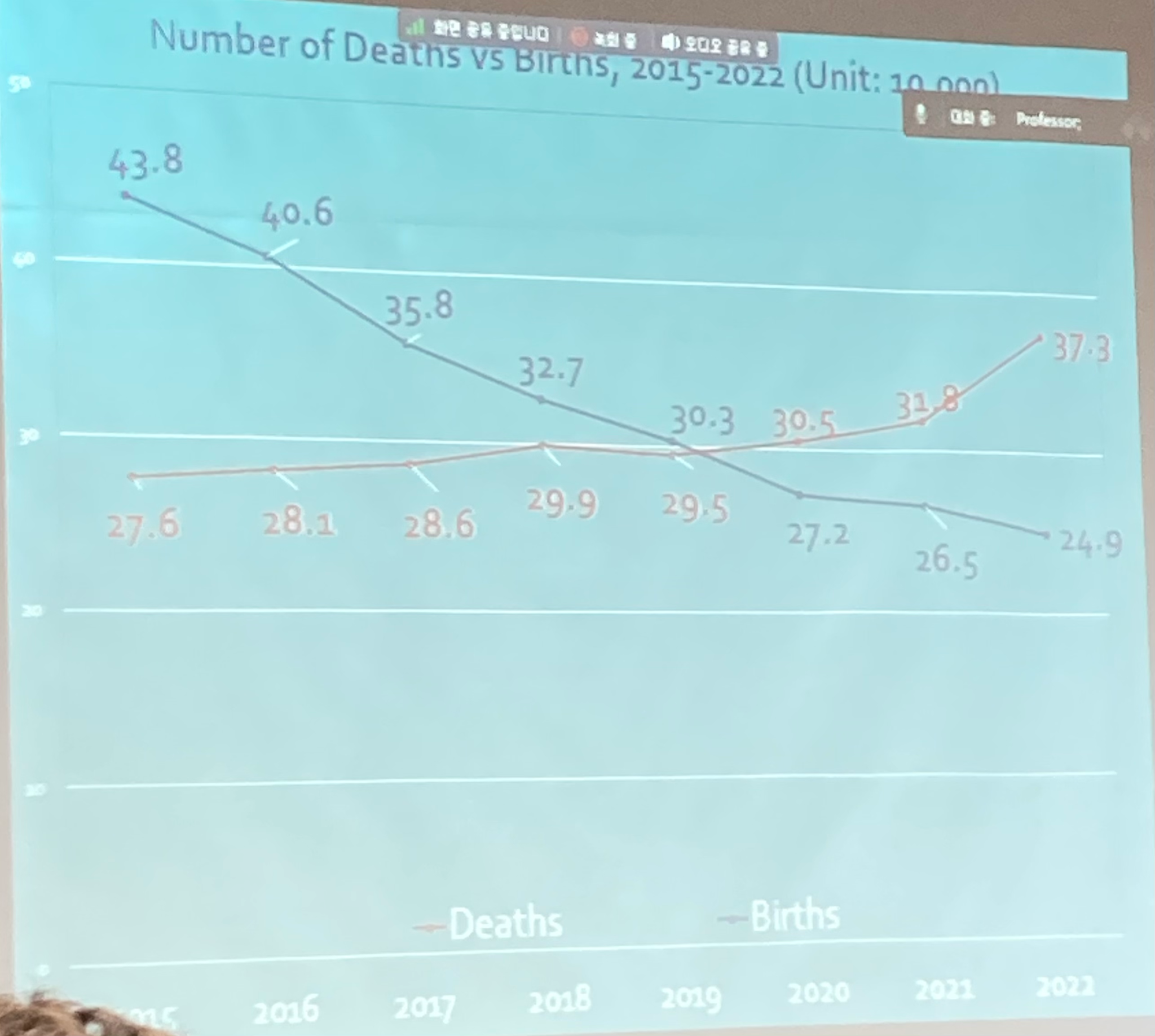
- Korean population declined for the first time in 2020, down from 30,000 from the previous year
- The number of newborns in 2020 was 257,815 the lowest level ever with the number of decreased total 308,764
- About 30,000 more deaths than the number of births
- It is the firrst time in 58 years that the national population decreased since such statistic has been compiled beginning in 1962
- “Population dead cross”, the pehnomenon in which the number of newborns is smaller than the number of decreaed leading to a fall in the overall population, has become a reality
- Population Trends of Korea, 1949-2022
- 1949- 21.19 million
- 1960- 24.99 million
- 1970- 30.88 million
- 1980- 37.44 million
- 1990-43.42 million
- 2000- 46.24 million
- 2010- 48.58 million
- 2015- 51.07 million
- 2019- 51.85 million
- 2020- 52.82 million
- 2021- 51.64 million
- 2022- 51.44 million
Urbanization
- An important aspect of social change and population growth over the centuries has been urbanisation or the rise and growth of cities
- Urbanisation is the princess by which an increasing proportion of a population lives in cities
- Urbanization has had important consequences for many aspects of social, political and economic life as well as for the ecosystem
What defines an urban area?
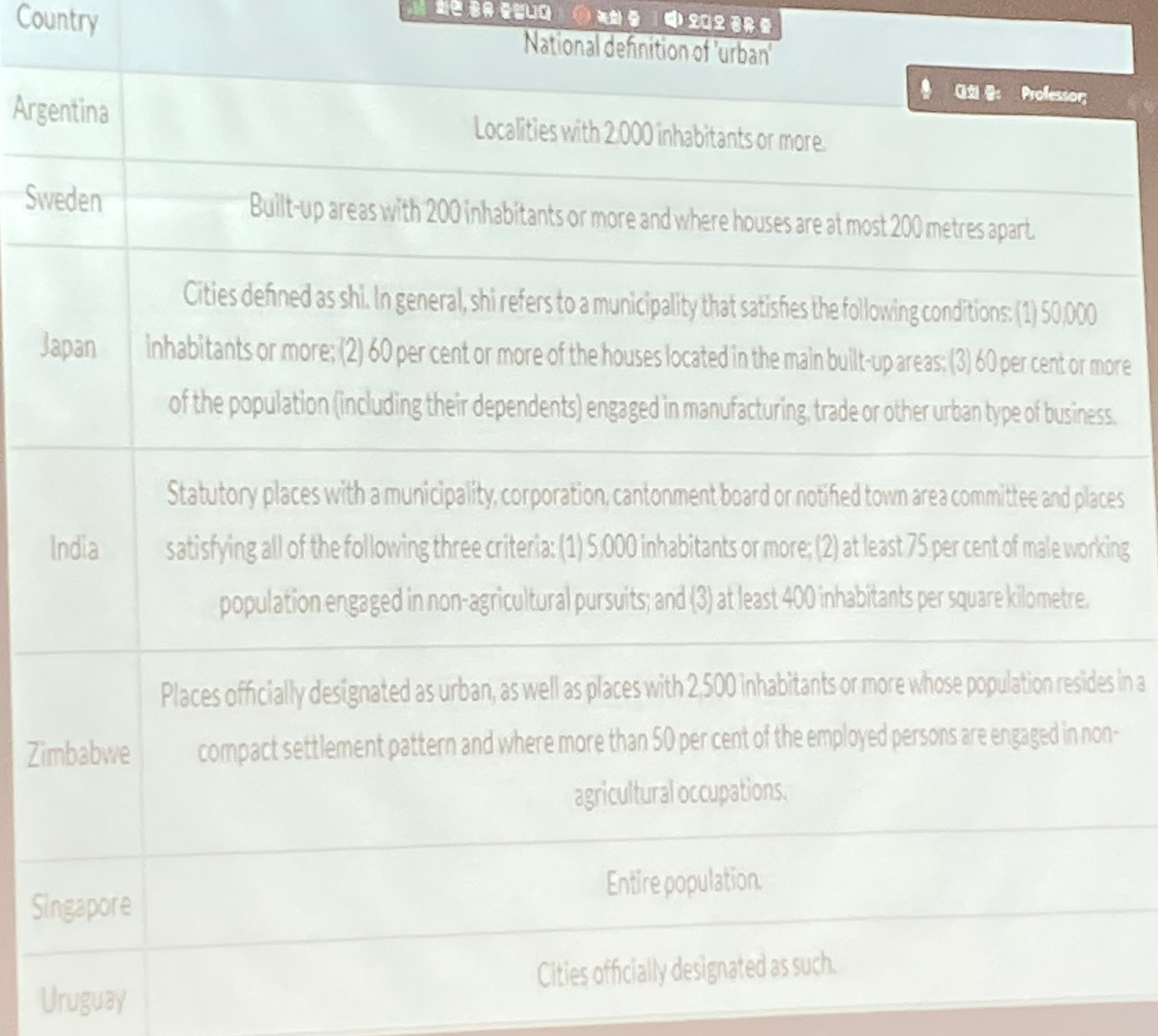
- Currently there is no universal definition of what urban means
- The UN reports figures based on nationally defined urban shares
- The problem howver is that countries have very different defintions of urbanisation
- Some country use minimum population thresholds while others use other criteria including
- Population density
- Infastructure development
- Employement type (e.g. agriculture)
- The following table highlight the varied definition across a selection of countries
- When we look at the frequency at given population threshold is used by a country 2000 and 5000 inhabitants were jointly the most frequently-adopted threshold
- However the variation across countries is vast
- Sweden and Denmark set this threshold at only 200 inhabitants
- Japan: 50,000
- 250-fold difference between sweden and Japan
- However the variation across countries is vast
- Until 18th century most people in the world were living and working on small farms
- The few existing cities were mainly market towns
Impact of Industrial revolution
- Over time technological innovations made it possible for cities to expand
- The use of cast iron in building construction and the invention of the elevator enabled cities to expand vertically
- Other inventions like train and railroads and automobiles have made it possible for cities to expand horizontally as well
- Today urbanisation means that not only morepeople livie in cities but that cities are much larger
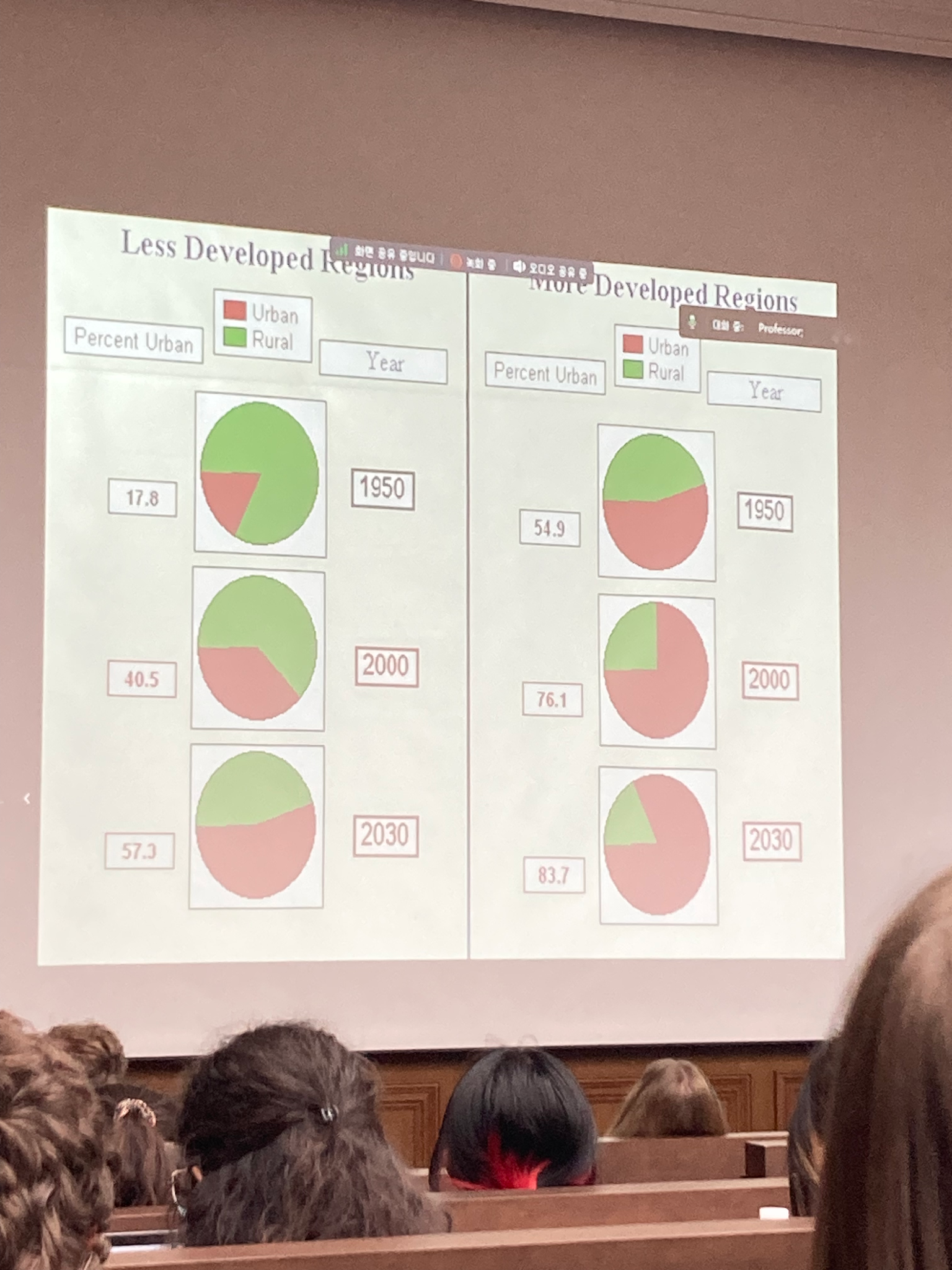
- According to the UN, in 2008, for the first time in history, more than half the world populairon were living in urban areas
- The figure is expected to rise to 60% by 2030
Types of Urban Settlememnts
- City
- Typical working definitions for small-city populations start at around 100,000 people but countries differ in awarding a city status
- Global city is a prominent centre of trade, banking, finance, innovation and markets
- Suburbs
- Subrubs are the communities surrounding cities, allowing for more spacious living than city living
- Exurbs
- Communities that exit outside the ring of suburbs and are typically populated by even wealthier families who want more space
- Metropolis
- Metropolitan area comprising of the central city and surrounding smaller cities, suburbs and exurbs which are connected economically, politically and socially
- A form of metropolis is a megacity
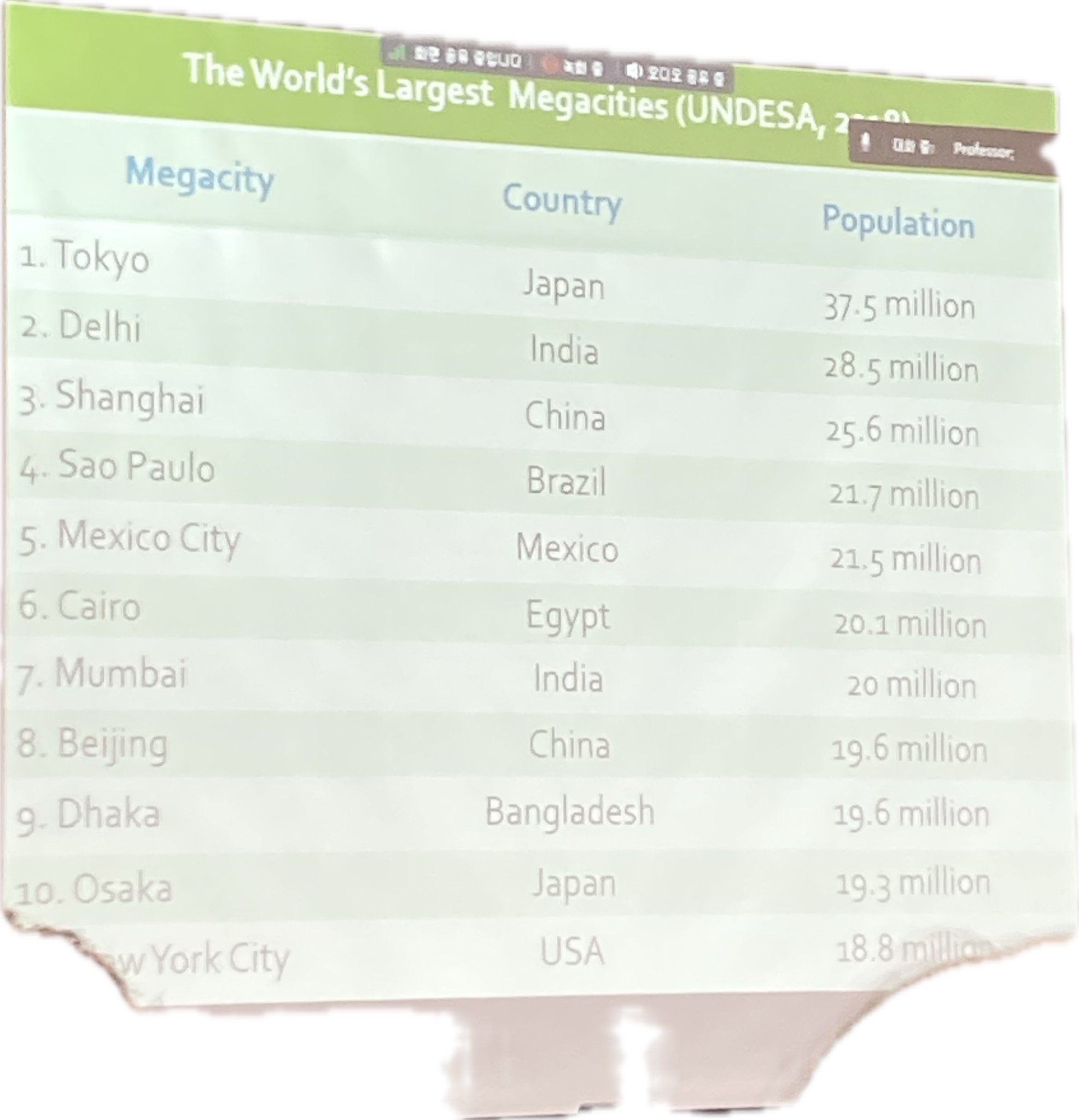
- Although precise definitions vary, a megacity is a very large city, typically with a population of over 10 million, according to the United Nations Department of Economic and Social Affairs
- According to a 2018 by UNDEF 33 megacities in the world as of 2018
- The largest megacity is Tokoyo
- Megalopolis
- Greek word meaning ‘large city’ or ‘great city’
- A long chain of continuous metropolitan areas or a region made up of several large cities and their surrounding areas
- Example of megapolis in US include:
- 1) Northeast megapolis: The Eastern seaboard of the US, including Boston, New York City, Philadelphia and Washington, D.C.
- 2) Southern California: the LA-San Diego- Santa Barbara area
- Megalopolises in Korea
- Incheon-Seoul-Suwon-Daejon-Daegu-Busan (pop. 32 million)
- Incheon-Seoul-Daejon-Jeonju-Gwanju
- Megalopolises in China- There are 13
Urbanization in Korea
- By 1789 there were only 3 cities with more than 20,000 residents in Korea and the proportion of urban population was a mere 3.3%
3 stages of Urbanisation in Korea
- First Stage: 1910-1945
- Urbanisation in Korea began in earnest during the Japanese colonial rule, 1910-1945
- Urban residents during the Joseon period (1392-1910) accounted for 3-5% of the total population but increased to 10-210% between 1910-1945
- Urbanisation at the time was closely linked to Japanese needs
- Until 1935, Korea served mainly as a supplier of rice
- Mokpo and Daejeon in the South were developed as important centres for rice supply
- After 1935, Korea served as a base of war supplies
- As Japan geared itself to invade mainland China, new industrial centres were created in the north, including Pyongyang
- Until 1935, Korea served mainly as a supplier of rice
- Second Stage: 1945- End of 1950s
- Growth of cities is closely linked to large influx of:
- Refugees from the north
- Retrunee from Siberia, China and Japan most of whom were sent there as forced labourers
- 2.2 million Koreans returned followed the liberation including:
- 1.3 million from Japan
- 330,000 from Manchuria
- 100,000 from other parts of China
- Also around 1 million refugees came from South Korea form North Korea
- Third Stage: Early 1960s to 1980s
- Most rapid- Most migrants moved from rural to urban areas
- A period of rapid industrialization which led to rapid urbanisation
- One of the major features of urban migration in the 1960s was the migration to one city: Seoul
- Between 1960 and 1970 more than 65% of all migrants headed to Seoul
- Starting in the mid-1970s a diversification in the destinations of migrants
- Migration to Soeul decreased while other cities, including Busan, began to grow considerably
Characteristics and Problems of Urbnisation in kora
- Compared to rural dwellers, city dwellers, in general, have:
- Higher levels of income and education
- Greater social mobility
- Smaller families
- Greater diversity
- Less stable marriages
- Higher reported rates of
- Alcoholism
- Drug addiction
- Mental illness
- Suicide
Characteristics of Urbanisation in Korea
- 90.6% of the total population in Korea live in cities with more than 20,000
- More apartments than houses (90% of new housing units were in the form of apartments in the 1990s and 2000s)
- Shortage of public facilities such as parks, libraries, recreational centres, sports facilities (tennis courts, swimming pools, ice rinks, etc)
- Lack of Affordable Housing
- Housing prices inc ities especially in Seoul are very high
- Lack of affordable housing → Shelter Poor
- Price-to-income ratio- The ratio between the price of a median home to that of the median annual household income in a particular area
- Seoul’s price-to-income ratio was 11.2 in 2017
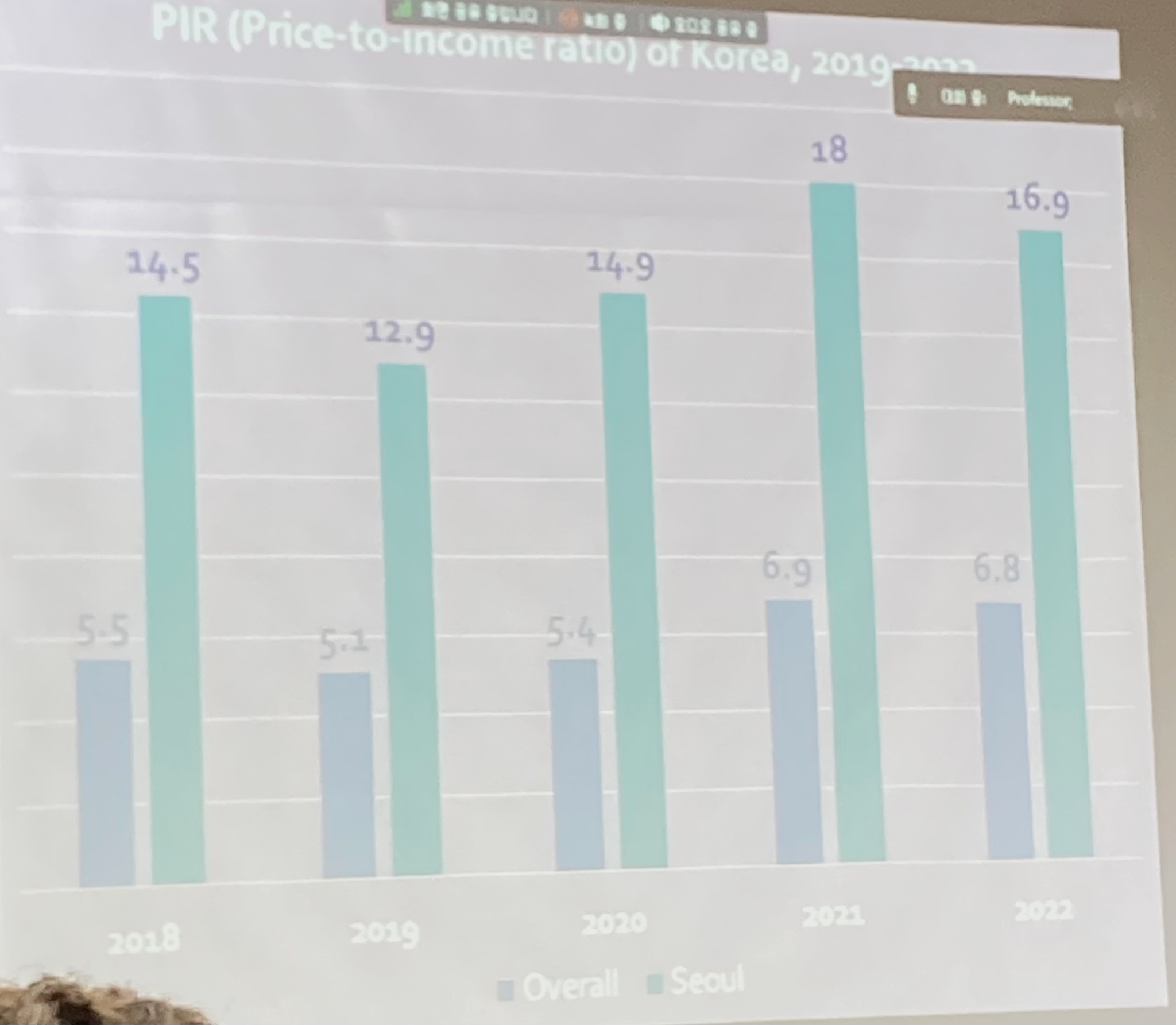
- Low homeownership rate of 56.8% in South Korea
- Pollution (Air Pollution)
- Environmental degradation: low priority on environment and high priority on expanding quantitative urban facilities
- Poor air quality due to, among others:
- Large number of power plants which use coals
- Dirposoritonate number of vehicles using diesel fuel
- Waste incineration
- Crowding
- Crowding is associated with higher levels of stress, depression and aggression
- People living in Seoul are said to have one of the highest stress levels in the world due to high population density (crowding)
- High population density in Seoul
- 17,711 (2021) persons per km² vs 528 for the whole country
- The world wide human population density (land only): 50 persons per km²
- “Seoul-based urbanisation”: “Seoul Republic”
- Seoul (and the capital region) is the country’s economic, social, cultural and political centre
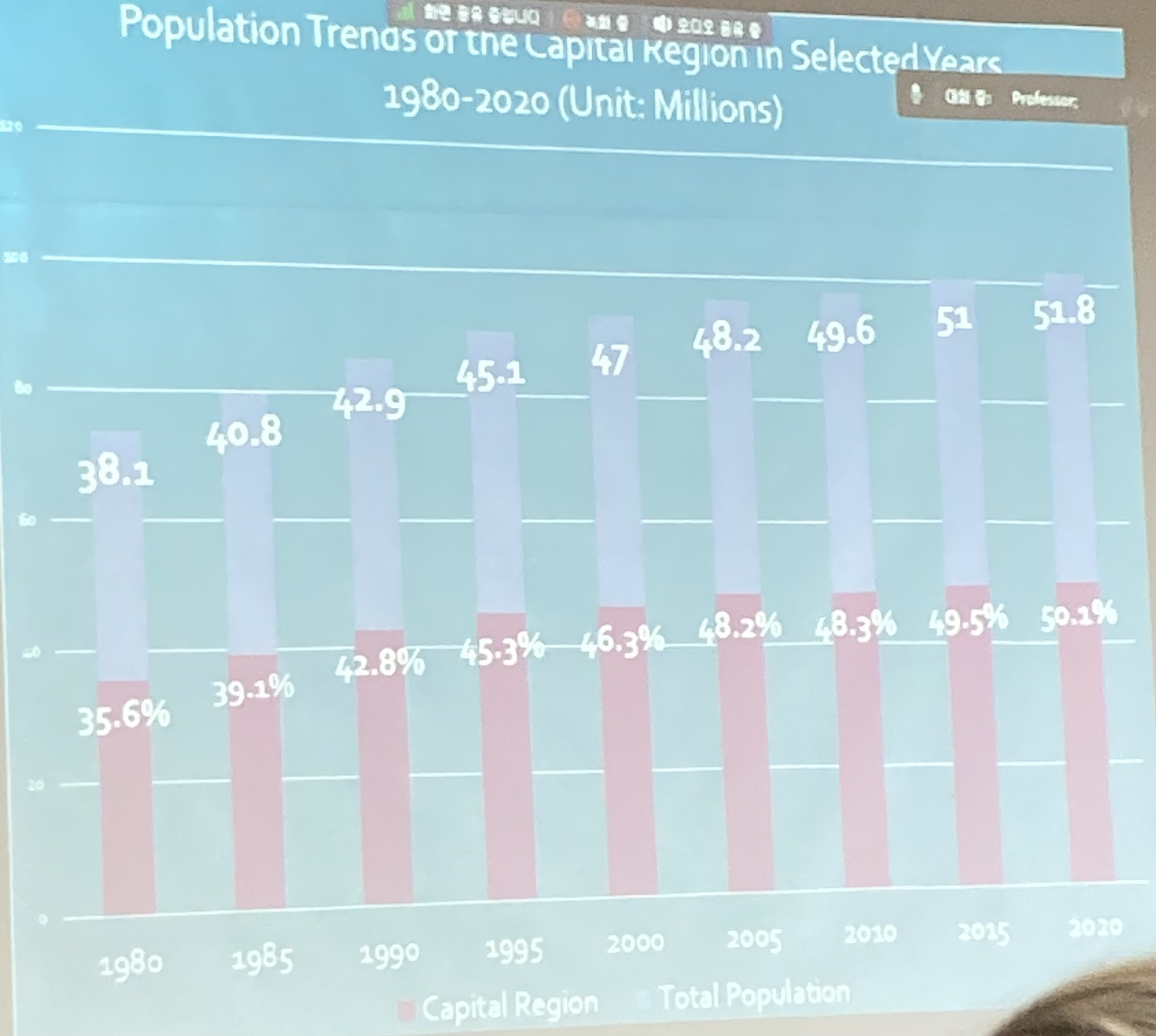
- Excessive population in the capital region
- Seoul comprises only 0.63% of total land mass in SK
- But its population comprises of 19.4% of the total population
- The capital region (Seoul and its satellite cities like Seongnam, Goyang, Uijeongbu, etc, Incheon and Suwon
- Comprises of 8.5% of the total land
- More than a half of population (+25 million) live in the region
- Excessibve concentration of economic activities
- 96% of the headquarters of large conglomerates are based in the capital region (compared to US)
- 80% of all transactions take place in the capital region
- 68.0% of savings
- At any given period, around 65% of new employments are created in the capital region
- Capital region is also the cultural and educational centre of Korea
- 39.2% of all the universities
- Most of the prestigious universities are found in the region, especially in Seoul
- Concentration of amenities and others in the region
- 50.4% of all medical facilities
- 48.7% of cars
- The “Gangnam Republic” phenomenon
- Gangnam stands out as the most affluent district in Seoul with more positive characteristics more true in this area
- Seoul-centreded development has limited the economic potential of other regions
- Regional disparity in economic development and growth, job opportuntieis, levels of social welfare, quality of life and chances of personal advancement
- Stronge sense of relative deprivation for those living outside Seoul and the capital region