AP Physics C: Mechanics — Unit 1: Kinematics Breakdown
Fundamental Concepts: Position, Velocity, and Acceleration
One-dimensional kinematics describes motion along a straight line (e.g., the x-axis or y-axis) without considering the forces causing the motion. In AP Physics C, unlike Physics 1, we define these quantities using differential calculus.
Position and Displacement
- Position ($x$): The location of an object relative to a defined origin at a specific time $t$.
- Displacement (): The change in position. It is a vector quantity.
- Distance: The total path length traveled. It is a scalar and is never negative.
Velocity vs. Speed
- Average Velocity: The total displacement divided by the time interval.
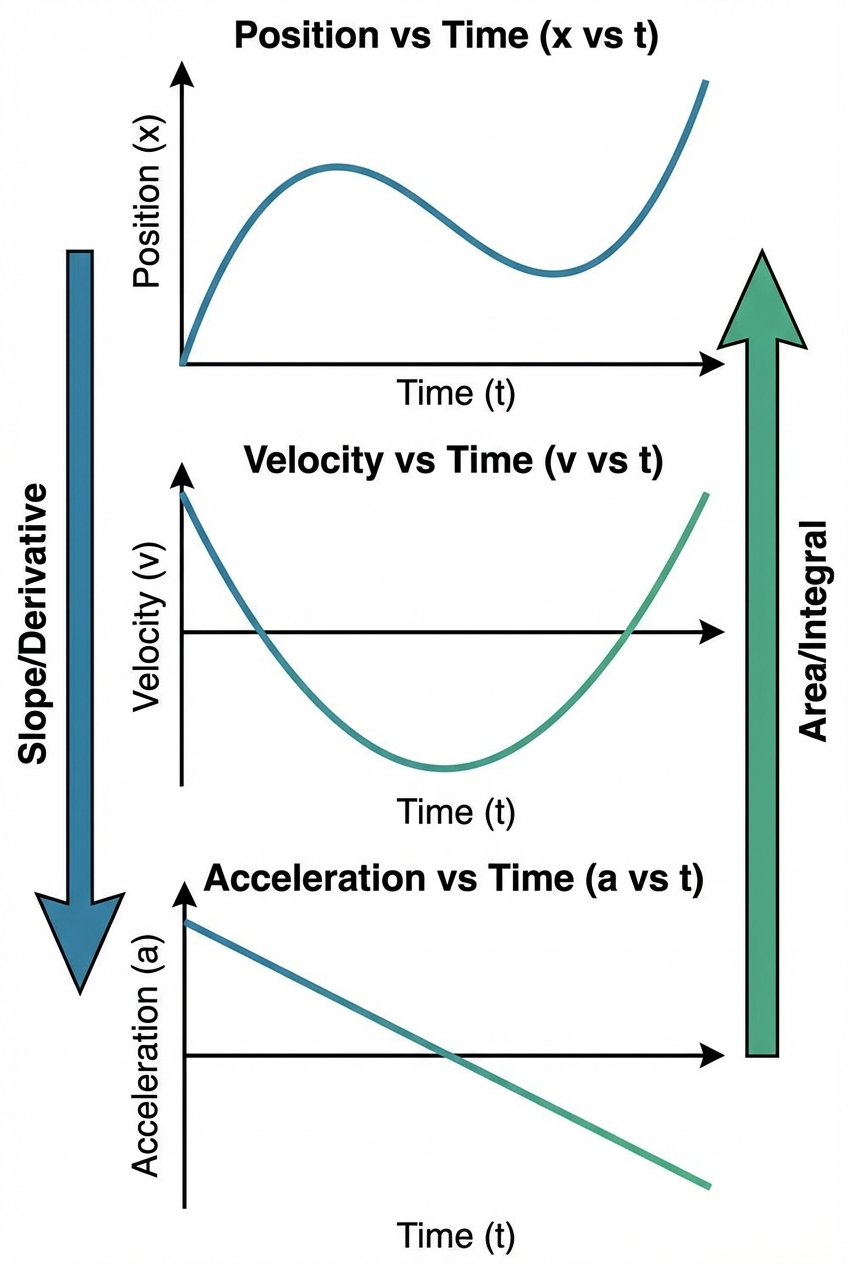
- Instantaneous Velocity ($v$): The velocity at a specific moment in time. Following calculus definitions, it is the derivative of position with respect to time.
- Speed: The magnitude of the instantaneous velocity vector ($|v|$). Speed is a scalar.
Acceleration
- Average Acceleration: The change in velocity over a time interval.
- Instantaneous Acceleration ($a$): The rate of change of velocity. It is the derivative of velocity, or the second derivative of position.
Motion with Constant Acceleration
When acceleration is constant (i.e., ), we can derive the "Big Three" kinematic equations. These are frequently used for free-fall problems and uniform interactions.
Warning: These equations ONLY apply when acceleration is constant.
The Kinematic Equations
| Equation | Variables Related | Missing Variable |
|---|---|---|
| Velocity, Time, Accel | Position ($x$) | |
| Position, Time, Accel | Final Velocity ($v$) | |
| Velocity, Position, Accel | Time ($t$) |
Notation Refresher:
- $x_0$: Initial position at $t=0$
- $v_{x0}$: Initial velocity at $t=0$
- $a_x$: Constant acceleration
Free Fall
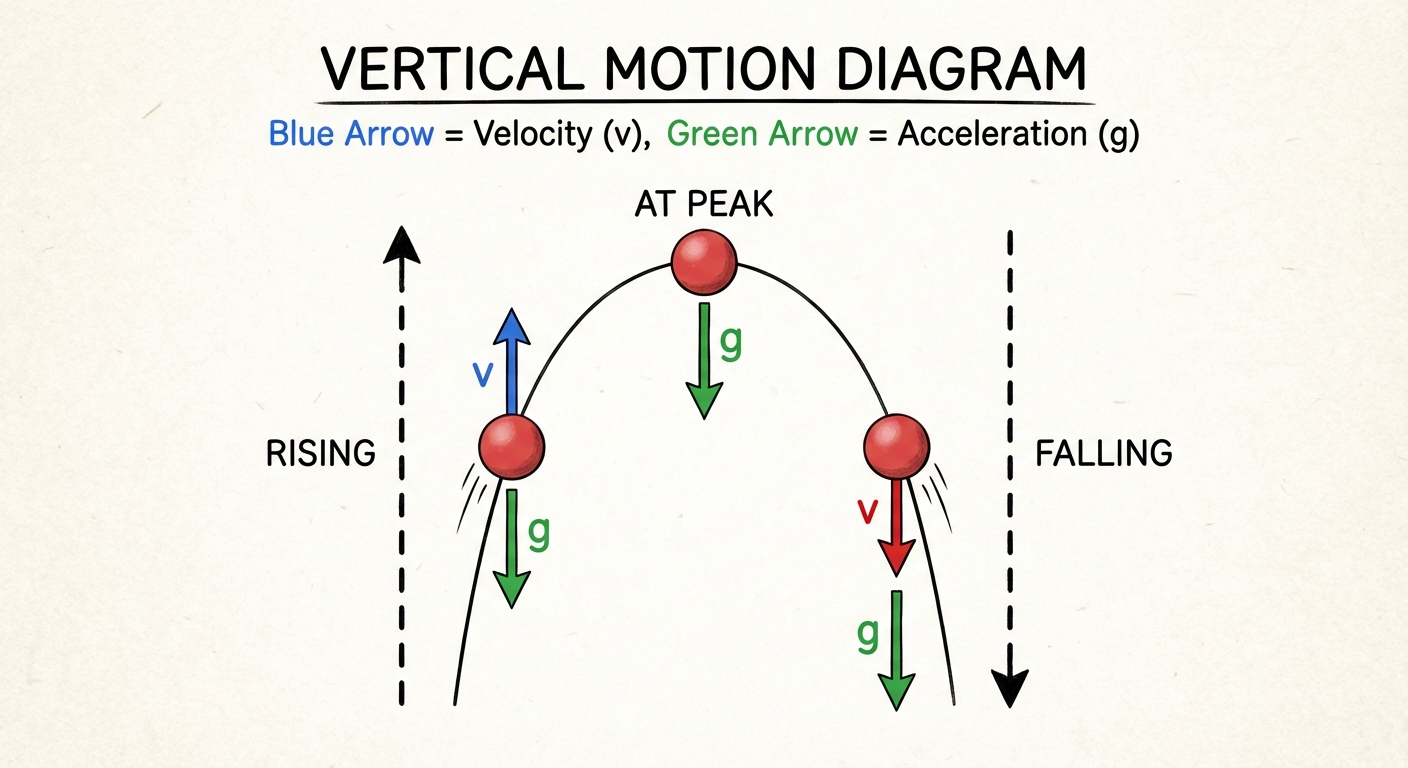
Free fall is the most common example of constant acceleration. In the absence of air resistance, all objects near Earth's surface accelerate downward at a constant rate $g$.
- Value: (often approximated as $10 \; m/s^2$ on multiple choice depending on exam instructions).
- Direction: Gravity acts downward. If you define "up" as positive, then $a_y = -g = -9.8 \; m/s^2$.
Example: The Vertical Toss
A ball is thrown straight up with an initial speed of $20 \; m/s$. How high does it go?
Solution:
- Define coordinates: Let ground $= 0$, Up $= +y$.
- Identify variables: $v{y0} = 20$, $ay = -9.8$, $v_{final} = 0$ (at the peak).
- Select Equation:
- Substitute:
- Solve:
Motion with Non-Constant Acceleration (Calculus)
This section distinguishes AP Physics C from lower-level physics. If acceleration changes with time (e.g., air resistance, varying engine thrust), you cannot use the kinematic equations above. You must use integration.
From Acceleration to Velocity
Since , we can integrate acceleration to find velocity:
Or, using definite limits:
Note: The area under the Acceleration vs. Time graph represents the change in velocity ().
From Velocity to Position
Since , we can integrate velocity to find position:
Or, using definite limits:
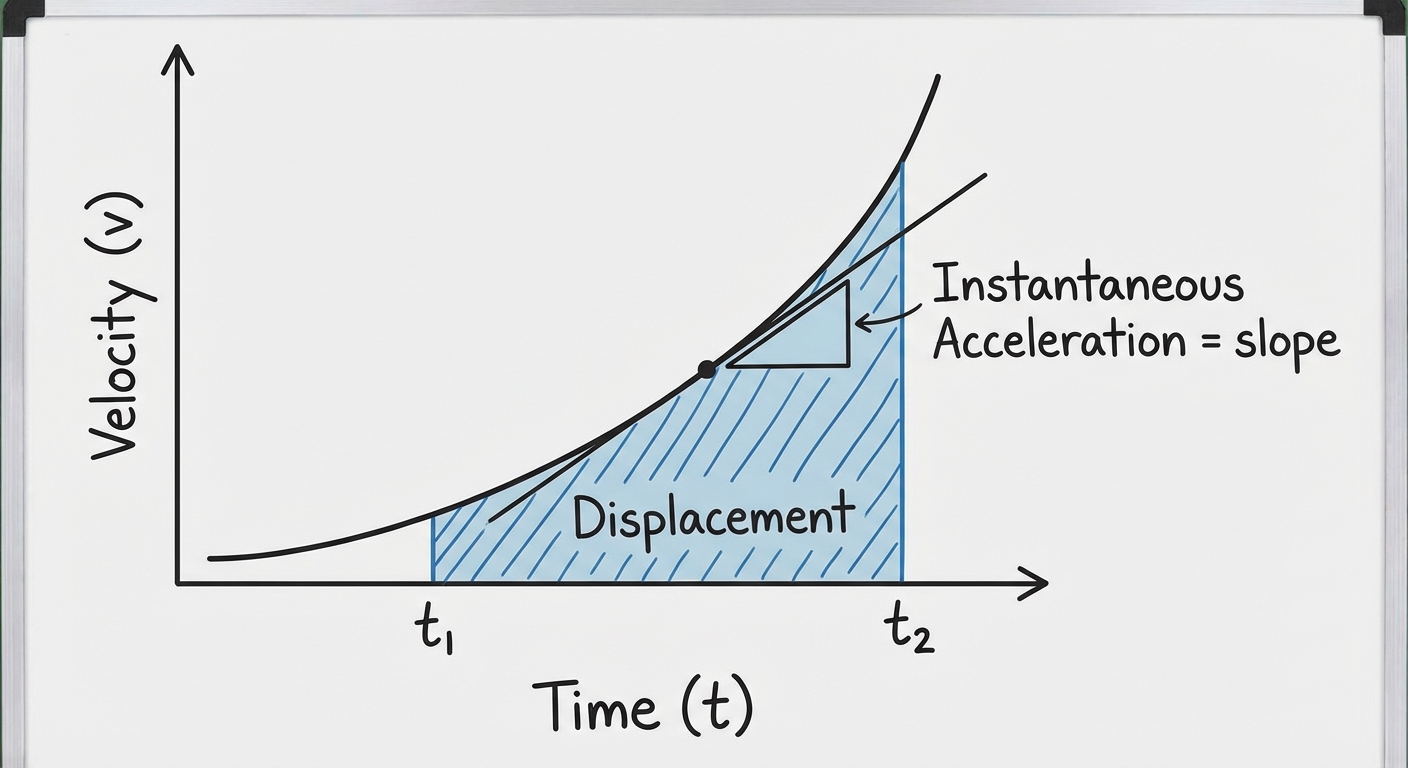
Note: The area under the Velocity vs. Time graph represents the change in position (displacement).
Worked Example: Non-Constant Acceleration
An object moves with acceleration given by $a(t) = 6t \; m/s^2$. At $t=0$, the object is at rest at the origin.
Find the velocity function $v(t)$.
Apply initial condition: at $t=0, v=0$. Therefore $C1 = 0$.Find the position function $x(t)$.
Apply initial condition: at $t=0, x=0$. Therefore $C2 = 0$.
Graphical Analysis Summary
Understanding the relationship between graphs is crucial.
| Graph Type | Slope Represents | Area Under Curve Represents |
|---|---|---|
| Position vs. Time ($x-t$) | Velocity ($v$) | N/A (physically meaningless) |
| Velocity vs. Time ($v-t$) | Acceleration ($a$) | Displacement () |
| Acceleration vs. Time ($a-t$) | Jerk (change in accel) | Change in velocity () |
Common Mistakes & Pitfalls
- Using Kinematic Equations when : This is the most common error. If $a$ depends on time ($t$) or position ($x$), you MUST use calculus (integration), not the algebraic equations.
- Confusing Displacement with Distance: If an object moves forward and then backward to its starting point, displacement is 0, but distance is positive. is distance, while is displacement.
- Forgetting the $+C$: When performing indefinite integration, always add the constant of integration ($C$) and solve for it using the Initial Conditions given in the problem statement.
- Sign Errors in Free Fall: Define your coordinate system immediately. If Up is positive, then $g$ is negative. If Down is positive, $g$ is positive. Be consistent.