Key Cognitive Assumptions
How does the Cognitive Approach help explain our behaviour?
Cognitive psychology revolves around the notion that if we want to know what makes people tick then we need to understand the internal processes in their mind
Cognition literally means “processing”. In other words, Cognitive psychology refers to they study of human mental processes and their role in thinking, perceiving, and behaving.
The cognitive approach views humans as processors of information
Cognitive Assumption 1: Behaviour is a product of information processing
Cognitive psychology focuses on the way humans process information, looking at how we treat information that comes into the person.
Your mind takes in information from your senses (input), then it processes the information and stores it in the memory, which then affects how you behave (output)
Input Storage Output
Cognitive psychologists’ study internal processes including perception, attention, language, memory and thinking, which are areas of behaviour that the behaviourist approach ignores.
Cognitive Assumption 2: The brain can be compared to a computer
Computer are also information processors; psychologists often compare the mind with a computer as the process in the same.
Information goes into the system in the form of data from the keyboard (input), it is changed and stored (processed), and then it is used to respond to the environment, like printing a document (output).
The brain is a humans central processing unit (hardware) and it codes information to change it from one format to another (software).
This approach to understanding the mind and behaviour to develop Artificial intelligence.
Key Concept 1: Characteristics of three memory stores
There are many different types of memory, and you need to know about the encoding, capacity and duration (these are memory characteristics) of each of these types
Sensory Memory
Long Term Memory
Short Term Memory
The Multi-Store Model (Atkinson & Shiffrin 1972)
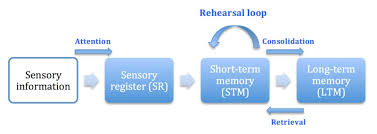
Sensory Memory
Sensory memory is the first part of the memory system where all stimuli from the environment pass into it
Sensory memory has 5 stores, one for each of our 5 senses
Duration - Very short in visual information, short in auditory information
Capacity - Very high
Encoding - depends on the sense the information was received from (Iconic = Visual, Echoic = Sound/audible)
Short Term Memory (STM)
Short term memory (STM) is a temporary second part of the memory system where information may be stored if you pay attention to it
Duration - information can stay in our STM for 15-30s but can stay for longer and transfer to our LTM if rehearsed
Capacity - Limited capacity before forgetting occurs, usually between 5-9 items
Encoding - Mainly acoustic, any mistakes in recall from hearing a list of words are usually acoustic
Long Term Memory (LTM)
Long Term Memory is the permanent third part of the memory system where information may be stored if you have rehearsed it completely.
Duration - Information can potentially stay in out LTM for a lifetime (Unlimited)
Capacity - Practically unlimited, even if information appears to be forgotten, it can be recalled with the right cues
Encoding - Mainly semantic, any mistakes in recall from a list of words involves substituting a word means the same thing
Evaluation of Key Concept 1
Point - One strength of knowing about memory stores is that it offers practical applications
Explanation - The limited capacity of STM can be improved through techniques, like ‘Chunking’
Conclusion - This shows how understanding the characteristics of memory stores can help to improve memory
Point - There is evidence to support the characteristics of the memory stores
Explanation - SM Sperling, STM Peterson & Peterson, LTM Bahrick
Conclusion - Therefore, SM, STM, and LTM are different because they have different characteristics
Point - There is a lot of research involves tasks not typical in everyday memory
Explanation - Trigrams (Peterson & Peterson), we form memories related to useful things
Conclusion - Different memory characteristics may not be so clear