Acids and Bases CN
Properties of Acids and Bases
Acids:
aq. solutions → sour taste
change color of acid-base indicators (litmus paper)
blue paper → red in acid
red paper → blue base
some react with active metals and release H2 gas
Ba (s) + H2SO4(aq) → BaSO3(s) + H2(g)
acid + base → salt (ionic compound) + H2O
conduct electric currents (electrolytes)
strong: lots of ions; weak: not many ions
Acid Nomenclature
binary acid: contains only 2 diff. elements
hydrogen and one of more electronegative elements
HF, HCl, HBr, HI
begins with hydro-
root of name of 2nd elements follows this prefix
ends with -ic
H2S
ocyacid: compound of hydrogen, oxygen, and third element (usually nonmetal)
names of anions based on names of acids
Bases
aq solution taste bitter
change color of acid-base indicators
diluted feels slippery
acid + base → salt (ionic compound) + H2O
conduct current
Acid-Base Theories
Arrhenius Acids and Bases
arrhenius acid: chem compound that inc. concentration of Hydrogen Ions, H+, in aq sol.
ionizable hydrogen atoms (water sol. known as aqueous acids)
when 2 or more hydrogen per oxygen is strong
weak acids hold their H ions
strong acid ionizes completely (almost) in aq sol. → good electrolytes (separate ions, lots) (Cl, Br, I with H dissociates the most)
weak acid releases few hydrogen ions in sq sol.
hydronium ions, anions, dissolved acid, HCN, (anything with —COOH)
arrhenius base: substance that inc. concentration of Hydroxide Ions, OH-, in aq sol.
most are ionic compounds w/ metal cations and hydroxide anion, OH-
dissociate in H2O (example) NaOH (s) + H2O → Na (aq) + OH- (aq)
Ammonia NH3 is molecular → produces hydroxide ions when reacts w/ H2O molecules (example) NH3 (aq) + H2O (I) → NH4 (aq) + OH- (aq)
strong bases: (all group 1, heavy group 2 from Calcium) very soluble (strong electrolytes)
weak bases: doesn’t grab every water molecule, only few do
Bronsted and Lowry acid and base
acid: proton donor
HCl + NH3 → NH4 + Cl (HCl as Bronsted Lowry acid)
base: proton acceptor
HCl + NH3 → NH4 + Cl (NH3 as Bronsted Lowry base)
OH- ion produced in solution by arrhenius hydroxide bases (NaOH) is the Bronsted-Lowry base
acid transfer protons to bases
what becomes of base after it does is job → becomes conjugate acid
what becomes of acid after it does its job → becomes conjugate base
Monoprotic and Polyprotic Acids and Bases
Monoprotic Acid: can donate only one proton (hydrogen ion) per molecule
HClO, HCl, HNO3
only one ionization step

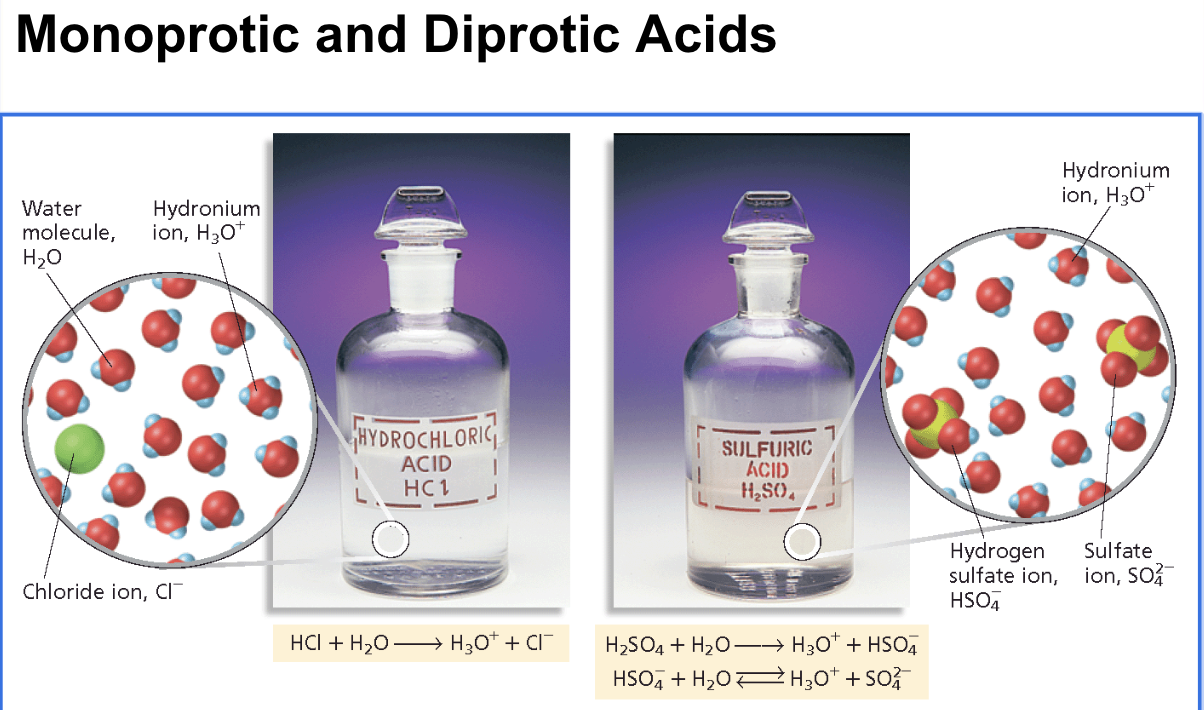
Polyprotic Acid: donates more than one proton per molecule
multiple ionization steps

Diprotic Acid: donate two protons per molecule
H2SO4
Triprotic Acid: donate three protons per molecule
H3PO4
Acid-Base Reactions
Conjugate Acid and Bases
conjugate base: Bronsted lowry acid that has given up a proton
conjugate acid: bronsted lowry base that has gained a proton

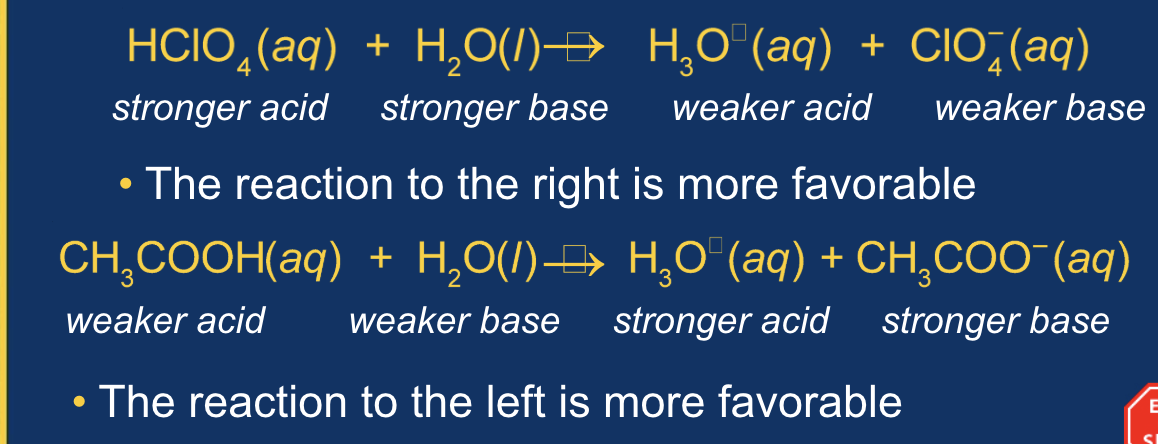
Stronger an acid is → weaker conjugate base
stronger a base is → weaker conjugate acid
Proton transfer goes in direction of stonger base
which base is better at grabbing protons?
strong acid favors right
weak acid favors left
Amphoteric Compounds
any species can act as either an acid or base
ex. Water can be either base or acid
Neutralization Reactions
neutralization: H+ reacts w/ OH- to form water molecules
salt: ionic compound made of cation from base and anion from acid

H+ + -OH → H2O
Acid rain
NO, NO2, CO2, SO2, SO3 (g) from industrial processes can dissolve in atmospheric H2O → acidic solutions
very acidic rain is known as acid rain
erode many things & can affect ecosystems