AP United States History Unit 1 (Heimler Video Notes)
Time Period One: 1491-1607
skipping topic one…
Topic Two: Native American Societies BEFORE 1492
Aztecs
Housed the magnificent city of Tenochtitlan
At its height, it was home to 300,000 people
They had
A written language
Complex irrigation systems
Priests who held a cult of fertility
Both for the land AND for the people
This fertility was only upheld through human sacrifice
Maya
Established themselves on the Yucatan Peninsula
Developed large cities
Made use of Complex Irrigation and Water Storage systems
Built giant stone temples and palaces
For rulers whom they believed were descended from the gods
Inca
Established their civilization in the Andes Mountains
In what is today Peru
At its height, the Inca Empire ruled 16 million people and covered about 350,000 square miles
Maize
Very nutritious crop
As it spread north into the present-day American Southwest, maize supported
Economic development
Settlement of Peoples
Advanced irrigation
Social Diversification among societies
Pueblo
Lived in present-day New Mexico and Arizona
Sedetary population
Farmers of Maize and other crops
Built adobe and masonry homes
both in the open AND right into the sides of cliffs
Highly organized society. They had
Offices
Religious Centers
Craft Shops
Etc.
Up North, within the Plains and Great Basin regions, nomadic people resided; in contrast to the sedentary people of the south.
These regions were populated with hunter-gatherer people who needed a LOT of land to perform said hunting and gathering.
(due to the aridity of the region)
A good example of these people was the…
Ute
Lived out this lifestyle in small egalitarian(relating to or believing in the principle that all people are equal and deserve equal rights and opportunities), kinship-based bands
Within the Pacific Northwest, people lived by the sea. They settled in fishing villages and relied on the abundance of elk found within the region. A good example of these people was the…
Chinook
Made use of the great cedar trees in the region to construct giant plank houses
Could house up to 70 members of the same kinship band
Chumash
Further down in present-day California
Still hunter-gatherers, BUT they lived in permanent settlements
These were constructed in places where there was enough game and vegetation to support them
Around the Mississippi River, much larger and complex societies were present. This was mainly due to the fertile soil surrounding the rivers. The fertile soil allowed societies to stay, farm, and develop themselves. Two examples are:
Hopewell
Lived in towns of about four thousand to six thousand people, and they traded extensively with other regions as far away as Florida and the Rocky Mountains
Cahokia
Largest settlement in the region
At its height, the settlement counted between 10-30,000 people.
Government was led by powerful Chieftains who
centralized the government
engaged in extensive trade networks from the Great Lakes all the way down to the Gulf of Mexico
Within the Northeast of America, the Iroquois resided.
Iroquios
Lived in villages that made up several hundred people
They grew crops such as
Maize
Squash
Beans
Similar to their Northwestern counterparts, they built and lived in settlements called Longhouses
Between 30-50 of their family members could fit
___________________________________________________________________________
Topic Three: European Exploration in the Americas
EUROPE STABILIZES! But first, if we look within the context of the time period (think back to AP World), Europe was seen as a laughing stock across the world PRIOR to Westward expansion into the New World. The Islamic Caliphates and China were the powerhouses of the world; they controlled trade, had the strongest armies, strong agricultural practices, and centralized governments. Europe was mostly fragmented without any of these advantages of state.
Europe’s population had TANKED on account from
The Black Plague
Hard agricultural times as a result of a period of global cooling known as the Little Ice Age
Europe Stabilizes
The Climate Warmed
which led to..
Improved Agricultural Productivity
Aided by new Agricultural techniques and technology
More food = More babies
Desire for Asian Luxury Goods
Porcelain and Silk
The Renaissance
Europe was experiencing a cultural rebirth
Political Unification
This strengthened the governments of various European states
This highlights how Europeans COULD explore. But why did they explore?
GOLD, GOD, and GLORY!!!!!
Cause One: Gold (Economic Motives)
Demand for Eastern Luxury Goods
At this point in history, the main trade routes were land-based (Silk Roads). In 1453, the Ottoman Empire took control of Constantinople which was a major chokepoint of European access into the Silk Roads. Since Ottomans now controlled their means of trade, Europe wanted to find another way to trade with Asia…..
Improved Banking Systems
Helped facilitate trade
Portugal was first
Established trading posts all around the African coast and throughout Indian Ocean
Instead of colonies, they built a trading post empire
They became very wealthy from this
Spain wanted a piece of the pie until…..Christopher Columbus showed up
He believed that the Earth was a sphere and thought that if he sailed Westward, he would be able to reach Asia and cut out the hassle of the Indian Ocean Trade
Spain decided to fund his expedition
Cause Two: God (Religious Motives)
Dominant Belief System: Christianity
Specifically, Roman Catholic Christianity
Played a significant role in creating a European common culture
Simony
Buying and selling of important church positions
Sale of Indulgences
The exchange of money for the forgiveness of sins
This led to Martin Luther being fed up with the Catholic Church and publishing the 95 Theses. This sparked the beginning of the Protestant Reformation.
Catholic Christianity vs. Protestant Christianity
No separation of church and state
Led to political feuds and power struggles
Spain’s Kingdoms Combine
Marriage of Isabella of Castile and Ferdinand II of Aragon
Led the Spanish Inquisition
Eliminated religious dissent in Spain
Expelled 200k Jews from Spain
Spain believed that expansion toward Asia would help fuel and reinforce Catholic dominance
Cause Three: Glory (Political Motives)
Competition for Colonial Possessions
Wanted to shift the balance of power in their favor
Political change was occurring in some European states in which large, multi-ethnic empires were breaking apart while small kingdoms were uniting and becoming more powerful, e.g.) Isabella and Ferdinand in Spain
New Political Reality: The Nation-State
A political entity that governs a single, unified people
Promotes fierce competition to become the most powerful
Spain vs. Portugal
Because they were both Catholic states, the Pope settled their dispute
Drew a line of demarcation to settle New World territory questions
___________________________________________________________________________
Topic Four: Columbian Exchange & Spanish Conquest
Increased Trade: Causes
Improvements in Maritime Technology
Caravel: fast and highly navigable ship
Lateen Sail: Took wind from both sides, not just behind
Magnetic Compass: Gave an accurate sense of direction
Astrolabe: Gave accurate reckoning of lines of latitude
Joint-Stock Companies
Limited liability businesses
Charted by the state and funded by investors
States had limited funds to invest in such risky ventures
Money came from a pool of investors that shared risk
Relied on the state for safety and monopolies
Increased Trade: Effects
THE COLUMBIAN EXCHANGE!
The Columbian Exchange refers to the transfer of diseases, plants, animals, minerals, and people between the Old and New Worlds.
The Columbian Exchange
Diseases
Transferred germs that people in the Old World had already adapted to into the New World, which killed lots and lots of natives who were already adapted.
Spanish introduced Smallpox
Spread through Mexico and Central America
Killed half of the indigenous population
Spanish introduced Measles
In some cases was as deadly as smallpox
Food & Plants
Had major effects on both the Old and New Worlds
Europeans: wheat, olives, grapes
Eventually introduced African and Asian foods: rice, bananas, sugar
Indigenous Peoples: maize, potatoes, manoic
Enslaved Africans also brought new foods like okra
The introduction of new foods created the occasion for a more varied diet, which meant healthier populations.
This led to Europe’s post-1700 population explosion
Animals
Horses had the most significant impact to the Americas
Those who adopted horses had an advantage over those who did not
Pigs, Sheep, Cattle
They had no natural predators, and multiplied quickly
Minerals
Silver & Gold
ex: Conquistadors conquered the Inca and Aztecs for their large quantities of Gold
Caused the Price Revolution
Prices for European goods rose steadily for 150 years
Caused a shift from Feudalism to Capitalism
Feudalism: A social and economic system that created a closed system focused on land ownership
Capitalism: A social and economic system that created a more open system focused on manufacturing and trade
___________________________________________________________________________
Topic Five: Spanish Empire in the Americas
Spanish Empire
King Ferdinand and Queen Isabella Issued the Requerimiento
Legal document claiming that Spain possessed biblical authority to rule in the Americas
Threatened violence against indigenous groups that defied the order
Read in Spanish
An example of the Spanish attempting to justify their right to conquer and pillage
Cortes’ Two Advantages
Ex.) Smallpox
Made them vulnerable to attack
Allied with indigenous groups under Aztec rule
Fought alongside the Spanish to secure their own liberation
Encomienda System: A system of coerced labor in which the Spanish crown granted tracts of land to Spanish encomenderos who forced the indigenous people within its borders into mining and plantation-based agriculture
Labor Systems
Encomienda Systen
Encomenderos required indigenous people to work for them
In turn, the Encomenderos had to provide protection and Christianization
Encomienda = Slavery
Two Sources of Wealth
Mining for gold and silver
Export of cash crops
Sugar cone, tobacco, and cotton
Indigenous Labor Breaks Down
Enslaved workers knew the land much better than the Spanish
Allowed for frequent escapes
Enslaved workers died from Spanish diseases
Importation of Enslaved Africans
Worked the mines and plantations
Spanish merchants partnered with West African groups
Traded goods like guns for enslaved laborers
Africans less likely to escape
Africans had been in contact with European diseases
Had better immunity
Spanish Caste
No Traditional Spanish Nobility in the New World
Spanish conquistadors imposed a new social hierarchy on the people of the New World
Casta System
Organized colonial society into a ranked social hierarchy
Based on race and heredity
More “white” blood = more social power
Less “white” blood = less social power
Top: Spanish
Bottom: Indigenous Americans and Africans
Caste System Erased Cultural Complexity
An ordered society by the standards of a small minority
Category dictated education, occupation, tax payments, etc.
Altered the spatial makeup of towns and villages
By these means, the Spanish consolidated control over the Americas.
___________________________________________________________________________
Topic Six: How Europeans, Native Americans, and Africans Shaped Each Other
As contact between Europeans and the various indigenous peoples of the Americas increased, they asserted divergent worldviews.
Worldview: A people’s constellation of cultural experiences- their history, belief system, language, etc.- that dictates how that people make sense out of the world’s people and events
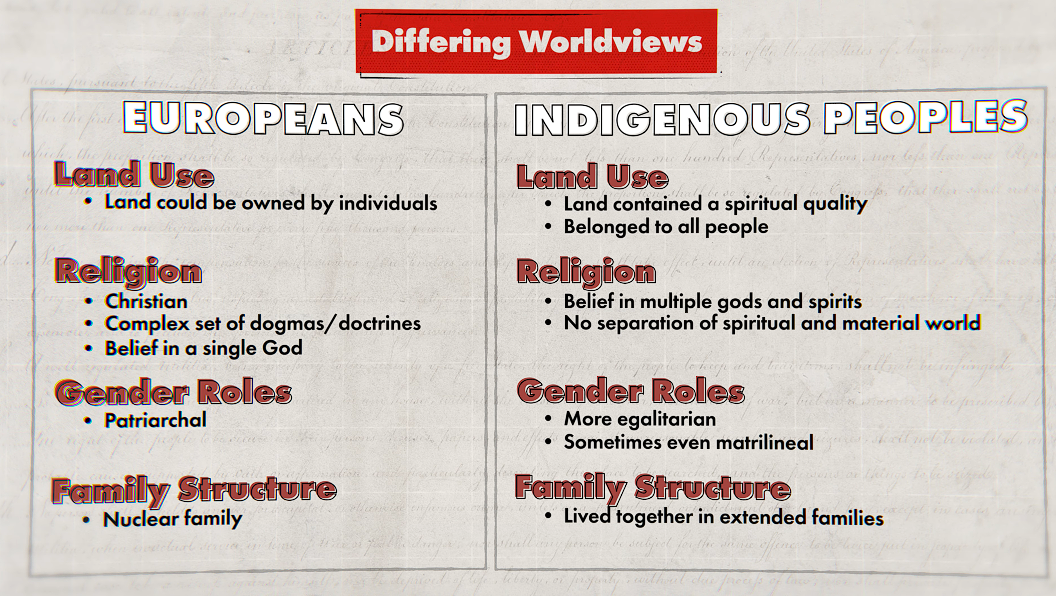
In some cases, Europeans and Native Americans adopted some useful aspects of easch other's culture
Cultural Adoption
Indigenous Peoples Converted to Christianity
Largely due to the Spanish effort to establish Christian missions in southwest North America
Polytheists
Saw no conflict in adding the Christian God to worship with their other gods
Indigenous People Adapted Christianity
Syncretism: adapting to own worldview
Out of this encounter with Christianity and indigenous belief systems, a blending occurred in which the indigenous people developed a form of Christianity that reflected their own worldview
Europeans Adopted Aspects of Indigenous Culture
English settlers learned local agricultural techniques
French settlers intermarried with indigenous women to benefit fur trade relations
Resistance
Diplomacy
Native Americans defended themselves from Europeans by allying with them against other native groups
Violence Through Military Resistance
Taino Rebellion
Native people of modern-day Puerto Rico rebelled against the Spanish
Superior weapons of the Spanish allowed them to suppress the rebellion
Racial Debates (Valladolid Debates)
Bartolome de las Casas
Was previously a conquistador in the Americas
Argued that indigenous people were fully human
Should not be subjected to the inhumane encomienda system
Still had a paternalistic view of indigenous peoples
Juan Gines de Sepulveda
Argued that indigenous peoples were less than human
Subjugation and brutality helped transform them into full humanity
Curse of Ham
From the book of Genesis in the Bible
Justified the condemnation and mistreatment of Africans (through twisted logic)
END OF UNIT ONE WOOHOOO!!!!