Lecture 3: Earth's Interior
Differentiation of the early earth
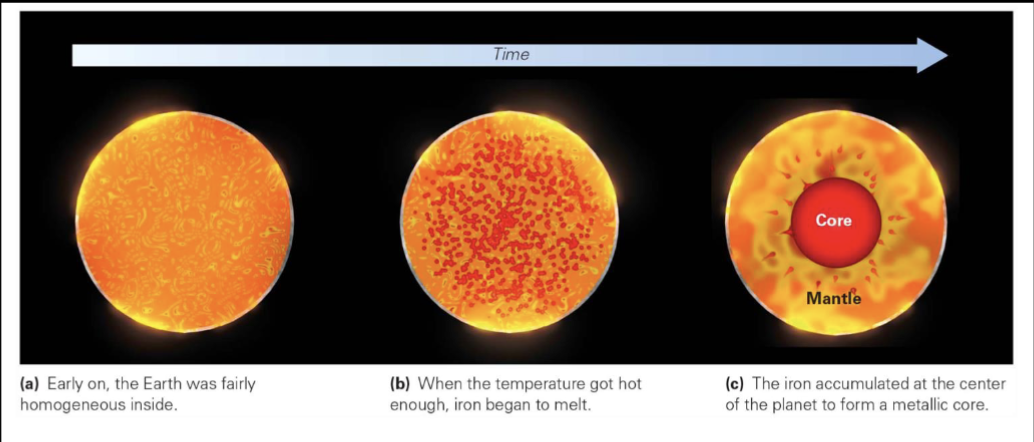

earth’s interior
Humans have never physically sampled the deep interior of the earth
we can estimate the overall density of the earth based on its volume and gravitational pull
The overall density of the Earth is greater than the density of rocks at the surface – so there must be denser material in the middle
we can also infer where boundaries between layers are using earthquake waves
meteorites and magma can also give us and idea of the earths overall composition
Earthquakes generate seismic waves
primary waves (p-waves)
longitudinal waves
parallel to direction of travel
travel through solids and liquids
secondary waves (s-waves)
transverse waves
perpendicular to direction of travel
travel through solids but not liquids

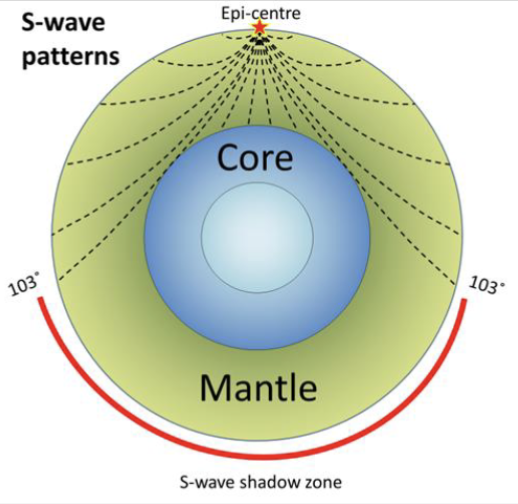
Seismic waves reveal the deep earth (s-waves)
seismic waves are energy moving through the earth
these two waves cause materials to oscillate in different directions
when there is an earthquake the s-waves (transverse) are not observed on the far side of the earth
s-wave shadow zone
Seismic waves reveal the deep earth (p-waves)
when there is an earthquake, the p-waves (longitudinal) are observed on the far side of the earth, but not everywhere
p-wave shadow zone
waves refracted (bend) at solid/liquid boundaries

these seismic waves give us other clues about the structure and density of the inner earth
generally, seismic waves travel faster through denser materials
we can think about earth’s interior in two ways:
Composition
mechanical properties
pressure and temp increases as we approach the center
The core
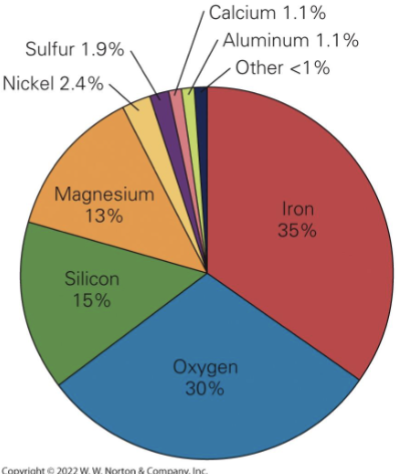
mostly iron and nickle
the outer core is liquid due to the higher temperatures
the inner core is solid despite being hotter than the outer core, due to pressure from the surrounding layers
convective flow of the outer core generates a magnetic field
Mohorovic Discontinuity (Moho)
it was observed in 1909 that seismic waves travelled faster once they got below 5 to 70 km depending on where you are on earth
this seismic boundary represents the boundary between the earth’s crust and its mantle

Crust-mantle boundary
average: 5-7 km below the seafloor
remember deep ocean is 3-4 km below water surface
Average 35-40 km below the continents
even deeper under mountian belts
this means the thickness of oceanic crust differs from that of continental crust
density of oceanic vs continental crust
Oceanic Crust: 3.0 g/cm3
• Mostly basalt
• Mafic minerals
• Rich in Fe and Mg
Continental Crust: 2.7 g/cm3
• Lots of different types of rocks
• More Felsic minerals
• Rich in Al, K, and Na
The crust
the very thin outside layer of the earth - where life exists
earth’s diameter: 6,731 km
crust: 5-70 km thick
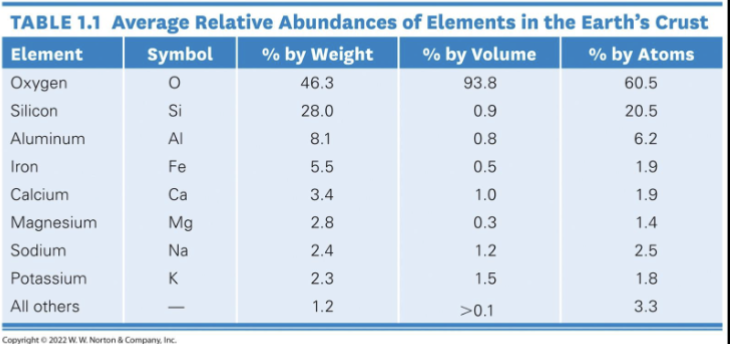
major elements are oxygen, silicon, aluminum
The mantle
denser than the crust, less dense than the mantle
the mantle is mostly made of the mineral peridotite and is solid rock
lower mantle is plastic and can flow (slowly)

The Lithosphere and Asthenosphere
the crust and upper mantle collectively form the Lithosphere, the rigid outer portion of earth (it’s brittle)
below the Lithosphere is the Asthenosphere the portion of the mantle that while viscous, can flow and deform (it’s ductile)
Archimedes
any object that floats displaces its own weight of fluid
Temperature in earth’s interior
3 sources of heat
originally accretion
planetary differentiation
radioactive decay