Consciousness
Seminars
1: Synesthesia
2: Rubber hand illusion
3: EEG demo
4: Robot lab
5: Mindfulness
1: Introduction
Chapter 1, 2, 3, 5
Chapters
Materialism vs. Dualism
How do you know that others see colors the same as you? You can describe sensations, but it’s never the same as feeling them- that’s consciousness (your experience)
When you hold a pencil, there’s 2 things- your experience of it (visual, sensation, smell) and it’s physical existence
Monist theories
Dualist theories: Colloquially adopted “jumped out of my skin”- ‘my skin’ means it BELONGS to you but isn’t you. Descartes’ Cartesian dualism
The mental self isn’t material like the body
Substance dualism (the mind is a non-physical substance that interacts with the physical body, they exist independently tho- Descartes)
vs.
Property dualism (physical and mental don’t have separate substances, but they have diff properties- mental states aren’t just physical ones, but they are dependent on them (caused by hormone changes, etc.))
Dual aspect theory: The mind and body are split (but not necessarily made of diff materials, so it’s lwk monism)
Neutral monism: A material that is neither mental, nor physical
Descartes proposed that mind-body interact in pineal gland, but do the brain cells have thought-like parts to convey them? What exactly is interacting?
Now we think substance dualism is silly
Wittgenstein’s ‘ordinary-language philosophy’: philosophies like substance dualism arise from ppl saying things like “in my mind” as if it’s a separate location w a phantom operator
Ryle wanted a middle ground between dualism and behaviorism
Dogma of the ghost and the machine (idea that we’re a spirit driving a body)
Modernly, we say that the mind is what the brain does (so they’re not separate, and the mind doesn’t have any material)
Andy Clark said that was reductive, and added that the mind was also what the brain creates, and the cognitive influence over the whooooole body
Alva Noe said consciousness doesn’t happen in us, but is what we do.
Materialism: Everything that exists is physical or material. Mental states (thoughts, feelings, consciousness) are fully reducible to physical processes in the brain.
Karl Popper and John Eccles’ dualist interactionism: brain synaptic firing (mechanical) can easily be influenced by non-physical thinking and feeling
Benjamin Libet’s conscious mental field: a force field that emerges during brain activity that allows non-neural communication within cerebral area- uniting subjective and free will (bro’s spitballing)
Chalmers’ naturalistic dualism: dualism ‘but it just works w science no flaws, I won’t explain’
Denett’s Cartesian materialism: Pretending to be a materialist but relying on dualism
Materialism includes identity theory (mental states = brain neurological state) and functionalism/ there is no mind, just matter.
they do kinda believe that mind exists but it doesn’t do anything itself- anything mind is BECAUSE OF PHYSICAL BRAIN CHANGE
Epiphenomenalism: Mental states are byproducts of physical brain processes but do not have causal power over physical events.
Consciousness and stuff could exist, but they’re have no causal influence
However, we can talk about consciousness, so it’s clearly affected us
William James proposed that everything ever is made of the same material (opp neutral monism ig)
Panpsychism: All material things have awareness (even clouds and rivers)
Experience would be an physics element like matter and energy (since anything can have it)
James- psych isn’t entirely soul stuff cos being drunk or tired can fw thinking, so physiology is involv.
Helmholtz w the activity speed
Phenomenology: philosophy + psychology- see immediate subjective experience
Conscious experiences are always about sth
Pure consciousness- you can simply be conscious wo it being about sth
Wundt, Titchener, and introspection
Sensory elements (heat, light) and affective elements (simple feelings, pleasure, etc.)
Radical empiricism (James): Experience NEEDS to be considered for any philosophical inquiry, not just ‘physical data’- anti behaviorism wave
Led to spiritual psychology research
Gut wall has 500mill neurons that communicate w spinal cord, it also ‘thinks’, not just brain
Cognitivism: Cognition + intentionality 4eva (not cog + consciousness)
There’s a chasm between inner and outer world
Automaton theory
Easy problems of consciousness: Sleep, attention, behavioral control
Hard problem of consciousness: The experience of being an organism and feeling
Freud’s unconscious theory
→ Cognitive unconscious (capable of subliminal perception and unaware thinking, learning…)
We can never know what it’s like to acc be a bat even if we get turned into one cos we’d have our consciousness and be able to think “oh so this is what it’s like” which isn’t the authentic batxperience
P-consciousness: ‘Phenomenal consciousness is experience; what makes a state phenomenally conscious is that there is something “it is like” to be in that state’.
A-consciousness: ‘availability for use in reasoning’
is the ability to say something about our experience inherent to conscious experience, or is the conscious experience one thing, and the ability to access it another? - subliminal
Overflow: conscious experience overflows (when communicating what we saw and felt, we feel that we are only scratching the surface)
Qualia: The qualities of an experience are private to you
Problem w consciousness is essentially how qualia relates to physical world
substance dualist believes qualia (e.g. the smell of coffee) are part of a separate mental world from physical objects
epiphenomenalist believes qualia exist but have no causal properties
idealist believes that everything is ultimately qualia
eliminative materialist denies that qualia exist
You can grow to like the taste of beer (always ass at first)- the taste itself doesn’t change, but your opinion does, which then affects your qualia.
Dennett acknowledges the conscience, but denies qualia’s “super private, personal interpretation”
Intuition pump: Thought experiment that draws intuition to surface
Mary the color scientist- knowing the mechanics of color perception, how it interacts w eyes, optic system etccccc doesn’t mean she knows what red looks like, it’ll still be new to acc see it
Facts are insufficient, qualia needed (∴ materialism ❌)
Is it acc a new fact to her or is it just a reinterpretation of what she knew?
Philosopher’s zombie: Creature that looks and talks just like you, but is dark inside. If thinking and making decisions is = consciousness, then the zombies can’t exist. If they can, then consciousness must be a hoax (consciousnesses in-essentialism).
If you believe in the possibility of zombies, then you believe that consciousness is distinct from the physical body and is an inessential optional extra to behaviour (this is epiphenomenalism or conscious inessentialism). We might do everything we do either with or without it and there would be no obvious difference. It is therefore a mystery why we have consciousness at all. On the other hand, if you believe that zombies
are not possible, you might be a dualist who believes we need a soul or non-physical
mind as well as a body.
Responses to the hard problem
Insoluble- we will never solve it
Soluble, just needs reformulating first
Easy problem- break the problem down into researchable bits
More hard problems
Hard existence problem: Why and how do we have phenomenal consciousness
Hard character problem: Why does particular brain activity feel like this and not that
There is no hard problem!! We can solve the easy problems, and that’ll prob answer the hard
The real problem is a meta-problem: We deny materialism cos we think of pain and nociceptive-specific neuronal activity differently, and thus seek a ‘mind’ explanation
‘strong illusionism’—‘the thesis that nobody is phenomenally conscious, and that our
beliefs that we are conscious involves some sort of illusion’
‘weak illusionism’: ‘the thesis that although we are conscious, we are wrong about some of its features and our beliefs about these features
Illusionists would say that while our experiences exist, consciousness (as often imagined) doesn’t
Vision is often subjected to illusions (despite being our main sense)- telling of consciousness?
Papers
Lecture
Reality vs perception (which direction are you looking at the cube from? Illusions)
“which direction is __ turning”
we interpret and correct based on contextual clues (this block must be darker cos its in the shadow- but remove bg and they’re identical)
Blind spots: filling-in gaps
Visual hallucinations
Scotoma: parts of retina that don’t get visual info anymore
Language- boba and kiki
2: Unity and damage
Chapter 4, Chapter 6, Chapter 8
F. Jackson- Knowing everything chemical and scientific about seeing a color but still not knowing what it looks like
William James on attention- “implies withdrawal from some things in order to deal effectively w others”
Selection to pay attention
In an inattention blindness trial (“in the +, which line is longer?” while adding random little dots and shapes occasionally- how much do they notice?)
Location> color > number > shape
“FLA” finish the word = FLAME. But when they’re flashed word FLAKE but claim not to have seen it, they say FLAKE- subconsciously processed!
Change Blindness: not detecting large changes if they’re not in area of focus
Mack and Rock- without attention, no conscious perception
Wolfe: Inattentional amnesia (we see it but immediately forget it)
O’regan: “it was all an illusion”?
Color phi phenomenon
Flash lag illusion- “did this fast moving line and slow line flicker at the same time?” we lag
Stopped clock illusion- a viewed clock seems to pause
is there a continuous stream of vision if time seems to stop?
Cocktail party effect- you can hear your name in random loud ahh convos somehow (not a continuous stream)
Sensational theater- everything we perceive is constantly revised, so there’s multiple drafts at diff stages
Libet’s Expeirments- sibjects decided to make a movement 200ms before acc movement- HOWEVER EEG charged 500ms before movement- so brain began preparing for movement 300ms before you acc thought of it
we then assume “oh ya my intention tot called the action”- illusion of free will
Bilateral brain split- blindsight when geniculo-striate pathway to V1 is removed, but superior colliculus pathway is intact (so you can’t see, but you can still sense your way around)
Neglect- Albert Task or Line Bisection ("split long line in half” but they can’t see the whole line so the half is fucked)
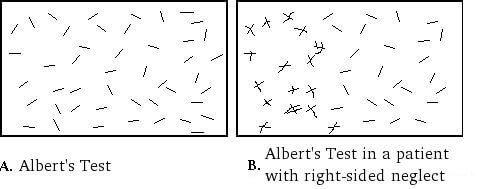
When shown drawings of 2 identical houses (but 1 has fire on their neglected side), they say they’d prefer living in the non-fire one “idk why”. They can’t see the fire but unconsciously sense??
Visual agnosia-
Augmented reality w sound for blind
V1 is the primary distributor of visual info and feedback
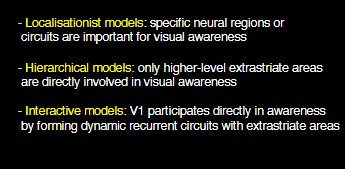
V1 lesion = cortical blindness
Phosphenes (stars when you press your eyes) when your motion sensitive brain area is stimulated, which can then be blocked by stimulated V1 ∴ V1 also does sth w phosphenes.
V1 is the goat, esp. in the interactive model (which is superior)
Easy problem- explaining cognitive functions
Hard problem: how do sensations arise from brain processes, and how do you generally explain the human experience scientifically
There is an explanatory gap between understanding brain, and conscious experience.
3: The self
Chapter 9; Chapter 16
4: Evolution
Chapter 10, Chapter 11
5: Sleep and dreams
Chapter 15
6: Artificial consciousness
chapter 12 (voluntary reading)
7: First-Person approaches
Chapter 7, Chapter 17, Chapter 18