1.1-1.2 Scarcity, choice and potential conflicts
==The problem with scarcity== is that there are ==unlimited want and needs but limited resources== in relation to these human wants and needs. One of the causes of this is because resources are not shared or distributed evenly throughout societies and countries.
- The result of scarce resources is that choices need to be made
- Which then leads to an opportunity cost
The importance of opportunity costs to consumers, producers and government
- E.g., producers – may have to choose between hiring new employees and investing in new machinery.
- E.g. government – may have to choose between spending more money on the NHS than on education – both cannot be done due to finite resources so choice shave to be made for where resources can be best spent
<<Scarcity question (4 marker)<<
- <<When talking about scarcity…<<
- <<<<<<: what is scarcity? – when there are unlimited wants and needs and resources are limited in relation to the human wants and needs<<
- <<<<<<: – Pick out 2 examples – look for what is scarce? And maybe the impact of this scarcity? – E.g. there are insufficient affordable houses to meet the demand + 255,000 people were recorded without a home at the last count – make sure your answer is contextualised o<<
- <<<< <<– develop your answer – consequence of the scarcity - as there are only enough resources to build a finite amount of housing, homelessness is on the increase.<<
]]Opportunity cost question (4 marker)]]
- ]] – identify the opportunity cost (if you cannot identify define – the cost of the next best alternative forgone) – loss of regular income from paid employment]]
- ]] – 2 examples of opportunity cost - Adam using his recently gained degree to seek employment (1) Elliot had trained to be a solicitor (1)]]
- ]] – consequence of the opportunity cost – When doing analysis, always start your sentence with consequently - Not having secure employment and a regular income (1)]]
%%Trade off:%%
- When choosing one thing can be achieved by giving up something in exchange, i.e., a compromise
- E.g., Trying to do homework and watch Tv at the same time but you may miss some important parts of the programme at the same time getting a lower grade in your homework
1.1.2 Different business objectives and reasons for them:
When answering a question on business objectives, you must be able to explain each one of the objectives using economic terms
\n ==Profit maximisation - (MC = MR)==
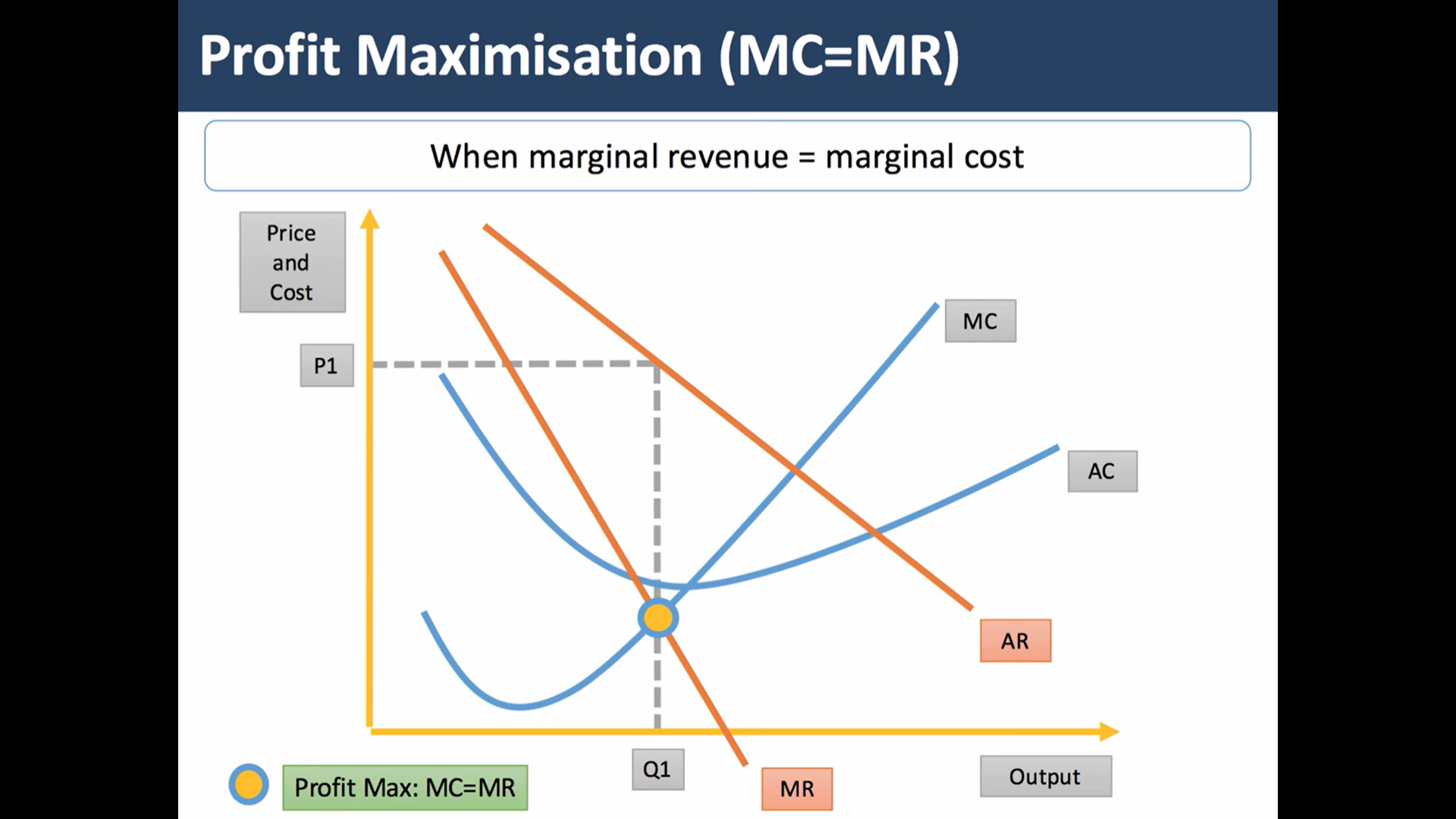
What is profit maximisation?
- When profits are maximised at an output when marginal revenue = marginal costs.
- Example of an industry where profit maximisation is the main objective:
- The airline industry
- In 2014, American airlines made a net profit of $2.9 billion as well as Emirates who made $1.5 billion in profit.
Advantages of Profit Maximisation
==Higher profits can lead to reinvestments==, in the form of new and upgraded capital, new technology and innovations
- An increase in capital investments spending can lead to an increase in productivity
- as new business equipment gives employees the right tools and equipment to work efficiently
- as it increases the performance of employees to perform their job well
- also, a decrease in manual and repetitive tasks and human error, which leads to less wastage and decrease in resources used
Allows for ==greater dividends== for shareholders
- the shareholders of the company want the for their investments or they
- if shares are sold, this could create for the company, → reduces the company’s profits and cash flow, which can impact the firms ability to pay dividends to remaining shareholders → dissatisfaction among shareholders
- which may of goods and services
- resulting in lower quality goods
- less product is sold
- therefore less revenue and profit is made
To be able to ==maintain the high level of product development of the product,== which ensures that the product is at its highest possible quality
- This in turn creates more profit for the company as their will be an , thereby encouraging the consumers to buy more products from the store
- Making the product at high quality may mean that the company can put the product at a as the product is niche and provides more value to the consumer e.g., it lasts longer
Disadvantages of Profit Maximisation
- Key Stakeholders may be harmed
- ==Other objective== more appropriate, e.g. sales maximisation
==Sales maximisation (Average Cost = Average Revenue)==
Summary
- Done by cutting prices and increasing sales
- }}Firms sell as much goods as possible without making a loss → Increase Market share in attempt to dominate the market → Build a good customer base → Earn more profit in the long run}}
- May come at the expense of lower profit
- Increases market share which increases profit in the long run
Advantages of Sales Maximisation
- ==Economies of Scale==
- Allows the business to reduce their costs
- Pass on low costs in the form of low prices
- Thereby allowing the business to improve their price competitiveness in the global markets
- This then leads to higher profits
- Generating a higher return of capital investments
- ==Deter other firms from entering the market==
- By cutting prices
- Firms are able to deter the profitable entry of new firms and thus maintain more market power in the long run
- (Chain of reasoning??)
%%Example:%%
- %%The UK grocery market is dominated by Tesco who owns more than 1/3 of all sales%%
{{Satisficing{{
a decision-making strategy used by firms where they accept to meet their needs and goals, rather than searching for the optimal solution
instead of
involve choosing a solution that meets certain criteria, such as a minimum level of quality, cost, or efficiency, instead of pursuing the absolute best solution
as the search process is stopped once a solution that meets the criteria is found
carries the risk of that does not fully meet the firm's needs
- result in reduced competitiveness, lower quality products or services, and reduced customer satisfaction.
%%Advantages of Satisficing%%
- ]]Increased efficiency]]
- Satisficing allows firms to make decisions quickly and move on to other tasks, which can increase overall efficiency.
- ]]Reduced costs]]
- By focusing on acceptable solutions rather than the optimal solution, firms can reduce the time and resources required to make decisions, leading to lower costs.
- ]]Improved decision making speed]]
- Satisficing can help firms make decisions more quickly, which can be important in fast-paced industries where speed is of the essence.
%%Disadvantages of Satisficing%%
- ]]Reduced quality of solutions]]
- Firms that adopt a satisficing approach may settle for subpar solutions, which can result in lower quality products or services, and reduced customer satisfaction.
- ]]Missed opportunities]]
- By settling for an acceptable solution, firms may miss the opportunity to find a better solution that would provide greater benefits and improve their competitiveness.
- ]]Potential for suboptimal decision making:]]
- Firms that rely on satisficing may not thoroughly consider all available options, which can result in suboptimal decisions that do not fully meet their needs.
[[Example of Return of Investment[[
- A firm in the ==technology industry== may use a satisficing approach . Instead of thoroughly researching and testing all possible solutions, and . This may result in the firm @@releasing a product that is "good enough"@@ but @@does not have all the features that consumers want@@, leading to @@reduced sales and customer satisfaction@@.
==Survival==
- Many businesses aim to survive as many go bankrupt within the first 18 months - they do this by just breaking even, selling assets to keep creditors at bay
- During periods of economic decline, such as the %%Financial Crisis in 2008%%, where consumer spending plummeted, most firms made their main objective to survive until their was economic growth again
- it is a short term objective
- \n

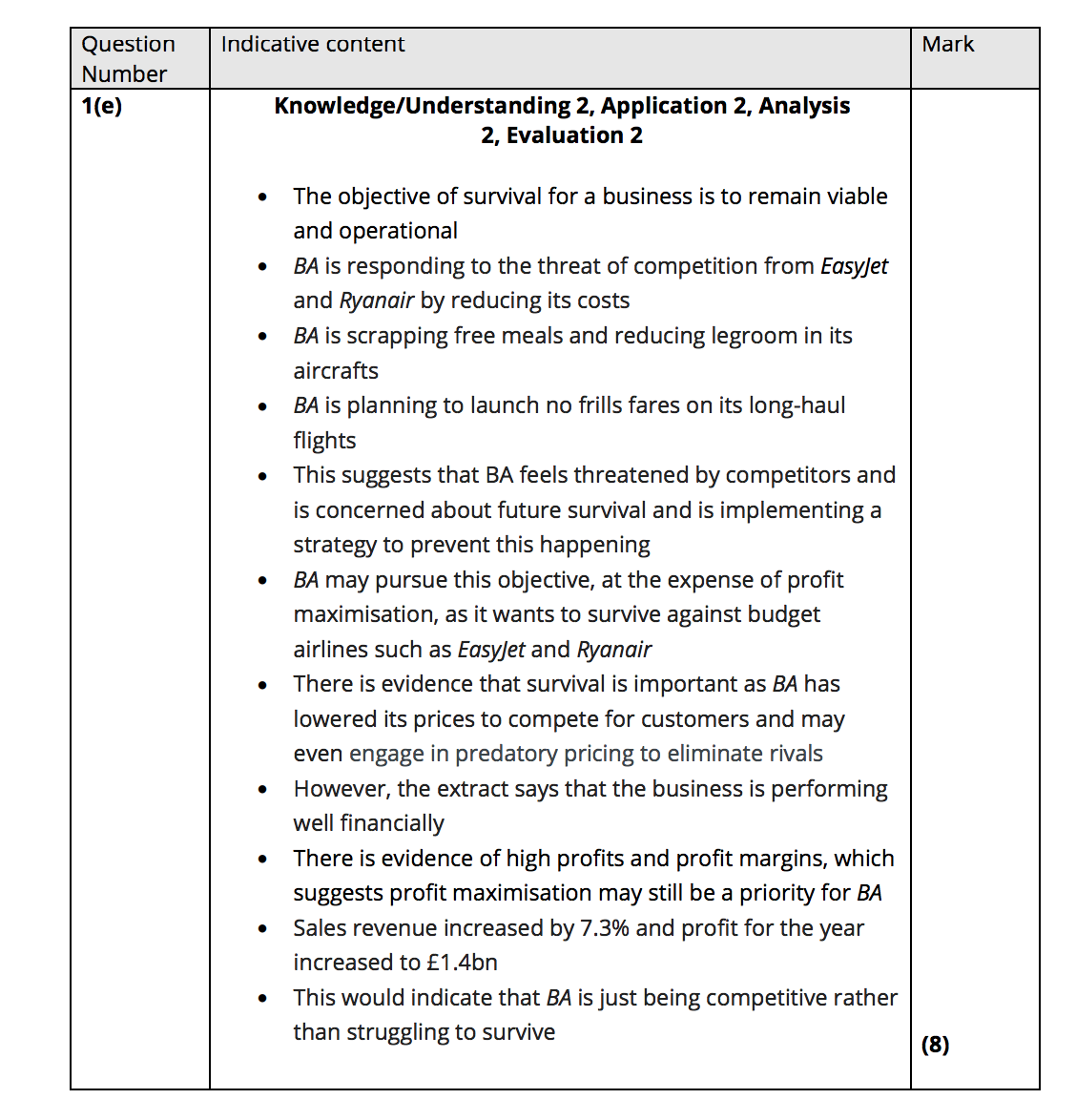
- When answering a question on survival you must:
- state the actions that the firm is taking to survive e.g. better customer service, lowering prices
- and explain why they may be taking theses actions
- As an evaluation, use a different business objective to counteract the one being talked about, e.g, profit maximisation or sales maximisation
==Advantages of survival==
Advantage 1: Ensures continuity of operations
Point: Prioritizing survival as a business objective ensures the continuity of operations, which is critical for maintaining market share and achieving long-term success.
Evidence: An example of a firm that has prioritized survival to ensure continuity of operations is Boeing. In the wake of the COVID-19 pandemic, Boeing faced significant financial challenges due to a decline in air travel and cancelled orders for its aircraft. However, the company implemented a series of measures to reduce costs and raise capital, including laying off thousands of employees, reducing production rates, and seeking government aid. As a result, Boeing was able to continue operating and fulfilling orders from its customers.
Explain: By prioritizing survival, firms like Boeing are able to weather economic downturns and unexpected disruptions, such as the COVID-19 pandemic, and ensure that they can continue to operate and generate profits over the long term. This enables the firm to maintain its market share and competitive advantage, as well as contribute to the economy by creating jobs and generating tax revenue.
Develop: Additionally, prioritizing survival can also help firms to avoid bankruptcy and the associated costs and negative effects on stakeholders, such as creditors, employees, and customers. By ensuring continuity of operations, firms can maintain their relationships with stakeholders and continue to meet their needs and expectations.
Link: In this way, prioritizing survival as a business objective can help firms achieve long-term success and contribute to the overall health and stability of the economy.
Advantage 2: Facilitates strategic decision-making
Point: Prioritizing survival as a business objective facilitates strategic decision-making, enabling firms to respond to changes in the business environment and take advantage of new opportunities.
Evidence: An example of a firm that has prioritized survival to facilitate strategic decision-making is Microsoft. In the late 1990s, Microsoft faced a significant antitrust lawsuit that threatened its survival as a company. In response, Microsoft implemented a series of measures to reduce its dependence on its Windows operating system and diversify its revenue streams. This included investing in new technologies and acquisitions, such as the acquisition of LinkedIn in 2016.
Explain: By prioritizing survival, firms like Microsoft are able to make strategic decisions that enable them to adapt to changes in the business environment and take advantage of new opportunities. This enables the firm to maintain its competitive advantage and continue to generate profits over the long term.
Develop: Additionally, prioritizing survival can also help firms to maintain their flexibility and agility, allowing them to respond quickly to changes in the business environment and adjust their strategies accordingly. This can be especially important in industries that are characterized by rapid technological change or shifting consumer preferences.
Link: In this way, prioritizing survival as a business objective can help firms to achieve long-term success and remain competitive in their industries.
Advantage 3: Enhances stakeholder confidence
Point: Prioritizing survival as a business objective enhances stakeholder confidence, which is critical for maintaining relationships with customers, investors, and other stakeholders.
Evidence: An example of a firm that has prioritized survival to enhance stakeholder confidence is Toyota. In the early 2010s, Toyota faced a series of product recalls that threatened its reputation and market share. However, the company implemented a series of measures to improve its quality control and address the underlying issues that led to the recalls. This included investing in new technology and processes, and working closely with suppliers and other stakeholders to ensure quality and safety.
==Disadvantages of survival==
Survival as a business objective refers to the goal of maintaining the firm's existence in the long-term, despite challenging economic conditions. Although survival is a fundamental objective for most businesses, it can also have significant drawbacks, as discussed below.
- Point: Short-term focus
Evidence: When a firm's primary objective is survival, it may become overly focused on short-term gains and fail to invest in long-term growth strategies. For example, during the global financial crisis of 2008-09, many firms focused on cost-cutting measures rather than investing in innovation and expansion.
Explain: This short-term focus can limit a firm's ability to remain competitive and grow over time. By neglecting long-term growth strategies, firms may miss opportunities to expand into new markets or develop new products that could increase profitability in the future.
Develop and link: For instance, Kodak is a well-known example of a company that focused too much on survival and failed to invest in innovation. Despite being a dominant player in the photography industry for many years, Kodak fell behind its competitors when digital photography emerged. By the time Kodak recognized the importance of digital photography, it was too late, and the firm eventually filed for bankruptcy.
- Point: Lack of risk-taking
Evidence: When firms prioritize survival, they may become risk-averse and avoid pursuing new ventures or investments that could potentially increase profitability but also come with a higher degree of risk. For example, during the COVID-19 pandemic, many firms cut back on investments in new projects or expansion, choosing instead to conserve cash and focus on survival.
Explain: This risk-aversion can limit a firm's ability to innovate and adapt to changing market conditions. By avoiding risky investments, firms may miss opportunities to gain a competitive advantage or enter new markets.
Develop and link: For instance, Blockbuster is an example of a company that failed to take risks and adapt to changing market conditions. Despite being a dominant player in the video rental industry, Blockbuster failed to invest in digital streaming technology and was eventually surpassed by competitors such as Netflix.
- Point: Limited employee motivation
Evidence: When a firm's primary objective is survival, employees may become demotivated and disengaged, as they may feel that the company's focus is solely on avoiding failure rather than achieving success. For example, firms that are constantly restructuring or downsizing may experience high levels of employee turnover and low morale.
Explain: This lack of motivation can lead to decreased productivity and lower quality of work, which can ultimately harm the firm's bottom line.
Develop and link: For instance, Sears is an example of a company that struggled with employee motivation due to its focus on survival. The company underwent several rounds of layoffs and store closures, which led to low morale and decreased productivity among remaining employees.
In conclusion, while survival is an essential objective for businesses, it can also have significant drawbacks. A short-term focus can limit a firm's ability to grow and remain competitive, while a lack of risk-taking can prevent firms from innovating and adapting to changing market conditions. Furthermore, a focus on survival can result in demotivated employees and decreased productivity. Therefore, firms must balance their focus on survival with long-term growth strategies and investment in innovation to remain competitive and thrive in the long term.
{{Market share{{
This is the percentage of sales a business owns in a particular industry or market
an indicator of the company’s performance in relation to the market and its competitors
By having a high market share (the company) will be growing it revenue faster than its competitors
Businesses focusing on market share as an business objective will aim to expand their business organically through sales and stores in the UK.
Market share may be a long term goal
- ]]@@Increased bargaining power@@]]
- more bargaining power over suppliers, distributors and customers, allowing it to negotiate better prices and terms
- ]]@@Economies of scale@@]]
- A larger market share usually translates into higher volumes, which allows the firm to spread its fixed costs over more units and reduce unit costs, resulting in increased profitability.
- ]]Brand recognition]]
- A high market share often results in increased brand recognition and customer loyalty, which can make it easier for the firm to launch new products and enter new markets.
- ]]@@Increased regulation@@]]
- A high market share often leads to increased scrutiny from regulators and can result in the imposition of regulations aimed at promoting competition.
- ]]@@Decreased innovation@@]]
- Maintaining a high market share often requires significant investment in marketing and product development, which can increase costs and reduce profitability.
- ]]@@Decreased customer focus@@]]
- A firm with a high market share may become less responsive to customer needs and less focused on customer satisfaction, potentially leading to a decline in customer loyalty.
[[Examples of Market share [[
- Apple Inc - market share of approximately 14% in the global smartphone market due to its strong brand image, innovative products, and a loyal customer base.
Advantage of market share
Market share is a key business objective that refers to the proportion of total market sales that a company captures. There are several advantages to prioritizing market share as a business objective, which are outlined below using economic terminology and specific examples of firms.
Advantage 1: Economies of scale
Point: Prioritizing market share as a business objective can result in economies of scale, which enable firms to reduce their costs and increase their profitability.
Evidence: An example of a firm that has prioritized market share to achieve economies of scale is Walmart. Walmart has pursued a strategy of low prices and high volume, which has enabled it to capture a significant share of the retail market. As a result, Walmart is able to negotiate better prices from suppliers and benefit from lower costs per unit, which in turn allows the company to offer even lower prices to customers.
Explain: By prioritizing market share, firms like Walmart are able to achieve economies of scale, which enable them to produce goods and services at lower costs than their competitors. This enables the firm to increase its profitability and potentially gain a competitive advantage in the market.
Develop: Additionally, economies of scale can also enable firms to invest in new technology, research and development, and marketing, which can further increase their market share and profitability. This virtuous cycle of growth and profitability can be difficult for competitors to replicate, which can further strengthen the firm's position in the market.
Link: In this way, prioritizing market share as a business objective can help firms achieve long-term success and become dominant players in their respective industries.
Advantage 2: Brand recognition and loyalty
Point: Prioritizing market share as a business objective can lead to increased brand recognition and loyalty, which can be a valuable asset for firms.
Evidence: An example of a firm that has prioritized market share to increase brand recognition and loyalty is Coca-Cola. Coca-Cola has long been the dominant player in the global soft drink market, and its brand is recognized around the world. Coca-Cola has invested heavily in marketing and advertising to maintain its position as the top soft drink brand and has also diversified its product line to include other beverages such as Dasani water and Minute Maid juice.
Explain: By prioritizing market share, firms like Coca-Cola can increase their brand recognition and loyalty, which can be a valuable asset. Strong brand recognition and loyalty can enable a firm to charge higher prices, attract new customers, and retain existing ones, all of which can contribute to increased profitability and long-term success.
Develop: Additionally, strong brand recognition and loyalty can also act as a barrier to entry for competitors, as it can be difficult for new entrants to compete with established brands that have a strong customer base and reputation. This can further strengthen the firm's position in the market and increase its potential for long-term success.
Link: In this way, prioritizing market share as a business objective can help firms achieve long-term success and become dominant players in their respective industries.
Advantage 3: Increased bargaining power
Point: Prioritizing market share as a business objective can lead to increased bargaining power, which can enable firms to negotiate better terms with suppliers and other stakeholders.
Evidence: An example of a firm that has prioritized market share to increase its bargaining power is Amazon. Amazon has become the dominant player in the e-commerce market, and its size and market share have given it significant bargaining power with suppliers and other stakeholders. This has enabled Amazon to negotiate better prices and terms with suppliers, which in turn has allowed the company to offer lower prices to customers.
Explain: By prioritizing market share, firms like Amazon can increase their bargaining power, which can enable them to negotiate better terms with suppliers and other stakeholders. This can lead to lower costs, increased profitability, and potentially a competitive advantage in the market
==Disadvantages==
Disadvantage 1: Decreased innovation
Point: Prioritizing market share as a business objective can lead to decreased innovation, as firms may focus on maintaining their current market position rather than investing in new products or processes.
Evidence: An example of a firm that has experienced decreased innovation as a result of prioritizing market share is Nokia. Nokia was once the dominant player in the mobile phone market, but its focus on maintaining its market share led the company to neglect innovation and fail to adapt to changing consumer preferences. As a result, Nokia lost its market share to competitors such as Apple and Samsung.
Explain: By prioritizing market share, firms may become complacent and focus on maintaining their current market position rather than investing in new products or processes. This can lead to a lack of innovation and an inability to adapt to changing market conditions, which can ultimately result in decreased market share and profitability.
Develop: Additionally, decreased innovation can also make it difficult for firms to compete with new entrants or disruptors in the market, as they may be more agile and able to quickly adapt to changing market conditions.
Link: In this way, prioritizing market share as a business objective can be a double-edged sword, as it can lead to short-term success but also decrease a firm's ability to innovate and adapt over the long-term.
Disadvantage 2: Increased regulatory scrutiny
Point: Prioritizing market share as a business objective can lead to increased regulatory scrutiny, as regulators may view dominant firms as a threat to competition.
Evidence: An example of a firm that has experienced increased regulatory scrutiny as a result of prioritizing market share is Google. Google has become the dominant player in the search engine market, and its market share has led to increased regulatory scrutiny from antitrust regulators. In 2020, the US Department of Justice filed a lawsuit against Google, alleging that the company had abused its dominant market position to stifle competition.
Explain: By prioritizing market share, firms may become dominant players in their respective markets, which can attract increased regulatory scrutiny from antitrust regulators. This can lead to costly legal battles, fines, and reputational damage, which can ultimately hurt a firm's profitability and market position.
Develop: Additionally, increased regulatory scrutiny can also limit a firm's ability to pursue certain business strategies, such as mergers and acquisitions, which may be necessary for long-term growth and success.
Link: In this way, prioritizing market share as a business objective can expose firms to increased regulatory risk and limit their ability to pursue certain business strategies.
Disadvantage 3: Reduced customer satisfaction
Point: Prioritizing market share as a business objective can lead to reduced customer satisfaction, as firms may focus on volume over quality.
Evidence: An example of a firm that has experienced reduced customer satisfaction as a result of prioritizing market share is Ryanair. Ryanair has pursued a strategy of low prices and high volume, which has enabled the company to capture a significant share of the budget airline market. However, this strategy has also led to customer complaints about poor service, hidden fees, and uncomfortable seating.
Explain: By prioritizing market share, firms may focus on volume over quality, which can lead to reduced customer satisfaction. Firms may cut corners on quality control, customer service, or other aspects of their business in order to maintain low prices and capture market share. This can ultimately lead to a loss of customer loyalty and a decline in profitability.
Develop: Additionally, reduced customer satisfaction can also make it difficult for firms to differentiate themselves from competitors and create a unique value proposition
{{Cost Efficiency{{
%%Advantages of cost efficiency%%
- ]]Increased profits]]
- By reducing costs, a firm can increase its profits, as it can either sell products at the same price while making a higher profit margin or lower prices to increase market share.
- ]]Gives firm a competitive advantage]]
- A cost-efficient firm is better positioned to compete in the market as it can offer lower prices than its competitors, attract more customers and increase market share.
- ]]Improved cash flow]]
- By reducing costs, a firm can improve its cash flow, which can be used to reinvest in the business, pay dividends to shareholders or pay down debt.
%%Disadvantages of cost efficiency%%
- ]]Decreased quality]]
- In an effort to reduce costs, a firm may cut corners and sacrifice quality, which can negatively impact customer satisfaction and ultimately harm the firm's reputation.
- ]]Reduced innovation]]
- If a firm is too focused on cost cutting, they may limit their investment in research and development, which can stifle innovation and limit their ability to compete in the long-term.
- ]]Customer dissatisfaction]]
- If a firm reduces costs by cutting back on customer service or reducing product quality, customers may become dissatisfied and choose to do business with a competitor.
[[An example of the disadvantages of cost efficiency[[
- Airline industry, where many airlines have implemented cost-cutting measures to stay competitive. These measures have included reducing legroom and in-flight amenities, increasing fees for checked baggage, and outsourcing jobs. While these cost-cutting measures have improved the airlines' bottom line, they have also led to a decrease in customer satisfaction and an increase in customer complaints.
\n Cost efficiency is an important business objective that can offer several advantages to firms. These advantages are outlined below using economic terminology and specific examples of firms.
Advantage 1: Increased profitability
Point: Prioritizing cost efficiency as a business objective can lead to increased profitability, as firms may be able to reduce their costs and increase their margins.
Evidence: An example of a firm that has experienced increased profitability as a result of prioritizing cost efficiency is Walmart. Walmart is known for its focus on cost efficiency and has been able to achieve low prices through its supply chain management, inventory control, and other cost-saving measures. This has enabled the company to capture a significant share of the retail market and generate high levels of profitability.
Explain: By prioritizing cost efficiency, firms can reduce their costs and increase their margins, which can lead to increased profitability. This can be achieved through a variety of methods, such as improving supply chain management, reducing waste, and streamlining operations.
Develop: Additionally, increased profitability can also enable firms to invest in new products, expand into new markets, or pursue other growth opportunities, which can further increase their long-term profitability and competitiveness.
Link: In this way, prioritizing cost efficiency as a business objective can be an effective way for firms to improve their financial performance and achieve long-term success.
Advantage 2: Improved competitiveness
Point: Prioritizing cost efficiency as a business objective can improve a firm's competitiveness, as it can enable the firm to offer lower prices than its competitors.
Evidence: An example of a firm that has improved its competitiveness through cost efficiency is Amazon. Amazon has focused on reducing its costs through its logistics network, data analytics, and other cost-saving measures. This has enabled the company to offer lower prices than many of its competitors and capture a significant share of the e-commerce market.
Explain: By prioritizing cost efficiency, firms can improve their competitiveness by offering lower prices than their competitors. This can be particularly effective in markets where price is an important factor in consumer decision-making, as it can help firms capture market share and grow their customer base.
Develop: Additionally, improved competitiveness can also lead to increased brand awareness, customer loyalty, and long-term profitability, as customers may be more likely to return to a firm that offers high-quality products at low prices.
Link: In this way, prioritizing cost efficiency as a business objective can be an effective way for firms to improve their competitiveness and achieve long-term success in competitive markets.
Advantage 3: Increased flexibility
Point: Prioritizing cost efficiency as a business objective can increase a firm's flexibility, as it can enable the firm to adapt to changing market conditions and customer preferences.
Evidence: An example of a firm that has increased its flexibility through cost efficiency is Toyota. Toyota has focused on cost efficiency through its lean manufacturing processes, which have enabled the company to reduce waste and increase flexibility in its production processes. This has enabled the company to quickly adapt to changing market conditions and customer preferences, such as shifts towards more fuel-efficient vehicles.
Explain: By prioritizing cost efficiency, firms can increase their flexibility by reducing waste and streamlining their operations. This can enable firms to quickly adapt to changing market conditions and customer preferences, which can be particularly important in dynamic and rapidly changing markets.
Develop: Additionally, increased flexibility can also enable firms to pursue new growth opportunities, such as entering new markets or launching new products, which can further increase their long-term profitability and competitiveness.
Link: In this way, prioritizing cost efficiency as a business objective can be an effective way for firms to increase their flexibility and achieve long-term success in dynamic and competitive markets.
{{Return of Investment{{
- commonly used metric for evaluating the performance of a firm's investments
- the ratio of the profit or loss generated by an investment compared to the initial cost of the investment
%%Advantages of Return of Investment%%
- ]]@@Provides a clear measure of investment performance@@]]
- ROI provides a simple, straightforward measure of the performance of a firm's investments, which can help decision-makers make informed decisions about which investments to pursue and which to avoid.
- ]]Supports resource allocation decisions]]
- By measuring the return on investment for different initiatives, firms can prioritize their resources and allocate them to the initiatives that are most likely to generate the highest return.
- ]]Encourages efficient use of resources]]
- By focusing on the return on investment, firms can ensure that they are using their resources effectively and efficiently, rather than squandering them on investments that are unlikely to generate a positive return.
%%Disadvantages of Return of Investment%%
- ]]Short-term focus]]
- ROI can encourage firms to focus on short-term gains at the expense of long-term investments that may be more important for the firm's future success.
- ]]Narrow focus]]
- ROI provides a measure of the return on investment, but it does not take into account other factors such as social, environmental, and ethical considerations, which may be important to the firm's overall success.
- ]]Can be manipulated]]
- Firms can manipulate ROI by using accounting tricks, such as recognising profits before they are actually earned, to make their investments look more profitable than they really are.
[[Example of Return of Investment[[
- An example of the impact of ROI on a firm's decision-making can be seen in the ==tech industry==. A tech firm may have ==a large investment in research and development==, but if the ROI on that investment is not ==deemed sufficient==, the firm may decide to ==redirect its resources to other initiatives== that have a higher ROI. This can result in the @@firm missing out on opportunities for long-term growth,@@ even though the investment in research and development may have been critical for the firm's success in the long run.
\
{{Employee Welfare{{
%%Advantages of employee welfare%%
- ]]Improved employee morale and job satisfaction:]]
- When employees have access to programs and benefits that support their well-being, they are more likely to feel valued and satisfied with their job, which can lead to improved morale and reduced turnover.
- ]]Increased productivity]]
- Employees who feel supported and well-cared for are more likely to be motivated and engaged in their work, which can lead to increased productivity.
- ]]Better recruitment and retention]]
- Employers who offer robust employee welfare programs are more likely to attract and retain top talent, as employees are more likely to choose to work for an employer that values their well-being.
%%Disadvantages of employee welfare%%
- ]]Increased costs]]
- Providing employee welfare programs and benefits can be expensive, and employers need to be mindful of the costs involved to ensure that they are sustainable over the long-term.
- ]]Complex administration]]
- Employee welfare programs can be complex to administer, requiring significant time and resources to manage effectively.
- ]]Potential for abuse]]
- If not designed or managed properly, employee welfare programs can be subject to abuse by employees who take advantage of the benefits without actually needing them.
[[Example of Employee Welfare[[
- An example of the impact of employee welfare on a firm can be seen in the @@tech industry,@@ where companies like , , and have been known for @@offering extensive employee welfare programs@@, such as , o, and . While these programs have helped the companies @@to attract and retain top talent@@, they have also @@contributed to the firms' operating expenses@@, and have required significant time and resources to manage effectively.
\
{{Customer Satisfaction{{
- refers to the extent to which customers are happy and satisfied with the products or services they have received from a firm
%%Advantages of customer satisfaction%%
- ]]@@Improved customer loyalty@@]]
- Satisfied customers are more likely to return to do business with a firm in the future, which can lead to increased customer loyalty and repeat business.
- ]]Positive word-of-mouth]]
- Satisfied customers are more likely to recommend a firm to their friends and family, which can lead to increased brand awareness and new business.
- ]]Increased revenue]]
- Satisfied customers are more likely to purchase additional products or services from a firm, which can lead to increased revenue.
%%Disadvantages of customer satisfaction%%
- ]]Cost of meeting customer demands]]
- Firms may need to invest significant time and resources to meet customer demands and maintain high levels of customer satisfaction, which can be costly.
- ]]Potential for unrealistic expectations]]
- If customer expectations are not managed effectively, customers may have unrealistic expectations that the firm is unable to meet, which can lead to dissatisfaction and negative feedback.
- ]]Dependence on customer feedback]]
- Firms may become overly dependent on customer feedback and be unable to make important decisions without considering the potential impact on customer satisfaction, which can limit their ability to make important business decisions.
[[Example of Customer Satisfaction[[
- An example of the impact of customer satisfaction on a firm can be seen in the ==restaurant industry==, where a restaurant with a reputation for high levels of customer satisfaction is more likely to @@attract new customers and retain repeat customers@@ than a restaurant with a reputation for poor customer service. On the other hand, a restaurant that invests too much in customer satisfaction, such as or , may @@struggle with high costs and decreased profitability@@.
\
{{Social Objectives{{
- the goals and aspirations that organisations have in terms of the impact they have on society
%%Advantages of Social Objectives%%
- Positive impact on society
- By pursuing social objectives, firms can have a positive impact on society, such as through supporting causes like education or healthcare.
- Improved brand image
- Firms that prioritise social objectives are often perceived as socially responsible and are more likely to be positively viewed by consumers, which can improve brand image and reputation.
- Attraction of socially-conscious customers
- Firms that prioritise social objectives are more likely to attract customers who are conscious of the impact of their purchasing decisions on society, which can help to increase revenue
%%Disadvantages of Social Objectives%%
- Reduced profitability
- Pursuing social objectives can be costly and may require significant investment of time and resources, which can lead to reduced profitability.
- Complex implementation
- Social objectives can be complex to implement and may require significant planning and coordination to be achieved effectively.
- Potential for conflict with other business objectives
- Firms may struggle to balance their social objectives with their financial goals, which can result in conflicting priorities and challenges for decision-making.
[[Example of Social Objectives[[
- An example of the impact of social objectives on a firm can be seen in the ==fast food industry==, where some companies have chosen to prioritise social objectives such as . For instance, some fast food chains have , , and While th ese social objectives have @@helped to improve the firms' reputation@@ and @@attract customers who prioritise sustainability@@, they have also @@required significant investment of time and resources@@, and may have @@reduced the firms' profitability@@.
\
1.1.3 Stakeholders (economic agents) and their objectives
]]Stakeholders:]]
- The shareholder
- Employees
- Consumers
- Managers
- Government
- Suppliers
- The community
]]Stakeholders Objectives:]]
- refer to the goals, priorities, and interests of individuals or organisations that have a vested interest in a particular project, business, or decision
Stakeholder objectives of the ^^shareholders^^ of a firm:
- <<Maximising returns:<<
- Shareholders want to maximise their returns on investment and see their shares appreciate in value over time. This is usually achieved through a combination of dividend payments and share price appreciation.
- <<Capital appreciation:<<
- Shareholders aim to see the value of their investment grow over time. They want the firm to perform well and generate profits that will drive up the share price.
- <<Dividend payments:<<
- Shareholders receive a portion of the firm's profits in the form of dividends, which are payments made to shareholders on a regular basis. Shareholders want to receive regular and consistent dividend payments.
- <<Management accountability:<<
- Shareholders want to ensure that the firm's management is accountable for their decisions and actions. They want to see that the firm is being run in a responsible and transparent manner.
- <<Growth opportunities:<<
- Shareholders want to see the firm grow and expand over time. They want to invest in a company that has a clear growth strategy and a track record of success.
]]@@A possible conclusion when asked an 10, 12, or 16 marker on shareholder objectives@@]]
- It is important to note that while these are the primary objectives of shareholders, they may also have other, more specific goals that are unique to their individual investment strategies and objectives. Ultimately, @@the objectives of shareholders will depend on their personal goals, investment strategies, and risk tolerance.@@
{{Benefits of meeting stakeholder objectives{{
- }}Increased investor confidence:}}
- By demonstrating a commitment to meeting the needs of shareholders, a company can build trust and confidence among its investors, which can result in increased investment and improved financial performance.
- }}Improved financial performance}}
- By focusing on meeting shareholder objectives, a company can make decisions that maximise profits and optimise its financial performance. This can lead to improved financial stability and greater investor confidence in the long-term prospects of the company.
- }}Access to capital}}
- By demonstrating a commitment to meeting the objectives of shareholders, a company can increase its ability to raise capital and expand its operations. This can lead to increased growth and profitability.
Stakeholder objectives of the ^^employees^^ of a firm:
- <<Job security<<
- Employees want to feel secure in their positions and have confidence that they will not be laid off or let go without good reason.
- <<Fair compensation<<
- Employees want to be paid a fair wage for the work they do, taking into account factors such as experience, education, and job responsibilities.
- <<Opportunities for growth and development<<
- Employees want to have opportunities to learn and grow within the company, whether through training, promotions, or new projects.
- <<Positive work environment<<
- Employees want to work in a supportive and inclusive environment, where they feel valued and respected.
- <<Work-life balance<<
- Employees want to be able to balance their work and personal responsibilities, without feeling that one is taking over the other.
{{Benefits of meeting ==employee ==objectives{{
Meeting employee objectives @@help the employee achieve their professional goals@@ and provide the company with @@a more motivated and engaged workforce@@.
- }}Increased Productivity}}
- When employees have clear, achievable objectives, they are more motivated and focused on their work, leading to increased productivity and better performance.
- }}Improved Morale}}
- Meeting objectives provides a sense of accomplishment and boosts employee morale, leading to a more positive work environment and increased job satisfaction.
- }}Better Retention}}
- Employees are more likely to stay with a company that supports their career development and provides opportunities for growth. When objectives are met, employees feel valued and invested in their work, reducing turnover.
- }}Better Alignment}}
- Objectives help align individual employee goals with the company's overall strategy and vision, ensuring that everyone is working towards a common purpose.
- }}Improved Communication}}
- Setting and reviewing objectives helps improve communication between employees and managers, creating a more open and transparent work environment.
Stakeholder objectives of the ^^consumers^^ of a firm:
- <<^^Quality Products or Services^^<<
- Consumers expect the products or services they purchase to be of high quality and meet their needs and requirements.
- <<Affordable Prices<<
- Consumers want to receive value for their money, so they often seek out products and services that are reasonably priced.
- <<Convenience<<
- Consumers want products and services that are easily accessible and convenient to use. This could include online ordering, home delivery, and accessible customer service.
- <<Safety<<
- Consumers want to feel confident that the products and services they purchase are safe to use and pose no significant risk to their health or well-being.
- <<Sustainability<<
- An increasing number of consumers are concerned about the impact of products and services on the environment and seek out options that are environmentally friendly and sustainable.
{{Benefits of meeting consumer objectives{{
- }}Increased Customer Satisfaction}}
- When a firm meets the objectives of its consumers, it leads to increased customer satisfaction, which can result in higher levels of customer loyalty and repeat business.
- }}Improved Reputation}}
- Firms that consistently meet the objectives of their consumers develop a positive reputation in the market, which can lead to increased customer acquisition and growth.
- }}Increased Sales and Profitability}}
- Meeting consumer objectives leads to increased customer satisfaction and loyalty, which can result in increased sales and higher profits
- }}Competitive Advantage}}
- Firms that prioritise meeting consumer objectives often have a competitive advantage over their rivals, as they are better equipped to meet the evolving needs and expectations of the market.
[[Example of benefit:[[
- An example of a firm that has successfully met consumer objectives is ==Amazon==. The company has a reputation for providing , and , and . This has helped Amazon @@become a trusted brand@@, with @@millions of loyal customers@@ who @@consistently choose to purchase from the company over its competitors.@@
\
{{Conclusion for meeting the consumer objectives{{
- ==In conclusion,== meeting consumer objectives is essential for firms @@to build strong relationships with their customers and ensure their long-term success@@. By focusing on the needs and expectations of their consumers, firms can i@@ncrease customer satisfaction, improve their reputation, increase sales and profitability,@@ and gain a competitive advantage.
Stakeholder objectives of the ^^GOVERNMENT^^ for a firm:
- <<Tax Revenues<<
- Governments often have a primary objective of generating tax revenues from firms operating within their jurisdiction
- <<Job Creation<<
- Governments often aim to promote job creation and economic growth through their interactions with firms.
- <<Consumer Protection<<
- Governments aim to protect consumers from harmful or unethical business practices, such as fraud, false advertising, and exploitation.
- Environmental Protection: Governments often have an objective to promote environmental sustainability and limit the negative impact of business activities on the environment.
[[Example:[[
- An example of a government objective being met by a firm is in the case of ==renewable energy production==. Governments around the world have set objectives to reduce greenhouse gas emissions and transition to clean energy sources. In response, @@firms in the renewable energy sector have developed innovative technologies to produce energy from sources@@ such as wind and solar, @@helping to meet government objectives@@ and reduce their carbon footprint.
\
}}Conclusion:}}
- ==In conclusion==, the objectives of the government as a stakeholder in a firm can range from and to and promoting environmental sustainability. By working with the government and meeting its objectives, firms can benefit from @@a supportive business environment@@ and @@positive public perception@@.
{{Benefits of meeting government objectives{{
- }}Improved Reputation}}
- Firms that comply with government regulations and meet government objectives are viewed positively by the public and often have a strong reputation in the market.
- }}Access to Resources}}
- By working with the government and meeting its objectives, firms may have access to resources and opportunities that are not available to their competitors.
- }}Legal and Regulatory Compliance}}
- Firms that meet government objectives are often in compliance with relevant laws and regulations, which can reduce the risk of legal or regulatory action and minimise negative consequences
- }}Increased Competitiveness}}
- By meeting government objectives, firms can demonstrate their commitment to sustainability, social responsibility, and ethical business practices, which can give them a competitive advantage in the market.
[[Example[[
An example of a firm that has successfully met government objectives is ==Tesl==. The company has and which align with the government's objectives to reduce greenhouse gas emissions and promote sustainability. As a result, Tesla has received @@government support and incentives@@, which @@have helped the company grow and become a leader in the renewable energy sector.@@
}}Conclusion:}}
- ==In conclusion==, meeting government objectives as a firm can bring numerous benefits, including , , and . By working with the government and @@demonstrating their commitment to sustainability, social responsibility, and ethical business practices@@, firms can position themselves for @@long-term success and growth.@@
Stakeholder objectives of the ^^SUPPLIERS^^ for a firm:
- <<Secure and Reliable Purchases<<
- Suppliers want to ensure that the firm they are supplying to is a reliable customer that will make regular and timely purchases.
- <<Fair Prices<<
- Suppliers want to receive fair prices for the goods and services they provide to the firm.
- <<Quality of Goods and Services<<
- Suppliers want to provide high-quality goods and services that meet the needs and expectations of the firm they are supplying to.
- <<Long-Term Relationships<<
- Suppliers value long-term relationships with firms as this provides them with stability and security in their business.
[[Example[[
An example of a firm that has successfully met the objectives of its suppliers is ==Toyota==. The company has a reputation for its just-in-time production system, which relies on a close relationship with suppliers to This has helped @@Toyota build strong, long-term relationships with its suppliers@@, @@who appreciate the stability and reliability@@ of their business with the company.
}}Conclusion }}
- In conclusion, meeting the objectives of suppliers as stakeholders in a @@firm is essential for building strong, long-term relationships and ensuring the success and growth of the business@@. By prioritising the needs and expectations of suppliers, @@firms can benefit from secure and reliable purchases@@, , and , and
{{Benefits of meeting supplier objectives{{
- }}Improved Quality of Goods and Services}}
- By ensuring that suppliers receive fair prices and have a secure and reliable source of business, firms can encourage the provision of high-quality goods and services.
- }}Stronger Supplier Relationships}}
- Firms that prioritise the objectives of their suppliers can build stronger, more stable relationships with them, which can lead to better communication, collaboration, and mutual trust.
- }}Increased Supply Chain Efficiency:}}
- By building strong relationships with suppliers and ensuring the timely delivery of high-quality goods and services, firms can improve the efficiency of their supply chain, reducing costs and increasing productivity.
- }}Better Reputation}}
- Firms that prioritise the needs of their suppliers and demonstrate a commitment to ethical and responsible business practices can improve their reputation and attract more customers.
[[Example:[[
- An example of a firm that has successfully met the objectives of its suppliers is ==Walmart/Asda==. The company has a and has to ensure that its . As a result, Walmart has @@built strong relationships with its suppliers@@ and has been @@able to ensure the timely delivery of high-quality goods and services@@, which has helped the @@company maintain its position as a leader in the retail sector.@@
}}Conclusion:}}
- ==In conclusion==, meeting the objectives of suppliers as stakeholders can bring numerous benefits to a firm, including , , increased supply chain efficiency, and a better reputation. By prioritising the needs and expectations of suppliers, @@firms can ensure the success and growth of their business.@@
Stakeholder objectives of the ^^COMMUNITY^^ for a firm:
- <<Economic Development<<
- Communities want firms to contribute to local economic development by creating jobs, supporting local businesses, and investing in the local economy.
- <<Environmental Sustainability<<
- Communities are increasingly concerned about the environmental impact of business and want firms to prioritise sustainability and reduce their environmental footprint.
- <<Community Engagement<<
- Communities want firms to be active and engaged members of the local community, participating in community events, supporting local initiatives, and promoting social and cultural diversity.
- <<Ethical Business Practices<<
- Communities want firms to operate in an ethical and responsible manner, demonstrating a commitment to social responsibility and respect for human rights.
[[Example:[[
An example of a firm that has successfully met the objectives of its community is ==Patagonia==. The company has , , and . The company and , and is @@widely regarded as a leader in the sustainable fashion industry@@.
- THE BODY SHOP IS ANOTHER EXAMPLE
{{Benefits of meeting supplier objectives{{
- }}Improved Reputation:}}
- Firms that prioritise the needs and expectations of their local communities can improve their reputation and attract more customers, employees, and investors.
- }}Stronger Community Relationships}}
- Firms that are active and engaged members of their local communities can build stronger relationships with their stakeholders and foster a positive image in the market.
- }}Increased Market Opportunities}}
- By investing in local initiatives and promoting economic development, firms can increase market opportunities and attract new customers and partners.
}}Conclusion:}}
- In conclusion, meeting the objectives of the community as stakeholders is essential for the success and growth of a firm. firms can demonstrate their commitment to the well-being of the communities in which they operate, build stronger relationships with their stakeholders, and improve their reputation in the market.
]]Stakeholders Conflicts:]]
- ^^Shareholders vs. Employees:^^ Shareholders may , while employees may .
- ^^Customers vs. Suppliers:^^ Customers may prioritise , while suppliers may prioritise f
- ^^Management vs. Employees:^^ Management may prioritise , while employees may .
- ^^Companies vs. Local Communities^^: Companies may prioritise , while local communities may prioritise .
- ^^Companies vs. Government^^: Companies may prioritise , while regulators may prioritise .
}}Corporate Social Responsibility (CSR)}}
- A form of self-regulation where the firm makes sure their actions are good for society
- In order to be more socially responsible, a firm might behave more ethically, perhaps by refusing to use cheap, exploited labour
- E.g., a firm could focus on reducing its carbon footprint to benefit society
1.2 Enterprise, business and the economy
}}1.2.1 Role of an entrepreneur in the economy}}
Creative destruction (organising factors of production to create and set up an enterprise)
- Creative Destruction - when a new invention destroys what came before it
- refers to the process of innovation that replaces old and outdated technologies, business models, and industries with new and more advanced ones.
- key driver of economic growth
}}Advantages of Creative Destruction}}
- New technologies and business models often result in greater efficiency and productivity, leading to lower costs and higher profits.
- By replacing old and outdated industries with new and more advanced ones, creative destruction can lead to overall economic growth.
- : The process of creative destruction encourages and drives innovation, leading to new products, services, and industries that can improve our lives.
[[Example of why creative destruction is beneficial:[[
- For example, the has led to the . While this has been challenging for some retailers, it has also led to the which have and and . Additionally, e-commerce has allowed for , as businesses are able to and .
}}Disadvantages of Creative Destruction}}
Creative destruction can lead to job losses in industries that are becoming obsolete. This can have a significant impact on the lives and livelihoods of individuals and families, particularly if they are unable to find alternative employment.
- [[Example[[
The has resulted in job losses in many While the decline of the coal industry may be beneficial in terms of reducing carbon emissions, it can have a significant negative impact on the lives and well-being of the people who work in that industry and their families.
: Creative destruction can also lead to social disruption and dislocation, particularly if it occurs rapidly or without appropriate support for those affected.
- [[Example[[
The , e.g., ==Uber== has and led to job losses for many taxi drivers. While ride-sharing may be beneficial in terms of @@providing consumers with more choices and competitive prices@@, the disruption of the taxi industry can have @@negative consequences for taxi drivers and their families@@, who may @@struggle to find alternative employment.@@
Creative destruction can also have negative environmental consequences, particularly if the or industries that
- [[Example[[
For example, the has , but it has also led to @@increased environmental damage@@ due to the @@production and disposal of low-quality, disposable clothing.@@
}}Industries in danger of creative destruction}}
- @@Retail@@: are facing increasing competition from online retailers, which offer consumers the convenience of shopping from home and often lower prices.
- @@Print Media:@@ With the rise of digital media, print media such as newspapers and magazines are facing declining readership and advertising revenues.
- @@Cable Television:@@ With the increasing popularity of streaming services such as ==Netflix== and ==Hulu==, traditional cable television is facing declining viewership and subscriptions.
- @@Traditional Taxi Industry:@@ Ride-sharing services such as ==Uber== and ==Lyft== are disrupting the traditional taxi industry, leading to declining ridership and revenue for taxi drivers and companies.
- @@Coal Industry:@@ The decline of the coal industry is being driven by a shift towards renewable energy sources and concerns about carbon emissions.
- @@Traditional Advertising:@@ The rise of digital advertising is disrupting traditional advertising models, as companies are able to reach consumers more effectively and efficiently through online platforms.
- @@Traditional Banking:@@ The is disrupting , as consumers are increasingly able to manage their finances through online platforms.
Added Value
}}Ways a firm can add value to their product}}
- ^^Quality^^: Improving the quality of a product can add value by making it to customers. This can be achieved through processes.
- [[Example:[[
- @@Apple@@ is known for its high-quality products, with a focus on design, functionality, and durability.
- ^^Design^^: Attention to design can add value by making a product more . This can involve to create products that are and meet the needs of customers.
- ^^Innovation^^: Developing new and innovative products can add value by providing customers with that are . This can involve to create new products, or incorporating new technologies into existing products.
- [[Example:[[
- @@Tesl@@ has added innovative features to their electric cars, such as autonomous driving capabilities and a large touchscreen interface.
- ^^Customisation^^: Offering customisation options can add value by to their individual preferences and needs. This can involve offering a range of options for materials, .
- [[Example:[[
- @@Nike@@ allows customers to design their own shoes on their website using a variety of colour and style options.
- ^^Service^^: Providing can add value by making it easier for customers to purchase and use products, and by and satisfactorily.
- [[Example:[[
- @@Zappos@@ is known for its exceptional customer service, with representatives who are empowered to make decisions that prioritize customer satisfaction.
- ^^Branding^^: Developing a strong brand identity can add value by and for the product, which can
- [[Example:[[
- @@Coca-Cola@@ has built a strong brand identity around its classic logo and distinctive taste.
- ^^Sustainability^^: A firm could add value by into their product or service, such as by using or reducing waste.
- [[Example[[
- @@Patagonia@@ has made sustainability a core part of its brand identity, with a focus on ethical sourcing and reducing environmental impact.
}}Why is adding value to a product or a service important?}}
- Adding value to a product or service can help a firm stand out from competitors, especially in crowded or highly competitive markets.
- For example, offering customisation options or exceptional customer service can make a firm more attractive to customers than competitors who do not offer these features.
- Adding value can improve customer satisfaction and loyalty, as customers are more likely to be satisfied with products or services that meet their needs and preferences.
- For example, a firm that offers high-quality products or sustainable practices may be more likely to attract and retain customers who value these features.
- : Adding value can lead to increased revenue and profitability, as customers may be willing to pay more for products or services that offer additional value.
- For example, a firm that offers innovative or high-quality products may be able to charge premium prices, leading to increased revenue and profitability.
}}Conclusion:}}
- %%In conclusion%%, adding value to a product or service is essential for firms that want to succeed in competitive markets. By focusing on meeting customer needs and preferences, and by continuously improving and innovating, firms can differentiate themselves from competitors, increase customer satisfaction and loyalty, and ultimately drive revenue and profitability. Adding value requires a commitment to understanding customer needs, investing in research and development, and prioritising quality, service, and sustainability.
[[Example of a firm that has added good value to their product[[
AMAZON
- Amazon has built a reputation for offering convenient, reliable, and cost-effective services that add value for customers.
- : Amazon offers a variety of delivery options, including same-day or next-day delivery for many products. This convenience adds value for customers who want to receive their purchases quickly and reliably.
- Amazon has added innovative features to its products and services, such as its virtual assistant Alexa and its Prime membership program, which offers free shipping, access to streaming content, and other benefits. These features add value for customers who want access to the latest technology and convenient services.
- : Amazon offers a vast selection of products, from books to electronics to groceries, adding value for customers who want a one-stop-shop for their needs.
}}1.2.2 Entrepreneurial motives}}
Non-financial motives:
Ethical stance
- refers to a business owner's commitment to acting in a morally responsible way, beyond the pursuit of profit. This approach emphasises the importance of ethical considerations, such as social responsibility, environmental sustainability, and community engagement.
- ethical considerations become a driving force behind the entrepreneur's decision-making process, and they seek to make a positive impact on society, rather than just maximising profits. This approach can help businesses build trust and loyalty among their customers, and contribute to a more sustainable and equitable economy.
<<Advantages <<
- Businesses that prioritise ethics over profits can have a positive impact on society and the environment, which can contribute to a more sustainable and equitable economy.
- Increased brand loyalty: Consumers are increasingly looking for socially and environmentally responsible businesses to support, and businesses that prioritise ethics can build trust and loyalty with their customers.
- Attract and retain employees: Businesses that prioritise ethics can attract and retain employees who share their values, which can help create a more engaged and committed workforce.
<<Disadvantages <<
- : Prioritising ethics over profits can lead to financial challenges, as businesses may need to invest in more expensive sustainable or socially responsible practices.
- While there is a growing demand for socially and environmentally responsible businesses, not all consumers prioritise these values when making purchasing decisions.
[[Example [[
- For example, a social entrepreneur may start a business that focuses on addressing a particular social or environmental issue, such as . They may @@prioritise social impact over financial gain@@, and make decisions that @@prioritise the well-being of their stakeholders@@, such as their employees, customers, and the environment.
- %%Patagonia%%, a clothing company that has a strong ethical stance on environmental sustainability. They have made significant investments in sustainable materials and practices, and have built a strong brand reputation based on their commitment to ethics.
}}Conclusion }}
- In conclusion, an ethical stance as a non-financial entrepreneurial motive recognises the importance of ethical considerations in business, and prioritises social and environmental impact over financial gain. This approach can help entrepreneurs create businesses that are not only financially successful, but also make a positive impact on society and the planet.
Social Entrepreneurship
<<Advantages <<
- Positive social impact: Social entrepreneurship is focused on creating positive social change, which can have a significant impact on society.
- Innovation: Social entrepreneurs often use creative and innovative solutions to address social issues, which can lead to new products, services, and business models.
- Brand loyalty: Similar to ethical entrepreneurship, social entrepreneurship can build strong brand loyalty among consumers who support businesses that are making a positive impact.
<<Disadvantages <<
- Financial sustainability: Social entrepreneurs often face financial challenges as they may prioritize social impact over profits, and may need to rely on external funding or donations to sustain their business.
- Limited scalability: Some social entrepreneurship models may have limited scalability, as they may require a significant amount of time and resources to build a sustainable model.
[[Example [[
- %%TOMS Shoes,%% a company that operates on a "One for One" model where they donate a pair of shoes for every pair purchased. TOMS has built a strong brand around their commitment to social impact, and their model has inspired other companies to adopt similar models.
Independence
<<Advantages<<
- Control: Independence allows entrepreneurs to have control over their business, including decision-making and strategic direction.
- Flexibility: Entrepreneurs who are independent have the flexibility to make changes to their business as needed, without having to seek approval from external stakeholders.
- Innovation: Independent entrepreneurs have the freedom to pursue new and innovative ideas without being constrained by the priorities or agendas of others.
<<Disadvantages<<
- Financial risk: Independent entrepreneurs are often responsible for funding their own business, which can be financially risky, especially in the early stages of the business.
- Limited resources: Independent entrepreneurs may have limited resources, including funding, talent, and time, which can make it challenging to scale their business.
- Isolation: Independent entrepreneurs may feel isolated or unsupported, especially if they don't have a strong network of peers or mentors.
[[Example[[
- A freelance writer who starts their own writing business is an example of an entrepreneur who is motivated by independence. The writer has the freedom to choose their own clients, set their own schedule, and determine their own rates.
1.2.4 Specialisation
%%Give an example of an advantage of specialisation%% (1)
One advantage of specialisation of labor for a firm is increased efficiency and productivity. When workers specialise in specific tasks, they become highly skilled and efficient at those tasks, allowing them to complete them more quickly and accurately than if they were performing a wide range of tasks. This can result in significant cost savings for the firm, as it can produce more goods or services with the same amount of resources.
For example, in a car manufacturing plant, workers may specialise in assembling specific parts of the car, such as the engine, the doors, or the transmission. This allows each worker to become an expert in their particular task, which can help to streamline the assembly process and reduce the likelihood of errors or defects. As a result, the overall production process can be completed more quickly and efficiently than if each worker had to perform a wide range of tasks.
Furthermore, specialisation of labor can also result in economies of scale, as the firm may be able to produce larger quantities of goods at a lower cost per unit. This can help to improve profitability and competitiveness, as the firm can offer its products at a lower price point than its competitors.
In conclusion, the specialisation of labor can provide a significant advantage for firms by increasing efficiency, productivity, and profitability. By allowing workers to focus on specific tasks, firms can streamline their production processes, reduce costs, and offer their products at a competitive price point.
(2) One advantage of specialization of labour for a firm is the %%ability to achieve economies of scale%%, which can %%lead to lower production costs%% and %%increased profitability%%. This occurs when a firm is able to produce a higher volume of goods or services, resulting in lower average costs per unit.
==For example==, a large software development firm may specialise its employees into various teams, with one team focused on developing mobile applications, another on web development, and a third on artificial intelligence. By specialising in these specific areas, each team can become highly skilled and efficient in their respective tasks, which can result in faster and more cost-effective production of high-quality software.
Specialisation of labor can also lead to increased productivity, as workers become highly proficient in their specialised tasks. This can lead to a reduction in production time and a decrease in waste, resulting in higher output levels for the firm.
Moreover, specialisation of labor can facilitate the adoption of advanced technologies and methods that are best suited to the specific task at hand, further enhancing productivity and reducing costs.
, specialisation of labor provides firms with numerous benefits, including increased productivity, lower production costs, and the ability to achieve economies of scale. By focusing on their core competencies and leveraging their specialised expertise, firms can achieve a competitive advantage in their respective industries.
%%Give an example of an advantage of specialisation%% (1)