Genetics
I. History
A possible explanation of heredity is the “blending” hypothesis from the 19th century
Idea that genetic material from 2 parents blends (like paint)
“Particulate” hypothesis of inheritance; the gene idea
Parents pass on discrete heritable genes
Documented by Gregor Mendel
Gregor Mendel
What Mendel called a “heritable factor” is what we now call a gene
Advantages of working with pea plants for genetic study:
Many varieties with distinct heritable features (ex: flower color)
Easy to grow
Mating of plants can be controlled
Stamens (sperm-producing) & carpels (egg-producing) organs; cross-pollination is achieved by dusting one plant with pollen from another
Crossing pea plants
Parentals are the P generation
Hybrid offspring of the P generation are called the F1 generation
When F1 individuals self-pollinate, the F2 generation is produced.
A monohybrid cross tracks the inheritance of a single trait
True-breeding: plants that produce offspring of the same variety when they self-pollinate

The Law of Segregation
Mendel developed a hypothesis to explain the 3:1 inheritance pattern that he observed among the F2 offspring. 4 related concepts make up this model:
1. Alleles: alternative versions of genes that account for variations in inherited traits; simply variations in a gene’s nucleotide sequence
2. For each trait, an organism inherits 2 alleles, one from each parent; a genetic locus is actually represented twice, one per homologous chromosome.

3. If the 2 alleles at a locus differ:
The dominant allele determines the organism’s appearance
The recessive allele does not affect the organism’s appearance.
4. Law of Segregation
The 2 alleles for a heritable trait separate during gamete formation and end up in different gametes.
Test cross: Cross an unknown dominant phenotype with a recessive genotype to determine whether the dominant genotype is dominant or recessive.
Monohybrid cross: cross between F1 offspring (heterozygotes); tracks one trait
Law of Independent Assortment
Crossing 2 true-breeding parents differing in 2 characters produces dihybrids in the F1 gen, heterozygous for both traits
Dihybrid cross: cross between F1 dihybrids; tracks two traits to determine whether those traits are transmitted to offspring as a package or independently
Mendel developed the law of independent assortment: each pair of alleles segregates independently of each other pair of alleles during gamete formation
This law applies only to genes on different, nonhomologous chromosomes
Genes located near each other on the same chromosome (LINKED GENES) tend to be inherited together
Probability
Segregation in a heterozygous plant is like
flipping a coin: Each gamete has a chance
of carrying the dominant allele and a
chance of carrying the recessive allele

Probability in a dihybrid cross is: P(1st trait) x P(2nd trait)
Practice CH.14 Slides 44-47
Frequency of Dominant Alleles
Dominant alleles are not necessarily more common in populations than recessive alleles
Ex: Having more than five fingers is determined by a dominant allele, yet only 1 baby out of 400 in the US is born with extra fingers.
Degrees of Dominance
Complete dominance: when the phenotypes of the heterozygote and the dominant homozygote are identical
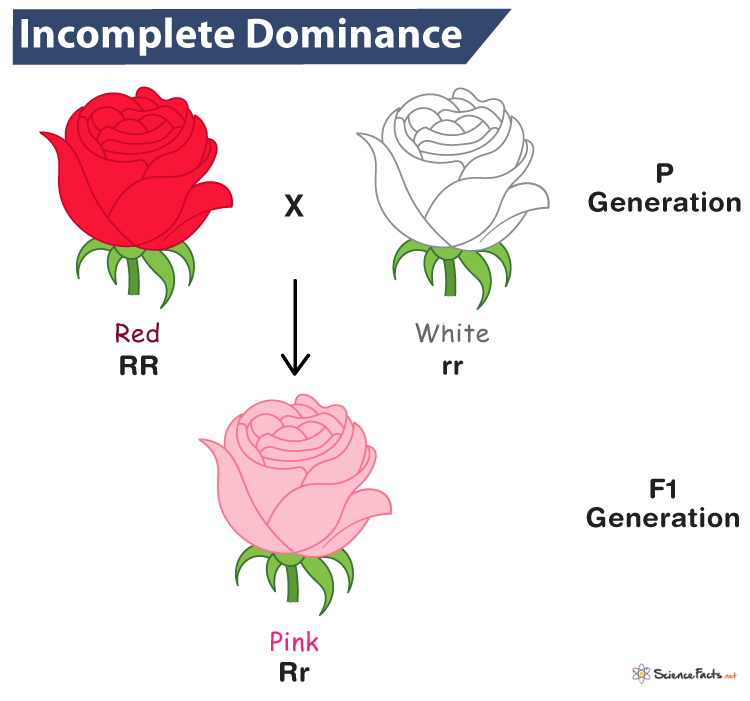
Incomplete dominance: the phenotype of F1 hybrids is somewhere between the phenotypes of the 2 parental varieties; a blend
Example: Crossing a homozygous red snapdragon with a homozygous white snapdragon produces offspring with pink flowers
Codominance: 2 dominant alleles affect the phenotype in separate, distinguishable ways
Example: Human ABO blood groups (where type AB expresses both A and B antigens equally)
Example: Roan cattle have red and white hair alleles that show up together as distinct patches

Multiple Alleles
Most genes exist in populations in more than two allelic forms
For example, the four phenotypes of the ABO blood group in humans are determined by three alleles for the enzyme (I) that attaches A or B carbohydrates to red blood cells: IA, IB, and i.
The enzyme encoded by the IA allele adds the A carbohydrate, whereas the enzyme encoded by the IB allele adds the B carbohydrate; the enzyme encoded by the i allele adds neither
Pleiotropy
One gene controls or impacts several different traits
Ex: a mutation in one gene changes eye color, heart function, and skeletal growth simultaneously
Pleiotropic alleles are responsible for multiple symptoms of certain hereditary diseases (ex: vision problems, swollen hands and feet, fragile blood cells can all be due to cystic fibrosis)
Polygenic Inheritance
Some traits may be determined by two or more genes
The opposite scenario of pleiotropy, where multiple distinct genes combine to influence a single trait (such as human height or skin color)
Quantitative variation: additive of 2 or more genes on a single phenotype; ex: skin color (usually indicates polygenic inheritance)
Epistasis
A gene at one locus alters the phenotypic expression of a gene at a second locus
Example: in mice, coat color depends on 2 genes: one gene determines pigment color (B for black and b for brown), the other gene determines whether the pigment will be in the hair (C for color and c for no color)

Sometimes the phenotype for a trait depends on the environment as well as on the genotype
Example: hydrangea flowers of the same genotype range from blue-violet to pink, depending on soil acidity
An organism’s phenotype:
includes its physical appearance, internal anatomy, physiology, and behavior
reflects its overall genotype and unique environmental history
Humans are not good subjects for genetic research:
– Generation time is too long
– Parents produce relatively few offspring
– Breeding experiments are unacceptable
• However, basic Mendelian genetics endures as the foundation of human genetics

