Memory Revision
What are the Three Key Memory Processes?
Encoding
Storage
Retrieval
What is Encoding?
Encoding is mentally processing information so that it can be entered into memory
What is Storage?
Storage is holding a piece of information for a period of time
What is Retrieval?
Retrieval is accessing or recalling stored memories when needed.
What is declarative memory?
Declarative memory involves facts and events that an individual knows and can be put very well into words and can describe easily.
What is non-declarative memory?
Non-declarative memory involves skills and habit learning and other forms of behaviour that are expressed through performance rather than verbal recollection.
What are the Three different Types of Long Term Memory?
The three different types of memory are:
Episodic memory
Semantic memory
Procedural memory
What is EPISODIC MEMORY?
Episodic memory is a long term memory store for personal events and includes memories of when the events occured and memories of the people, objects, place and behaviours that were involved in the event.
Memories from this store have to be retrieved consciously and with effort.
An EXAMPLE of episodic memory is knowing and remebering a recent visit to the dentist.
What is SEMANTIC MEMORY?
Semantic memory is a long term memory store for out knowledge of the world. Semantic memory includes facts and our knowledge of what words and concepts mean.
Memories in the semantic memory usually need to be recalled deliberately.
An EXAMPLE of semantic memory is knowing and recalling that the capital of France is Paris.
What is PROCEDURAL MEMORY?
Procedural memory is a long term memory store for our knowledge on how to do things. Procedural memory includes our memories of learned skills.
Memories in procedural memory are usually recalled without conscious effort or deliberate effort.
An EXAMPLE of procedural memory is knowing and remembering how to tie your shoe laces.
What are the differences between LONG TERM MEMORY and SHORT TERM MEMORY?
Short Term Memory is acoustically encoded which is encoding by sound.
Short Term Memory has a very limited capacity.
The duration of Short Term Memory is 18 to 30 seconds if the new information is not rehearsed.
Long Term Memory is encoded semantically which means that Long Term Memory is encoded by meaning
Long Term Memory has a virtually unlimited capacity as, in the Long Term Memory, there will always be more space for more memories.
The duration of Long Term Memory could last a lifetime.
What is the MULTI-STORE MODEL of Memory?
The multi-store model of memory first starts of with sensory memory. Sensory memory is when a stimulus from the environment around us, such as the sound of a persons name, passes into the sensory memory along with other stimuli such as tastes, feelings and sights. This part of the memory is not just one store, but several as there is one store for each of the five senses. The two main stores in the sensory memory are called the ‘iconic memory’ (which is visual information that is coded visually) and the ‘echoic memory’ (which is sound or orditory information that is coded acoustically). Material in the sensory mmeory only has a duration of half a second. Sensory memory has a very high capcity however, with there beeing 100 million cells in each eye that are all storing data. Very little of what passes into the sensory memory makes it deeper into memory unless attention is paid to it. Information in sensory memory is lost through decay.
Short Term Memory has a limited capacity store because it can only contain a certain amount of pieces of information before forgetting takes place. The capacity of the Short Term Memory is roughly 5-9 pieces of information. Information in the Short Term Memory is coded acoustically and the duration of the Short Term Memory has a duration of 18 to 30 seconds unless rhe information in the Short Term Memory is rehearsed. Maintenance rehearsal occurs when we repeat to ourselves over and over again and we can keep information in the Short Term Memory as long as it is rehearsed. Information in Short Term Memory is lost through decay or dsplacment.
Long Term Memory is the potentially permanent memory store. For information that has been rehearsed for a prolonged amount of time, the rehearsal then passes the information into the Long Term Memory. Psychologists believe that the capacity of the Long Term Memory is unlimited and that the duration of the Long Term Memory can last for many years or even a life time. The coding of the Long Term Memory is mainly semantic (which means that the Long Term Memory is coded by meaning). An examople of the Long Term Memories duration is Bahrick’s study in 1975 which found that many of their participants were able to recognise the names and faces of their school classmates almost 50 years after graduating. We also see that the Long Term Memory is coded sematically, in terms of meaning. Although the information in the long term memory is stored in the long term memory, when we need to recall the information, it must be passed back through to the short term memory. This is true for all memories that are stored in the Long Term memories. Information in the Long Term Memory is lost/forgotten through decay, retrieval failure and intereference.
What are some EVALUATIVE POINTS of the Multi-Store Model of memory?
An advantage of the Multi-Store Model of memory is that there is research to suppport it.One piece of research is HM that was done by Milner in 1965. During this time, meory was thought to be monolithic and all of it just being stored throughout the brain. HM had his hippocampus removed (which was vital for storing long term memories). However, after some research, it was found that although HM had lost uis ability to form long term memories, he could still retain information long enouh to recall things like numbers and recalling them when he repeated them to himself over and over again. This therefore proves that there is a distinction between long term and short term memory and it also proves that there is evidence for rehearsal helping information be stored.
A disadvantage of the Multi-Store Model of memory is that it is too simplistic in the sense that there is more than one type of rehearsal. According to the Multi-Store Model, what matters in rehearsal is the amount that you do. So the more and more you repeat a piece of information to yourself, the higher the chance that this information will be stored in the Long Term Memory. However, Watkins had discovered that there is another type of rehearsal. Elaborative reheasal is when you pair a piece of information to your existing knowledge or thonk about what it means. This is a limitation because the Multi-Store Model of memory cannot explain this.
Another disadvantage of the Multi-Store model of memory is that it uses artificial stimuli. In normal life, we form memories related to useful things such as peoples names and faces. But research that backs up the Multi-Store model of memory uses artificial stimuli such as digits and letters. This is a limitation because these things are arbitrary and do not reflect what people from memories of in their day to day lives.
What are the Three different Types of Long Term Memory?
The three different types of Long Term Memory are:
Episodic memory
Semantic memory
Procedural memory
What is Episodic Memory?
Episodic memory refers to our ability to recall events (also known as episodes) from our lives. this can be things such as a memory of a trip to the dentist. These memories can be comnplex. Firstly, memories in the Episodic Memory are ’time stamped’, which means that we can remember when they happened. Secondly, a memory of a single event will include several elements to it such as the people that were involved, objects, places and behaviours which all come together to produce a single memory. Thirdly, a conscious effot has to be made to recall episodic memories.
What is Semantic Memory?
Semantic memory is a store that contains our knowledge of the world. This includes facts, but in the broadest possible sense. The Semantic Memory has often been likened to a combination of an encyclopaedia and a dictionary. The Semantic Memory includes knowledge of things such as the taste of an orange and the meanings of words. The Semantic Memory also includes knowledge of an impressive number of concepts such as ‘animals’ and ‘love’. Memories in the Semantic Memory are not ’time stamped’ meaning that we can not recall when we first learned this knowledge. Semantic Memory is also less personal and is more about facts that the majority of people share, however, the Semantic Memory is much more that just facts.
What is Procedural Memory?
The Procedural Memory is our memory of skills and actions. This is basically how to do things. We can recall these memories without conscious effort. An example of Procedural Memory is tying shoelaces. These are the sorts of skills taht we may find difficult to explain to someone else.
What are some Evaluative Points on the different types of Long Term Memory?
One advantage of the different types of Long Term Memory is that there is real life application to them. Being able to identofy the different aspects of the Long Term Memory allows psychologists to target certain kinds of memory in order to better people’s lives. Belleville in 2006 demnonstrated that episodic memories could be improved in older people who have mild cognitive impairment. The trained participants performed better on a test of episodic memory after training than a control group. This is an advantage because it shows that there is some practical and real life use to the different types of Long Term Memory and are not just theories.
Another advantage of the different types of Long Term Memory is that there is neuroimaging evidence to support it. Tulving in 1994 got their participants to perform various memory tasks while their brains where scanned using PET scanners. They foudn that episodic and semantic memories were both recalled from an area of the brain known as the prefrontal cortex. This area is divided into two, one on each side (or hemisphere) of the brain. This is an advantage because it supports the view that there is a physical reality to the different types of Long Term Memory within the brain. It has also been confirmed many ties in later research studies.
What is the WORKING MEMORY MODEL?
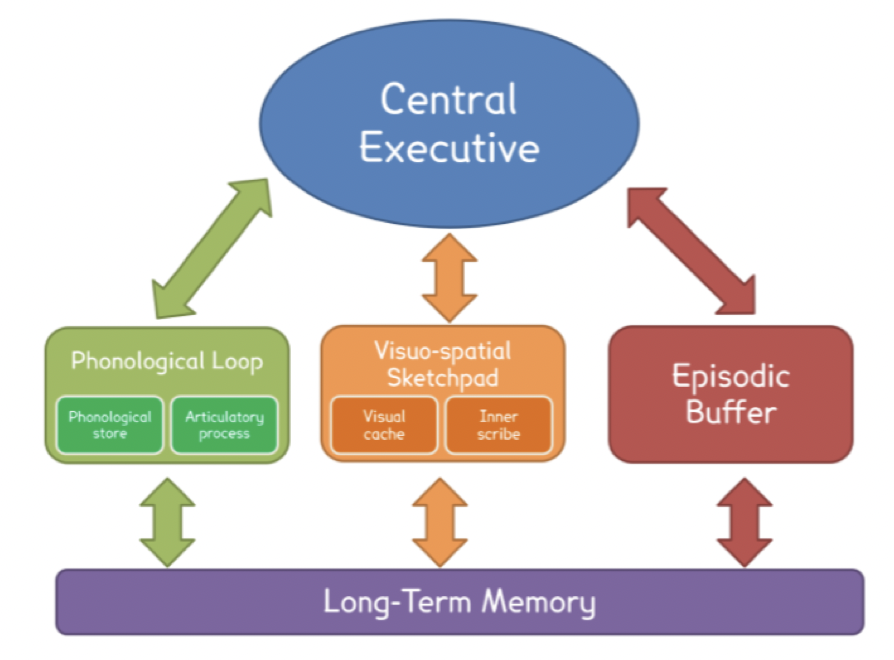
What are the different components of the Working Memory Model?
The central executive
The phonological loop - which is broken down into:
The phonological store
The articulatory process
The visuo-spatial sketchpad - which is broken down into:
The visual cache
The inner scribe
The epidodic buffer
What is the Central Executive in the Working Memory Model?
The Central executive is essentially an attentional process that monitors data, makes decisions and then allocates slave systems to tasks. The central executice has a very limited processing capacity.
What is the phonological loop in the Working Memory Model ?
The phonological loop is one of the slave systems and deals with auditory information and so the phonological loop’s coding is acoustic. The phonological loop preserves the order in which information arrives. The phonological loop can then be broken down into:
The phonoligical store which stores the words that we hear.
The articulatory process which allows maintenance rehearsal to take place
The capacity of the phonoligcal loop is believed to be two seconds woth of words that we can say
What is the Visuo-Spatial Sketchpad in the the Working Memory Model?
The Visuo-Spatial Sketchpad is another one of the slave systems. The Visuo-Spatial Sketchpad stores visual and spatial information when required.
For example if you were asked to work out how many windows there are in your house, you would be able to do it by visualising your house.
The Visuo-Spatial Sketchpad has a lmited capacity, which, according to Baddeley in 2003, is about three or four objects long.
The Visuo-Spatial Sketchpad can then be broken down into:
The visual cache which stores visual data
The inner scribe which records the arrangements of objects in a visual field.
What is the Episodic Buffer in the Working Model of Memory?
The Episodic Buffer is the third and final part of the slave system. The Episodic Buffer is a temporary store for information, intergrating the visual, spatial and verbal information processed by other stores and maintaining a sense of time sequencing.
The Episodic Buffer can be seen as the storage component of the Central Exective and the the Episodic Buffer has a limited capacity of about four chunks.
What are some Evaluative Points of the Working Model of Memory?
One disadvantage of the Working Model of Memory is that the expeirments that support the Working Model of Memory have low ecological validity in the sense that the tasks that are involved in the experiments do not reflect how memory is used in peoples day to day lives and so clear generalisations cannot be made from these experiments.
Another disadvantage of the Working Model of Memory is that there is a lack of clarity over the Central Executive. Psychologists argue that the Central Executive compomonent of the Working Model of Memory is unsatisfactory and does not really explain anything. Baddeley himself recognised this as he stated that the Central Executuve is the most important but least understoood component of the Working Model of Memory.
What are the two theory's of Forgetting?
Interference
Retrieval failure due to the absence of clues.
What is Interference?
Interference is when forgetting occurs due to one memory blocking another, which causes both memories to be distorted or forgotten.
What is Proactive intereference? Give an example of Proactive Interference.
Proactive interference is the disruptive effect of prior learning on the recall of new information
An example of Proactive Interference is when when you change an old passoword to a new password, but then when going to type in the new password, you can only recall the old password.
What is Retroactive Interference? Give an example of Retroactive interference.
Retroactive Inteference is the disruptive effect of new learning on the recall of prior learning
An example of Retroactive Interference is when an individual has known how to speak French for years, and then takes a course to learn Spanish, the Spanish then interferese with the already learnt French.
What piece of research backs up Retroactive Interference?
The piece of research that backs up Retroactive Interference was done by McDonald and they had studied Retroactive Interference by setting up an experiment where participants had to learn a list of 10 words until they could remeber the words with 100% accuracy. They were then given a list to learn. There were 6 groups of participants who had to learn different types of lists.
Group 1 - Had to learn words that were synonymous
Group 2 - Had to learn words that were antonyms
Group 3 - Had to learn words that were unrelated
Group 4 - Had to learn words that were consonant syllables
Group 5 - Had to learn 3 digit numbers
Group 6 - Were given no new list, the participants of Group 6 just rested.
The results from McDonalds study had shown a higher recall from the original list if the participants just rested, compared to if the participants were given a second list to remember.
This therefore backs up the retroactive interference theory as it shows that new learning csan interfere with our ability to recall prior information.
What are some Evaluative Points on the Interference Theory of forgetting?
A strength of the Interference Theory of Forgetting is that there are many other lab experiments that have been carried out into the Interference Theory of Forgetting. Most of these studies sjow that the Interference Theory of Forgetting is a likely way of how we forget information. This is an advantage because lab experiments control the effects 0f irrelevants influences.
A weakness of the Interference Theory of Forgetting is that the research used to back up the theory use artificial tasks. This is a disadvantage because these tasks are more arbitrary and so aren’t a true reflection of how people forgetting information in real life and itr makes interference more likely in a lab.
What is Retrieval Failure due to the Absence of Cues?
Retrieval Failure due to the Absence of Clues is when forgetting occurs due to the absence of the cues that are necessary to recall a memory. The memory is there but you can’t get it.
The reason people forget information is because of insufficient cues. When information is placed in memory, there are aslo associated cues that are stored at the same time. If these are not available at the time of recall, then it may appear as it the memory was forgotten, but in fact, it is due to retrieval failure which is not being able to access the memories that are there.
What is the Encoding Specificity Principle?
Tulving (1983) had reviewed research into retrieval failure and discovered a consistent pattern to the findings. The Encoding Specificty Principle states that if a cue is to help us recall information then it has to be present at the time of encoding and also present at the time of recall. The Encoding Specificity Principle then states that if the cues that were available at encoding are different to the ones available at recall, there will be some forgetting.
What is Context Dependent Forgetting?
Context Dependent Forgetting was discovered by Godden (1975). Godden carried out a study on divers working underwater. In the study, the divers learned a list of words either under water or on land, and then recalled the list of words either under water or on land. There were four conditions in Godden’s study which were:
Learn on land - recall on land
Learn on land - recall underwater
Learn underwater - Recall underwater
Learn underwater - recall on land.
The results of Godden’s study was that there was less forgetting when learning and recall happened in the same conditions. E.g. learn on land - recall on land.
This is therefore evidence of retrieval failure due to the absence of cues because when recalling and learning in the same conditions, there will also be the same cues present, therefore allowing for less forgetting when the same cues are present.
What are some Evaluative Points on Retrieval Failure due to the Absence of Cues?
One advantage of ‘retrieval failure due to the absence of cues’ is that Michael argues that retrieval failure due to the absence of cues is likely to be the main reason for forgetting from the Long Term Memory. This is an advantage because it increases the validity of the explanation.
A disadvantage of ‘retrieval failure due to the absence of cues’ is that Baddeley argues that cintext effects are actually not very strong, especially in real life. Different contexts have to be very different for there to be a visible effect on recall ability. Therefore when applying this to real life, the only other environment that is different to land is underwater. This means that in real life application, learning something in one room and attempting to recall it in another will likely not have a visible affect on recall as the environments are likely not to be that different. This is a disadvantage because it means that the real life applications of retrieval failure due to context cies don’t actually explain much about forgetting.
What are the Two types of Misleading Information that can affect the accuracy of Eyewitness Testimonies?
The two types of misleading information that can affect the accuracy of eyewitness testimonies are:
Leading questions
Post-Event Discussion.
What was Loftus and Palmers study into leading questions?
Loftus and Palmer (1974) had arranged for students (who were participants) to watch film clips of a car accident and then gave them questions about the accident. In the criticial question, (which was a leading question) participants were asked to describe how fast the car was going. “About how fast were the cars going when they hit eachother?” This question was a leading question because the verb ‘hit’ suggests the speed that the cars were going. There were five groups of participants, and each group was given a different verb in the criticial question. One group had ‘hit’, others had ‘contacted’, ‘bumped’, ‘collided’, ’smashed’.
What were the results from Loftus and Palmer’s study into leading questions?
The results from Loftus and Palmers study in leading questions were that the mean estimate speed was calculated for each participant group. The verb ‘contacted’ resulted in a mean estimate speed of 32 mph. For the verb ’smashed’, the mean was 41 mph. The leading question biased the eyewitnesses recall of the event.
What are the two explanations for why leading questions affect the accuracy of eyewitness testimonies?
The first explanation of why leading questions affect the accuracy of eyewtiness testimonies is the response bias effect. The ‘response bias affect’ argues that the wording of the question has no real effect on the participants memory of the event, but instead just influences how the participant chooses to answer. For example, when a participant got a leading question using the word ’smashed’, this encouraged them to choose a higher speed estimate
The second explanation of why leading leading questions affects that accuracy of eyewitness testimonies is the substitution explanation. The substitution explanation suggests that the wording of the leading question actually does change the participants’ memories of the clip. This was shown as the participants who originally heard ’smashed’ were more likely to report seing broken glass (when there wasn’t any) than those who heard the verb ‘hit’. The critical verb altered the participants memory of the event
What are some Evaluative Points of the theory that leading questions affecting the accuracy of eyewitness testimonies?
One disadvantage of Loftus and Palmers’ study into leading questions affecting the accuracy of eyewitness testimonoies is that they used an artificial task. In the study, participants were asked to watch a clip of the accident. This is very different from witnessing a real accident, mainly beacuse such clips lack the stress if a real incident as there is research that shows that emotions can affect memory. This is a disadvantage beacuse it does not reflect how leading questiions affect eyewitness testimonies in real life incidents.
One advantage of the theory that leading questions affects tha accuracy of eyewitness testimonies is that ir has practical uses in the real workd, where consequences of inaccurate eyewitness testimonies can be very serious. This is an advantage as it shows that leading questions can actually have an affect on eyewitnesses memories and not just in studies.
What was Gobberts research into Post-Event Discussion?
Gobbert (2003) had participants watch a short film where a girl went to borrow a book. However, there were two clips of the event (which is similar to two eyewitnesses watching the same evnt from different perspectives) and so the two clips showed different pieces of evidence from the event. After watching the clip, the participants then completed a questionnaire about the clips they had watched. One group of participants watched one clip of the event which showed one perspective, and the other group of participants watched watched the second clip of the event which showed a different perspective to the first, and so showed different evidence.When completing the questionnaire, one group of participants did not talk about the clip and answered the questionnaire independently, where as the other group of participants engaged in post event discussion about the clip before completing the questionnaire.
What were the results of Gobberts research into Post-Event Discussion?
The results of Gobberts research into Post-Event Discussion is that 71% if the participants who discussed the event that they had seen in the clip had went on to mistakenly recall evidence in the clip comapred to 0% of the control group that did not discuss the event they had seen.
Gobberts research shows that Post-Event Discussion affects the recall ability and what an individual will recall about an event.
What are the two explanations for why Post-Event Discussion affects the accuracy of eyewitness testimonies?
The first explanation for why Post-Event Discussion affects the accuracy of eyewitness testimony is the ‘Memory Conformity’ explanation. The Memory Conformity explanation is when the individual has spoken about the event to someone else who had also witnessed the event and then goes along with what the other person said happened. This is because the individual may think taht they are wrong and that the other person is right. However, the individual has no change to their memory.
The second explanation for why Post-Event Discussion affects the accuracy of eyewitness testimonies is the ‘Memory Contmination’ Explanation. The Memory Contamination explanation is when individuals who have witnessed an event engage in post event discussion which then forms what the individual will recall if or when they are asked to recall what they witnessed at the event. In the memory contamination explanation, there has been a change to the individuals memory.
What are some Evaluative Points on the theory that Post-Event Discussion affects the accuracy of eyewitness testimony?
One disadvantage of Gobbert’s research into post event discussion is that it uses artificial tasks. Watching a clip of an event is no way comparable to witnessing an event such as a serious crash or crime in real life. This is a disadvantage bec ause it does not truly represent how Post-Event Discussion can affect the accuracy of eyewitness testimonies.