NATIONAL INCOME
National income is the total value of all goods and services produced over a specific time period within a country's economy. It is typically measured on an annual basis and includes the value of production from various sectors such as agriculture, manufacturing, and services. National income can be assessed using different approaches, including the production approach (total output), the income approach (total income earned), and the expenditure approach (total spending). It serves as an important indicator of a country's economic health and is used to inform policy decisions.
features of national income
marco economic concept = national income is a key macroeconomic concept that reflects the overall economic performance and wealth generation of a nation
Net aggregate value : National income includes net value of goods and services produced and does not include depreciation cost. (i.e. wear and tear of capital assets
Net income from abroad : National income includes net income from abroad i.e. difference between export value and import value (X-M) and net difference between receipts from abroad and payments made abroad (R-P).
financial year : National income is always expressed with reference to a time period. In India, it is from 1st April to 31st March
low concept : National income is a flow concept as it shows flow of goods and services produced in the economy during a year.
Money value : National income is always expressed in monetary terms. It represents only those goods and services which are exchanged for money
circular flow of two sector
the upper segment represnt factor market and lower segment represnt money markert
the factor of production flows from household to firm . the firm uses the factor to produce goods and services required by household
thus goods flows from household to firm and firm to household . it is called factor flow
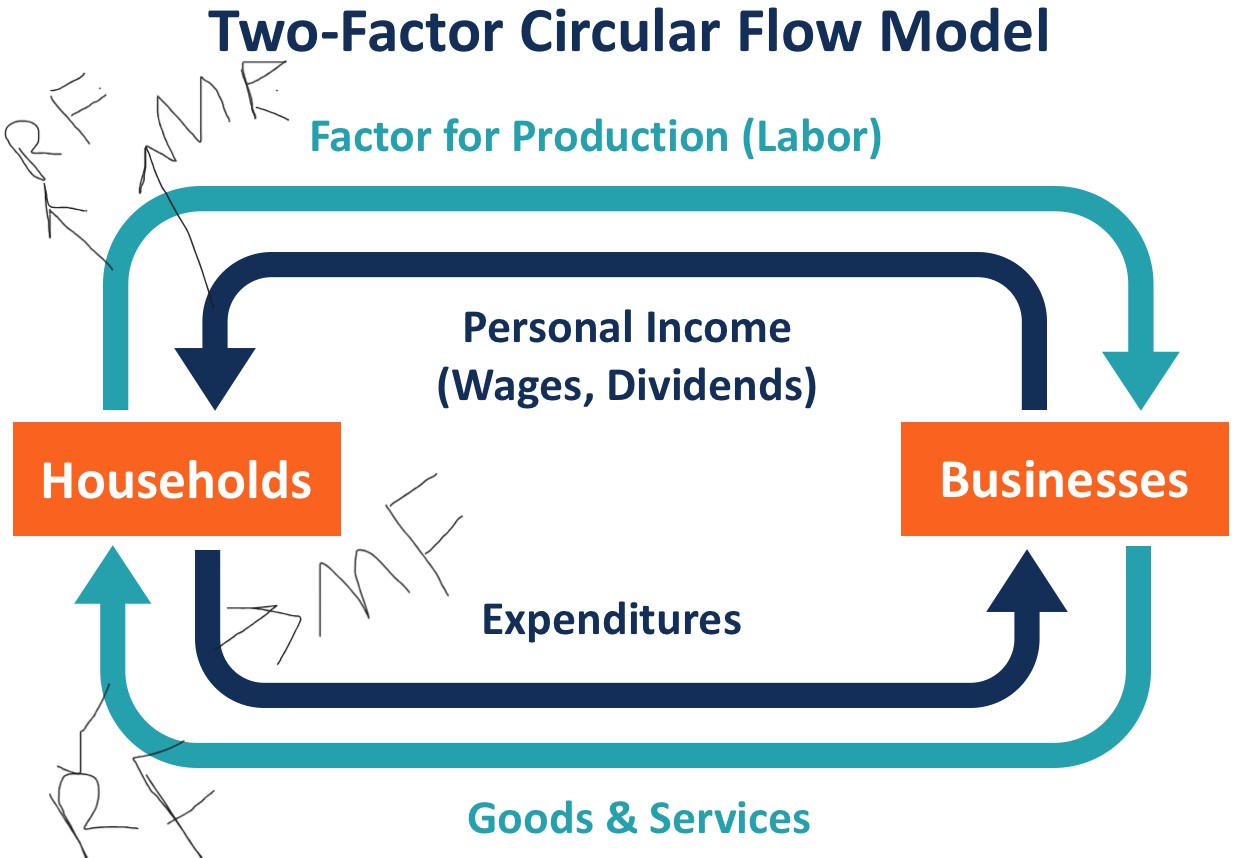
similary money flows from fiem to household in the factor payment such as rent wages and income that are requied by household
money flows from firm to the household and from the household to fiem called money flow
different concepts of national income
Gross Domestic Product (GDP) : Gross Domestic Product is the gross market value of all final goods and services produced within the domestic territory of a country, during a period of one year. ∴ GDP = C + I + G + (X-M) ,Where C = Private consumption expenditureI = Domestic Private InvestmentG = Government's consumption and Investment ExpendituresX - M = Net export value (Value of Exports - Value of importsNet Domestic Product (NDP) : Net Domestic Product is the net market value of all final goods and services produced, within the territorial boundaries of a country, during a period of one year. ∴ NDP = GDP – Depreciation.
Gross National Product (GNP) : Gross National Product means the gross value of final goods and services produced annually in a country, which is estimated according to the price prevailing in the market. ∴ GNP = C + I + G + (X-M) + (R-P). (R = receipts from abroad and P = payments
net national product:-NP = GNP – Depreciation
GNP=C + I + G + (X-M) + (R-P)
dep= ware and tare of assets or goods and services
meathods to measure NI
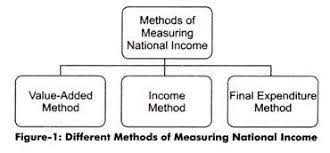
output method
his method of measuring national income is also known as product method or inventory method.
This method approaches national income from the output side
economy is divided into different sectors, such as agriculture, mining, manufacturing etc
he output or product method is followed either
by valuing all the final goods and services, produced during a year.
by adding up all the values at each higher stage of production, until these products are turned into final products
utmost care must be taken to avoid multiple or double counting.
To avoid double counting this method suggests two alternative approaches for the measurement of GNP.
final Goods Approach / The Final Product Approach
inal goods are those goods which are ready for final consumption. According to this approach, value of all final goods and services produced in primary, secondary and tertiary sector are included and the value of all intermediate transactions are ignored. Intermediate goods are involved in the process of producing final goods, that is, the final flow of output purchased by consumers. Hence, the value of final output includes the value of intermediate products
Thus, a separate accounting of the values of intermediate goods, along with the accounting of the value of final product, would mean double counting. To avoid this, the value of only the final product or goods must be computed.
value Added Approach / The Value Added Method
in order to avoid double counting value added approach is used. According to this approach, the value added at each stage of the production process is included. The difference between the value of final outputs and inputs, at each stage of production is called the value added. Thus, GNP is obtained as the sum total of the values added by all the different, stages of the production process, till the final output is reached in the hands of consumers, to meet the final demand.
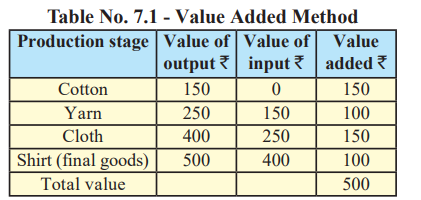
alue added at each stage is calculated bydeducting the value of inputs from the value of output produced. The sum total added at different stages make GNP. In the above table the value of final good (Shirt) is
500. The sum total of value added at each stage of production is also500. Thus the total value added is equal to the value of final goods. (150 + 100 + 150 + 100 = 500
Precautions
1) To avoid double counting, only the value of final goods and services must be taken into account.
2) Goods used for self consumption by farmers should be estimated by a guess work. Imputed value of goods produced for self consumption is included in national income.
3) Indirect taxes included in the market prices are to be deducted and subsidies given by the government to certain products should be added for accurate estimation of national income.
4) While evaluating output, changes in the price level between different years must be taken into account.
5) Value of exports should be added and value of imports should be deducted.
6) Depreciation of capital assets should be deducted.
7) Sale and purchase of second hand goods should be ignored as it is not a part of current production.
Output method is widely used in the underdeveloped countries. However, it is less reliable because of the margin of error. In India, this method is applied to agriculture, mining and manufacturers, including handicrafts. But it is not applied for transport, commerce and communication sectors in India.
Expenditure Method
This method of measuring national income is also known as Outlay Method
.According to this method, the total expenditure incurred by the society, in a particular year, is added together. Income can be spent either on consumer goods or on capital goods. Thus, we can get national income by summing up all consumption expenditure and investment expenditure made by all individuals, firms as well as the government of a country during a year.Thus, gross national product is found by adding up
NI = C + I + G + (X–M) + (R–P)
Private Final Consumption Expenditure(C)=Private Final Consumption Expenditure(C) by households on non-durable goods, such as food, which are used immediately; expenditure on durable goods such as car, computer, television set, washing machine etc., which are generally used for a longer period of time; and expenditure on services like transport services, medical services, et
Gross Domestic Private Investment Expenditure (I) : It refers to expenditure made by private businesses on replacement, renewals and new investment (I)
3) Government Final Consumption and Investment Expenditure (G) :i) Government's final consumption expenditure refers to the expenditure incurred by government on various administrative services like, law and order, defence, education, health etc. ii) Government's investment expenditure refers to the expenditure incurred by government, on creating infrastructural facilities like construction of roads, railways, bridges, dams, canals, which are used by theusiness sector for production of goods and services in any economy (G).
4) Net Foreign Investment/Net Exports : It refers to the difference between exports and imports of a country during a period of one year.
5) Net Receipts (R-P) : The difference between expenditure incurred by foreigners on domestic goods and services (R) and expenditure incurred abroad by residents on foreign goods and services (P).
Precautions:
While estimating national income by Expenditure Method, the following precautions should be taken.
1) Expenditure on all intermediate goods and services should be ignored, in order to avoid double counting.
2) Expenditure on the repurchase of second hand goods, should be ignored, as it is not incurred on currently produced goods.
3) Expenditure on transfer payments like scholarships, old age pensions, unemployment allowance etc., should be ignored.
4) Expenditure on repurchase of financialassets such as shares, bonds, debentures et
5) Indirect taxes should be deducted.
6) Expenditure on final goods and services should be included.
7) Subsidies should be included.
Out of these methods, the Output Method and Income Method are extensively used. In advanced countries like U.S.A. and U.K. the Income Method is popular. Expenditure Method is rarely used by any country because of its practical difficulties. In India, the Central Statistical Organization (CSO) adopts a combination of both output method and income method to estimate national income of India
Precautionsof input method :
While estimating national income by income method, the following precautions should be taken.
1) Transfer incomes or transfer payments like scholarships, gifts, donations, charity, old age pensions, unemployment allowance etc., should be ignored.
2) All unpaid services like services of a housewife, teacher teaching her/his child, should be ignored.
3) Any income from sale of second hand goods like car, house etc., should be ignored.
4) Income from sale of shares and bonds should be ignored, as they do not add anything to the real national income.
5) Revenue received by the government through direct taxes, should be ignored, as it is only a transfer of income.
6) Undistributed profits of companies, income from government property and profits from public enterprise, such as water supply, should be included.
7) Imputed value of production kept for self-consumption and imputed rent of owner occupied houses should be included.
In India, the National Income Committee In India, the National Income Committee
input method
The Income Method, also known as the Factor Cost Method, measures National Income by summing up the incomes earned by all factors of production (land, labor, capital, and entrepreneurship) in an economy during a specific period, usually a year.
types of Incomes Considered:
Rent: Income from land.
Wages: Income from labor.
Interest: Income from capital.
Profit: Income from entrepreneurship.
Mixed Income: Earnings of self-employed individuals using their own land, labor, and capital.
Net Receipts from Abroad:
Includes net income received from abroad (exports-imports and foreign receipts-payments).
formula
National Income (NI)=R+W+I+P+MI+(X−M)+(R−P)
Where:
Theoretical Difficulties or Conceptual Difficulties
1) Transfer payments : Individuals get pension, unemployment allowance etc. but whether these transfer payments should be included in national income or not, is a major problem. On one hand they are a part of individual income and on the other hand, they are part of Government expenditure. Hence, these transfer payments are not included in national income.
2) Illegal income : Illegal incomes like income from gambling, black marketing, theft, smuggling etc. are not included in national income.
3) Unpaid services : For the purpose of calculating national income, only paid goods and services are considered. However, there are a number of unpaid services which are not accounted for in the calculation of national income. For example, services of housewives and the services provided out of love, affection, mercy, sympathy, charity etc. are not included in national income.
4) Production for self consumption : The products kept for self consumption by the farmers and other allied producers do not enter the market. Hence, it is not accounted for in the national Income.
5) Income of foreign firms : According to IMF, income of a foreign firm, should be included in the national income of the country, where the firm actually undertakes
6) Valuation of Government Services : Government provides a number of public services such as law and order, defence, public administration, education, health services etc. The calculation of these services at market price is difficult, as the real value of these services is not known. Therefore, it is difficult to calculate national Income.
7) Changing price level : Difficulties in calculating national income also arise due to changes in price levels. For example, when the price level rises, the national income may show an increase even though the production may have decreased. Also, when the price level falls, the national income may show a decrease even though there may be an increase in production
Practical Difficulties or Statistical Difficulties :
In practice, a number of difficulties arise in the collection of statistical data required for estimation of national income. Some of the practical difficulties are as follows :
1) Problem of double counting : The greatest difficulty in calculating national income is of double counting. It arises from the failure to distinguish properly, between a final and an intermediate product. For example, flour used by a bakery is an intermediate product and that by a household is final product.
2) Existence of non-monetized sector : In India, especially in rural areas, there exists the non-monetized sector. Agriculture, still being in the nature of subsistence farming, a major part of production is partly exchanged for other goods and services. It is excluded while counting national income.
3) Inadequate and unreliable data : Adequate and correct data on production and cost data relating to crops, fisheries, animal husbandry, forestry, construction workers, small enterprises etc., are not available ina developing country. Besides this, data on unearned incomes, consumption and investment expenditure of rural and urban population are also not available. This does not reveal the actual size of national income.
4) Depreciation : Depreciation refers to wear and tear of capital assets, due to their use in the process of production. There are no uniform, common or accepted standard rates of depreciation applicable to the various capital assets. Thus, it is difficult to make correct deductions for depreciation.
5) Capital gains or losses : Capital gainsor capital losses, which accrue to the property owners by increase or decrease in the market value of their capital assets or changes in demand, are not included in the national income because these changes do not result from current economic activities.
6) Illiteracy and ignorance : Due to ignorance and illiteracy, small producers do not keep an account of their production. So they cannot give information about the quantity or value of their output.
7) Difficulties in the classification of working population : In India, working population is not clearly defined. ForInstance, farmers in India are not engaged in agriculture round the year. Obviously, in the off season, they engage themselves in alternative occupations. In such a case, it is very difficult to identify their incomes from a particular occupation.
8) Valuation of inventories : Raw materials, intermediate goods, semi-finished and finished products in the stock of the producers are known as inventories. Any mistake in measuring the value of inventory, will distort the value of the final production of the producer. Therefore, valuation of inventories requires careful assessment
Importance of National Income :
For the Economy : National income data are important for the economy of a country. In present times, the national income data are regarded as accounts of the economy, which are known as ‘Social Accounts’. It tells us how the aggregates of a nation's income, output and product result from the income of different individuals, products of industries and transactions of international trade.
2) National policies : National income data forms the basis of national policies such as employment policy, industrial policy, agricultural policy etc. These figures enable us to know the direction in which the industrial output, investment and saving etc., change. National Income also helps to generate economic models like growth model, investment models etc. Thus, proper measures can be adopted to bring the economy to the right path.
3) Economic planning : For economic planning, data pertaining to national income is very essential. This includes data related to a country's gross income, output, savings, investment and consumption which can be obtained from different sources.
4) Economic Research : National income data are also used by the research scholars of economics. They make use of various data of the country's input, output, income, savings, consumption, investment employment etc., which are obtained from social accounts.
5) Comparison of Standard of Living :National income data helps us to compare the standards of living of people in different countries and of people living in the same country at different times.
6) Distribution of Income : National income statistics enables us to know about the distribution of income in the country from the data related to wages, rent, interest and profits. We understand the disparities in the incomes of different sections of the society