Lecture 3 - Oxygen
Intended Learning Objectives:
Identify key features that distinguish Type I and Type II photosynthetic reaction centres.
Explain how Type I and II reaction centres came together in cyanobacteria and why this allowed them to use water as an electron donor.
Describe the impacts of oxygen production on the planet, triggering the Huronian Ice age, and on life, causing the first mass extinction event
Explain why oxygenation of the atmosphere allowed the evolution of large cells.
Notes:
Covered:
The origin of oxygen - cyanobacteria
How oxygen affected the ancient Earth and life
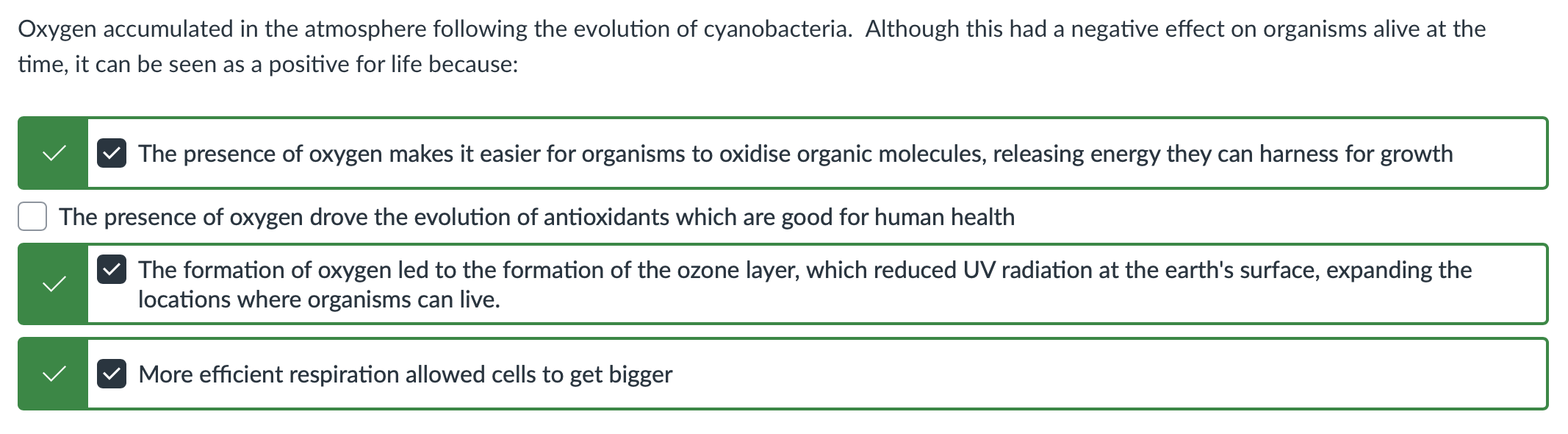
Positives and negatives of oxygen
Reaction Centres:

In reaction centres, chlorophyll is in the middle of the dimeric core.
Energy from light excites the electrons and these feed the ETC.
Reaction Centres - Type 1 and 2
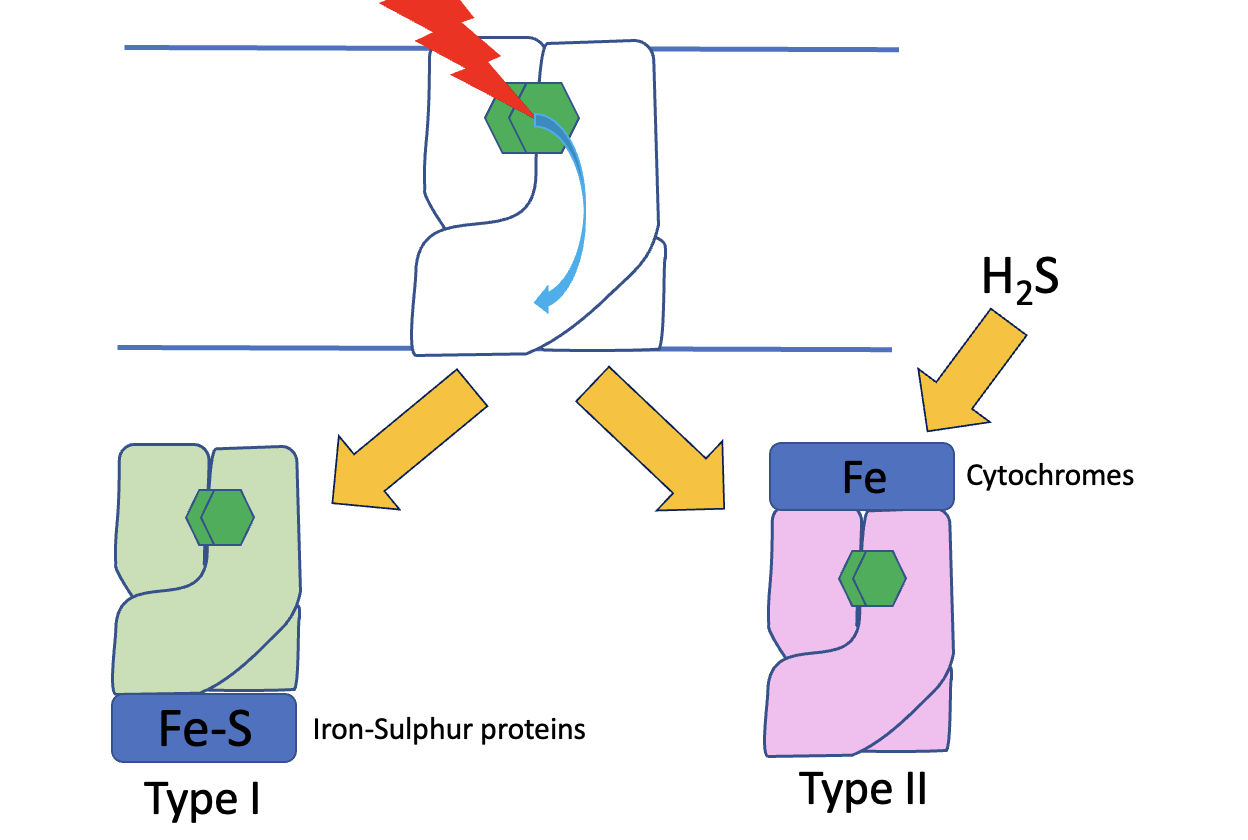
These reaction centres have developed over time. Originally there was only one, but now there are two types. Bacteria can only contain one type, they do not contain both, and they cannot have 2 at the same time.
There is a slight variation in the structures, but they still do the same job. They absorb light which excites the electrons in chlorophyll.
Type I:
Contains Iron-Sulphur proteins
Type II:
Contains cytochromes.
Evolution of Reaction Centres:

Type 1:
Found in green sulphur bacteria - Heliobacteria
Chlorobium tepidum, this is a type of green sulphur bacteria.
Type 2:
Found in purple sulphur bacteria.
Found in purple non-sulphur bacteria.
Found in green non-sulphur bacteria.
Rhodopseudomonas palustris, this is a type of purple non-sulphur bacteria.
The Exception is Cyanobacteria:
This is a ‘blue-green’ algae.
Contains both T1 and T2 reaction centres.
There are many species of cyanobacteria.
They are green due to the photosynthetic pigments they contain.
Cyanobacteria is harmful.
E.g. when you have an algal bloom.
A type of cyanobacteria that can be responsible for this is 4. Microcystis aeruginosa
How can cyanobacteria have BOTH reaction centres?
Can have both based on horizontal gene transfer.

Gene transfer between the bacteria here occurs from the positive end to the negative end, and it is transported in this direction through the pilus.

During conjugation, Type I and Type II are moved into the recipient bacterium.
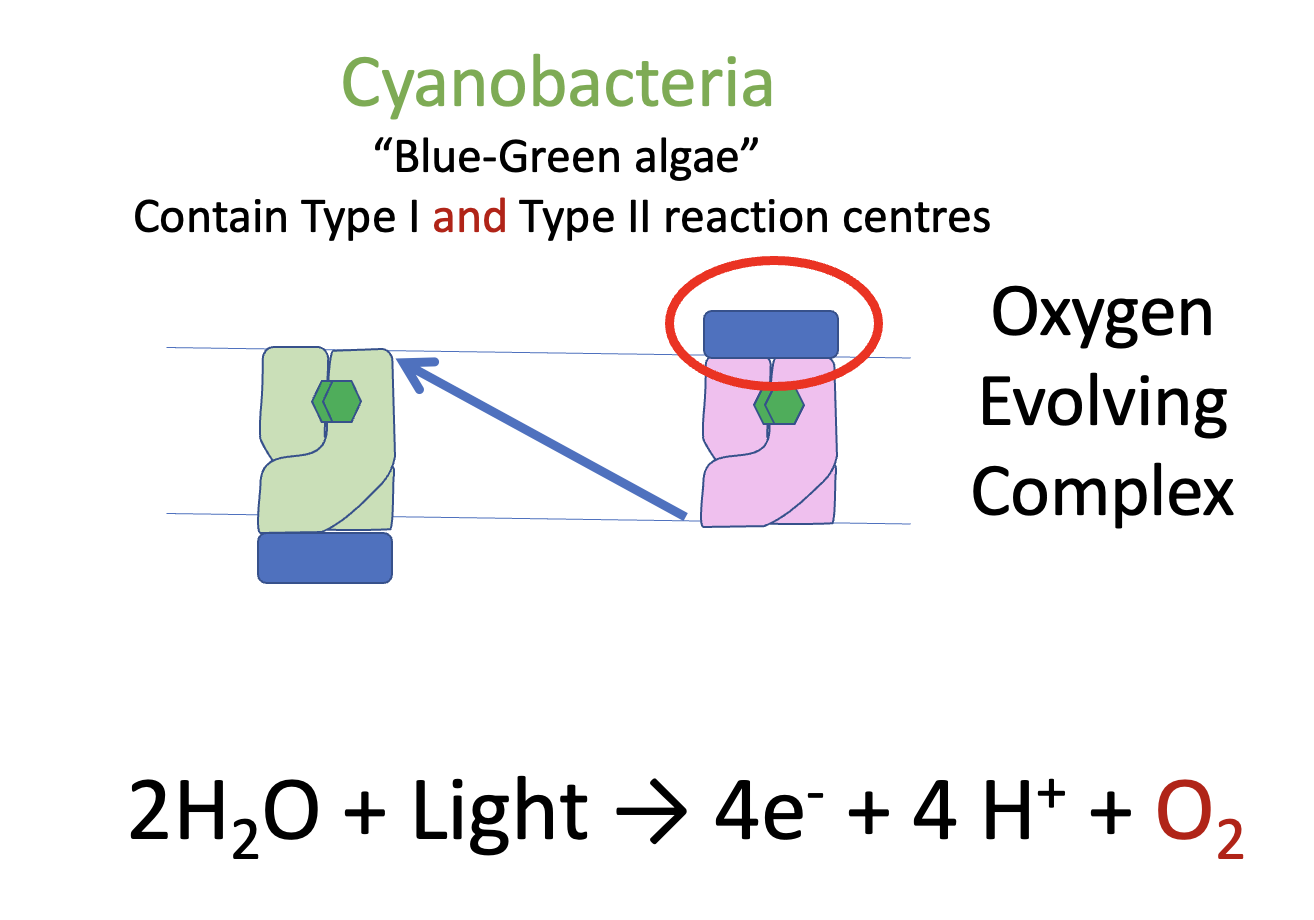
T1 and T2 work as a chain inside the bacteria.
Reaction centre II releases the electrons as light is absorbed.
These electrons are then passed along the ETC and are received by reaction centre I.
However, following this reaction T2 is left deficient of electrons.
This is where the Oxygen Evolving Complex comes in:

^This equation is the reaction that occurs which allows the electrons to be replaced in T2.
As a by-product, oxygen is released.
All ancient bacteria can only have one kind of reaction centre, and so cannot do this reaction. It is unique only to cyanobacteria. After cyanobacteria, we start to see an increase in oxygen levels in the atmosphere. LUCA did not have this.
Cyanobacteria Fossils:
Stromatolites:
Can be formed by the growth of microbial mats of cyanobacteria. Early fossil evidence of life 2.7-2.9 billion years ago.
Lots of fossils of CB that appeared from 2.7-2.9 billion YA.

Bands of iron oxides show evidence of oxygen production - around 2.1 billion years old.

The Oxygen Crisis

It took a long time to fill up the atmosphere and air with oxygen. This is because the sources that take up oxygen had to be saturated before it began to fill up the atmosphere. This included reduced forms of metal ions in the oceans.
Oxygen reduced the concentration of metal ions in the water - as iron and manganese became oxidised, they formed insoluble precipitates which tended to sediment out, making it difficult for organisms to access them.
Oxygen has a tendency to react with biological molecules. The formation of reactive oxygen molecules can lead to damage to cell membranes, making cells leaky, and DNA, causing mutations to occur. As oxygen first appeared, organisms did not have mechanisms to protect themselves from this, so were especially vulnerable.

Following the appearance of an oxygen rich atmosphere, there was a drastic change to the Earth’s climate. The Huronian Ice Age began. This was the first and most deadly ice age, and lasted 300 billion years.
It was a biological cause due to cyanobacteria’s production of oxygen.
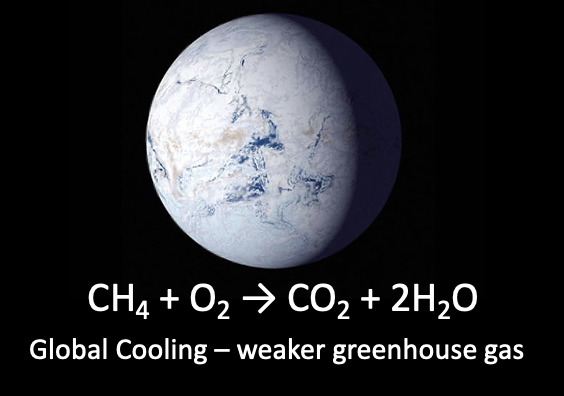
Before O2, earth had been covered in methane. O2 then started to react with methane to form carbon dioxide.
CO2 is a greenhouse has, but methane is a stronger GHG.
So the amount of methane in the atmosphere decreased, as the amount of CO2 increased. This resulted in a global cooling period.
This caused the earth to freeze over, and this is what caused the Ice Age.
The Negatives of Oxygen:

Fenton reaction relates to the last equation on the image.
These reactions led to a mass extinction event due to toxic molecules being produced as a result of oxygen, but some were able to survive it.
The Positives of Oxygen:

Here, O2 reacts with UV to form ozone.
Ozone forms a layer in the stratosphere (2nd closest layer to us in the atmosphere), and this prevents UV light from reaching the Earth’s surface. This allows life to live outside of water.
Previously, organisms that had survived lived in the ocean to avoid harmful UV radiation, e.g. LUCA in hypothermal vents.
With oxygen, a greater amount of ATP is produced during aerobic respiration, as opposed to anaerobic.

Better respiration means BIGGER cells are able to be generated.
^In the equation above (aerobic), more molecules of ATP are produced in the presence of O2. This is a better version of respiration which allows for more growth, so larger cells and organisms can generate. This is a more effective system than using purely anaerobic.
Early Ecosystems:

Transition from chemotrophs to heterotrophs.
Heterotrophs start eating other organisms instead of making their own energy from light.
These heterotrophs are larger than, for example, cyanobacteria, etc.
Summary:
Cyanobacteria - combining photosystems allows for the oxidation of water, leads to a loss of electrons which allows the electrons in PSII to be replaced after they are excited and move down the ETC.
Oxygen is toxic, it caused widespread extinctions and an ice age.
Oxygen changes the atmosphere - the ozone layer appears, and it is now safe for organisms to come out of the water.
Oxygen allows for bigger cells - more efficient respiration, more ATP synthesis, 36>2
Bigger cells evolve to ‘eat’ the smaller cells instead of using chemicals around themselves to source energy - phagocytosis.