S13 - Lecture
Strategic Patenting and the Misuse of the Patent System
The dark side of patent protection: Do patents really stimulate innovation or do they hinder it?
DISCUSSION
RESOURCES AS DUAL SOURCES OF ADVANTAGE: IMPLICATIONS FOR VALUING ENTREPRENEURIAL-FIRM PATENTS HSU & ZIEDONIS. SMJ 2013
WHAT WAS THE MAIN MESSAGE?
Patents provide a signal that helps startups raise capital from prominent VCs
The signaling role of patents is particularly beneficial for those startups that lack alternative means for conveying quality to outside investors
But is this due to patents or better products?? Firms with no patents might have no products!
RECENT RESEARCH ON THIS TOPIC
Recent research shows that startups with patents are more likely to receive venture capital and grow - are they giving money to the start-up bc they have a patent or because they believe in the person?
Farre-Mensa, Hegde, and Ljungqvist (2020, Journal of Finance) shows that startups have;
60% higher probability to obtain VC by 60% after the approval of their first patent application
55% higher employment growth
80% higher sales growth five years later
Compare granted patents with “similar” rejected patents
Patents are randomly assigned to different examiners
Some examiners are strict; other are lenient ⇒ good luck vs bad luck!
looked at patents in which patents where rejected by strict examiners and others accepted by lenient ones
UPDATE ON PATENT EXAMINERS
Interview with the VP of IP for a large multinational
This approach is not valid because companies use AI and «strategic patent drafting» to predict the patent examiners
Barber and Diestre (SMJ, 2022) Can firms avoid tough patent examiners through examiner shopping? Strategic timing of citations in USPTO patent applications
Firms are more likely to cite patents reviewed by “lenient” examiners in their original information disclosure statement (IDS) (sent before the examiner has been selected), and delay citations to patents reviewed by “tough” examiners to subsequent IDS (sent once the examiner has been selected).
some firms are using AI to infer through keywords which examiner will be submitted the patent and therefore will act accordingly to make it easier
lot of strategic behaviour by the companies to manipulate the possibility to receive a patent!
going back to start-up: make sure you have a patent if you can - it increases the probability to have funding
COMPANIES BEHAVE STRATEGICALLY WHEN DRAFTING AND FILING THEIR PATENTS
If having filed patents helps raise capital:
Does rushing to patent fool investors?
In the US, startups get provisional patent applications
Between 75 and 150 dollars - but this diminishes the power of the patent as a signal drastically
For 12 months you can prepare to make the full application
some submit more than one to protect possible developments
Provisional patent applications
A provisional patent application is the first step towards gaining a US patent on a new idea or invention
The “patent pending” label indicates a product that is protected from copycats by a provisional patent application
Is not an actual patent!!
Cheap and fast way to gain protection on an invention for 12mos and allows the inventor to test and perfect a concept prior to filing a full patent
Only have a 12-month window to convert your provisional application to a full non-provisional application. Failing to do so before the deadline could result in the loss of your idea.
ARE PATENTS REALLY PROVIDING INCENTIVES TO INNOVATE?
Premise: patents should be granted for innovations that benefit society but innovator might not be able to cover the investment because of knowledge spillovers
otherwise why should you get a patent if you have no effect on society? but actually lot of people are patenting with no value for society
WHY DO WE CARE ABOUT PATENTS?
COSTS OF PATENTS FOR SOCIETY
Patents create monopoly power
The price of a drug could be too high because of the lack of competition and customers might be unable to access treatment for certain diseases
Innovators might find it difficult to further develop a technology without infringing the rights of patent holders
other companies might need to access patent through licensing (not granted…) to innovate so possible reduction of innovation
Monopoly power problem especially when the protected product is very needed by society, but company targets only those who are willing to pay high price
Litigation costs
companies try to enter in litigation to enforce as much as possible
COSTS OF MONOPOLY POWER
The excessive use of the patent system keeps the prices of the medications at exorbitant levels, often at the expense of American consumers, according to the report from the Initiative for Medicines, Access & Knowledge, or I-MAK, a nonprofit organization that advocates drug patent reform.
EVERGREENING:
Drug companies file, on average, more than 140 patent applications per drug, according to the I-MAK report. Out of those patent applications, 66% of them were filed after the Food and Drug Administration approved the drug to be on the market.
in other words, they develop variations and patent them and this makes it difficult for others to create possible variations of the same pharmaceutical product
PATENT EXPROPRIATION: IS IT RIGHT?
Patent expropriation typically refers to the act of a government or authority taking control of a patented invention without the consent of the patent holder.
In 2012, Natco Pharma, an Indian pharmaceutical company, was granted a compulsory license (at royalty rate of around 6%) to produce a generic version of the drug, which was originally patented by Bayer.
The Indian government's argument was that the cost of Bayer's version made it unaffordable for many patients, and allowing the production of a generic alternative would increase accessibility.
MOST INNOVATIONS ARE CUMULATIVE
these innovations will create additional levels that are only possible because of the applications of the previous innovations. not that frequent in the pharma industry, and then the same principle of continuous innovation is not common. some innovation have previous innovations as prerequisites also for tools.
Touchscreen Technology (First Innovation):
It allowed users to interact directly with the device by touching the screen, eliminating the need for physical keyboards or buttons.
App Ecosystem (Second Innovation based on the First):
Various applications developed for a touchscreen device transformed smartphones into versatile tools for communication, productivity, entertainment, and more.
Biometric Security (Third Innovation based on the First):
The integration of biometric security features like fingerprint scanners and facial recognition became possible ⇒ Enhanced the security of smartphones and streamlined the user authentication process.
CUMULATIVE INNOVATIONS: DO PATENTS WORK WELL?
Suzanne Scotchmer (Journal of Economic Perspectives, 1991); Greene and Scotchmer (RAND, 1995)
How to protect innovations when one piece of new knowledge is based on prior knowledge?
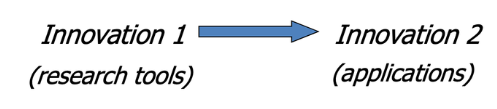
Innovation 1 is a prerequisite for innovation 2
Two different innovators, firm1 and firm2
A NUMERICAL EXAMPLE
Consider two firms: firm 1 (early innovator) and firm 2 (late innovator)
Firm 1 invests 10 units in R&D to develop a new technology for the production of semiconductors that brings a benefit of 13 units.
Firm 2 inspired by the innovation of firm 1 invests other 10 units in R&D to develop a much improved technology that brings a benefit of 18 units, although the benefit of firm 1 is reduced to 8 units.
Should these innovations be developed?
Total cost: 10+10 = 20, Total benefit: 18+8 = 26 ⇒ YES
Should the second innovation be developed?
Cost: 10, Benefits 18–5 = 13 ⇒ YES
Minimum I’m willing to accept is 5 at a negotiation table as the licenser
CASE 1: weak patent on the first innovation
Firm 2 makes 18 – 10 = 8 ⇒ invests in R&D and develops the late innovation
Firm 1 now makes 8 – 10 = - 2 ⇒ anticipating the loss, it does not invest in R&D ⇒ both the first and the second innovations are not developed
CASE 2: strong patent on the first innovation
Firm 2 invests in R&D and then negotiates with firm 1
How much would firm 1 charge? What is firm 1 minimum willingness to accept? What is firm 2 maximum willingness to pay?
If the price for the use of the patent is too high, firm 2 might decide to not invest
ASK AGAIN FOR EXAMPLE (?)
if you give a lot of power to the first innovator, there may be a lot of complications due to 1st innovator not being able to accept less than the profit he is doing, and the second firm innovating cumulatively not breaking even because of little bargaining power, and lots of investment sunk costs
Weak patent protection: Firm 1 might have insufficient incentives to innovate
The total value of innovation 1 includes innovation 2
Innovation 2 can compete with innovation 1
Strong patent protection: Firm 2 might have insufficient incentives to innovate
If a contract for the use of the patented technology is signed after the investment in R&D, firm 2 has weak bargaining power in the negotiation as the cost is sunk
Problem solved with ex-ante contract, but very difficult in practice
PATENT THICKETS
The term "patent thickets" describes technology fields with a high number of patents that have overlapping claims.
either you are going to risk by investing a lot and not being able to sit at the table successfully, or otherwise negotiate licensing before even investing in order to make sure you have a possible exit strategy
Patent thickets are most likely to emerge in "complex technologies", i.e., fields where multiple patents are used to protect products such as smartphones, computers, semiconductors, etc.
Smartphones: the LCD screen, antennas, Wi-Fi standards, processors, batteries.
Semiconductors: integrated circuits, memory chips, even light emitting diode.
Patent thickets are less likely in pharma
PATENT THICKETS ⇒ Companies often acquire licenses for parts of the end product that are patented by others.
WHAT HAPPENS TO THE COMPETITIVE LANDSCAPE WHEN THERE IS A PATENT THICKET?
LITIGATION
Total number of patent litigations in the US has been growing since 1991 at a 6.7% Compounded Annual Growth Rate to a total of more than 5600 cases in 2015
Litigation costs about 15% of total R&D budgets
CROSS-LICENSING
If companies are in the situation where they need to negotiate with other companies—and potentially competitors—to get access to technologies or patents, there is mutual dependence.
Samsung needs licenses from Motorola and Apple to manufacture a smartphone.
Since the other companies also need licenses, they end up granting cross licenses; however, if one company has a bigger patent portfolio, it can demand payment to make the deal work.
EXCESSIVE PATENTING TO BOOST PORTFOLIO TO GAIN BARGAINING POWER IN NEGOTIATIONS
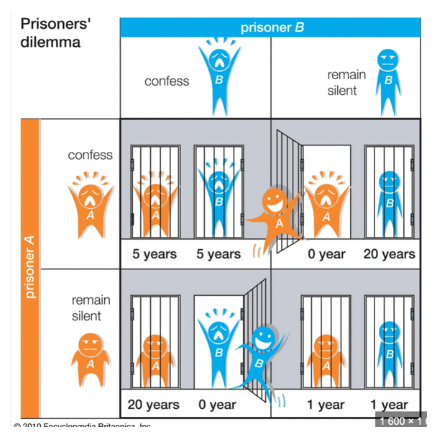
PRISONER DILEMMA
EXCESSIVE PATENTING AS A PRISONER DILEMMA
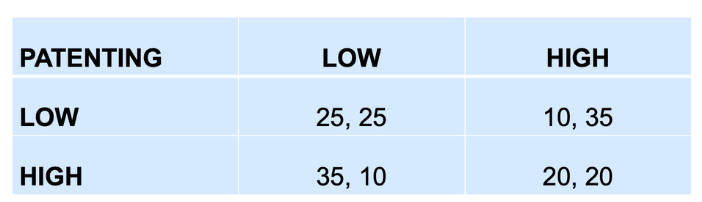
Consider the case with only 2 firms: each firm can just patent to protect its innovations (LOW) or patent excessively (HIGH) to eventually threaten the other company to court
If one firm plays HIGH, it threatens the other firm to court that will settle by paying 15m. However, patent aggresively requires setting up a whole legal unit (including hiring lawyers), which costs of 5m.
If both firms choose to play LOW, they make 25m each
If both firms play HIGH, they will end up cross-licensing their patents and still make 25m each; however, they both pay the cost of excessive patenting
If I know other companies is behaving low, i’ll be the one patenting high. so by expecting this, both companies will want to avoid the disadvantageous situation of patenting little and being suppressed some profit. therefore, everyone patents a lot (high).
Why should these firms patent in excess (i.e. increase in patent propensity)?
 ENTRANTS/SMALL FIRMS → unable to compete → high patenting creates high entry barriers and thus de facto less competition for the incumbents
 PAPER - Ziedonis “DON’T FENCE ME IN: FRAGMENTED MARKETS FOR TECHNOLOGY AND THE PATENT ACQUISITION STRATEGIES OF FIRMS”
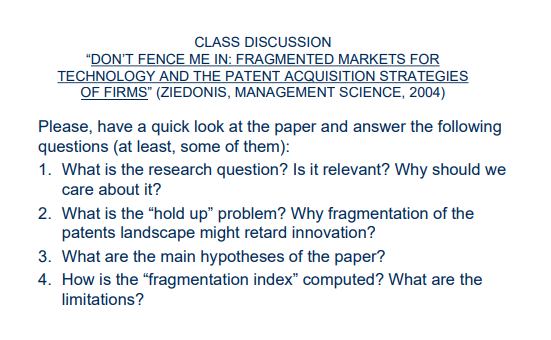
CLASS DISCUSSION
What is the research question? Is it relevant? Why should we care about it?
Why do firms patent →
Key role of patents is to protect innovation, but firms patent for different other reasons, such as for “freedom to operate”.
When large firms are all under risk to infringe each other patents', having a large portfolio of patents help them to better negotiate potential agreements either ex ante or ex post
Yes, it is relevant because we see an explosion of patents in recent decades. For strategy, it explains heterogeneity in firm behaviours (some firms patent more than others). For policy, it suggests that there might be room for intervention.
How does it contribute to the literature? What is new? Describe an empirically relevant phenomenon. Build a novel measure of fragmentation (used by others later). Look at the potential theoretical mechanisms that help identify the correlation
What is the “hold up” problem? Why fragmentation of the patents landscape might retard innovation?
Transaction costs → specific investment, failure of contracts
Hold up → after some (specific) investment has been undertaken, negotiations might steal most of the value created by the investment → reduced incentives for investment (i.e. innovation)
Greater N → greater transaction costs → more strategic behavior → greater uncertainty
What is a Coasian cetting? Why fragmentation is not a problem in a Coesian setting? (complete contracts + no transaction costs lead to efficient solutions independently of the initial distribution of property rights)
What are the main hypotheses of the paper?
Greater fragmentation of technology markets → more patenting (sort of exchange of hostage → improve expost bargaining positions)
Expropriation risks are higher for firms with assets that are costly to redeploy to alternative uses or users → large sunk investment in semiconductor facilities
Both effects are stronger, the stronger the patent enforcement
How is the “fragmentation index” computed? What are the limitations?
Ideal measure should capture the technologies on which the technology of the focal company builds
Measure based on citations (Herfindahl-based → square of the share (1 minus) → so if all citations refer to just one company, the share is 1 and thus 1 - 1 = 0 we have no fragmentation. If citations are spread over infinite number of companies, the share is zero so the index is = 1, its max).
Is this a measure of “real” infringement? → no just likelihood, it is a proxy
It is also suggesting that ex ante contracting is more difficult, less likely
Are citations really antecedents of one technology? Do they imply the need of negotiating the rights? Yes because patents are exclusory rights
Limitations? → not all innovations are patented, negotiations might be required even if patents do not cite
Paper - Heller and Eisenberg “Can patents deter innovation? The anticommons in biomedical research”
Patents cover early stages, pieces of innovations, components, fragments of products or technologies
FRAGMENTATION: several owners hold rights on parts of the same prospect innovation
⇒ tragedy of anticommons
Commons: many owners have the privilege to use a given resource and no one has the right to exclude others → OVERUSE
Anticommons: multiple owners have the right to exclude others from a scarce resource and no one has a privilege of use → UNDERUSE
Coase Theorem: In a world without transaction costs, agents are able to implement solutions that maximize total value
But..
Transaction costs
Strategic and opportunistic behaviour (different agents)
Cognitive biases of agents (different expected values)
... might make the trade of rights difficult, slow and, in some cases, impossible
EXAMPLES OF POTENTIAL PROBLEMS
Negotiation costs
Negotiations to acquire the right to use a patent are costly
The more fragments the higher the costs of negotiation
Strategic delays
As long as the investor is accumulating patent rights, his bargaining power with remaining patent holders is reduced (since he has already invested a lot of money in the project)
Patent owners try to arrive late at the negotiation table since they could obtain better terms --> retards in the development of the product
Uncertainty
N is unknown, the value of each patent is unknown, there might be some hidden key patents (uncertainty increases the risks of investment and its effect is related to N)
POSSIBLE SOLUTIONS
Cross-licensing
Used a lot in semiconductors and electronics
Each firm has the right to use other firms’ patents (sometimes future patents)
Sometimes royalty free (Intel has a policy of IP for IP)
Patent pooling
Many firms put together their patents in the hands of a separate entity that collects royalties for the use of the patents and pay a share to each owner
Efficient infringement or eminent domain
More money to patent offices
Much of the problem is due to bad patents granted by patent offices
Paper - Murray & Stern. “Do Formal Intellectual Property Rights Hinder the Free Flow of Scientific Knowledge?: A Test of the Anti- Commons” - skip paper and discussion3
Conclusion: ARE PATENTS DISCLOSING INFORMATION?
Legal requirement: adequate description of the invention in the patent application (see, for instance, 35 U.S. Code §112, or Article 83 of the European Patent Convention), but patent examiners are very busy, and they also might make mistakes.
“Patents are often vague, ambiguous, or otherwise difficult to interpret [...] and prone to strategic use of vague language” (Federal Trade Commission, 2011)
“the burden imposed by the legal language is in sharp contrast with the precision of the technical language used by inventors to such an extent that inventors often have a hard time to recognize their own inventions.” (European patent examiner – personal interview)
AN AGENCY PERSPECTIVE ON THE STRATEGIC DRAFTING OF PATENTS (DATAR, AMORE, FOSFURI, 2023)
(Vague) Language in patents is a deliberate choice of the corporations.
PATENTS ARE READ... & NOT JUST BY LAWYERS
ESPECIALLY THEY ARE STUDIED BY COMPETITORS, WHO CAN GAIN KNOWLEDGE BY CLEAR AND TRANSPARENT DISCLOSURE. You can therefore prevent knowledge spillover and protect future stealing of market share thanks to building of new staff on your patent.
Learn about competitors’ technologies
Browse information about cutting-edge technology
Evaluate competitors’ intellectual properties
BENEFITS OF USING VAGUE LANGUAGE IN PATENTS
Prevent imitation efforts of rivals
Avoid rivals from developing follow-on innovation
Prevent knowledge spillovers
⇒ A PROBLEM FOR SOCIETY
COSTS OF USING VAGUE LANGUAGE IN PATENTS
it takes 12ys to go to court. average CEO lasts 6 years. they prefer to have short-term benefit and therefore prefer vague language in order to delay the moment of court, and protect themselves from competition.
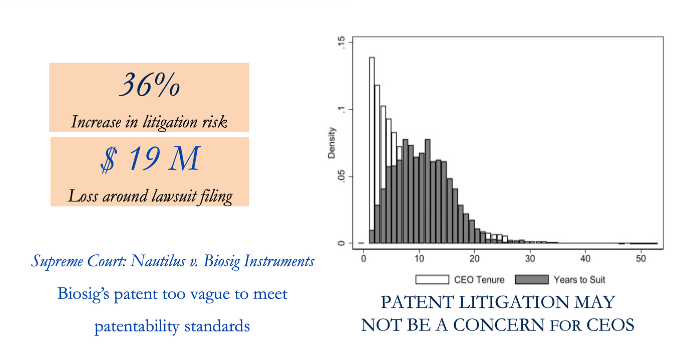
BENEFITS AND COSTS OF PATENT VAGUENESS
Benefits are accrued in the short-term while costs are accrued in the long-term
Short-term oriented decision makers prefer a higher degree of vague language in patents
HOW TO MEASURE PATENT VAGUENESS?
Linguistic Measures of Readability:
FOG INDEX: combines the average sentence length in words and the ratio of words with more than three syllables to all words. It captures how many years of formal education are needed to understand the text on first reading.
DICTIONARY-BASED APPROACH:
Counts the number of vague words over the total number of words in a patent document
FINDINGS
VAGUE PATENTS
Take longer to be granted
Are more likely to be litigated in court
Are filed by companies whose CEO stay for a short tenure and has a legal degree