2 - Energy Transfer by Heating
Guide
- Ctrl+F to find a specific heading/ topic/ keyword you want to learn.
- Key Points for the topic are at the end of every section.
> 
- Use the Study modes (shown in the image above) to test yourself after reading through the notes.
- If you do like this resource, please rate it 5 stars :)
… yeah, right now. What are you waiting for?
- Check out my profile for similar stuff 👍🏾
- I’m always releasing new content, so give me a follow to be notified when I release something new!
- If you don’t find these helpful, I’m sure you’ll find one of my other sets will help you - I have study material on tons of topics here: (https://knowt.io/u/flashj007)
Energy Transfer by Conduction
KEY POINTS:
- Metals are the best conductors of energy.
- Non-metal materials such as wool and fibreglass are the best insulators.
- The higher the thermal conductivity of a material, the higher the rate of energy transfer through it.
- The thicker a layer of insulating material, the lower the rate of energy transfer through it.
Thermal Conductivity
Practical: Testing rods of different materials as conductors
- The rods need to be the same width and length for a fair test.
- Each rod is coated with a thin layer of wax near one end.
- The uncoated ends are then heated together.
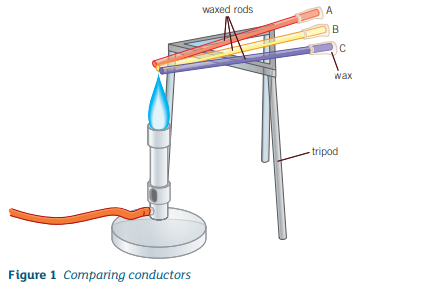
Observations (Look at Figure 1)
- The wax melts fastest on the rod that best conducts energy.
- Metals conduct energy better than non-metals.
- Copper is a better conductor than steel.
- Glass conducts better than wood.
Explanation
In Figure 1, each rod has the same temperature difference between its ends. Each rod is the same length and diameter. The energy transfer by conduction through a material depends on its thermal conductivity. The greater the thermal conductivity of a material, the more energy per second it transfers by conduction.
So, in Figure 1, if
A conducts better than C, and C conducts better than B, then…
- the thermal conductivity of A is higher than the thermal conductivity of C, and
- the thermal conductivity of C is higher than the thermal conductivity of B.
Insulation
- Materials that are good insulators are necessary to keep you warm in winter, whether you are at home or outdoors.
- Good insulators need to be materials that have low thermal conductivity, so energy transfer through them is as low as possible.
The energy transfer per second through a layer of insulating material depends on 3 main things:
- the temperature difference across the material
- the thickness of the material
- the thermal conductivity of the material.
To reduce the energy transfer i.e. to insulate as much as possible…
- the thermal conductivity of the insulating material should be as low as possible
- the thickness of the insulating layer should be as thick as is practically possible
Example
- When insulating a loft, fibreglass is a good insulator because air is trapped between fibres.
- Several layers of this material fitted on the loft floor will reduce the energy transfer through the roof significantly.
KEY POINTS:
- Metals are the best conductors of energy.
- Non-metal materials such as wool and fibreglass are the best insulators.
- The higher the thermal conductivity of a material, the higher the rate of energy transfer through it.
- The thicker a layer of insulating material, the lower the rate of energy transfer through it.
Infrared Radiation
- When you are in sunlight, you are absorbing infrared radiation from the Sun.
- Infrared radiation and visible (sun) light are parts of the electromagnetic spectrum.
- Electromagnetic waves: electric and magnetic waves that travel through space.
- The wavelength of light increases across the visible spectrum from blue to red light.
- Infrared waves are longer in wavelength than visible light waves.
- The Sun emits all types of electromagnetic radiation but, fortunately, the Earth’s atmosphere blocks most of the types of radiation that are harmful to people.
- But it doesn’t block infrared radiation or light from the Sun.
Key Points:
- All objects emit and absorb infrared radiation.
- The hotter an object is, the more infrared radiation it emits in a given time.
- Blackbody radiation is radiation emitted by a body that absorbs all the radiation incident on it.
Radiation and Surface Temperature
- All objects give out (emit) and absorb infrared radiation.
- If you want to see animals and people in the dark, you need to use special cameras. which detect infrared radiation.
The higher the temperature of an object, the more infrared radiation it emits in a given time.
- A body at constant temperature emits infrared radiation at the same rate as it absorbs it.
- A perfect black body: an object that absorbs all the radiation that hits it.
- It doesn’t reflect any radiation, and it doesn’t transmit any radiation (i.e., no radiation passes through it).
- A good absorber is also a good emitter, so a perfect black body is also the best possible emitter.
- The radiation emitted by a perfect black body is called black body radiation.
- No other object emits or absorbs radiation as effectively as a black body.
- An object that has a constant temperature emits radiation across a continuous range of wavelengths.
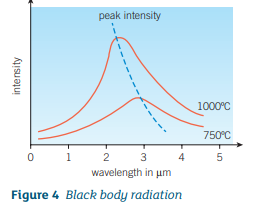
- Figure 4 shows how the intensity of black body radiation varies with wavelength.
- The intensity of the radiation is highest at a certain wavelength, which depends on the temperature.
- If the temperature of the object is increased, the intensity of the radiation it emits is greater at every wavelength – as shown in Figure 4.
- Figure 4 also shows that the peak of the higher radiation curve is at a shorter wavelength than the peak of the lower curve.
- This is because the shorter the wavelength of the radiation, the greater the increase in intensity at that wavelength.
- Therefore, the peak intensity is at a shorter wavelength than it was at the lower temperature.
Real-life example
- Rescue teams use light-coloured, shiny blankets to keep accident survivors warm.
- A light, shiny outer surface emits a lot less radiation than a dark, matt (non-glossy) surface.
- This keeps the patient warm, as less infrared radiation is emitted than if an ordinary blanket had been used
Key Points:
- All objects emit and absorb infrared radiation.
- The hotter an object is, the more infrared radiation it emits in a given time.
- Blackbody radiation is radiation emitted by a body that absorbs all the radiation incident on it.
Radiation and the Earth’s temperature
- The Earth’s temperature depends on a lot of factors, including:
- the absorption of infrared radiation from the Sun, and
- the emission of radiation from the Earth’s surface and atmosphere.
- If the Earth had no atmosphere, the temperature on the surface would plunge to about −180 °C at night, like the Moon’s surface.
- This happens because the surface does not receive any radiation from the Sun whilst still emitting radiation into space.
Greenhouses Gases
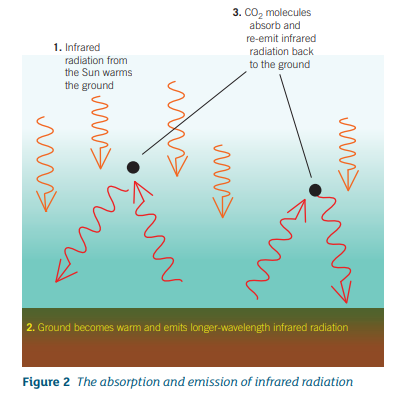
- Some gases in the atmosphere, such as water vapour, methane, and carbon dioxide (greenhouse gases) absorb longer wavelength infrared radiation from the Earth and prevent it escaping into space.
- These gases absorb the radiation and then emit it back to the surface (Figure 2).
- This process makes the Earth warmer than it would be if these gases were not in its atmosphere.
Key Points:
- The temperature of an object increases if it absorbs more radiation than it emits and vice-versa.
The Earth’s temperature depends on a lot of factors, including the absorption of infrared radiation from the Sun, and the emission of radiation from the Earth’s surface and atmosphere.
Specific Heat Capacity
- A car left in strong sunlight can become very hot but a concrete block with the same mass wouldn’t get as hot.
- This is because they car, which is metal, has a higher __specific heat capacity__ than concrete.
- Therefore, metal heats up more easily than concrete.
- When a substance is heated, its temperature rise depends on:
- the amount of energy supplied to it
- the mass of the substance
- the material
The specific heat capacity of a substance is the energy needed to raise the temperature of 1 kg of the substance by 1 °C.
The unit of specific heat capacity is the joule per kilogram degree Celsius (J/kg °C).
Specific Heat Capacity Formula
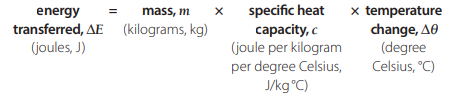
The energy transferred to the substance increases the thermal energy store of the substance by an equal amount.
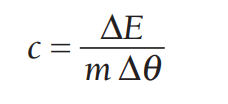
This equation can be rearranged - For instance, to find the specific heat capacity of a substance, rearrange the above equation into the form:
Example: A Storage Heater
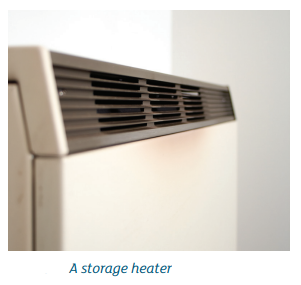
- A storage heater uses electricity at night (off-peak) to heat special bricks or concrete blocks in the heater.
- Energy transfer from the bricks keeps the room warm.
- The bricks have a high specific heat capacity, so they store lots of energy.
- They warm up slowly when the heater element is on, and cool down slowly when it is off.
 KEY POINTS:
The specific heat capacity of a substance is the amount of energy needed to change the temperature of 1 kg of the substance by 1 °C.
Use the equation ΔE = m c Δθ to calculate the energy needed to change the temperature of mass m by Δθ.
The greater the mass of an object, the more slowly its temperature increases when it is heated.
To find the specific heat capacity c of a substance, use a joulemeter and a thermometer to measure Energy in J (ΔE) and temperature (Δθ) for a measured mass (m), then use the rearranged formula.

2.5 - Heating and insulating buildings
Saving Energy - Reducing the rate of energy transfers at home
- When your home heating system is transferring energy into your home to keep you warm, energy is also transferring to the surroundings outside your home
- We call this wasted energy.
- Figure 1 shows some of the measures that can be taken to reduce the rate of energy transfer from a home, and so reduce home heating bills.
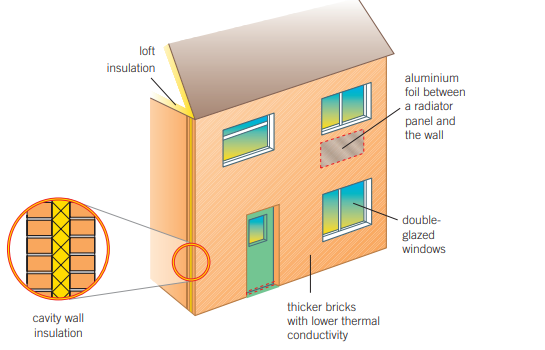
How does Loft insulation such as fibreglass reduce the rate of energy transfer through the roof?
Fibreglass is a good insulator. The air between the fibres also helps to reduce the rate of energy transfer by conduction. The greater the number of layers of insulation, the thicker the insulation will be. So the rate of energy transfer through the roof will be less.
How does Cavity wall insulation reduce the rate of energy transfer through the outer walls of the house. The cavity of an outer wall is the space between the two layers of brick that make up the wall. The insulation is pumped into the cavity. It is a better insulator than the air it replaces. It traps the air in small pockets, reducing the rate of energy transfer by conduction. ● Aluminium foil between a radiator panel and the wall reflects radiation away from the wall and so reduces the rate of energy transfer by radiation.