Anglophone Survey British
Notes from the lecture: 383 got rid of Romans (local leaders got the power, regional wars between kingdoms)
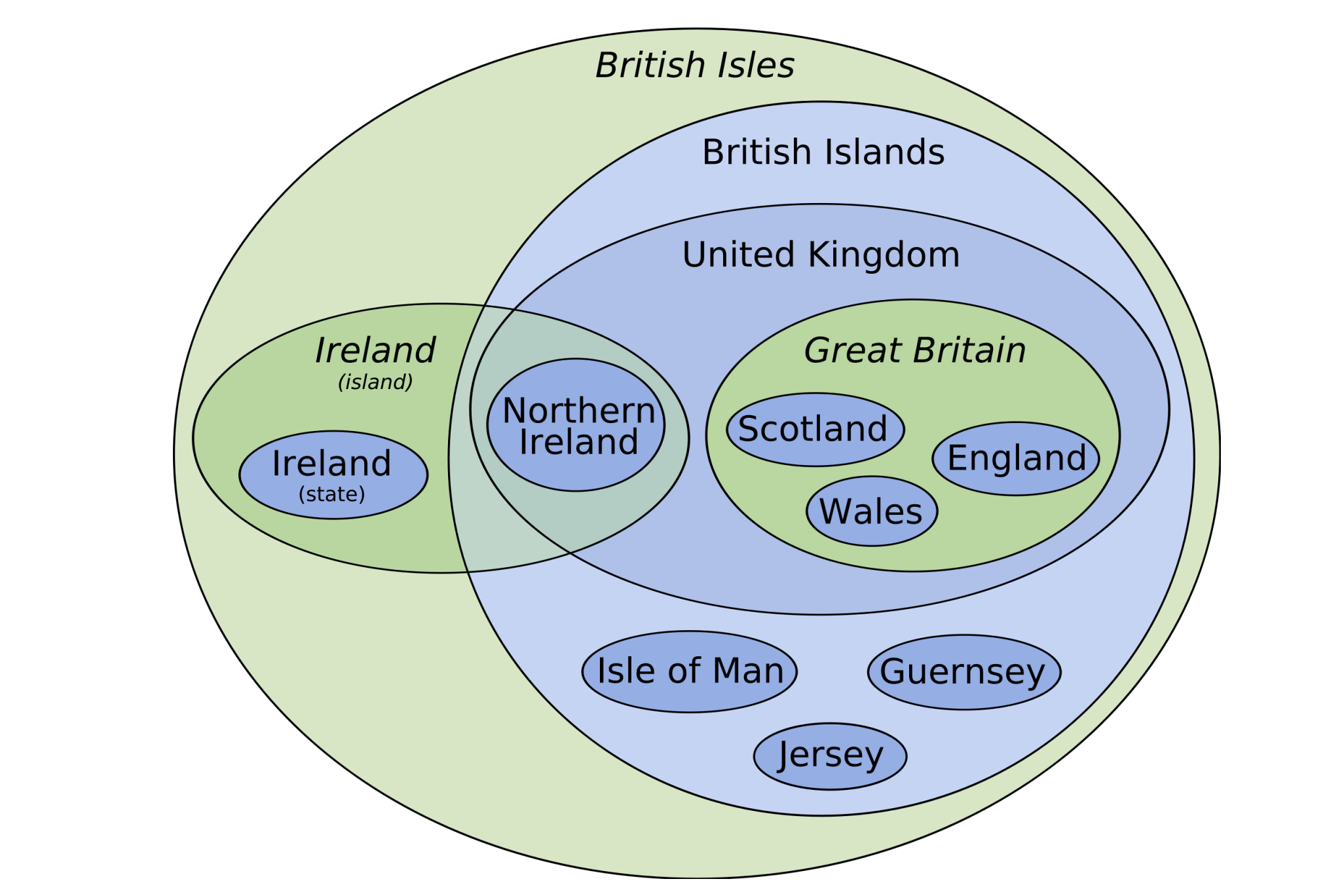
Germanic tribes invaded the island of Britain which was at the time occupied by the celts (including Romanized celts) and Romans who were still there
The Stone Age (not Britain)
In Britain, the Paleolithic period spanned from roughly 500,000 BCE to 12,000 BCE, followed by the Mesolithic period from 12,000 BCE to 3,000 BCE, and then the Neolithic period from 3,000 BCE onward. These periods represent distinct phases in human history characterized by technological advancements and changes in lifestyle.
The Bronze Age (still not Britain)
Around 2,750 BCE the Beaker people settled in Cornwall, which was the richest area of minerals (there were many mines). Bronze =copper + tin. There was no implication for violence from the South, which means that the settlers from Turkey were peaceful. By this time, they started to build huts. The immigrants brought a new lifestyle. The wheel and pottery were invented in Zummar, Iraq. The history of Britain is a history of immigrants (new technology revolution). There was never an invasion, they just came and started building artificial hills (Beaker People). It was a peaceful migration.
The Iron Age (750 BCE – 43 AD) (Britain as a concept starts to happen)
Britons (Celtic Britons) arrived in 750 BCE. They developed art and Celtic crafts; culture started. The immigrants brought the culture (also agriculture and warfare) on the island. Hillforts were built.
Greeks:
Herodotus (was a Greek historian and geographer from the Greek city of Halicarnassus, under Persian control in the 5th century BC, and a later citizen of Thurii in modern Calabria, Italy), called British Isles “Tin Islands” but was actually questioning if such a place existed.
Strabo, Britain “Albion” and Ireland “Irene”
Pytheas, known for his voyage to Britain around 325 BCE => Britain was then called the ‘tin islands’, now Pretannike (Britons called themselves Pretannikai).
Romans (Britons are savages propaganda 101):
Tacitus called them savages in order to get a justification for their invasion. Created a wrong image of Britons
Caesar, speeches against Britons, going to “civilize” them. Commentarii de Bello Gallico - “barbarians who wore skins or went naked, and practised a form of polygamy".
Two main architecture styles brought by the migrants;
La-Tène style: 500 BC, spirals, wavy lines. Curvilinear designs, abstract animal motifs, and the use of spirals and knots, often found on metalwork like torcs, scabbards, and horse-bits (think Ireland)
Hallstatt style: 800 BC, geometrical designs, clear and straight lines
Celts came in 2 waves to Britain;
1st wave - the Gaels, moved to Ireland and the Scottish Highlands and brought Gallic as a language
2nd wave - the Brythoni, moved to to England, Wales, and the Scottish Lowlands (Welsh, Cornish and Breton).
There were different tribes like nations:
the Ulaid (Emain Macha/Navan Fort) Northern Ireland (Ulster Cycle – Irish mythology)
the Durotriges (biggest city Mai Dun; people of the hill: Dunedin in Tolkien’s Lord of the Rings.)
the Brigantes (name goes back to the word “hill”) in North County (Northern England)
the Picti in Scotland (means painted people, tattooed).
Languages: celtic languages (Indo-European languages) travelled across Europe (might be older than Sanskrit) – very old culture brought to Britain.
Scots, Irish, Gaelic, Manx (is a Celtic language, historically spoken on the Isle of Man, closely related to Irish and Scottish Gaelic. The Manx people are the inhabitants of the Isle of Man, and the Manx cat is a breed known for its taillessness)
Cornish, Welsh, Breton (not originated in Brittony – British dialect)
British place names:
Avon (abona = river)
Dover (dubris = water)
Kent (cantus= border) was the county closest to the continent
Thames (tamesis =darkness, black) because the water was so muddy (low tight – black river)
Hill Dun Brick – actually means “Hill Hill Hill
Pretani (original name of Britain but Caesar misheard it and called it Britannia)
Welsh = not a celtic name, called themselves “Cymry” = companionship, brotherhood (companions), the Germanic called them “Welsh” = foreign, the others, the wealas
The Cymry called the Britons “Prydyn”
Romans called the Brits “Britannia” and the celts “Picti” (Latin)
Roman Britain (43-410 CE)
They did not conquer all of Britain, only to the Hadrian Wall and the Antonius Wall. Never invaded Wales or Scotland! King Offa built a wall called “Offa’s Dyke”.
Myth of the leader = Arthus, who fought the invaders.
Anglo-Saxon Britain (449-1066 CE)
The period used to be known as the Dark Ages, mainly because written sources for the early years of Saxon invasion are scarce. However, most historians now prefer the terms 'early middle ages' or 'early medieval period'.
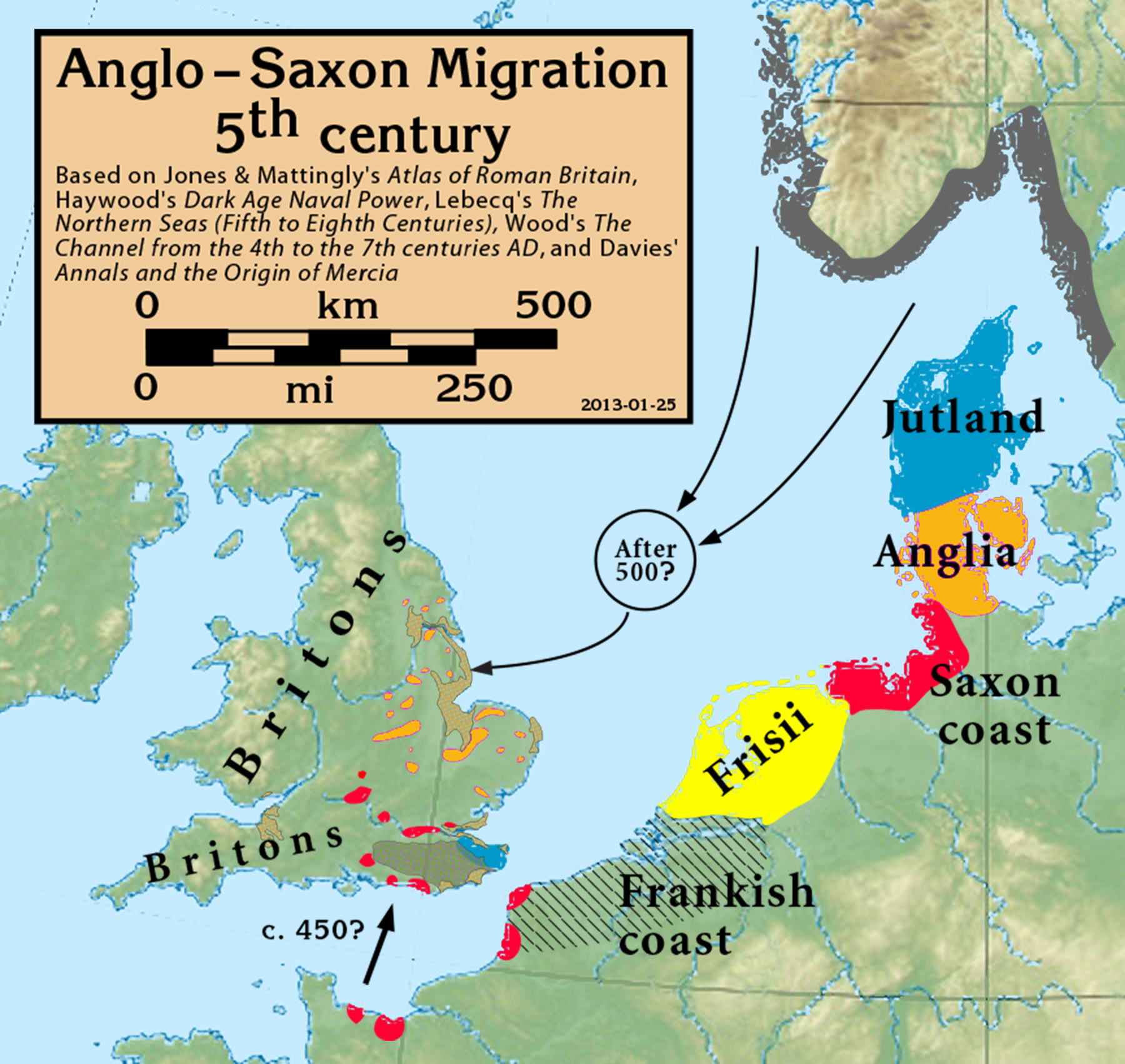
Germanic people came to help with the Romans but decided to stay (not a peaceful migration!). Forced their culture, raped women to replace the Celts and Romans by Germanic people.
MIDDLE AGES I - Medi(a)eval English Literature
Old English literature (the beginning of English literature)
Late antiquity, very early Middle Ages 409/10 BC
Country was divided into little Roman and Celtic kingdoms. But then the Germanic tribes decided to invade. Romans were literally erased by war from Britain.
Hengist and Horsa - Hengist and Horsa (stallion and horse) are Germanic brothers, said to have led the Angles, Saxons and Jutes in their supposed invasion of Britain in the 5th century. Tradition lists Hengist as the first of the Jutish kings of Kent (they did’t come uninvited, they were invited by the British High King himself Vorhgern, to help him fighting the Scots and Picts from Ireland) Fought for him and then stayed there and turned against the High King. We call them Anglo-Saxons.
Germanic tribes had a shared society – gift giving, they were no traders, had a strong sense of kinship (Verwandschaft). They had open debates to settle disputes = ‘thing’ (oldest democratic tradition since the 8th century → gather it in a thing). The oldest parliamentary tradition comes from Iceland (oldest democracy). Jutes (from northern Denmark) settled to Kent, Isle of Weight → highly stratified and rural culture they were gift givers; strong sense of kinship, had open assemblies and debates called “thing”.
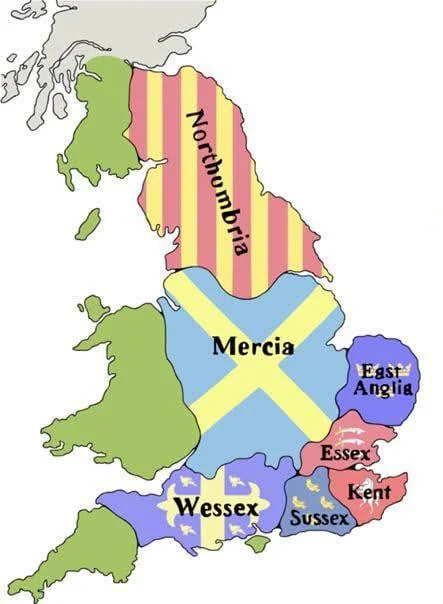
Heptarchy - The Heptarchy is the name for the division of Anglo-Saxon England between the sixth and eighth centuries into petty kingdoms, conventionally the seven kingdoms of East Anglia, Essex, Kent, Mercia, Northumbria, Sussex, and Wessex. (8th century) (Henry of Huntington, English historian, came up with the idea of Heptarchy)
Kingship was based on your achievements (military), you didn’t just inherit it from your father. In 793 CE the Viking Age began! Overlords from everywhere came to form own kingships in Britain, but this didn’t last long (because all kings were greedy).
The Kings ig:
Offa of Mercia - was king from 757 until his death in 796. Offa had to rebuild his kingdom from the chaos, including re-establishing control over the Hwicce and Magonsate (West Midlands), Lindsey (East) and the Middle Angles. Established a monastery system, introduced money, created Offa’s Dyke (large linear earthwork that roughly follows the border between England and Wales), Christian af
King Alfred the Great (848-899) - king of the West Saxons. He is the only English monarch to be called "the Great." He defeated the Vikings and united the Anglo-Saxons, leaving his son and grandsons to rule over a united England. Alfred wrote the first substantial English law codes (Empire with Christian codes). +Anglo-Saxon chronicles (biased). Also Christian, introduced education to people.
Æthelstan or Athelstan was King of the Anglo-Saxons - from 924 to 927 and King of the English from 927 to his death in 939. Athelstan is remembered for his piety; he was a great benefactor of religious bodies, bestowing land, holy books and relics to many churches and monasteries.
King Edgar the Peaceful - was a firm and capable ruler whose power was acknowledged by other rulers in Britain, as well as by Welsh and Scottish kings. Edgar's late coronation in 973 at Bath was the first to be recorded in some detail; his queen Aelfthryth was the first consort to be crowned queen of England.
Æthelred the Unready was King of the English from 978 to 1013 and again from 1014 until his death in 1016. He ordered the massacre of all Danes in England to eliminate potential treachery. (loser)
King Cnute - Cnut also known as Canute and with the epithet the Great, was King of England from 1016, King of Denmark from 1018, and King of Norway from 1028 until his death in 1035. The three kingdoms united under Cnut's rule are referred to together as the North Sea Empire by historians. Brought peace and prosperity to England, issued an important law code, and became a strong supporter of the church.
King Edward the Confessor (son of Cnute who survived) - Edward the Confessor ( c. 1003 – 5 January 1066) was an Anglo-Saxon English king and saint. Patron saint of kings, difficult marriages, and separated spouses.
Duke William of Normandy (was a norman) - founded a mighty Anglo-Norman kingdom. Invaded England, said that Edward promised him the throne and took over when King Harold got the throne. The Conqueror commissioned The Domesday Book, an extensive census of the country's populace and assets, and initiated the construction of numerous structures, including the Tower of London, built from Caen stone.
The Domesday Book was designed to perform three key functions. To record the transfer and possession of land. After the conquest huge amounts of land in England changed hands and a record of these changes was needed to keep track. To record the value of each estate (land owned by an individual).
French became a new language of the elite
The Venerable Bede - Bede, also known as Saint Bede, the Venerable Bede, and Bede the Venerable, was an English monk, author and scholar. He was one of the most known writers during the Early Middle Ages, and his most famous work, Ecclesiastical History of the English People, gained him the title "The Father of English History". He was one of the most known writers during the Early Middle Ages, and his most famous work, Ecclesiastical History of the English People, gained him the title "The Father of English History"
Ecclesiastical History of the English People, is a history of the Christian Churches in England, and of England generally; its main focus is on the growth of Christianity
From Northumbia .
Cædmon's Hymn is a short Old English poem attributed to Cædmon, a supposedly illiterate and unmusical cow-herder who was, according to the Northumbrian monk Bede, miraculously empowered to sing in honour of God the Creator. The poem is Cædmon's only surviving composition.
The Exeter Book - The Exeter Book, also known as the Codex Exoniensis or Exeter Cathedral Library MS 3501, is a large codex of Old English poetry, believed to have been produced in the late tenth century AD.
The Song of Roland is an 11th-century chanson de geste based on the deeds of the Frankish military leader Roland at the Battle of Roncevaux Pass in AD 778, during the reign of the Emperor Charlemagne. It is the oldest surviving major work of French literature
The Lament of Deor - "Deor" is an Old English poem found on folio 100r–100v of the late-10th-century collection he Exeter Book. The poem consists of a reflection on misfortune by a poet whom the poem is usually thought to name Deor. The poem has no title in the Exeter Book itself; the title has been bestowed by modern editors. In the poem, Deor's lord has replaced him with another poet. Deor mentions various figures from Germanic tradition and reconciles his own troubles with the troubles these figures faced, ending each section with the refrain "that passed away, so may this."
The Dream of the Rood, Old English lyric, the earliest dream poem and one of the finest religious poems in the English language, once, but no longer, attributed to Caedmon or Cynewulf. In a dream the unknown poet beholds a beautiful tree—the rood, or cross, on which Christ died.
The Battle of Maldon - Anglo-saxon’s were slaughtered and lost to the vikings, celebrating defeat as heroes.
The death of King Harold, the death of Anglo-Saxon England, Harold Godwinson (c. 1022 – 14 October 1066), also called Harold II, was the last crowned Anglo-Saxon English king. Harold reigned from 6 January 1066 until his death at the Battle of Hastings on 14 October 1066, the decisive battle of the Norman Conquest. Harold's death marked the end of Anglo-Saxon rule over England. He was succeeded by William the Conqueror.
Hoarding Dragon - not using wealth is bad, if you do not share your wealth you will fall to a sickness that will eat your spirit and you alive
Beowulf is an Old English epic poem in the tradition of Germanic heroic legend consisting of 3,182 alliterative lines. It is one of the most important and most often translated works of Old English literature. Structured in 3 encounters/battles with monsters that our hero has to kill to save society
Grendel (first monster, descendent of Cain) is a character in the Anglo-Saxon epic poem Beowulf. He is one of the poem's three antagonists, all aligned in opposition against the protagonist Beowulf. He is referred to as both an eoten and a þyrs, types of beings from wider Germanic mythology.
Water witch - Grendel's mother was an 'aglæc-wif', 'a female warrior' [...] there is no more reason to introduce the idea of monstrosity or of misery here than there is in line 1519 where she is called merewif, defined simply as 'water-woman', 'woman of the mere”
In Germanic mythology, Sigmund is a hero whose story is told in the Völsunga saga. He and his sister, Signý, are the children of Völsung and his wife Hljod. Sigmund is best known as the father of Sigurð the dragon-slayer, though Sigurð's tale has almost no connections to the Völsung cycle except that he was a dragonslayer. (used to foreshadowing for Beowulf’s death)
Final battle with the Dragon. Beowulf knows he will die very soon (he is old), still goes to fight the Dragon. Beowulf is betrayed, no one wants to go with him to fight (except for one single warrior). He kills the Dragon but also dies, laying down his life for the people who betrayed him. He is loyal till the end as the King must. After Beowulf’s death the kingdom is threatened by it’s neighbours
The lesson - what makes us survive as the community is loyalty, everyone doing their part, sticking together
Beowulf decides to fight the dragon just as he once fought Grendel. But then he was a warrior. Now he's a king who is responsible for his people. It can be argued that Beowulf's decision, while courageous, is inappropriate for a king.
Idea of Jesus as a warrior, “laying down his life” like a warrior
Humans (society with rules) vs monsters (the other)
"Ælfrics Grammatik und Glossar" by Abbot of Eynsham Aelfric is a linguistic text written in the late 10th century. This scholarly work is aimed at providing grammatical instruction and vocabulary for learning Old English, drawing from Latin sources. The text appears to compound Aelfric's efforts to make language learning accessible, particularly for children and novice scholars. The opening of the text serves as a preface where Aelfric expresses his intent to translate
John Dryden. After John Donne and John Milton, John Dryden was the greatest English poet of the 17th century. After William Shakespeare and Ben Jonson, he was the greatest playwright. And he has no peer as a writer of prose, especially literary criticism, and as a translator.
Historical Event:
The Battle of Maldon took place on 10 or 11 August 991 AD near Maldon beside the River Blackwater in Essex, England, during the reign of Æthelred the Unready. Earl Byrhtnoth and his thegns led the English against a Viking invasion. The battle ended in an Anglo-Saxon defeat. After the battle Archbishop Sigeric of Canterbury and the aldermen of the south-western provinces advised King Æthelred to buy off the Vikings rather than continue the armed struggle. The result was a payment of Danegeld of 10,000 Roman pounds (3,300 kg) of silver (approx £1.8M at 2022 prices).
Norman Invasion/Conquest - The Norman Conquest was the 11th-century invasion and occupation of England by an army made up of thousands of Norman, French, Flemish, and Breton troops, all led by the Duke of Normandy, later styled William the Conqueror.
Vocab:
A scop - was a poet as represented in Old English poetry. The scop is the Old English counterpart of the Old Norse skald, with the important difference that "skald" was applied to historical persons, and scop is used, for the most part, to designate oral poets within Old English literature. Very little is known about scops, and their historical existence is questioned by some scholars. Used alliteration to structure the text (the first syllable is the same)
Kenning - a compound expression in Old English and Old Norse poetry with metaphorical meaning, e.g. oar-steed = ship. A different name to not summon the spirit that is connected to the name (casting a spell through language)
Petty kingdoms - small kingdoms
Juts - people came from a place today known as Denmark
Viking (raiders) norse (the people)
Comibatus - king’s personal “bodyguard”, brothers in all but name that leave together and only serve to protect the King
Heriot - “death tax”, after a warrior’s death their armour is collected by the Lord who is now obliged to take care of the dead warrior’s family (later on the inheritance tax)
Wyrd - sense of faintness, they know they will die but they have to do what they have to do (Germanic element of old literature)
THE MIDDLE AGES II
The stereotypical romance - epic poetry shifting to romance, introduction of new elements, gradual shift from epics to romance. Shift from communal mentality to more private, introducing individuals and their state of mind. Respect to the warrior cast (kinda like mafia). Shift in language from Germanic English to Middle Ages English. Romance it NOT about being romantic, it’s a story told in French, story told in romance dialect. Still focuses on male characters. The knights stand on for the ethics
Eleanor of Aquitaine aka Aliénor d‘Aquitaine (and Henry II) - Eleanor of Aquitaine was queen of two great medieval European powers – England and France. One of the wealthiest women in Europe, she played a very active role in government affairs. Key moment: Taking part in a plot against her husband, King Henry II, in 1173. Eleanor of Aquitaine (born c. 1122—died April 1, 1204, Fontevrault, Anjou, France) was the queen consort of both Louis VII of France (1137–52) and Henry II of England (1152–1204) and mother of Richard I (the Lionheart) and John of England. She was perhaps the most powerful woman in 12th-century Europe. She was also a patron of the arts !!For a woman to be a politician and to inherit the land, was not possible in the North but was possible in France!!
In the South of France (Occitan, the language at the time, Romance language), trobador - someone who creates literature, who creates romances and preforms them while they travel from court to court. The Donna “Lady” becomes the stand in for the mother of God
3 Great Thematic Clusters.
Bodel, who classified romances
First: Matter of Britain - Legends that are situated in England
Second: Matter of Rome - classical antiquity (many version of Arthurian legends where he goes ot fight in Rome).
Third: Matter of France - Roland, the leading paladin (imperial guard). Focuses on France
Layamon’s Brut - "Layamon's Brut" by active 1200 Layamon is a historical account likely written in the early 13th century. This narrative recounts the legendary history of Britain, focusing on its rulers and the turbulent events surrounding their reigns, beginning with King Constantin and his battles against the invading forces.
traditional heroic narrative, epic + romance motives. Celebrates Arthur. Anglo-Norman literature, new identity that is Norman in nature
State sanctioned literature that talks about what happens when you break the oath, justifying the decisions made by the elite
Now you need to do more than just kill people as a King, you need to have a strong ethical framework, maintain peace
Sir Gawain and the Green Knight - Sir Gawain and the Green Knight is one the great Arthurian romances, an epic poem in which the noble Sir Gawain plays the 'beheading game' with a mystery knight – setting him on course for a grand quest in which his virtues are sorely tested.
Unknown author, most likely a man since women weren’t allowed to write literature. The text is written by a dialect that was spoken in North-west midlands, well read and well versed in scripture (Bible), had education.
Start of using alliteration. Germanic words, words of Romance origin
One of King’s knights becomes his champion and has to fight for the King
Number 3 is important to pre-Christian Europe, the mother Goddess was three women in one, 3 roles (the maid, the mother and the crone). Then it turned into the holy spirit, ghost and…
The Order of the Garter - The Most Noble Order of the Garter is an order of chivalry founded by Edward III of England in 1348. The most senior order of knighthood in the British honours system, it is outranked in precedence only by the decorations of the Victoria Cross and the George Cross
Gawion is originally was called a different name “the hot of name”, originally a celtic literature. It’s a power that follows the cycle of the sun, weak at midnight, was originally a demi-human heroic figure but then turned into a Christian Knight
De Consolatione Philosophiae (Boethius) - The philosophical message of the book fits well with the religious piety of the Middle Ages. Boethius encouraged readers not to pursue worldly goods such as money and power, but to seek internalized virtues. Evil had a purpose, to provide a lesson to help change for good; while suffering from evil was seen as virtuous.
The Three Estates - the clergy, which was the First Estate; the nobility, which was the Second Estate; and the peasantry, which was the Third Estate. In France, this system was known as the Ancien Régime.
Serf - you are not a person but part of the land, the owner of the land also owns you
Chaucer adds himself as the character, the last one
Decamerone (Boccaccio) - The plot of The Decameron involves ten young men and women feeling Florence during the Black Plague. They stay at a villa for ten days, during which time they share a total of one hundred stories to pass the time. First goes the knight
Chaucer as Canterbury Pilgrim (Ellesmere manuscript) - The Ellesmere Chaucer is not only the most beautiful manuscript of Chaucer's best known work, the Canterbury Tales, but the most famous literary manuscript in English. This large beautiful and innovative manuscript was probably produced soon after 1400. The stories follow a specific order. Each stories triggers the next and it’s plot. Chaucer writes a parody of a romance, it’s awkward and a sing song text. Then he gets interrupted who tells him he’s a bad storyteller (Chaucer basically makes a character tell him he can’t tell stories)
The Wife of Bath - in control of her own life, her body and sexuality. She has a good life, she is enjoying it. “A feminist icon”
The Chancery - responsible for ensuring that official instructions were carried out and recorded. The Chancellor was the king's principal administrative officer and the custodian of the great seal, used to authenticate the king's written instructions, official letters, and grants.
The Great Vowel Shift - a massive sound change affecting the long vowels of English during the fifteenth to eighteenth centuries. Basically, the long vowels shifted upwards; that is, a vowel that used to be pronounced in one place in the mouth would be pronounced in a different place, higher up in the mouth.
speaking and spelling got “divorced” from each other, spelling preserves medieval form while the pronunciation changed
The School of Athens (Raphael, 1508-11)
reading was only something done out loud, silent reading that only became a thing during a modern era because it became more individualize.
the state is no longer defined by their military functions. Knight someone who holds both economic and political powers
Pearl - Pearl is a late 14th-century Middle English poem that is considered one of the most important surviving Middle English works.
free gentleman - someone who comes from money and can afford creating time
The Red and White Roses in the Temple Garden (Henry Payne, 1908) - a bloody civil war that tore the country apart. Two houses fighting for power.
Henry Tudor aka Henry VII - stops the Roses War by taking the throne for himself, he was very clever to bring two Roses together (married the woman). Knew how propaganda worked. Insisted that he was from the Welsh family, named his son Arthur (King Arthur), Arthur died and we got Henry VIII (oops)
awareness of historical tension between idolization of the past and fear of the present
Thomas Malory’s Le Morte d’Arthur - It is an art piece that talks about King Arthur's time on the throne and his kingdom's downfall. The story depicts Arthur's effort to maintain peace and order, only to be faced with betrayal.
wasn’t only a writer but also a reader, he wrote his poem in prison. He was charged with violence, rape…. He wrote his own outtake on Arthurian ideals of a knight
William Caxton - first printer in England. Caxton edited Malory’s story and printed it. Middle class, he made profit of selling literature, it’s what made him rich.
English Renaissance Literature
‘rebirth’ of interest in classical Greek and Roman antiquity
Time line - Battle of Bosworth Field (1485) to Restauration of the Stuart Kings (1660)
Wars of the Roses:
Battle of St. Albans (1455) - the king and Somerset left London and marched north to St Albans, their force estimated at 2,000 men. On 22nd May the battle that is regarded as the opening of the Wars of the Roses (although it was little more than a skirmish) was fought. York's objective appears to have been the elimination of Somerset.
Battle of Bosworth Field (1485) - Battle of Bosworth Field (1485) - marking the end of the Wars of the Roses and the Plantagenet dynasty, as Yorkist King Richard III was defeated and killed by Henry Tudor, who then ascended the throne as Henry VII, establishing the Tudor dynasty (START OF RENAISSANCE)
Henry Tudor (1457-1509) - Henry Tudor (later Henry VII) defeated and killed Richard III at Bosworth Field on August 22, 1485, bringing the Wars of the Roses to a close.
V Henry VII (1485) - Henry VII was the founder of the Tudor dynasty, unifying the warring factions in the Wars of the Roses. Although supported by Lancastrians and Yorkists alienated by Richard III's deposition of his nephew, Edward V, Henry VII's first task was to secure his position.
Thomas Wolsey (1473-1530) made a name for himself as an efficient administrator, both for the Crown and the church. When Henry VIII became king in 1509, Wolsey's rapid rise began. In 1514, he was created archbishop of York and a year later the pope made him a cardinal. Soon afterwards the king appointed him lord chancellor.
Thomas Cromwell (1485-1540) - was a key figure in English history, serving as chief minister to King Henry VIII and playing a crucial role in the English Reformation, as highlighted in Hilary Mantel's Wolf Hall trilogy. Responsible for establishing the Reformation in England, for the dissolution of the monasteries, and for strengthening the royal administration.
Church of England (1534) - In 1534 Parliament passed the Act of Supremacy which defined the right of Henry VIII to be supreme head on earth of the Church of England, thereby severing ecclesiastical links with Rome
Edward VI (1547) - During Edward's reign, the Church of England became more explicitly Protestant - Edward himself was fiercely so. The Book of Common Prayer was introduced in 1549, aspects of Roman Catholic practices (including statues and stained glass) were eradicated and the marriage of clergy allowed.
Edward Seymore, Duke of Somerset (1547-1549) - who served as Lord Protector of England from 1547 to 1549 during the minority of his nephew King Edward VI.
John Dudley, Duke of Northumberland (1504-1553) - English general, admiral, and politician, who led the government of the young King Edward VI from 1550 until 1553, and unsuccessfully tried to install Lady Jane Grey on the English throne after the King's death.
Lady Jane Grey (1536-1554) - Jane pleaded guilty and was sentenced to death. The carrying out of the sentence was suspended, but Suffolk's support for Sir Thomas Wyatt's rebellion in February 1554 sealed Jane's fate.
Wyatt’s rebellion (1554) - The rebellion arose out of concern over Queen Mary I's determination to marry a foreigner, Philip II of Spain, and to return England to the Catholic Church and papal authority. The uprising failed, with consequences for the rebels that ranged from death to forgiveness.
Mary I (1553) - the first Queen Regnant (that is, a queen reigning in her own right rather than a queen through marriage to a king). Courageous and stubborn, her character was moulded by her early years. The first Queen Regnant (that is, a queen reigning in her own right rather than a queen through marriage to a king). Courageous and stubborn, her character was moulded by her early years. She was known as Bloody Mary for her persecution of Protestants in a vain attempt to restore Roman Catholicism in England. As long as the Queen remained childless, her half-sister Elizabeth was her successor.
Elizabeth (1558) - daughter of Henry VIII and Anne Boleyn, ascended to the throne of England and Ireland upon the death of her half-sister, Mary I, becoming the last Tudor monarch. Her reign, known as the Elizabethan period, lasted until her death in 1603. Queen Elizabeth I, upon ascending the throne in 1558, inherited an unstable kingdom but successfully established a period of relative peace and stability, often referred to as the "Golden Age," through shrewd political maneuvering, religious compromise, and a strong sense of national identity. NEVER HAD A HEIR. Upon the death of Elizabeth I in 1603, James VI of Scotland, who was also James I of England, became the first Stuart monarch of England, unifying the thrones of England and Scotland. Robert Cecil, the dominant politician of Elizabeth's final years, took it upon himself to arrange for a smooth succession. He felt that James was the best candidate and began secret correspondence with him in March 1601. Elizabeth was at Richmond Palace when her health began to fail in February 1603.
Culture - Humanism:
Petrarch (1304-1374) - was an Italian scholar, poet, and humanist who is considered a founder of Renaissance humanism and a key figure in the early Italian Renaissance
Sir Francis Bacon (1561-1626) was an English philosopher, statesman, and author, known for his contributions to the scientific method and his advocacy for empirical observation and inductive reasoning. He served as Attorney General and Lord Chancellor of England, and his writings, including "Novum Organum," shaped the development of modern science
William Tyndale (1494-1536) Tyndale was eventually captured in Belgium, and in 1536 was strangled and burned at the stake. His translation work and printing of Bibles opened the floodgates of new versions, and most of the English translation work in the remainder of the 16th and early 17th centuries was based largely on Tyndale's work.
William Lily (1486-1522) - was an English Renaissance scholar and classical grammarian, a pioneer of Greek learning in England and one of the authors of an extremely popular Latin grammar that, with corrections and revisions, was used as late as the 19th century.
the "Septem Artes Liberales" (Seven Liberal Arts), comprising the Trivium (Grammar, Rhetoric, and Logic) and the Quadrivium (Arithmetic, Geometry, Music, and Astronomy), formed the foundation of education, influencing both secular and religious learning.
The trivium is the lower division of the seven liberal arts and comprises grammar, logic, and rhetoric.
The quadrivium, comprising arithmetic, geometry, music, and astronomy, was a cornerstone of medieval and Renaissance education, representing the advanced level of the liberal arts after the trivium (grammar, logic, and rhetoric)
Early Modern English - Between roughly 1400 and 1600 there was a series of shifts in the pronunciation of English's long vowels, and between 1500 and 1700 foreign loan words flooded into the language as English's vocabulary expanded to meet its increasingly varied needs.
The Questione della lingua (Language question) was a debate that emerged in late medieval and Renaissance Italy concerning the nature of the linguistic practice to be adopted in the written Italian language. Literary Italian developed in various forms in the 13th and 14th centuries. Unlike English and French, its development did not follow that of a national spoken language, since this emerged only after the Unification of Italy in 1860. Thus writers mostly had to acquire a knowledge of the written language by literary imitation, instead of drawing on their native speech. It was the lack of a national spoken language on which to base the language of literature that gave rise to the protracted and controversial debate about what the standard literary language should be.
Sir Thomas More, venerated in the Catholic Church as Saint Thomas More, was an English lawyer, judge, social philosopher, author, statesman, theologian, and noted Renaissance humanist. He also served Henry VIII as Lord High Chancellor of England from October 1529 to May 1532
Utopia is a work of fiction and socio-political satire by Thomas More, written in Latin and published in 1516. The book is a frame narrative primarily depicting a fictional island society and its religious, social and political customs. (first “Utopian” book)
Thomas More (1478-1535) and Erasmus of Rotterdam (1466-1536) were prominent Renaissance humanists who were friends and intellectual collaborators, though they later diverged on religious matters, with More famously refusing to accept King Henry VIII as head of the Church of England, leading to his execution.
Thomas More's Utopia is often seen as a response to, and a reflection upon, Plato's Republic, exploring themes of ideal societies, justice, and the nature of governance, while also offering a critical perspective on Plato's ideas (Plato. The Republic by Plato, written around 380 BCE, is one of the foundational works of Western philosophy. Set against the historical and political background of ancient Athens, the dialogue is a Socratic exploration of justice, the nature of the soul, and the ideal state.)
Lucian's "True History," a satirical and fantastical travelogue, influenced works like Thomas More's "Utopia" and Swift's "Gulliver's Travels". Lucian questioned the idea of truth in non-fiction writing, and his work was translated and appreciated during the Renaissance and Enlightenmen (The novel is a satire of outlandish tales that had been reported in ancient sources, particularly those that presented fantastic or mythical events as if they were true)
Hythloday - In Thomas More's Utopia, Raphael Hythloday is a fictional character who serves as a voice for radical ideas and critiques of European society, particularly its reliance on private property and its perceived injustices. He presents a vision of an ideal society, Utopia, as a counterpoint to the problems of the real world, emphasizing communal ownership and a rational, just society.
Erasmus (born October 27, 1469 [1466?], Rotterdam, Holland [now in the Netherlands]—died July 12, 1536, Basel, Switzerland) was a Dutch humanist who was the greatest scholar of the northern Renaissance, the first editor of the New Testament, and also an important figure in patristics and classical literature
Edmund Spenser
Attended new schools at this time and went on to an education at Cambridge on a scholarship
Joachim Du Bellay (1522-1560) - Edmund Spenser, an English poet of the Renaissance, was significantly influenced by and translated works of Joachim Du Bellay (1522-1560), a French poet and founder of La Pléiade. Du Bellay's writings, particularly his collection Les Antiquités de Rome, were translated by Spenser in 1591 as Ruines of Rome: by Bellay
The Shepheardes Calender was Edmund Spenser's first major poetic work, published in 1579. In emulation of Virgil's first work, the Eclogues, Spenser wrote this series of pastorals at the commencement of his career. However, Spenser's models were rather the Renaissance eclogues of Mantuanus.
Geoffrey Chaucer (c. 1343-1400) and Edmund Spenser (c. 1552-1599) were influential figures in the development of English literature, separated by over a century and representative of distinct literary eras. Chaucer is considered the "Father of English Poetry" and is known for his vernacular writing and innovative use of language in works like The Canterbury Tales. Spenser, writing in the High Renaissance, admired Chaucer and was influenced by him, particularly in his own epic poem, The Faerie Queene (a sprawling and surreal allegorical poem populated by robot squires, lady knights, evil sorceresses, and sundry figures from both Classical mythology and English legend.)
Sir Walter Raleigh, a prominent figure at Queen Elizabeth I's court, was a close friend and patron of Edmund Spenser, author of The Faerie Queene. Raleigh's influence at court helped secure the Queen's favorable reception of Spenser's epic poem. Spenser dedicated The Faerie Queene to Queen Elizabeth, and Raleigh even wrote a commendatory verse for the work (was a favourite and possible lover of Queen Elizabeth I of England)
Sir Francis Drake (1540-1596) and Edmund Spenser (1552-1597) were contemporaries who lived during a period of significant cultural and political upheaval in England, primarily influenced by the Elizabethan era. While they had separate careers, they were both prominent figures of their time and their lives and works intertwined with the broader context of English expansion and its interactions with other countries, particularly Spain
Thomas Malory - Malory's Le Morte d'Arthur (The Death of Arthur) is the source of the modern form of most Arthurian mythology, and is the only major work of English literature between Geoffrey Chaucer, around a century earlier, and Shakespeare, around a century later. It has been called the first English novel.
William Wordsworth (1770-1850) was a prominent English Romantic poet, known for his contributions to the Romantic movement and his work with Samuel Taylor Coleridge. He co-authored "Lyrical Ballads" (1798), a publication widely considered the start of Romanticism in English poetry. Wordsworth also penned "The Prelude," a long, semi-autobiographical poem. He became England's Poet Laureate in 1843, a role he held until his death in 1850
John Keats (1795-1821) was a prominent English Romantic poet known for his vivid imagery, sensuous appeal, and exploration of classical legend. He is considered one of the key figures in the Romantic movement, alongside Lord Byron and Percy Bysshe Shelley. Keats's poetry, though initially poorly received, gained significant recognition after his death.
Lord Byron and Edmund Spenser were both poets, with Byron (1788-1824) being a Romantic poet and Spenser (c. 1552-1599) a significant figure in the English Renaissance. While they lived in different eras, their works are sometimes compared, particularly due to Byron's use of the Spenserian stanza in his Childe Harold's Pilgrimage. Spenser's influence is also evident in the themes of adventure and exploration that Byron explored in his poetry
❖ He translated Joachim du Bellay and Petrarch Sonnets into English
❖ His first major poem was the Shephearde’s Calendar in 1579 – which is a series of busters (Good life, sheep, suns)
❖ Spenser was colonist in Ireland
❖ “The Faerie Queene” (1590) (started writing it in Ireland) – Robert Dudley wanted Edmund Spenser to publish the first 5 books. → reference to Queen Elizabeth I.
❖ Book dedicated to the queen – she liked it and paid Spencer
❖ The image of the virgin queen was propaganda
❖ She flipped when her favourites had sex with other people of court when took away warship of her, she found something else; Diana/Artemis etc. used as metaphors of Elizabeth. has the idea of the world as a stage; he wants to get the reader into a trance, dreamlike state, main strategy: allegory; problem: his texts are very complicated so you can miss meanings; The Faerie Queene: written to glorify Queen Elizabeth; ideology of queen separated into two people at the same time: as a woman and as a queen; book 2: Sir Guyon represents the virtue of temperance. His major heroic act is destroying the Bower of Bliss controlled by Acrasia; she turns animals into men, only one pig wants to stay a pig – you have a choice, idea of humanism; The Red Crosse Knight – impersonates England and Holiness; Una impersonates the "True Church". She travels with the Red Cross Knight, whom she has recruited to save her parents' castle from a dragon. She also defeats Duessa.
Philip Sidney (1554-1586)
was the superstar at this time; leader of the club Areopagus; he was educated in Oxford and toured Europe for 2 years; he was a Protestant, son of Governor of Ireland; there was a purpose of the texts he created, he thinks about how to write a text; he wrote Astrophil and Stella, it is a tragic love story, more literal; you can connect Sidney to Astrophil; Astrophil was in love with Stella but she had to marry another man. How do I write a perfect text; “Arcadia” when he was only 25 years old; rewrite Arcadia 1582 and1584; the version we use today isn’t his text but a version his sister brought out called “The countess of Pembroke’s Arcadia (because she was the countess of Arcadia); Arcadia Greek and Italian, Spanish and French prose acts (poems); Singing
contests between Shepheards; my true love has my heart, etc. classics; 2 princesses get shipwrecked (fantastic and tragic elements); good end (princess and shepardesses?; very artificial) text not read that often; “Defense of Poesy” third text (center of text literature) → really isn’t very beautiful but literature makes it beautiful (first classics of English literature critics); Dryde, Johnson, etc. were poems and critics at the same time; the defense of poesy because Gosson attacked him that literature makes people crazy and Sidney came and refused so (it’s full of humour and sprezzatura→ you needed it to have the seeming effortlessness); interesting than unedifying history; author says that only bad poems are liars and corrupt; English Literature at this time didn’t constantly satisfy Sidney; love, honour and pride doesn’t work that good in real life.
Sir Philip Sidney was an English poet, courtier, scholar and soldier who is remembered as one of the most prominent figures of the Elizabethan age. His works include a sonnet sequence, Astrophil and Stella, a treatise, The Defence of Poesy and a pastoral romance, The Countess of Pembroke's Arcadia
Sir Edward Dyer (born October 1543, Sharpham Park, Somerset, Eng. —died May 1607, London) was an English courtier and poet whose reputation rests on a small number of ascribed lyrics in which critics have found great dexterity and sweetness.
The Saint Bartholomew's Day massacre (French: Massacre de la Saint-Barthélemy) in 1572 was a targeted group of assassinations and a wave of Catholic mob violence directed against the Huguenots (French Calvinist Protestants) during the French Wars of Religion.
Paolo Veronese (1528-1588) painted a famous portrait of Sir Philip Sidney, a prominent English poet and soldier, in 1576/7. This portrait is widely considered to be a significant work in the history of art and a valuable record of Sidney's appearance at the time.
"Astrophel and Stella" is a sonnet sequence by Sir Philip Sidney, likely written in the 1580s and published posthumously in 1591. It consists of 108 sonnets and 11 songs, exploring the theme of unrequited love between the characters Astrophel ("star lover") and Stella ("star"). The sequence is considered a significant work of Elizabethan sonnet literature.
The Canzoniere—a collection of sonnets, songs, sestine, ballads, and madrigals on which he worked indefatigably from 1330 until his death—gave these ideals poetic expression.
Penelope Rich, Lady Rich, later styled Penelope Blount (née Devereux; January 1563 – 7 July 1607) was an English court office holder. She served as lady-in-waiting to the English queen Anne of Denmark.
Robert Rich, 3rd Baron Rich, 1st Earl of Warwick (December 1559 – 24 March 1619), was an English nobleman, known as Baron Rich between 1581 and 1618, when he was created Earl of Warwick. He was the first husband of Penelope Devereux, whom he divorced in 1605 on the grounds of her adultery.
Arcadia - Basilius is the powerful duke of Arcadia, a quiet and peaceful province of Greece. He rules his faithful subjects happily and well. Overcome by an ungovernable curiosity to learn what the future holds for his family—Gynecia, his wife, and their beautiful daughters Pamela and Philoclea—he consults the Oracle at Delphos.
"The Defence of Poesy," also known as "An Apology for Poetry," is a significant work of literary criticism by Sir Philip Sidney, written in 1580 but published posthumously in 1595. This essay defends the art of poetry against criticisms that it is a waste of time, prevarication, or a corrupting influence.
Samuel Johnson was born in 1709 in Lichfield, Staffordshire. The son of a bookseller, he rose to become one of the greatest literary figures of the eighteenth century, most famously compiling A Dictionary of the English Language (1755). Poverty and illness followed Johnson for much of his life.
Samuel Taylor Coleridge was an English poet, literary critic, philosopher, and theologian who was a founder of the Romantic Movement in England and a member of the Lake Poets with his friend William Wordsworth. He also shared volumes and collaborated with Charles Lamb, Robert Southey, and Charles Lloyd
Matthew Arnold (born December 24, 1822, Laleham, Middlesex, England—died April 15, 1888, Liverpool) was an English Victorian poet and literary and social critic, noted especially for his classical attacks on the contemporary tastes and manners of the “Barbarians” (the aristocracy), the “Philistines” (the commercial middle class), and the “Populace.” He became the apostle of “culture” in such works as Culture and Anarchy (1869).
Thomas Stearns Eliot OM was a poet, essayist and playwright. He was a leading figure in English-language Modernist poetry where he reinvigorated the art through his use of language, writing style, and verse structure. He is also noted for his critical essays, which often re-evaluated long-held cultural beliefs. “I shall meet Sir Philip Sidney and other heroes of that kidney”
The Renaissance II
James I:
❖ first king of England/Wales + Scotland + Ireland (“The Peacemaker king”)
❖ he was highly educated and a philosopher; believed in mediation and diplomacy
❖ Had 2 sons
❖ Was completely different in comparison to Elisabeth
❖ End of his reign: 30 Years’ war (all of Europe)
❖ His heir Charles was completely different; his preferred court was the Hapsburg court in Spain (spend a lot of time there); was very private.
❖ James was good at picking people to run his administration – Charles did everything by himself
❖ James: Protestant; Charles: Followed a sect (the sect of Jacob Arminius)
❖ England became more Catholic in his time (Church of England became more Catholic)
❖ Charles was reattaching power to the person of the king; “I was chosen by god” – no diplomacy
❖ Mistake: trying to raise taxes – parliament was against it – got rid of parliament
❖ period of personal rule – absolute Monarchy
❖ open rebellion resulted (English Civil War 1642 – 1651)
❖ 1646: The New Model Army brought military conflict to an end
❖ 1649: Charles I was executed by Parliament – with this people made clear that it is not God who picks the ruler, but the people
❖ England was declared a Commonwealth (The idea: “Gemeinwohl”) –the community decides what is the best for them (by the people for the people) →The country is now a republic (1649 – 1660)
❖ Lord Protector Oliver Cromwell – headed the council of state →His son succeeded: Richard Crowell; did a very bad job → Parliament was rebuilt →Republic ended → Charles II (Stuart king)
Charles I
spend a lot of time on the continent (Austria connected to Habsburgs). In order to connect to them, many ruling families send their children to Habsburg courts, including Charles I. They learned court etiquette there. Charles wanted to install the Habsburg rule into England
practice a Christianity highly influenced by the Roman Catholic sacraments, rituals and beliefs (reintroduction of power installed in Priests)
taking power away from Parliament
Jacob Arminius
Focuses heavily on religious interests. More “laid back”.
Personal Rule (1629) - King Charles I ruled as an autocratic absolute monarch without recourse to Parliament. Charles claimed that he was entitled to do this under the royal prerogative and that he had a divine right /copypasted the rule of Habsburgs, absolute monarchy)
English Civil War (1642-1651) - uprisings in Scotland that spread into Ireland then into England too. Central issues; distrust in government, King vs. Parliament. Absolute monarchy. The King needs Parliament the money which Charles fucked up. Charles moves his Court to York in the North because he lost London, in 1645 the royalist army is loosing, in 1646 Parliament has a new army and defeat the King, in 1649 the House of Commons calls for a trials of Charles I (first time ever in EU) and find the King guilty and executed and monarchy is abolished only with House of Commons left (England becomes a Republic), in 1654 Protectorate (Republic was replaced with new autocracy of few people with power). People again are unhappy
The Commonwealth of England, established in 1649 after the execution of King Charles I, transitioned into the Protectorate in 1653 under Oliver Cromwell. This change marked a shift from a republican government to a state led by a Lord Protector, with Cromwell initially and then his son Richard Cromwell holding the position. The Protectorate, formally known as the Commonwealth of England, Scotland, and Ireland, lasted until 1659.
Levellers vs. Diggers (originally were working in mines, working class) - With this the Diggers sought to establish a communistic utopia (they believed there is no such thing as public property). The True Levellers advocated for an early form of public health insurance and communal ownership in opposition to individual ownership. The Levellers were a political movement active during the English Civil War who were committed to popular sovereignty, extended suffrage, equality before the law and religious tolerance.
Lord Protector Oliver Cromwell (1599 - 1658) - went against Levellers and Diggers (Irish don’t like this dude). Oliver ruled England with his own council but he made all the choices alone, Parliament elections were still held every three year but Cromwell chooses the people in Parliament. Very charismatic, great military leader, puritan. But he created stability due to fear.
Richard Cromwell (1626-1712) - Richard tried to succeed his father and become the new Protector but he isn’t as good as his father and looses that control. Willingly withdraws and gives up. Parliament is recalled to choose another person and set up a new political structure.
George Mock (a commander stationed in Scotland) to Charles II (1660) - Mock takes over and falls back into monarchy when he takes over because people thought this was the only way for stability in the country.
Christopher Marlowe (1564-1593) LITERATURE - popular plays, he was born a son of a shoe maker and is from lower middle class and turned himself into a famous play writer. The University tried to decline him his degree but the Queen Elizabeth I herself stepped in for Marlowe to receive his own degree. Marlowe most likely was a spy and worked for the Queen, spying on English catholics in France (the Queen was protestant, her fear was that English catholics would conspire with France to attack England). Marlowe died at 29, only created art for six years. Marlowe was openly queer and spoke up about his attraction to men. Died in a tavern brawl that might have been an assassination
Thomas Kyd (author of The Spanish Tragedy) - he was a lover of Marlowe, confessed under torture that Marlowe possessed heretical writings in his flat (was accused of atheism). After four days later that the brawl was set up on purpose to get rid of Marlowe. Drama is the entertainment for middle classes
iambic pentameter was created by Marlowe
Tamburlaine the Great - The play follows the shepherd Tamburlaine as he begins as a lowly bandit before becoming the emperor of Persia. From there, he begins a series of conquests and eventually creates an empire that spans much of the Middle East, Africa, and Europe. However, his bloodlust is never satisfied, leading to various tragedies. Power and Ambition: Towards the end of the play, Tamburlaine calls himself the ''scourge of God'' and claims he is greater than Him. Like other conquerors before him, such as Atilla the Hun or Genghis Khan, Tamburlaine wishes to extend his reach.
The Tragical History of Doctor Faustus - Doctor Faustus tells the story of a highly intelligent and ambitious German scholar who decides that he wants more from life than he currently has access to. He feels he has learned all he can about medicine, law, and logic, and that the only way forward for him is to learn magic. This turns out to be a bad idea. (FAUST OPERA!!)
Shakespeare - married an older women Anne Hathaway, has kids. Then he just vanishes and historians can only guess. Reappears in 1592 in London, picked a fight with a university.
Lord Chamberlain’s Men - The Lord Chamberlain's Men was a company of actors, or a "playing company for which William Shakespeare wrote during most of his career.
The Globe - theater
The King’s Men - when Elizabeth died and the were entertaining James
The Blackfriars - first indoor theater
Sonets (focuses on love): sequence of love sonnets for his friends ? personal poetry and then they are published in an unauthorized manner (He wasn’t the one to publish them), strange sequence of sonnets but there is a story through the sonnets (126 love sonnets to a young man that focus on his beauty but the young man uses his looks and takes the love for granted, 26 sonnets, sensual and sexual desire, to a dark woman) The sonnets towards the woman worried everyone more because of her dark skin.
Rewrites King Lear and makes his own with a bad end where Cordelia gets murdered even though she’s the only honest person
Geoffrey Chaucer: Troilus and Criseyde - first sonnet created in English ?
John Donne
Master of Revels at Lincoln’s Inn
Raid of Cadiz
Azores expedition
Robert Devereux, Earl of Essex
Gunpowder Plot - became a priest later on and then the
1. Early Life and Education
Born: 1572, London.
Raised in a Roman Catholic family at a time of anti-Catholic sentiment in England.
Studied at Oxford and Cambridge, but as a Catholic, he couldn't receive a degree.
Later studied law at Lincoln’s Inn, where he was also known for his wit and was possibly involved in the Revels (entertainments and pageantry) there.
2. Military Adventures
Raid of Cádiz (1596): Donne participated in this English naval expedition against Spain, led by Robert Devereux, Earl of Essex and Sir Walter Raleigh.
Azores Expedition (1597): Another naval venture against the Spanish, also under the command of Essex. These experiences shaped some of Donne’s early poetry and his perspective on glory and mortality.
3. Association with Robert Devereux, Earl of Essex
Essex was a favorite of Queen Elizabeth I and later executed for treason (1601).
Donne’s early connections to Essex and his circle placed him at the edge of courtly politics.
4. Conversion and Religious Career
Though raised Catholic, Donne converted to Anglicanism, especially important after the Gunpowder Plot (1605), which intensified anti-Catholic attitudes in England.
Eventually became an Anglican priest (ordained in 1615) and later Dean of St. Paul's Cathedral (1621), a highly respected position.
5. Literary Career
Known for his poems, including:
Satires – sharp, often cynical critiques of society and corruption.
Elegies – often erotic or sarcastic, exploring themes of love and desire.
Holy Sonnets – intense, devotional poetry reflecting his spiritual struggles and beliefs.
6. Style and Influence
Master of metaphysical poetry – complex metaphors (conceits), intellectual themes, and dramatic monologues.
Blended the sacred and profane, reason and emotion, in a uniquely powerful voice.
“Restoration and 18th Century”
John Milton (not AGAIn)
Just be familiar what these texts are about.
The theatre was the stage for
was a puritan and wrote “paradise lost” in 1667, rewriting the bible.
❖ had a highly religious family
❖ Early poems shaped by humanistic ideas.
❖ he went to St. Paul’s, then to Cambridge university and received private study
❖ he travelled Italy and talked about poetry, he was convinced that faith and poetry are combined. Due to his excellent early education, he had special facilities in languages such as Latin, Greek, Hebrew, Spanish and French (later Dutch and Spanish).
❖ He made his master’s in arts; he tried various things, that’s why he is a master of forms (he knows what he is doing) right from the beginning
❖ nature and art in his first poets (rather joyful) and become then a mixture of sober Anglicism and Italianism
❖ left Church of England because of its lack of reformation and became part of Caroline Church (Caroline→adjective carolus → rule of Charles I → North Carolina); he wrote for the court (masks and baroque style oats → is associated with Catholicism) and the church
❖ embraced renaissance and reformation
❖ 1637 poem dedicated to a friend. used to talk about the fame of poet. text is used to criticise pastoral care of bishops → used conventions to attack the shepherds of his religion (bishops).
❖ Milton was very experimental; he published attacking poets on church government, divorce, education, freedom of press, regicide, and republicanism.
❖ Married a girl half his age who returned to her royalist family a few months after the wedding. That’s the reason why he wrote poems about remarrying (a position almost unheard at the time), influenced by his disastrous marriage.
❖ During the outbreak of the war, Milton allied himself with the Puritan, because until his death Milton openly attacked the king (defended the decision to execute the king and the revolution itself); Milton asked for a Republic in England.
❖ wrote tracks, was in parliament, was involved in political issues → very interested (political animal)
❖ his oeuvre Areopagitica (1644) named after Aeropagus; classic of political liberalism (Commonwealth); it’s an impassioned defence of a free press and free commerce in ideas against a Parliament determined to restore effective censorship
❖ comes to poetry after 1658. he loses his eyesight in 1652 his son and wife; his daughter and his second wife (1558) when he was only 50 years old.
❖ he also felt that his political rule had failed because the bishops started ruling the country again (everything he dedicated his life to failed, everything in his life had collapsed)
❖ After the Restoration he was given an amnesty by the king.
❕
Just be familiar what these texts are about.
The theatre was the stage for
was a puritan and wrote “paradise lost” in 1667, rewriting the bible.
❖ had a highly religious family
❖ Early poems shaped by humanistic ideas.
❖ he went to St. Paul’s, then to Cambridge university and received private study
❖ he travelled Italy and talked about poetry, he was convinced that faith and poetry are combined. Due to his excellent early education, he had special facilities in languages such as Latin, Greek, Hebrew, Spanish and French (later Dutch and Spanish).
❖ He made his master’s in arts; he tried various things, that’s why he is a master of forms (he knows what he is doing) right from the beginning
❖ nature and art in his first poets (rather joyful) and become then a mixture of sober Anglicism and Italianism
❖ left Church of England because of its lack of reformation and became part of Caroline Church (Caroline→adjective carolus → rule of Charles I → North Carolina); he wrote for the court (masks and baroque style oats → is associated with Catholicism) and the church
❖ embraced renaissance and reformation
❖ 1637 poem dedicated to a friend. used to talk about the fame of poet. text is used to criticise pastoral care of bishops → used conventions to attack the shepherds of his religion (bishops).
❖ Milton was very experimental; he published attacking poets on church government, divorce, education, freedom of press, regicide, and republicanism.
❖ Married a girl half his age who returned to her royalist family a few months after the wedding. That’s the reason why he wrote poems about remarrying (a position almost unheard at the time), influenced by his disastrous marriage.
❖ During the outbreak of the war, Milton allied himself with the Puritan, because until his death Milton openly attacked the king (defended the decision to execute the king and the revolution itself); Milton asked for a Republic in England.
❖ wrote tracks, was in parliament, was involved in political issues → very interested (political animal)
❖ his oeuvre Areopagitica (1644) named after Aeropagus; classic of political liberalism (Commonwealth); it’s an impassioned defence of a free press and free commerce in ideas against a Parliament determined to restore effective censorship
❖ comes to poetry after 1658. he loses his eyesight in 1652 his son and wife; his daughter and his second wife (1558) when he was only 50 years old.
❖ he also felt that his political rule had failed because the bishops started ruling the country again (everything he dedicated his life to failed, everything in his life had collapsed)
❖ After the Restoration he was given an amnesty by the king.
John Bunyan (1628-1688)
Grace Abounding to the Chief of Sinners (1666) - chronicles Bunyan's spiritual journey from a profane life filled with cursing, blasphemy, and Sabbath desecration to a new creation in Christ Jesus.
The Pilgrim’s Progress (1678-9) is a Christian allegory written by John Bunyan. It is a symbolic narrative about a man named Christian's journey from the "City of Destruction" to the "Celestial City," representing the spiritual journey from sin to salvation. The book is considered one of the most important works of English literature and a classic of Protestant devotional literature.
The Restriction
Augustes - reestablished a peaceful order of society
Charles II (1660-1685) was interested in art “high literature”. Brought a lot of culture and French culture into Britain.
John Bunyan (1628-1688)
Grace Abounding to the Chief of Sinners (1666) - chronicles Bunyan's spiritual journey from a profane life filled with cursing, blasphemy, and Sabbath desecration to a new creation in Christ Jesus.
The Pilgrim’s Progress (1678-9)
Restauration Drama (showed the pre-civil war plays, put old plays on stage since it’s all they had, simpler language and morales.) Restoration drama, primarily associated with the Restoration period in England (1660-1700), was a period of dramatic and literary revival following the English Interregnum. The return of the monarchy under Charles II ushered in new theatrical forms, including comedies of manners, heroic tragedies, and a renewed focus on French influence. E.g; rewritten Shakespeare
Pierre Corneille - a prominent French playwright of the 17th century, significantly influenced Restoration drama, particularly the development of heroic tragedy. His works, especially those considered his "classical tetralogy" (Le Cid, Horace, Cinna, and Polyeucte), served as a model for English Restoration playwrights who were exploring similar themes of love, honor, and the complexities of human relationships.
Jean Racine
Pompey Philips
No more mixing comedy and tragedy, always separating the two. Simpler. Focused. The statement "art should imitate permanent nature" reflects the classical view of art as mimesis, the imitation of the natural world. This idea, prominent in the philosophy of Aristotle, suggests that art should recreate and, importantly, also enhance the natural world by making it more beautiful and perfect.
Ironically, restoration comedy was wild, focused on a lot of sexual topics, very different from tragedies presented. Pushing current trends to logical extreme, pushing the limits to what you can preform on stage, shock value - amoralism core of the comedy. But slowly people found it gross which made it later on go out of fashion, forcing for it to become lighter and more witty.
John Dryden - wrote both for stage and King’s court, was made the State Poet by Charles II (poet laureate, writes poetry for certain events, represents England.) Socially lower but poetically more professional than others, moved from Puritan to catholic which changed the style of his writing.
Mac Flecknoe - a verse mock heroic satire. Centers around the fictional character Mac Flecknoe, who serves as a mock king of dullness and ineptitude in the literary world. The analysis of the setting reveals significant locations that enhance the poem's themes and critique. The heroic is mock heroic, teasing, a lot of illusions, metaphors, very playful text.
Thomas Shadwell
Absalom and Achitophel - exclusion crisis (when they no wanted wanted the Catholic King James) These chapters relate the story of King David's favourite son Absalom and his false friend Achitophel (Ahithophel), who persuades Absalom to revolt against his father. In his poem, Dryden assigns each figure in the crisis a biblical name; e.g., Absalom is Monmouth, Achitophel is Shaftesbury, and David is Charles II. Reflects real politics.
Dryden was critical of his own generation of poets and thought the previous generation were greater. Dryden was always a political author, excepted the rule of William III.
Sylvae (1685)
Augustin Literature - when they start moving away from imitating the French and focusing on their own England culture. England expands through trade and military, Britania “rules the waves”, defeats France, India… Dominates South Pacific. Now middle class and upper class read. Middle class imitation former aristocrats, new rising middle class. Hopeful of prospect of human kind, better future, just future.
Augustan literature is a style of British literature produced during the reigns of Queen Anne, King George I, and George II in the first half of the 18th century and ending in the 1740s, with the deaths of Alexander Pope and Jonathan Swift, in 1744 and 1745, respectively.
Some characteristics of Augustan poetry are:
response against rival authors.
the concept of individualism versus society.
the imitation of the classics.
politics and social issues.
satire and irony.
empiricism.
comedy.
James Thomson (1700-1748) - a Scottish poet and playwright, known for his poems The Seasons and The Castle of Indolence, and for the lyrics of "Rule, Britannia!
Richardson/Defoe Defoe is known for his realistic narratives like Robinson Crusoe, often focusing on adventure and survival, while Richardson is celebrated for his epistolary novels, such as Pamela, which delve into psychological realism and moral themes
Voltaire
David Hume
Scottish Enlightenment, inspires the French Revolution.
Anthony Cooper (1711-1771) - “if everyone takes care of themselves then everyone will be taken care of”
Adam Smith - FREE MARKET then grabbed that idea, neo liberals/neo conservatives. Economics (yk) "every man is, no doubt, by nature, first and principally recommended to his own care" implies that individuals are naturally inclined to prioritize their own well-being. This isn't a condemnation of self-interest, but rather a recognition that humans are primarily motivated by what directly affects them. Smith also believed that individuals are better equipped to take care of themselves than others, further supporting this idea. However, his idea was that good Christians would adapt his idea.
Jane Austen (1775-1817) - sense (reason) and sensibility (feelings and ethics) were connected, later on oppose each other.
John Locke (1632-1704) - “real only based on sense and impression”, only experience the world through your senses - this is reality.
Joseph Addison - everyone can easily understand his ideas
The Spectator - the magazine him and Steele made. Addison’s essays become models of how to do writing in English. Critical analysis, political statements… “Human being is a ration animal in Christian sense.” Text targeting the entire family, including wives and kids to make proper society and provide education.
Richard Steele (1672-1729)
Jonathan Swift (1667-1745) - irishman, came to England to work as a secretary. Was a priest and then a dean, defended Ireland against the government “we need religion as we need our dinner” (an argument against abolishing Christianity 1708.) Artist, politician, priest
Modest Proposal (1729) - ironically, people can have more kids so they can eat their children if they are starving
Gulliver’s Travels (1726) - focus on common sense, helps you get through it all. The humans are the animals and animals are humans
Alexander Pope (1688-1744) - upper middle class, family had to move when Catholics where persecuted. Had tuberculosis made him small and deformed for the rest of his life. Defend values that make human beings different from other forms of existent, ethically functions of literature. Homer was used as the standard of ancient education, texts used in school, Pope translated all of Homer and earned his financial independence. The translator had to get the idea and now the language.
Essay on criticism (1711)
Rape of the Lock (1712/14) a comment on exclusion of catholics from private life. The poem is a mock-epic that satirizes the upper-class in London at the time. The story focuses on the central character, Belinda, whose lock of hair is cut off at a social gathering. Although trivial to most, Belinda is outraged that her lock of hair has been cut by the Baron. Here, the hero taken by women instead. Cricisism of colonization and the fact it uses up materials from those colonies, abusing them to make others suffer to be better (like Belinda wants to be more beautiful). The text warns women to be careful with their “powers”
Dunciad - 'The Dunciad' is a poem written by Alexander Pope that was published in various forms from 1728 to 1743. It satirizes Pope's enemies in the literary world and also details what Pope thinks is wrong with the art of his time. Satire on inversion of civilized values, allied with Swift against the government because they did not support the artists. Mediocorcy is systemic in political structure of England. The decline of public education, philosophy and science replaced christianity and it’s values
George I (1714-1727)
Daniel Defoe (1660-1731) - son of a butcher, worked as a spy, been to prison, found his calling in becoming a writer. All of the works are made up even though many think those are real stories
A Journal of the Plague Year (1722)
Moll Flanders (1722) - Moll was a word for a proustitute at the time
Robinson Crusoe (1719)
The Shortest Way with Dissenters (1702) - got him sent to prison, after that he stopped being so open about his ideas and using irony
A picaresque novel is a type of episodic prose narrative featuring a rogue or rascal, often a low-born wanderer, as the protagonist. The picaro, or rogue, usually tells the story of his adventures as he navigates various social settings. These novels, originating in 16th-century Spain, often offer a satirical and realistic portrayal of society and its hypocrisies. Defoe’s oportunists survive with bruised.
Samuel Richardson
Pamela; or Virtue Rewarded (1740) - first English novel to be the “first novel”. Young servants account in letters about how her master is trying to seduce her, feels like the character is talking to you, Soap Opera formula to create attachement. “Rewarded” by marrying her master, Mister B, who was harassing her. Even at the time people reacted strongly and negatively
Shamela (Fielding, 1741) speaks up against Pamela
Clarissa (1747-8) again letter novel, she fights him off but then kidnapped and raped which leads to her death. Different outtake on Pamela yet again. There is no remorse to the logic to Richardson’s novel. A cautionary tale to how English soceity back then saw women and their lives.
Henry Fielding (1705-1754) campaigned against injustice towards the poor, was interested in psychology of realism, loved satire.
Joseph Andrews (1742) - Pamela’s brother, regenders the plot, Joseph. He rejected advanced of Lady B, fired because of that, love adventures on the road.
The History of Tom Jones (1749) - a comic epic in 18 books. Unheroic hero who is honest, again focuses on sex, focuses on human nature vs goodness vs ethics.
Laurence Sterne (1713-1768) - irishman. romance fiction, tale fiction, non realistic fiction…. Stern liked to defeat common sense, wrote absurd.
Tobias Smollett (1721-1717) -
The Life and Opinions of Tristram Shandy, Gentleman (1759-67) - irrational, talks about the parents of the character and his conception before. When the protagonist shows up he does nothing. Irrational, dream logic. Story of masculine decline.
James Macpherson (1736-1796) - we’re empathetic and emotional by birth, focuses on feelings, focuses on internal human soul and private life, pre-romantics.
Jacobites, Culloden (1746) - The Battle of Culloden, fought on April 16, 1746, was the decisive clash between the Jacobite forces and the British government army, effectively ending the Jacobite Rising of 1745. The Jacobites, led by Charles Edward Stuart ("Bonnie Prince Charlie"), aimed to restore the Stuart monarchy to the British throne. They were defeated by the Duke of Cumberland's forces, resulting in heavy losses for the Jacobites. What followed was repression of Scottish culture
Fragments of Ancient Poetry (1760)
The Works of Ossian (1765) - successful, even read it in Europe and beyond. The "Ossian controversy" revolved around James Macpherson's publication of the Ossian poems, which he claimed were ancient Gaelic translations of a third-century Celtic bard named Ossian. The controversy arose because critics questioned the authenticity of these poems, suggesting they were, in fact, Macpherson's own creations or heavily embellished interpretations of existing Gaelic ballads
Horace Walpole (1717-1797)
The Castle of Otranto (1764) - claims its a translation, it was not. Tells the story of Manfred, the Prince of Otranto, who is obsessed with maintaining his family's name and property. The narrative unfolds as Manfred's son, Conrad, is killed by a falling helmet, leading Manfred to pursue his daughter's hand in marriage, Isabella, to secure an heir. The story is filled with supernatural events, including ghostly appearances and prophecies, ultimately revealing Manfred's tragic fate and the restoration of rightful rule to the kingdom. Camp thrillers, weird stuff in general.
Samuel “Dr” Johnson - dominated the world of English letters for 30 years, universal genius. Son of a book seller, had to leave Oxford when they lost money, married an elderly widow. Wrote down things from memory perfectly. Then he donated the letters to a magazine. Edited Shakespeare. Opposed of US American independence but spoke up against British use of slaves and oppression of the Irish. Didn’t like US because it was a slave holding society. Created his own club, doesn’t have a name. Composed in Latin or English in his head and then would copy it flawlessly onto the page. Established The Dictionary (1755), took nine years to make it, continued to work on other works meanwhile.
James Cook (1728-1779)
Edmund Burke (1729-1797)
The Sublime and the Beautiful (1756) - what it means that something is beautiful and sublime, the difference. His argument that aesthetic beauty of sublime comes from pain, darkness or pain at it’s heart that drives the experience of beauty. The insignificance of humanity
Reflections on the Revolution in France (1790) critiques the French Revolution and advocates for gradual reform rooted in tradition and social continuity.
Robert Burns
Poems, Chiefly in the Scottish Dialect, commonly known as the Kilmarnock Edition, is a collection of poetry by the Scottish poet Robert Burns, first printed and issued by John Wilson of Kilmarnock on 31 July 1786. It was the first published edition of Burns' work.
Ralph Waldo Emerson and Robert Burns, while separated by time and culture, both made significant contributions to literature and are remembered for their unique styles and perspectives.
Romantic Literature (poetry and prose):
turn away from general truth or common reader, authors know what to address specific readers. More imaginary, focus on individuals instead of society as one. Creating other worlds. Romanticism focuses on revolution. Personal and political revolutions.
At first people supported French Revolution but then ended up turning away due to blood shed. Napoleon (turning from a revolutionist to an Emperor")
"Julie; ou la Nouvelle Héloïse" (1761), Jean-Jacques Rousseau's epistolary novel, is a pivotal work in the history of Romantic literature. It explores themes of passionate love, social inequality, and the conflict between reason and emotion, often considered precursors to the Romantic movement. The novel's success and wide readership solidified Rousseau's influence on European thought and literature, making him a significant figure in the transition from Enlightenment to Romanticism
The Sorrows of Young Werther propelled Goethe to instant fame when it first appeared in 1774. Goethe's story of a sensitive young artist--an alienated youth of searching introspection and passionate intensity--captured the Romantic sensibility of the day and led to a wave of imitations.
La Terreur, meaning "the terror," was a period during the French Revolution when political repression and violence reached a high point. Romantic literature, emerging partly as a reaction against the Enlightenment's emphasis on reason and order, explored the psychological and emotional impact of such tumultuous times. While not directly focusing on the literal events of La Terreur, Romantic literature grappled with themes of fear, loss, individual experience, and the power of emotion, which resonated with the anxieties and upheaval of the era. (gone head oops)
William Blake (1757-1827) - poor in London, went to art school and then lived off engraving. Was never famous during his time. At first supported revolution but then spoke against them. Saw humanity as political but also spiritual and divine.
Poetical Sketches (1769-77) - wrote it as a teenager, were never widely published. Also hand painted the poems and engraved them himself.
The Marriage of Heaven and Hell (1790-93) - kinda like Divine Comedy? a poet goes to hell, epic poetry
Songs of Experience (1794) and Songs of Innocence (1789) - connected, most famous ones too.
Les Lettres Persanes (Montesquieu, 1721) - inspiration for William Blake.
Visions of the Daughters of Albion (1793) - Oothoon, Theotormon, Bromion
A Vindication of the Rights of Women (1792) Mary Wollstonecraft (1759-1797) - openly advocated for women’s rights. William Godwin (1756-1836)
William Wordsworth (1770-1850) - 1791 goes to France, returns to England for money but because of the war he can’t see his wife. Later on became the official poet of the crown. (idea that you need to write when you’re feeling but after you have calmed down)
Anette Vallon - William Wordsworth and Annette Vallon had a brief but significant relationship in the early 1790s in France, resulting in their daughter, Caroline. Wordsworth, a budding poet and revolutionary sympathizer, fell in love with Vallon, a French woman. Their relationship led to Caroline's birth in 1792. While their relationship was short-lived, it had a lasting impact on Wordsworth's life and work.
Lyrical Ballads (Wordsworth&Coleridge, 1789) -
Marries Mary Hutchinson
Lines Written Some Miles above Tintern Abbey, Michael, Nutting
Poems in Two Volumes (1807)
The Prelude; or Growth of a Poet's Mind (1850) - transformed his reputation, worked on it for over 50 years, the most worthwhile long poem of the 19th century. Wordsworth personal experiences, his view of humanity, him finding peace. Morally original, trusted in nature.
Samuel Taylor Coleridge (1772-1835) - called himself STC, son of a baker. Educated in both London and Cambridge, he pleaded insane to be relived of military duty. Was involved with a commune in Pennsylvania. Was an opium addict which lead to the fight between him and W. Takes three years for recovery. Weird magical poetry, “spell” like.
Rime of the Ancyent Marinere, Frost at Midnight, Kubla Khan, Christabel, Dejection: An Ode - his poems, classics of the English language. Here the human mind has the agency and affects the world around him. The poet creates a world, a lesser god.
George Berkeley (1685-1753) - named his child after him. He was a talented metaphysician famous for defending idealism, that is, the view that reality consists exclusively of minds and their ideas. Berkeley's system, while it strikes many as counter-intuitive, is strong and flexible enough to counter most objections.
Biographia Literaria (1817) - Literature is less a work of art but more of representing the mind of a poem.
Christabel and Other Poems (1816) - autobiographical.
Walter Scott - grew up in border are between Scotland and England. Famous until Byron took away his audience. Scott was the founding father of historical novels.
Minstrelsy of the Sottish Border (1802-03) - songs of border region
The Lay of the Last Minstrel (1805) - what makes him famous, orignal text based on a medieval Scottish tale. Long text, tale of lovers. A gnome, curse and a fight in the woods, tropes of fantasy. Happy ending, love wins, comedic structure.
Marmion (1808)
The Lady of the Lake (1810)
Lord Byron (1788-1824) - romantic poet, “superstar”, “I evoke one morning and found myself famous”. Was disabled, foot. Traveled a lot, adventures and a lot of sex. Dramatic, preformed himself, his existence was entertainment and performance. Liberal ? Leaves England after his incest oopsie. Frankenstein (met Shellys) Supported Greek rebelion against the Ottoman Empire.
George III (1760-1820)
Regency (1811-1820)
George IV (1820-1830)
Childe Harold's Pilgrimage (1812) - one way before becoming a knight you become a child.
"Manfred" is a piece of dramatic poetry written by Lord Byron that was published in 1817. It follows Manfred, who is a magician living in the Alps. Manfred is carrying a large amount of guilt because he committed incest by having a love affair with his late lover and sister, Astarte (1817) -
Caroline Lamb
Don Juan (1818) - here he is a humorous portrait of Byron. Satire.
Percy Bysshe Shelley (1792-1822) - aristocrat, revolutionary thinker, pacifist, vegetarian, free love. He argued that marriage enslaves women but still got married to Mary Shelly. His achievements are philosophical poems. Interested in sciences. Poetry helps us develop capacity to love, it makes us more ethical beings.
William Godwin (1756-1836)
Men of England, England in 1819, Mont Blanc, The Triumph of Life
Prometheus Unbound (1820) - famous. Themes: Freedom and Liberation: The theme of freedom and liberation is at the core of the narrative. Prometheus, who dared to defy the tyrant Jupiter (representing oppressive authority), becomes a symbol of the indomitable human spirit's quest for freedom.
Prometheus Bound (Aeschylus, 480-410BCE) -
A Defence of Poetry (1821/1840)
The Four Ages of Poetry (Peacock, 1820) - a friend of Shelley’s who argued that poetry was in decline for years.
John Keats (1795-1821) - died of tuberculosis, was banned (his writing). Entire family died due to tuberculosis
Endymion (1818) - "A thing of beauty is a joy for ever:". The poem is structured in rhyming couplets of iambic pentameter and explores the theme of beauty and its enduring power. The initial lines establish a sense of wonder and the poem's overarching theme of beauty's lasting impact.
Lamia, Isabella, The Eve of St. Agnes, and Other Poems (1820)
Hyperion (1818)
The Eve of St. Agnes (1819/1820)
La Belle Dame Sans Merci (1819)
Most famous for: Ode to a Nightingale, Ode on a Grecian Urn, Ode to Autumn, Ode to Psyche, Ode on Indolence, Ode on Melancholy - new and modern, longing and emotion together with thinking and reason, very symbolic, we understand everything through symbols. “Beauty is truth, truth is beauty”. Everything is subjective, no experience is objective.
Charles Lamb (1775-1834) -
"Two Races of Men” - “Sentimentally I am disposed to harmony. But organically I am incapable of a tune. Presents, I often say, endear Absents. The human species, according to the best theory I can form of it, is composed of two distinct races, the men who borrow, and the men who lend.”
Essays of Elia (1823) - Essays of Elia is a collection of essays written by Charles Lamb; it was first published in book form in 1823, with a second volume, Last Essays of Elia, issued in 1833 by the publisher Edward Moxon. The essays in the collection first began appearing in The London Magazine in 1820 and continued to 1825.
“Old China” (1823) - Old China is a classical essay written by famous English writer Charles Lamb in 1823. Charles Lamb was an English writer who lived from 1775 to 1834. He was famous for his essays, which were subjective. He wrote about his own experiences, thoughts, and feelings. Witty, charming, other people’s work.
William Hazlitt (1778-1830)
My Fist Acquaintance with Poets (1823) - wonderful accounts of his meetings with his own literary heroes
The Spirit of the Age (1825)
Thomas De Quincey (1785-1859)
Confessions of an English Opium-Eater (1821) - autobiographical text, opium addict, hallucinatory drug dreams
Thomas Love Peacock (1785-1864) - fiction writer, satire.
The Misfortunes of Elphin (1829)
"The War Song of Dinas Vawr" - parody of battle poems, gives them a “funny twist”
Mary Shelley (1797-1851) - used fake male persona to be published
Frankenstein, or the Modern Prometheus (1818)
Villa Diodati (where it was made)
Capt. Walton, Viktor Frankenstein, creature
Maria Edgeworth (1768-1849)
Castle Rackrent, published in 1800, is a novel that explores the social and political landscape of Ireland, particularly the relationship between the Anglo-Irish gentry and the Irish tenant farmers. It is considered a pioneering work of the regional novel genre and offers a glimpse into the complexities of the time. The novel is narrated by Thady Quirk, a character from the rural lower classes, which was a bold choice for the time.
She was the second child of Richard Lovell Edgeworth (who eventually fathered twenty-two surviving children by four wives) and Anna Maria Edgeworth (née Elers); Maria was thus an aunt of Francis Ysidro Edgeworth. Edgeworth did very important pioneering studies and experiments in telegraphy, and it was obscurantist on the part of the British Government of the time, not to implement his plans for a telegraphic communications system in Ireland before the end of the eighteenth century.
Walter Scott (1771-1832) historical novelist
was a Scottish novelist, poet, and historian, widely recognized as the inventor of the historical novel. He gained immense popularity in his lifetime and his works, like Ivanhoe, Rob Roy, and Waverley, continue to be considered classics of European and Scottish literature.
"Waverley; or, 'Tis Sixty Years Since," is a historical novel by Walter Scott, first published in 1814. It's considered one of the first historical novels in Western literature and is the first of Scott's "Waverley Novels" series. The story follows Edward Waverley, a young English gentleman, as he becomes embroiled in the Jacobite Rising of 1745 in Scotland
Sir Walter Scott (1771-1832) famously used the Jacobite Rising of 1745 as a backdrop for his novel, Waverley, which is considered the first historical novel. The novel, set in Scotland and England during the rebellion, follows Edward Waverley, a young man drawn to the Jacobite cause. Scott's novel explored the complex emotions and historical context surrounding the Jacobite uprising, contributing to a wider reimagining of Scottish and British identity
"Waverley Novels," which include "Waverley," set during the Jacobite Rising of 1745. This novel features a young English soldier, Edward Waverley, who becomes entangled with Bonnie Prince Charlie, the Jacobite claimant to the British throne
includes the character Flora MacIvor, who is a significant figure in the novel, particularly in the early part of the book. While the character Flora MacIvor is mentioned, information about a character named Ferguson in relation to Walter Scott's work is not available in the search results.
Ivanhoe: A Romance (/ˈaɪvənhoʊ/ EYE-vən-hoh) by Walter Scott is a historical novel published in three volumes, in December 1819, as one of the Waverley novels. It marked a shift away from Scott's prior practice of setting stories in Scotland and in the more recent past.
Jane Austen
Love and Freindship [sic] (1790)
Northanger Abbey (1789) "Northanger Abbey" (originally titled "Susan" and later "Catherine") is a satirical novel by Jane Austen, written around 1798-1799 but published posthumously in 1817 with "Persuasion". The novel, a coming-of-age story, follows Catherine Morland's journey through a social landscape as she navigates misunderstandings, friendships, and romantic notions, ultimately finding happiness and understanding. The novel is a lighthearted parody of gothic novels popular at the time.
Sense and Sensibility (1811) Written as a series of letters, "Love and Friendship" is a delicious romp through the highs and lows of a young girl's lot in life and a precursor of Austen's later works of genius.
Pride and Prejudice (1813)
Mansfield Park (1814) "Mansfield Park" is a novel by Jane Austen that explores themes of social class, morality, and personal values through the life of Fanny Price, a shy and sensitive girl sent to live with her wealthy relatives, the Bertrams, at Mansfield Park.
Emma (1815) significant for its revolutionary narrative structure, its nuanced exploration of female characters, and its enduring relevance to modern audiences. It is considered a cornerstone of literary experimentation, particularly for its use of first-person narration and its focus on the protagonist's flawed perspective. Emma also challenged traditional notions of female agency and happiness, portraying a heroine who embraces independence and finds fulfillment outside the confines of marriage.
Harriet Smith is a 17-year-old girl who boards at Mrs. Goddard's girl's school in Emma's town of Highbury. Her parents have basically given up custody of their daughter to the school and remain anonymous to Harriet and the rest of the town, although they provide her with regular financial assistance.
Frank Churchill is a character who is initially considered a potential suitor for Emma, but ultimately marries Jane Fairfax. He is described as charming and attractive, but also as deceptive and selfish
Jane Fairfax - Orphaned and without a dowry to attract a husband, she must rely on her charms to secure an engagement, or find work as a governes
Emma was not interested in marriage. That means, she chose to marry Mr. Knightley due to her overwhelming love for him. Moreover, I do not think many men of independent fortune would have put up with living with Mr. Woodhouse. That in-and-of-itself limits her pool even if she was exposed to a larger society.
Persuasion (1816/1818) Jane Austen's last novel, is a moving, masterly and elegiac love story tinged with the heartache of missed opportunities. It tells the story of Anne Elliot, who, persuaded to break off her engagement to the man she loved because he was not successful enough, has never forgotten him.
Anne Elliot is the novel's protagonist. She is the second daughter of Sir Walter Elliot, a vain and extravagant baronet. Anne is characterized by her quiet strength, integrity, and kindness. She is a mature and perceptive woman who has had to navigate a difficult situation involving her past love, Captain Wentworth
a character who serves as a friend, mentor, and advisor to Anne Elliot, particularly after the death of Anne's mother, Lady Elliot. She is a wealthy and respected woman of considerable birth, and her influence on the Elliot family is significant, especially regarding Anne's affairs
Captain Frederick Wentworth - he is the prototype of the new gentleman in the 19th century: a self-made man who makes his fortune by hard work rather than inheritance.
The Victorian Era
Early Victorian Era (1830)
William IV's reign (1830-1837) bridged the end of the late Georgian period and the beginning of the Victorian era, a time of significant social and political change in Britain. While not the first to use the term "Victorian era," his reign saw the start of many of the characteristics that would define the era, particularly with the passage of the Reform Act of 1832
Queen Victoria's reign (1837-1901) marked the beginning of the Victorian era, a period known for significant social, political, and economic changes in Great Britain. Her accession to the throne at 18, following the death of her uncle, William IV, ushered in an era of industrial growth, imperial expansion, and societal transformation
Middle Victorian (1850)
Late Victorian (1880)
Edward VII (1901-1910), who reigned from 1901 to 1910, is often associated with the late Victorian and early Edwardian periods. While his reign saw the end of the Victorian era, his personal style and cultural impact continued to reflect some aspects of the late Victorian era. His reign, known as the Edwardian era, was a period of significant transition and change, marking the start of the 20th century with advancements in technology and evolving social structures. Was known as Bertie.
Thomas Carlyle (1795-1881) scottish
published serially in Fraser's Magazine between 1833 and 1834, is a philosophical novel that explores the nature of human understanding and the importance of "heroes" in shaping society. The book, which translates to "The Tailor Retailored," presents the fictional life and opinions of Diogenes Teufelsdröckh, a German professor whose theories are recounted by a fictitious editor.
"The French Revolution: A History" is a three-volume work first published in 1837. It chronicles the French Revolution from 1789 to 1795, with a particular focus on the Reign of Terror (1793-1794). Carlyle's history, while not a traditional scholarly account, is a dramatic and insightful narrative, considered an authoritative source for understanding the early course of the revolution
Thomas Carlyle's Past and Present (1843) is a critique of 19th-century British society, contrasting it with the medieval era, particularly through the lens of the Chronicles of the Abbey of Saint Edmund's Bury. It critiques the idleness of the upper classes, the plight of the working class, and the perceived lack of leadership in modern society. Carlyle uses this historical contrast to argue for a society based on work, heroism, and moral responsibility, drawing inspiration from the monastic life
John Stuart Mill (1806-1873) was a highly influential British philosopher, economist, and social reformer. His work significantly impacted modern liberal thought, particularly in areas like utilitarianism, individual liberty, and women's rights. He is known for advocating for empirical reasoning, individual freedom, and the importance of qualitative differences in pleasures, contributing to the development of liberal ideas and the defense of individual rights.
"On Liberty," published in 1859, is a seminal work on individual liberty and the limitations of government power. It argues for the importance of individual freedom in matters of thought, action, and lifestyle, advocating for a society where individuals can pursue their own paths without undue interference from others or the state, as long as their actions do not harm others. Applies Mill’s own ethical system to society.
Principles of Political Economy (1848) was a seminal work that established him as a leading intellectual and served as a widely used economics textbook for a generation. The book synthesized existing economic theories, explored descriptive and normative issues in political economy, and critically examined proposed systems like communism and socialism.
"Utilitarianism" (1863) is a philosophical treatise advocating for a moral theory centered on maximizing happiness and minimizing suffering. Mill's version of utilitarianism, known as "qualitative hedonism," emphasizes that not all pleasures are equal and that some are intrinsically more valuable than others.
John Ruskin (1819-1900) British critic, writer, and polymath whose influence spanned art, architecture, social reform, and environmentalism. He was a leading figure in the Victorian era and his ideas continue to resonate today. His work was characterized by a keen eye for observation, a passion for social justice, and a deep appreciation for nature.
Modern Painters, a five-volume work published between 1843 and 1860, is a seminal text in art criticism, particularly concerning landscape painting. The book was initially written to defend J.M.W. Turner's landscape paintings, arguing that Turner's work, especially his later style, accurately captured nature and surpassed earlier masters. Ruskin emphasized the importance of "truth to nature" and argued that art should be based on the close observation and representation of the natural world
The Seven Lamps of Architecture, book-length essay on architecture by John Ruskin, published in 1849. According to Ruskin, the leading principles of architecture are the “lamps” of Sacrifice, Truth, Power, Beauty, Life, Memory, and Obedience.
The Stones of Venice, published in three volumes from 1851 to 1853, is a detailed treatise on Venetian art and architecture. It analyzes Venetian architecture across the Byzantine, Gothic, and Renaissance periods, linking these styles to the city's history and the evolving moral and spiritual state of its people. Ruskin argues that Gothic architecture, often considered rough and unfinished, reflects individual creativity and devotion, while Renaissance architecture, despite its polish, is seen as soulless and indicative of moral decline.
Praeterita, written between 1885 and 1889, is an incomplete autobiography that explores his childhood, Oxford years, travels, and the guiding forces of his life. It's considered a subtle and memorable history of his development, though also described as unfinished and chronologically unreliable. The book is a reflection on lost places and people, paying attention to the meaning of everything around Ruskin.
John Henry Newman (1801-1890) his pivotal role in the Oxford Movement, his eventual conversion to Roman Catholicism, and his significant contributions to theology and education. His influence spans both Anglicanism and Catholicism, with his ideas impacting the Second Vatican Council and shaping modern Catholic thought.
John Henry Newman was a key figure in the Tracts for the Times, a series of 90 theological publications published by members of the Oxford Movement between 1833 and 1841. He wrote approximately 24 of the tracts, which were designed to promote a renewal of "catholic" thought and practice within the Church of England. Newman's Tracts for the Times played a crucial role in disseminating the Oxford Movement's views and influencing the broader religious landscape of the time
Apologia Pro Vita Sua (1864), a spiritual autobiography, is a detailed account of his religious journey from Anglicanism to Catholicism. It serves as a defense of his conversion and a reflection on his intellectual and spiritual development. The book was written in response to accusations of dishonesty leveled against Newman by Charles Kingsley.
An Essay on the Development of Christian Doctrine, published in 1845, is a seminal work in theological and historical analysis. It argues that the doctrines of the Catholic Church, particularly those not held by Protestants, can be seen as natural developments of the core Christian faith, rather than corruptions. Newman's work explored the historical evolution of Christian beliefs, demonstrating how the core message of Christ and his apostles remained consistent, even as specific doctrines deepened and developed over time
"The Dream of Gerontius," written in 1865, is a poem exploring the Catholic perspective on death, Purgatory, and the afterlife. The poem follows the soul of Gerontius, an elderly man, as he dies, faces judgment, and enters Purgatory
The Idea of a University (1873) is a seminal work outlining the purpose and value of a university education, particularly within a Catholic context. Newman argues for a liberal education that cultivates intellectual development and prepares students for a broad range of roles in society, rather than solely focusing on professional skills. He emphasizes the role of theology and the Catholic Church in shaping a university's intellectual and moral landscape
Chalres Darwin (1809-1882)
"The Voyage of the Beagle," by Charles Darwin, is a revised and expanded version of his 1839 work, "Journals and Remarks," and is both a travel memoir and a scientific field journal. It details Darwin's observations and experiences during his five-year voyage around the world aboard the HMS Beagle from 1831-1836. The book explores various topics including biology, geology, and anthropology, and includes Darwin's initial thoughts on evolution by natural selection
The Origin of species (1859), introduced the scientific theory that populations evolve over the course of generations through a process of natural selection
"The Descent of Man" (1871) by Charles Darwin is a book that applies his theory of evolution by natural selection to human evolution. It expands on Darwin's earlier work, "On the Origin of Species," by arguing that humans share a common ancestry with other primates, including apes, and that human diversity, including differences between races and sexes, is also the result of natural selection. The book also explores the concept of sexual selection, where traits are favored not just for survival but also for attracting mates
Alfred Tennyson (1809-1892)
"Poems, Chiefly Lyrical," published in 1830, is a collection of poems by Alfred Tennyson, containing experimental elements like irregular meters and words chosen for their musicality. The collection includes introspective poems like "The Owl" and "The Kraken," and also some of Tennyson's well-known shorter works such as "Claribel: A Melody," "Mariana," and "A Spirit Haunts the Year's Last Hours". Is important because it established his reputation and marked the beginning of his literary career. This collection, though uneven in quality, included poems like "The Kraken," "Ode to Memory," and "Mariana," demonstrating his talent and influence. It also brought Tennyson to the attention of literary figures like Samuel Taylor Coleridge. The poems, with their medieval themes and visual imagery, also foreshadowed the Pre-Raphaelite Brotherhood.
"In Memoriam A.H.H." is an elegy by Alfred, Lord Tennyson, published in 1850. It commemorates Tennyson's friend Arthur Henry Hallam, who died in 1833, and explores Tennyson's grief and the subsequent intellectual and emotional transformations he experienced. The poem is a collection of 131 sections, a prologue, and an epilogue, exploring different stages of mourning
"Maud" is a narrative poem by Alfred, Lord Tennyson, published in 1855. It explores themes of love, grief, and societal decay through the lens of a troubled protagonist. The poem tells the story of a young man who experiences a tumultuous relationship with Maud, the daughter of a neighboring squire, and the tragic consequences that follow, including a duel, exile, and the protagonist's descent into madness.
"Enoch Arden" is a narrative poem by Alfred, Lord Tennyson, published in 1864. It tells the story of a fisherman who is shipwrecked, presumed dead, and returns to find his wife has remarried. The poem is important because it explored themes of marriage, duty, and the struggle between love and societal expectations prevalent in the Victorian era. It also influenced legal doctrines, particularly the "Enoch Arden Doctrine," which deals with remarriage when a spouse is presumed dead
Idylls of the King, published between 1859 and 1885, is a cycle of twelve narrative poems by the English poet Alfred, Lord Tennyson (1809–1892; Poet Laureate from 1850) which retells the legend of King Arthur, his knights, his love for Guinevere and her tragic betrayal of him, and the rise and fall of Arthur's kingdom.
"The Charge of the Light Brigade," by Alfred, Lord Tennyson, is a poem written in 1854 that commemorates the British cavalry charge at the Battle of Balaclava during the Crimean War. The poem highlights the courage and bravery of the 600 soldiers, who charged into a valley of death despite the almost certain futility of their mission
Alfred, Lord Tennyson's "Ode on the Death of the Duke of Wellington" is a poem celebrating the Duke's life and legacy, reflecting on his military achievements and his impact on England. It's important because it captures the national sentiment at the time of Wellington's death in 1852. It also highlights Tennyson's personal reflections and anxieties about the future in the wake of such a prominent figure's passing
"Ulysses" is a dramatic monologue poem by Alfred, Lord Tennyson, written in 1833 and published in 1842. The poem depicts the mythical hero Ulysses, tired of his kingly duties and longing for adventure and exploration, despite his age. He contemplates leaving his kingdom of Ithaca and embarking on a final voyage.
"Tithonus," a poem by Alfred Lord Tennyson, explores the plight of Tithonus, a mortal granted immortality by the goddess Aurora (Eos) but not eternal youth. Tithonus, now old and weary, yearns for death, addressing Aurora in a dramatic monologue. The poem was first written in 1833 as "Tithon" and completed in 1859
Elizabeth Barret (1806-1861) was a prominent Victorian poet known for her passionate love poems, her advocacy for social justice, and her significant influence on other writers and reformers, particularly women. Her poetry, particularly "Sonnets from the Portuguese," is celebrated for its exploration of romantic love and its innovative use of the Petrarchan sonnet form from a woman's perspective
"Sonnets from the Portuguese," written between 1845 and 1846 and first published in 1850, is a sequence of 44 love sonnets written to her future husband, poet Robert Browning. The collection explores the development of their relationship, from initial reluctance to a deep and enduring love. The title is a clever ruse, as the sonnets are Browning's own work, not translations, and played on a nickname she was given.
"Aurora Leigh," published in 1856, is a novel-epic in blank verse that follows the life of its protagonist, Aurora, from childhood to adulthood, exploring themes of female identity, love, and social issues. The poem is a first-person narrative, narrated by Aurora, and encompasses nine books, offering a glimpse into her experiences and convictions. It is considered a major work of Victorian poetry and a key contribution to the feminist literature of the 19th century
Robert Browning (1812-1889) was a significant English poet of the Victorian era, renowned for his innovative use of dramatic monologue and his exploration of psychological themes. He is also known for his prolific output and the depth of his social commentary
Sordello (1840) is a narrative poem, often considered one of his most challenging works due to its complexity and dense language. The poem, composed between 1833 and 1840, explores the life and struggles of Sordello da Goito, a 13th-century poet and warrior, against the backdrop of political turmoil in early 13th-century Mantua.
"My Last Duchess" is a dramatic monologue by Robert Browning, published in 1842, that explores themes of power, control, and jealousy through the eyes of the Duke of Ferrara. The Duke, narrating to a messenger, reveals his past wife, the Duchess, and details his dissatisfaction with her, ultimately implying he had her killed. The poem is an example of ekphrasis, where the poem engages with and interprets a work of art (in this case, a portrait)
"Porphyria's Lover" is a dramatic monologue by Robert Browning, exploring themes of love, obsession, and psychological instability. It's a poem where an unnamed speaker, consumed by his desire for a woman named Porphyria, eventually strangles her, revealing a dark side of the relationship and power dynamics within it. The poem is structured as a soliloquy, with the speaker reflecting on his actions and the state of his love, highlighting the complexities of Victorian societal expectations and female sexuality (1836/1842)
Matthew Arnold (1822-1888) his significant contributions as a poet, literary critic, and cultural commentator during the Victorian era. He's known for his insightful analyses of poetry, his exploration of modern life's complexities through poetry and prose, and his articulation of the concept of "culture" as a response to social and religious changes of his time
Culture and Anarchy (1869) is a seminal work of cultural criticism that explores the role of culture in society and its relationship to the prevailing state of "anarchy" in 19th-century England. Arnold argues that culture, as a pursuit of "sweetness and light" and perfection, is essential for societal well-being and a necessary antidote to the disruptive forces of individualism and materialism. He identifies key social groups ("Barbarians," "Philistines," "Populace") and contrasts their values with the ideal of culture, urging readers to prioritize moral and intellectual growth.
"The Buried Life," a poem by Matthew Arnold, explores the struggle for authentic expression and the yearning for genuine connection in a world that often discourages it. The poem, written in 1852, examines the tension between the surface behaviors we adopt and the deeper, often hidden, emotions and desires within us
"The Scholar Gipsy," published in Matthew Arnold's Poems in 1853, is a lyric poem that explores themes of disillusionment, escape, and the pursuit of knowledge. It tells the story of an Oxford scholar who abandons his academic life to join a band of gipsies, seeking a different kind of wisdom and a more meaningful existence. The poem contrasts the scholar's renunciation of the modern world with the poet's own sense of alienation and the search for something deeper.
"Thyrsis," published in 1866, is a pastoral elegy written to commemorate his friend, Arthur Hugh Clough, who had died in 1861. The poem draws upon the classical pastoral tradition, using a shepherd narrative to explore themes of loss, grief, and the search for meaning in a changing world.
"Dover Beach" is a lyric poem by Matthew Arnold, written in 1867, which explores themes of faith crisis, alienation, and the loss of religious certainty in a rapidly changing world. The poem's speaker, contemplating the sea at Dover, expresses a sense of sorrow and disillusionment with the modern world, where traditional values and beliefs are fading.
Dante Gabriel Rossetti (1828-1882) He was a founder of the Pre-Raphaelite Brotherhood, a group that challenged the established art world and sought to return to a more natural and expressive style, drawing inspiration from pre-Renaissance art. His impact extended into poetry, where he is known for his vivid and evocative imagery and exploration of themes of love, beauty, and the supernatural.
founded the Pre-Raphaelite Brotherhood in 1848. This group aimed to challenge the academic approach to painting promoted by the Royal Academy and instead sought a more direct, sincere style influenced by pre-Renaissance art (John Millais, Holman Hunt)
"The Blessed Damozel," a poem by Dante Gabriel Rossetti, was first published in 1850 in the Pre-Raphaelite journal The Germ. The poem explores the longing and love of a woman in heaven for her earthly lover, who she believes is still alive. It's known for its visual imagery and exploration of love and the afterlife
and Robert Buchanan, a Scottish author and poet, were involved in a major literary controversy in the late 19th century known as the "Fleshly School" debate. Buchanan, under the pseudonym Thomas Maitland, published a critique of Rossetti's poetry in 1871, criticizing its sensuality and perceived lack of morality. Rossetti responded, and the debate escalated, involving other figures like Algernon Swinburne.
In 1871, Robert Buchanan published his essay, "The Fleshly School of Poetry," in the Contemporary Review, criticizing the poetry of Dante Gabriel Rossetti and other Pre-Raphaelite poets. Buchanan's essay, which he wrote under the pseudonym Thomas Maitland, argued that the poetry of Rossetti, Algernon Swinburne, and others was excessively sensual and lacked virility.
"The Stealthy School of Criticism," an essay by Dante Gabriel Rossetti, is his direct response to Robert Buchanan's attack on Rossetti's poetry, specifically in Buchanan's essay "The Fleshly School of Poetry". It was written in 1871 and published in The Athenaeum. Rossetti's essay is a counter-argument to Buchanan's criticisms, which were particularly harsh
Christina Rossetti (1830-1894) Christina Rossetti was deeply influenced by her brother, Dante Gabriel Rossetti, and the Pre-Raphaelite movement, which he co-founded. She was a prominent poet of the era, known for her romantic, devotional, and children's poems, with her most famous collection being "Goblin Market and Other Poems". While both Christina and Dante Gabriel wrote poetry, their styles and themes differed significantly
"In an Artist's Studio," written by Christina Rossetti in 1856, explores an artist's obsession with a model, focusing on how he idealizes and objectifies her, ignoring the real woman's sorrow. The speaker observes the artist's studio filled with portraits of the same woman, each depicting a different aspect of her idealized beauty, while the speaker is aware of the model's personal struggles. The poem critiques the artist's inability to see beyond his romanticized vision of her, overlooking her real-life sadness
"Goblin Market" is a narrative poem by Christina Rossetti, published in 1862. It tells the story of two sisters, Laura and Lizzie, who encounter goblin merchants selling exotic fruits. The poem explores themes of temptation, sin, and redemption, particularly in the context of Victorian societal expectations about women and sexuality
Algernon Charles Swinburne (1837-1909) his poetic innovations, particularly his use of prosody and rhythm. He was also a prominent critic, known for his insights into Elizabethan dramatists and other literary figures. Swinburne's work often rebelled against Victorian moral standards and was celebrated for its musicality and evocative language
Poems and Ballads (1866) is a collection of poems characterized by its sensuous imagery, pagan themes, and exploration of love and suffering. It is considered a seminal work in Swinburne's career, known for poems like "The Garden of Proserpine" and "Dolores". The collection's explicit and often pathological sexual themes sparked controversy and became a defining feature of Swinburne's image, though the book also garnered admiration for its lyrical beauty
"The Triumph of Time," published by Algernon Charles Swinburne in his 1866 collection Poems and Ballads, is a poem exploring the themes of lost love and the destructive nature of time. The poem is in an adapted ottava rima stanza form, featuring elaborate literary devices like alliteration. The speaker laments the ruin of their life, echoing a sense of despair reminiscent of Hamlet, and expresses a desire for oblivion symbolized by the sea. The poem is widely interpreted as autobiographical, with the speaker's experiences of rejection and despair serving as the central focus.
“The Garden of Proserpine," a poem by Algernon Charles Swinburne, is a part of his collection "Poems and Ballads" published in 1866. It describes the world of the underworld, where Proserpine, the goddess of the underworld, resides, and explores themes of death, sleep, and the nature of existence
Algernon Charles Swinburne, an English poet, was deeply influenced by and associated with the French poet François Villon. Swinburne first encountered Villon in his youth and developed a profound admiration for him, even translating his works. This admiration and the influence of Villon on Swinburne are significant connections between the two poets (1431-63)
Algernon Swinburne and Charles Baudelaire were connected through Baudelaire's influence on Swinburne's work and Swinburne's role in introducing Baudelaire to English audiences. Charles Baudelaire's influential poetry, particularly Les Fleurs du Mal, inspired Swinburne's poetry and artistic sensibilities. Swinburne even wrote a poem dedicated to Baudelaire, "Ave Atque Vale," which was published in 1868
'Lesbia Brandon' is an erotic novel written between 1859 and 1868, but was suppressed in its day due to its considered pornography (1952)
Gerard Hopkins (1844-1889) his innovative use of rhythm and imagery, particularly his invention of "sprung rhythm". He was a Jesuit priest and poet whose work, although not widely published during his lifetime, significantly influenced later poets. Hopkins's poetry is known for its exploration of themes like nature, spirituality, and the "inscape" (the unique inner essence of things)
"The Wreck of the Deutschland" (1877) is a long poem by Gerard Manley Hopkins, inspired by the real-life sinking of a German ship, the Deutschland, in 1875. The poem explores the event, the deaths of five Franciscan nuns among others, and Hopkins's struggle to reconcile the disaster with his faith. It showcases Hopkins's unique style, including his use of sprung rhythm and strong imagery. A disaster in which five Franciscan nuns died among many who were on the ship.
The Victorian Era II
Charlotte Brontë (1816-1855)
Brunty - , explored themes of individuality, social class, and the rights of women, reflecting both her own experiences and the societal constraints of her time. The story of an independent young governess who overcomes hardships while remaining true to her principles
Jane Eyre - The novel follows the story of Jane, a seemingly plain and simple girl as she battles through life's struggles. Jane has many obstacles in her life - her cruel and abusive Aunt Reed, the grim conditions at Lowood school, her love for Rochester and Rochester's marriage to Bertha.
Rchester - wins Jane's heart, because she feels they are kindred spirits, and because he is the first person in the novel to offer Jane lasting love and a real home.
Walpole, Shelly - Charlotte Brontë's literary works, particularly "Jane Eyre," and the concept of the Gothic novel are often connected to Horace Walpole, though the link is indirect. Walpole is credited with writing the first Gothic novel, "The Castle of Otranto," in 1764, and while "Jane Eyre" incorporates some Gothic elements, it's not a purely Gothic novel in the strictest sense (Walpole).
Emily Brontë (1818-1848)
Wuthering Heights (1847) was published the same year as Jane Eyre. Published it under pin name Ellis Bell. Emily died a year after publishing the novel.
Heathcliff,
Lockwood, reads the diary of Catherine,
Nelly Dean, the housekeeper and maid who worked at Wuthering Heights. She is the one to tell him the story.
Charles Dickens (1812-1870) had to work at age 12 to provide for his family. Took for him centuries to be taken seriously. Originally most of his novels were not published in book-form, but serialized in magazines, forerunner of TV-series, his audience was much broader in comparison to earlier literature, there were people who were totally different, but all read Dickens, the novels were immediately adapted to stage plays, and later to films, TV, musicals (Oliver Twist),
The Pickwick Papers (1837) follows the adventures of Samuel Pickwick, Esq., the founder of the Pickwick Club. The story begins with Pickwick and three fellow club members embarking on journeys to explore and report on various facets of life outside London. He really listened to how people talked, and he watched them how they behaved, it is strictly speaking not a novel. Mist stories about greed, corruption, focuses on different classes.
Oliver Twist (1838) adventures of young orphan. focuses on injustices, hardship and poverty.
George Cruikshank (1792-1878) illustrated Carles Dicken’s earlier books
A Christmas Carol (1843)
David Copperfield (1848-50) autobiographical fairytale. The story of a young man's adventures on his journey from an unhappy and impoverished childhood to the discovery of his vocation as a successful novelist
Dombey and Son (1847-48) follows the life of Paul Dombey, a wealthy shipping merchant obsessed with his business and the idea of a male heir. The story explores themes of pride, materialism, and the consequences of neglecting love and family in pursuit of wealth and status.
Bleak House (1852-53) a multi-layered novel primarily focused on the long-running, convoluted legal case of Jarndyce and Jarndyce, which consumes the lives and fortunes of those involved. The story is a sharp social commentary, particularly on the inefficiency and corruption within the English Court of Chancery.
Little Dorrit (1855-57) tells the story of Amy Dorrit, a young woman born and raised in a debtors' prison, the Marshalsea. She supports her family, including her long-imprisoned father, while navigating the social and financial complexities of Victorian England
Great Expectations (1860-61) follows the life of Pip, a young orphan, as he navigates social class, ambition, and love in Victorian England
William Makepeace Thackeray (1811-1863) Was born in India, but educated in Cambridge, his wife went mad, he had to support his family by writing, does not show people behaving well. Most of his work are satires.
Punch (1841-1992) contributed significantly to the British humor magazine Punch by writing satirical sketches and articles, particularly focusing on social commentary and character studies. His work in Punch, including The Snobs of England and Punch's Prize Novelists, satirized the social pretensions and literary trends of Victorian society
The Luck of Barry Lyndon (1844) delves into the life of Redmond Barry, a charming yet conniving Irish rogue who rises to prominence through deceit and manipulation. Themes; ambition, social mobility, and the nature of fortune.
The Book of Snobs (1846) a satirical work that dissects the social phenomenon of snobbery in Victorian England. Through a series of witty and insightful sketches, Thackeray exposes the absurdities and hypocrisies of individuals who prioritize social status and rank over genuine character and merit. The book isn't just a humorous critique, it's also a social commentary, prompting readers to question the values and assumptions that underpin class distinctions
Vanity Fair (1847-48) a satirical novel that follows the lives of two women, Becky Sharp and Amelia Sedley, as they navigate British society in the early 19th century.
Becky Sharp, a clever and ambitious orphan, navigates the social world with the goal of achieving wealth and status, primarily through marriage
Amelia Sedley, at the end of the novel, she returns to live in genteel poverty with her parents, spending her life in memory of her husband and care of her son. Personality, sweet, kind young woman, but her defining trait emerges as passiveness.
Anthony Trollope (1815-1882) saw writing as his job. Traveled a lot. Tolstoy liked him “he kills me with his excellence”?? Accessible realism.
Frances Trollope (mother of Anthony Trollope) - The Domestic Manners of the Americans (1832) a travel book, based on Trollope's travels through The United States between 1827 and 1830.
Barchester Towers (1857) about the bureaucratic divide between England's high and low Anglican churches. The book demonstrates how the power of the church relates to the political power of the state in England and how members of both institutions maneuver to secure positions of greater prestige and authority.
Palliser or Parliamentary novels (1864-1880) a series of six novels by Anthony Trollope, known for their focus on British political life and the characters of Plantagenet Palliser and his wife, Lady Glencora. The novels, published between 1864 and 1880, are: Can You Forgive Her?, Phineas Finn, The Eustace Diamonds, Phineas Redux, The Prime Minister, and The Duke's Children. These novels are also notable for exploring themes of love, ambition, and social class within the context of Victorian England's political landscape.
The Way We Live Now (1875) delves into the complexities of upper-class society in Victorian England. The story centers around Lady Carbury, a widow grappling with the futures of her children, Sir Felix and Hetta, as well as her own literary ambitions.
George Eliot (1819-1880) real name Mary Ann Evans. Explores issue of gender and class, focuses a lot of rural life. She manages to write a novel about social things from the inside through her characters. Nature nourishes emotions, she was a Romantic, but added critical thinking, she brought together Romanticism with the best the Enlightenment had to offer. She was educating herself in ancient and modern literature, she translated German texts into English, helped editing the Westminster Review, this means that she also worked as an academic. Wasn’t well liked, even her own brother shunned her, wasn’t invited to social gatherings.
Herbert Spencer (1820-1903) was also attached to him.
George Henry Lewes (1817-1878) was attached to him but he was already married, called herself Mrs Lewes anyways.
David Strauss: Life of Jesus (1846) - was highly controversial, challenging traditional views of Jesus's divinity and the historical accuracy of the Gospels. Eliot's translation of "The Life of Jesus, Critically Examined" was her first published work and played a significant role in introducing German biblical criticism to an English-speaking audience.
Feuerbach: Essence of Christianity (1854) another one of her translations
Auguste Comte (1789-1857) a French philopspher that greatly inspired Eliot. He questioned God and was more of a humanitarian, more agency on human beings. Because of him Eliot’s works focus on the agency and responsibility of people.
Scenes of Clerical Life (1857)the first novel by George Eliot, comprising three tales that had originally appeared serially in Blackwood's Magazine. A vivid exploration of the lives and struggles of English clergymen. This collection of stories delves into the heart of 18th and 19th-century English religious life, reflecting on themes such as love, redemption, and the essence of true religion.
Daniel Deronda (1874-76) final and most controversial novel. Daniel Deronda, Sir Hugo Mallinger's ward, embarks on a journey of self-discovery that leads him to connect with his Jewish heritage. His compassionate nature drives him to assist Mirah Lapidoth, a Jewish woman searching for her lost family amidst a backdrop of social and cultural tensions.
Romola (1862-63) a historical novel set in Renaissance Florence during the turbulent era of the Medici family. The narrative centers around Tito Melema, a penniless newcomer who rises to prominence through the sale of rare jewels, integrating himself into the intellectual elite of the city.
Middlemarch: A Study of Provincial Life (1871-72) a realist novel set in the fictional English Midlands town of Middlemarch, exploring the lives and relationships of its diverse inhabitants during the 1830s. The novel is known for its complex plotlines, intricate character studies, and examination of social issues like the status of women, the nature of marriage, and political reform
Dorothea Brooke and Edward Casaubon represent a failed marriage driven by Dorothea's idealism and Casaubon's intellectual vanity
Tertius Lydgate & Rosamund Vincy Will Ladislaw. Tertius Lydgate, a progressive young doctor, marries Rosamond Vincy, a beautiful but ultimately selfish woman. Their marriage is marked by Lydgate's financial struggles due to Rosamond's extravagant tastes and his own ambition.
Charles Lutwidge Dodgson aka Lewis Carroll (1832-1898) Carroll came from a family of high-church Anglicans, and pursued his clerical training at Christ Church, Oxford, where he lived for most of his life as a scholar, teacher and (necessarily for his academic fellowship at the time) Anglican deacon.
Alice’s Adventures in Wonderland (1865)
Isaac Watts (1674-1748) “Against Idleness and Mischief” - poem, emphasizes the importance of diligence and productivity, particularly in children. Carroll parodied it for Alice in Wonderland, “How Doth the Little Crocodile”.
Through the Looking Glass (1871)
“Jabberwocky”
“The White King’s Song”
Henry James (1843-1916) Was born in the USA, his father was a theologian, was educated at the USA and in Europe, he was also more of an observer writing about the British, he kept his outside perspective and wrote about the British, novels are not fiction, central figure is very often a young woman, victim of, narrative voice focuses the subject, you share the subject’s perspective, the central interest in James is innocence and people, who destroy innocence.
Portrait of a Lady (1881) he describes how his relationship with his grandmother changed over the years of his life – from childhood to adulthood. He had always seen his grandmother as an old woman and refused to accept any possibilities of a young and lively past.
Washington Square (1881) a masterful exploration of family dynamics and societal expectations in 19th-century New York. a novel about a young, plain woman named Catherine Sloper, who is courted by a handsome but penniless man named Morris Townsend, much to the disapproval of her wealthy and emotionally reserved father, Dr. Sloper.
The Turn of the Screw (1898) It centres on two parentless children, Miles and Flora, and their unnamed Governess, who is convinced that the children are being menaced by ghosts. It is never entirely clear whether the children can see the spirits, or if the Governess is imagining them. Explores and complicates the relationship between youth and innocence. Youth and innocence are difficult to pin down in the book: the children seem precocious and (in the governess's words) wicked, but at the same time they are presented as innocent and honest victims of a difficult situation.
Thomas Hardy (1840-1928) insignificance of humanity; he is the one guy who knows how to do everything. His father, Thomas Hardy, was a stonemason and local builder, and his mother, Jemima (née Hand), was well-read and initially educated him.
The Poor Man and the Lady (1867) a doomed romance between a poor, radical young man and a woman of a higher social class. The novel explores themes of class conflict, social injustice, and the struggles of love against societal barriers, ultimately ending tragically.
Under the Greenwood Tree (1872) a pastoral novel set in the fictional Wessex village of Mellstock, exploring themes of love, social class, and the clash between traditional and modern values. The story centers on the Mellstock choir, a group of musicians who play stringed instruments in the church, and their struggle against the introduction of a church organ by the new vicar, Mr. Maybold. The novel also follows the romantic pursuits of Dick Dewy, a member of the choir, who falls for Fancy Day, the new schoolmistress
Tess of the d’Urbervilles: A Pure Woman (1891) an epic tale telling the tragic life of Tess Durbeyfield and her disasters in love, her tear-wrenching experiences with death and her painstaking efforts to grow into a 'proper' woman
Tess Durbeyfield, mc
Alec,the handsome, but self-centred and manipulative eldest son of Tess's supposed illustrious relatives - the D'Urbervilles. After going to work at The Slopes - Alec's family home - Tess falls into his clutches. He is the "tragic mischief" and she is easily seduced by his apparent charm and generosity.
Angel Clare, idealistic husband of the title character in Tess of the d'Urbervilles (1891) by Thomas Hardy. He is disillusioned by Tess's revelations to him, but he eventually comes to terms with his love for her.
Jude the Obscure (1896) the story of a working-class young man from southern England, Jude Fawley, who dreams of someday becoming a scholar at the prestigious university at Christminster, modeled on the world-famous Oxford University. Was Herny’s last novel because of the harsh critique, focused more on poetry after. The message of the novel was to avoid standing out and that going against the societal norms ends badly.
Robert Louis Stevenson (1850-1894)
Treasure Island (1883)
The Strange Case of Dr. Jekyll and Mr. Hyde (1886)
The Beach at Falesá (1893) An adventure romance fused with realism, it depicts a man's struggle to maintain his decency in the face of uncivilized hostility. John Wiltshire, the story's narrator and protagonist, is a white trader on the island of Falesá in the South Seas.
The Ebb-Tide (1894) and Lloyd Osbourne, tells the story of three disreputable men, stranded in Tahiti, who seize an opportunity to captain a ship carrying champagne. Their greed and character flaws lead to betrayal, deception, and a desperate struggle for survival as they navigate the South Pacific, discovering the cargo is not what they expected.
Aestheticism!! art for art’s sake, avoid deeper meaning.
Grosvenor Gallery (1877) Edward Burne-Jones (1833-1898) George Frederic Watts (1817-1904) James Abbott McNeill Whistler (1834-1903) Arthur Symons (1865-1945) Aubrey Beardsley (1872-1898) The Yellow Book
Walter Pater (1839-1894) Big name of the Aesthetic movement, homosexual relationship, which was also known by the students, was associated with the Oxford movement, introduced a new ideal of ecstasy, discussed Da Vinci’s Mona Lisa, criticism is not about finding the truth of a cultural artifact, but about your individual, subjective reading, for Pater art relates to life, beauty is essential, if truth happens it is okay, but it must be beautiful, revival of drama during the late Victorian period.
The Renaissance (1873) Pater puts forward a whole aesthetic philosophy of life: Everything is in flux; both matter and mind are temporary; the only thing we have is the moment; and since death may come at any time, and will come inevitably, the only rational response is to enjoy this moment as best you can.
Théophile Gautier (1811-1872) he created the concept of “art for art’s sake” which influenced Pater.
Marius the Epicurean (1885) a philosophical novel set in the Rome of the Antonines (2nd century AD). Pater believed had parallels with his own century, he examines the "sensations and ideas" of a young Roman of integrity, who pursues an ideal of the "aesthetic" life
Oscar Fingall O’Flahertie Wills Wilde (1854-1900) IRISH AND GAY! A lot of comedies, making fun of the Victorian era and it’s ridiculousness, manners.
The Critic as Artist (1890) A two-part meditation that forms as a dialogue between two friends (Gilbert and Ernest), this conversation-as-essay explores the significance of the audience, and critical reception of a work of art, to the meaning of the work itself.
The Ballad of Reading Jail (1898) a poignant poem that explores themes of guilt, injustice, and the need for prison reform through the narrative of Charles Thomas Wooldridge, a man executed for murdering his wife.
De Profundis (1905) A letter written during his time in jail. De Profundis is in large part an effort to find a way of rationalizing his suffering. “Where there is sorrow there is holy ground,” Wilde writes, paraphrasing a stanza from Goethe that his mother used to recite. “Some day people will realize what that means. They will know nothing of life till they do”
Uranian movement, movement of poets: celebrating Queer-identities and relationships at a time when the concept itself did not exist, they also openly struggled for Queer anticipation
Marquess of Queensberry, wasn’t happy Oscar and Alfred (his son) were lovers. Accused Wilde of being a homosexual but Oscar also sued him for “lying” and damaging his image.
Lord Alfred Douglas, wrote De Profundis to him (friends and lovers)
The Picture of Dorian Grey (1890)
Lady Windermere’s Fan (1892), a comedy. The story concerns Lady Windermere, who suspects that her husband is having an affair with another woman; she confronts him with it.
A Woman of No Importance (1893) satirizes Victorian society's hypocrisy regarding morality and the treatment of women, particularly unwed mothers
The Importance of Being Earnest (1894) also a comedy
An Ideal Husband (1894/1895)
Henrik Ibsen (1828-1906) kinda similar, admired Ibsen. Both put on controversial plays.
Anton Chekhov (1860-1904) have similar vibes (GAY)
George Bernard Shaw (1856-1950) Came to London from Dublin, he worked as a critique of music and drama, all of his names are connected to each other, he combines socialism with hero-warship of strong men, after five novels he wrote many plays, claimed to be better than Shakespeare, very open critique of British social and political life of that time, he is mostly remembered for his entertaining aspect and not so much for his social criticism today, we still life in social market societies, all of these ideas that he propagated in his works all of this is more or less realized, at that time it was outrageous.
Widower’s Houses (1892) Set in 1892, Widowers' Houses is a hilarious yet scathing look at the ethics of making money. When a young doctor learns that his future father-in-law has earned his wealth by renting slum housing to the poor, the doctor refuses the dirty dowry that awaits him.
Mrs. Warren’s Profession (1893) The play is about a former prostitute, now a madam (brothel proprietor), who attempts to come to terms with her disapproving daughter. It is a problem play, offering social commentary to illustrate the idea that the act of prostitution was not caused by moral failure but by economic necessity.
Pygmalion (1913), a play, explores themes of social class, identity, and transformation. Set in early 20th century London, the story begins in the Covent Garden theater district, where an unrefined flower girl, Eliza Doolittle, encounters Henry Higgins, a phonetics expert.
Eliza Doolittle mc, a young woman from a lower class who dreams of becoming a duchess or lady after experiencing rejection from society because of her appearance and the accent she speaks.
Professor Higgins, a professor of phonetics who makes a bet that he can teach Cockney flower girl Eliza Doolittle how to speak proper English
The Tragic Generation The Rhymers’ Club The Cheshire Cheese Ernest Dowson (1867-1900) Lionel Johnson (1867-1902)
Alfred Edward Housman (1859-1936)s on of a Worcestershire (Wuster), he went to Oxford to study the classics (Latin and Greek), fell in love with a fellow student, homosexual relationship, failed his finals and became a clerk, he wrote
“A Shropshire Lad” (1896): set in a timeless fictitious structure, central themes are youth and death and male beauty, when you read these poems they are full of pastoral nostalgia; at the same time they show a very painful economy because you have to feel how the author had to hold back his admiration of male beauty.
Rudyard Kipling (1865-1936) A RACIST. Described the English as “God’s Own People” taking up “the White Man’s Burden”. Born in India, but went to school in England, worked as a journalist in India, his reputation of prose began with books such as… He lost readers (thank God) after the Empire fell but bro continued to rent about the Empire’s ideals.
Plain Tales from the Hills (1888) are primarily focused on the social and domestic lives of the British residents in India. They explore themes such as love, marriage, class dynamics, racial tensions, and the challenges faced by individuals adapting to a foreign environment.
The Jungle Books (1894/1895)
Barrack Room Ballads (1892) relive the experiences of soldiers sent around the world to defend the Empire-all for little pay and less appreciation. An immediate success, they were unlike anything the public had seen before.
“Ladies” (Super racist and sexist af, literally uses the hard n-word) “If” “The Road to Mandalay” - his poems
“The Betrothed” (1886)
“Recessional” (1897)
“The White Man’s Burden” (1899) Kipling's belief that the British Empire was the Englishman's "Divine Burden to reign God's Empire on Earth"; and celebrates British colonialism as a mission of civilisation that eventually would benefit the colonised natives.
The 20th Century I
Towards the Great War (1914-1918)
Edward VII (1901-1910) Victoria died (she was big deal) and Edward took the throne. Peaceful tbh
George V (1910-1936) 1918 women could vote. Wasn’t bad but the Great War affected the mentality of the people badly.
Detective genre:
G.K. Chesterton: The Innocence of Father Brown (1911) The collection consists of 12 short stories in which an English Roman Catholic priest named Father Brown investigates crimes and explores mysteries, using his spiritual and psychological insights and observational skills to solve them, often with the help of French reformed thief Hercule Flambeau.
E.C. Bentley: Trent’s Last Case (1913) a detective novel about Philip Trent, an artist and amateur detective, who investigates the murder of wealthy American financier Sigsbee Manderson. The story is known for its clever plot twists, flawed detective, and exploration of social dynamics and hidden motives. Trent, initially confident in his deductions, ultimately reaches a conclusion that is tragically flawed, leading him to declare it his "last case".
For kids:
Edith Nesbit: New Treasure Seekers (1904) a group of siblings who set about restoring the family fortune after their father loses his business. It's the first book in the Bastable Children series, and it's Nesbit's most popular novel.
Beatrix Potter: The Tale of Peter Rabbit (1902)
Kenneth Grahame: The Wind in the Willows (1908)
J.M. Barrie: Peter Pan (1904) ☹
John Galsworthy (1867-1933) son of a solicitor. Won the 1932s Nobel Prize for Literature, for his Forsyte Saga.
Forsyte Saga:
A Man of Property (1906) Galsworthy attacks the Forsytes through the character of Soames Forsyte, a solicitor who considers his wife Irene as a mere form of property. Irene finds her husband physically unattractive and falls in love with a young architect who dies. Explores the Victoriad and Edwardian times.
The Silver Box (1906) a play, a problem play that explores social inequality and the hypocrisy of the legal system through the contrasting fates of two individuals, Jack Barthwick, a wealthy young man, and Jones, a destitute stranger. When a silver cigarette box goes missing after Jack brings Jones home, both are implicated. While Jack's transgression is overlooked due to his social standing, Jones faces prosecution, highlighting the stark disparity in how the law is applied based on class. Sympathetic with the lower class, people with money escape justice.
Strife (1909) another play. Depicts a labor strike at the Trenartha Tin Plate Works, highlighting the conflict between management and workers, particularly the stubborn leaders on both sides. The play explores the human cost of the conflict as workers and their families suffer, culminating in a shift towards compromise and a realization that both sides risk losing sight of human well-being in their pursuit of victory.
Justice (1910) the issues of crime and punishment criticizing the judicial system of the world where the rich always go free leaving the poor to rot in the prison. Highlighting the incident of forgery where the culprit is put behind the bars resulting in the triumph of justice. Focusing on the story of William Falder, a junior clerk who forges a check to help his lover, Ruth, escape her abusive husband
H.G. Wells (1866-1946) one of the “founders” of sci-fi.
The Time Machine (1895) offers a dystopian vision of humanity's future. A scientist builds a time machine and travels to future. He finds that humanity has devolved into two races: the childlike Eloi and the monstrous Morlocks. His machine disappears, so he explores the future world. Message; class divisions must be removed before mankind wrecks itself.
The Island of Doctor Moreau (1896) Moreau tells the tale of an English traveler shipwrecked on a remote island governed by Dr. Moreau, a mad scientist bent on transforming animals into humans. The narrator's harrowing encounters with the “Beast Folk” who populate the island cause him to question what it means to be human (Glass Animals - Hooves). Messages; pain and cruelty, humanity and human identity. The Dr is cruel even though he is a human.
The Invisible Man (1897) tells the story of Griffin, a scientist who discovers how to make himself invisible but loses his sanity in the process. Again, message of danger of unchecked science (without ethics)
The War of the Worlds (1898) Martians attack England and invade it due to having superior technology. Message; the possibility of humanity's destruction, but also one that debunks the traditional notion of humanity as the "center" of the universe, presumably the only intelligent being in creation.
Not sci-fi works by H.G Wells;
Ann Veronica (1909) a feminist novel. Ann Veronica rebels against her sexist father. Focuses on the problems of “New Women”.
Tono-Bungay (1910) It is narrated by young George Ponderevo, who leaves college to help his Uncle Edward market Tono-Bungay, a worthless medicine. The medicine becomes a huge commercial success, causing George to reflect on the sickness at the heart of a society that lets itself be so easily duped.
The History of Mr. Polly (1910) a comedy novel. Depressed old man who wants to escape his life. Decides that best way to do it is burn his shop and then kill himself. Mr. Polly is an anti-hero. Focuses on trying to find meaning in life.
The Outline of History (1920) chronicling the history of the world from the origin of the Earth to the First World War
Mind at the End of its Tether (1945) his last book, a depressing essay. Wells considers the idea of humanity being soon replaced by some other, more advanced, species of being. He bases this thought on his long interest in the paleontological record.
G.K. Chesterton (1874-1936) philosopher, Christian apologist, journalist and magazine editor, and literary and art critic. Was a catholic but became one later on in life, believed that such organised religion was needed in his chaotic world.
Hilaire Belloc (1870-1953) He was also a close friend and collaborator of G. K. Chesterton. George Bernard Shaw, a friend and frequent debate opponent of both Belloc and Chesterton, dubbed the pair the "Chesterbelloc" (ship name).
The Napoleon of Notting Hill (1903) a novel. Democracy has given up the ghost. England's ruler is randomly selected, and this year it's Auberon Quin, a clerk with an odd sense of humour. Quinn mandates that each borough of London become an independent neo-medievalist state, complete with costume and armoury.
The Man Who Was Thursday: A Nightmare(1908) a novel. Gabriel Syme, a police detective, who infiltrates a council of anarchists in London, led by the enigmatic figure known as Sunday. The narrative juxtaposes order and chaos through Syme's interactions with various characters who embody differing philosophies regarding society and authority.
Heretics (1905) collection of essays. He critiques various contemporary philosophies and intellectual trends, arguing against what he sees as incomplete or inadequate views of life, the universe, and everything. Critiques everyone; nihilists, humanists, utilitarianism. Talks about dangers of eugenics (that later got adapted by nazis).
Orthodoxy (1908) his “spiritual biography”. The book chronicles Chesterton's personal journey to adopting a Christian worldview. Rather than rationalizing alleged paradoxes, Orthodoxy instead embraces them as evidence for the worldview's validity.
Josef Teodor Konrad Korzeniowski aka Joseph Conrad (1857-1924) of Polish descent. Fought in WW1 at sea.
The Secret Agent (1907) an undercover spy who commits an act of terrorism, a task given to Verloc by a foreign country for political motives. Criticism of terrorism, human nature. Conrad's manipulation of the timeframe of his narrative is a stunning achievement that maximises tension and emotional impact
Under Western Eyes (1911) traces the experiences of Razumov, a young Russian student caught up in the aftermath of a terrorist bombing. It deals with topical moral issues such as the defensibility of terrorist resistance to tyranny and the loss of individual privacy in a surveillance society.
The Nigger of the Narcissus (1897) The work was based on Conrad’s experiences while serving. Explores themes of mortality, identity, and the complexities of human relationships aboard a British freighter. Set in the 1890s, the story begins in Bombay harbor as the ship Narcissus prepares for a journey home. The central character, James Wait, a large black man suffering from a severe cough, becomes a focal point of tension and empathy among the crew as he exhibits signs of impending death during the voyage.
Heart of Darkness (1899/1902) The story follows Charles Marlow's harrowing journey up the Congo River in search of the mysterious ivory trader Kurtz. It could refer to the Belgian Congo, perhaps the most terrible of all of Europe's colonies. Or, it could refer to the character of Kurtz, who has embraced evil.
Nostromo: A Tale of the Seabord (1904) the story concerns an Italian longshoreman named Nostromo, who becomes entrusted to safeguard a priceless silver mine owned by an Englishman named Charles Gould, aka The King of Sulaco.
Edward Morgan Forster (1879-1970) Brought up by money that his grandaunt had left him; worked as a tutor and private secretary; later he became associated with the Bloomsbury group = modernist group in London. He was aware of his homosexuality at a young age, and was out to his close friends, although he didn't enjoy a sexual relationship until later in life.
Where Angels Fear to Tread (1905) tells the story of a young English widow who is seduced by her romantic vision of Italy and Italians and yearns to escape her controlling and snobbish in-laws in England.
The Longest Journey (1907) a sensitive and congenitally lame young man, orphaned at the age of 15, escapes from the misery of suburban life and the bullying of public school to Cambridge, where, like Forster himself, he finds sympathetic friends, chief amongst them Ansell, a grocer's son.
A Room With a View (1908) a young woman in the restrained culture of Edwardian-era England. Set in Italy and England, the story is both a romance and a humorous critique of English society at the beginning of the 20th century.
Howard’s End (1910) The narrative concerns the relationships that develop between the imaginative, life-loving Schlegel family—Margaret, Helen, and their brother Tibby—and the apparently cool, pragmatic Wilcoxes—Henry and Ruth and their children Charles, Paul, and Evie.
“The Story of a Panic” (1904) The story is set in Italy and revolves around a group of English tourists who find themselves trapped in a small town due to a sudden outbreak of cholera. As the panic spreads, the tourists begin to turn on each other, revealing their true selves and hidden desires.
A Passage to India (1924) explores the complex relationships and cultural tensions between the British colonial rulers and the Indian populace during the British Raj. The story centers on Dr. Aziz, an Indian Muslim physician, and his interactions with British characters such as Mrs.
Aspects of the Novel (1927) book on a series of his lectures.
Maurice (1971) Maurice Hall is a young man who grows up confident in his privileged status and well aware of his role in society. Modest and generally conformist, he nevertheless finds himself increasingly attracted to his own sex. Openly explores homosexual love. Was published after his death because of the topic.
Ford Madox Ford (1873-1939) his father was Dr. Höffer and changed his name after WWI into a more English name.
The Fifth Queen (1906-08) a trilogy of historical novels focusing on Katharina Howard, a Catholic
The English Review (1908) issue no. 1 included contributions by people like Hardy, Galsworthy, …. In translation, become one of the leading literary journals in Britain; Bridge the generations - connects pre-modernists to modernists.
The Good Soldier (1915) John Dowell, the narrator, discovers that his wife Florence has betrayed him with his friend Edward, the soldier of the title. Florence and Edward commit suicide, realistic novel
Parade’s End (1924-28) tetralogy of novels, based on his own war experiences setting them in contrast to Tietjens ideals (main character) of Old England – again bridging the gap between England before and after WWI; he uses language which real people were using.
Pre-War Verse, fading, but not gone; poetry became simpler; sense of solidarity; all different styles coexist, happen at same time, sometimes different styles were created by the same person at different times
Edward Marsh: Georgian Poetry (1912-22) a collection of five anthologies published between 1912 and 1922, showcasing a group of English poets active during the early reign of King George V. Edited by Edward Marsh, these volumes featured poets like Rupert Brooke, Walter de la Mare, and John Drinkwater, and are known for their focus on nature, traditional forms, and a reaction against the emerging modernist movement
John Masefield (1878-1967) primarily wrote poetry and novels, with a strong focus on maritime themes. His first collection, Salt-Water Ballads, was published in 1902 and included the well-known poem "Sea-Fever". He also published two novels, Captain Margaret (1908) and Multitude and Solitude (1909), before the war
W.H. Davies (1871-1940) was a homeless traveler and was called “tramp poet”. Observations on life's hardships, the ways the human condition is reflected in nature, his tramping adventures and the characters he met. His work has been classed as Georgian, though it is not typical of that class of work in theme or style.
Walter de la Mare (1873-1956) “The Listeners” his most famous poem, explores themes of mystery, isolation, and the unknown
D.H Lawrence (1885-1930) establishing himself as a writer, grappling with themes of sexuality, industrialization, and the human condition.
Robert Graves (1895-1985) Irish, middle class. Was expelled but then offered to study at Oxford but instead enlisted in the army.
Siegfried Sassoon (1886-1967) wealthy family, lived well in the countryside. His early poetry, largely imitative of the Pre-Raphaelites and Georgian poets, reflected this idyllic, pre-war existence
Harold Monro (1879-1932) had been intensely idealistic, convinced that poets should unite to build a new and better world. He opened the Poetry Bookshop in December 1912 to be a meeting place for poets and a centre for the propagation of their work.
Thomas Hardy, the poet
The Dynasts (1904, 1906, and 1908) an epic-drama of the war with Napoleon, in three parts, nineteen acts and one hundred and thirty scenes
Wessex Poems (1898) a diverse collection primarily set in the fictional region of Wessex, exploring themes of love, loss, fate, and the human condition against the backdrop of a harsh, unforgiving landscape
Winter Words (1928)It features a variety of styles and themes, including love, nature, and philosophical reflections, with a focus on the latter part of Hardy's life. Reflects on the end of his career.
“Afterwards” (1917) a poem where the speaker, likely the poet himself, contemplates how he will be remembered after his death
War poetry WW1
Hardy: “In Time of ‘The Breaking of Nations’” (1915) It recognizes the world-changing nature of the war (the “breaking of Nations”), but only to contrast this to the timeless nature of the work of the farmer and the meeting of lovers
Kipling: “Epitaphs of the War” (1919) a collection of short, often stark and somber poems by Rudyard Kipling, published in 1919 as part of his collection The Years Between. These epigrams offer brief, individual voices, memorializing those who died in World War I. The poems explore themes of loss, sacrifice, and the realities of war, often contrasting with more traditional, romanticized views of conflict.
Siegfried Sassoon (1886-1967) wrote of the horror and brutality of trench warfare and contemptuously satirized generals, politicians, and churchmen for their incompetence and blind support of the war. “The General” (1917)
Wilfred Owen (1893-1918) "Dulce et Decorum Est," "Anthem for Doomed Youth," (1917) and "Strange Meeting," explores themes of suffering, futility, and the psychological toll of war, making him a key figure in the modernist movement in poetry.
Isaac Rosenberg (1890-1918) "Break of Day in the Trenches," "Dead Man's Dump," and "Returning, We Hear the Larks,"
Edward Thomas (1878-1917) He began writing poetry late in life, shortly before enlisting in the army, and his work is characterized by its sensitive observation of nature and its exploration of themes of home, memory, and loss. While he died in action during the Battle of Arras in 1917, his poetry continues to resonate for its exploration of human experience amidst the backdrop of war.
Rupert Brooke (1887-1915) "1914". These poems, written in the early months of the war, reflect a romantic and patriotic view of England's involvement, emphasizing themes of sacrifice and glory. However, Brooke's early death in 1915, before experiencing the full horrors of the conflict, contributed to a contrasting perspective in later war poetry, which focused on the brutal realities of trench warfare. He wrote: “The Soldier” (1914)
Rosenberg: “Break of Day in the Trenches” (1916)
Richard Aldington (1892-1962) His work, particularly his early collections like Images of War and Images of Desire, published in 1919, captured the harsh realities of war and its aftermath. Aldington's poetry is known for its stark, unsentimental imagery and its departure from traditional Victorian verse. He was a key figure in the Imagist movement, which emphasized precise descriptions and free verse. Death of a Hero (1929)
Robert Graves (1895-1985) Goodbye to All That (1929) recounting his life from childhood to the early years after World War I.
Vera Brittain (1893-1970) notably her collection "Verses of a V.A.D," published in 1918, reflecting her experiences as a Red Cross nurse during the war
Modernism, experimentation, individualism, and a focus on the subjective experience, often reflecting the disillusionment and fragmentation of the modern world. Key characteristics include a departure from traditional narrative structures, exploration of psychological depth, and the use of symbolism and fragmented narratives.
James Joyce (modernist fiction writer): Exiles (1918) It features elements of psychological realism and explores themes of alienation, self-discovery, and the complexities of human relationships, all characteristic of modernism. Summary - focusing on the themes of love, fidelity, and exile through the relationships of Richard Rowan, his partner Bertha, and their friends Robert Hand and Beatrice Justice.
Wyndham Lewis (1882-1957) a prominent figure in the British modernist movement, known for his role in founding the Vorticist movement and for his contributions to both visual art and literature. The journal Blast, his novel Tarr, and his critiques of modern thought in works like Time and Western Man
David Herbert Lawrence (1885-1930)
Sons and Lovers (1913) deeply autobiographical; story of Paul Morel who escapes the love of his mother and 2 affairs; you can see how Lawrence works through his adolescence issues; Lawrence ran off with Frieda, the German wife of his old tutor; she left him behind and took off with a much younger guy; Lawrence was a pacifist; he was too clever to be in connection with his family any longer (working class), he was running off with the wife of his tutor, he was a difficult person; his paintings and novels were often banned for indecency in the UK; he travelled widely (Italy, Australia, Mexico, France,…) in search of natural life, he created travel books; he wanted to raise consciousness nature is life, beauty, civilization is death, cold.
The Widowing of Mrs. Holroyd (1914) Holroyd is married to a loutish miner, who drinks, patronizes prostitutes, and apparently brutalizes her. When a gentlemanly neighbor makes romantic advances to her, she wishes her husband dead. Sooner than she hoped, her wish comes true—when her husband dies in a mining accident.
The Rainbow (1915) saga of 3 generations of a farming family; highly symbolical; the sexual relations we follow through the novel express historical and emotional development; he writes a history of Britain through the sexual history of his characters; 3 different central modes of writing: realism, symbolism, expressionism; refers to the rainbow after the flood in the book of Genesis, but it is not a Christian novel, he only uses Christian metaphors; “Women in Love” (1920): modern but shows also a dislike of modernism, also a satire, once again it is a mess.
Lady Chatterley’s Lover (1928) The story concerns a young married woman, the former Constance Reid (Lady Chatterley), whose upper-class baronet husband, Sir Clifford Chatterley, described as a handsome, well-built man, is paralysed from the waist down because of a Great War injury. Constance has an affair with the gamekeeper, Oliver Mellors.
James Joyce (1882-1941) known for his experimental use of language and exploration of new literary methods, including interior monologue, use of a complex network of symbolic parallels, and invented words, puns, and allusions in his novels. From Dublin, Ireland.
Dubliners (1914) a collection of short fiction stories published by Irish author James Joyce in 1914. All of the stories are set in or around Dublin, Ireland, in the first years of the 20th century. The collection addresses the conflicts of interpersonal relationships, religious tension, and political concerns of the time.
Portrait of the Artist as a Young Man (1916) tells the story of Stephen Dedalus, a boy growing up in Ireland at the end of the nineteenth century, as he gradually decides to cast off all his social, familial, and religious constraints to live a life devoted to the art of writing.
Ulysses (1922) one of the hardest works of literature to read. Stephem Dedalus reappears in this book. follows the wanderings of three Dubliners – Leopold Bloom, Stephen Dedalus, and Molly Bloom – over the course of a single day, June 16, 1904. The novel parallels Homer's Odyssey, with Bloom as Odysseus, Stephen as Telemachus, and Molly as Penelope. The day is filled with mundane activities, intellectual conversations, and encounters that reveal the characters' inner lives and the complexities of Dublin society. But each chapter uses different technique; one written as a play, one as cheesy romance novel, one with bizzare exaggerated interruptions and etc… Last chapter Peneloppe barely uses punctuation. Was actually censored and banned in US for a while.
Finnegan’s Wake (1939) a complex novel by James Joyce that explores the collective unconscious and the interplay of myth and history through a dream-like narrative. The story revolves around the central character, Humphrey Chimpden Earwicker (HCE), who grapples with guilt stemming from an obscure incident in Dublin.
Ezra Pound (1885-1972)
Personae (1909) a collection of poems by Ezra Pound that showcases his early poetic development and his fascination with adopting various "personae" or masks.
Ripostes (1912) a collection of poems by Ezra Pound, showcasing his early modernist style and experimentation with language.
Lustra and Cathay (1915) "Lustra" and "Cathay" are two distinct, yet interconnected, works by Ezra Pound. "Cathay" (1915) is a collection of poems, primarily translations from the Chinese, that showcases Pound's innovative approach to poetic translation and his influence on modernist poetry. "Lustra," published in 1916, incorporates and expands upon the poems from "Cathay" and includes other original free-verse poems by Pound.
Homage to Sextus Propertius (1917) serves as a free translation and interpretation of the Roman elegiac poet Propertius's work. It uses Propertius's voice to comment on the British Empire in 1917, drawing parallels between the Roman and British imperial ambitions.
Hugh Selwyn Mauberley (1920) emphasizes Ezra Pound's refusal to bow to the commercialization that replaced classical art at the beginning of the 19th century.
Thomas Stearns Eliot (1887-1965) modernist poet.
The Love Song of J. Alfred Prufrock (1911) a dramatic monologue that explores the inner turmoil of a middle-aged, self-conscious man named J. Alfred Prufrock. The poem presents Prufrock's fragmented thoughts and anxieties as he grapples with indecision and the fear of social rejection, particularly in the context of pursuing a romantic relationship
The Waste Land (1922) a modernist poem exploring themes of spiritual desolation, disillusionment, and the decay of civilization following World War I.
Murder in the Cathedral (1935) poetic drama, a play. depicts the assassination of Archbishop Thomas Becket in Canterbury Cathedral in 1170. Focuses on cofnlicts between the church and King Henry II.
The Family Reunion (1939) a play. Centers on Harry, Lord Monchensey, returning to his family estate, Wishwood, after an eight-year absence. Haunted by the death of his wife (possibly a murder), he grapples with guilt and a sense of spiritual crisis.
Four Quartets (1943): a series of four poems. His best work.
Burnt Norton (1936) a meditation on time, memory, and the human condition, set in a rose garden of a ruined country house. Burnt Norton is a house.
East Coker (1940) explores themes of time, change, and the human condition, particularly in the context of World War II. East Coker is a village.
The Dry Salvage (1941) explores the nature of time, humanity's place within it, and the potential for spiritual redemption. Uses imagery of water.
Little Gidding (1942) reflects on themes of time, history, and spiritual renewal, drawing inspiration from the 17th-century Anglican community at Little Gidding. Has different timelines.
William Butler Yeats (1865-1939)
Collected Poems (1910)
A Vision (1925) a complex, philosophical work exploring the relationship between history, personality, and the human soul through a cyclical, almost astrological, lens
The Tower (1928) a poem. Portrays the absurdity of growing old. While he is physically weakening, he is becoming more passionate and motivated than ever before. Nonetheless, he recognises that in order to match his age, it is necessary to say goodbye to poetry and embrace reason.
The Winding Stair (1933) (and other poems). A collection that explores themes of spiritual wisdom, the conflict between earthly and spiritual existence, and the passage of time.
“Sailing to Byzantium” (1928) another poem. An escape to a distant, imaginary land where the speaker achieves mystical union with beautiful, eternal works of art.
Virginia Woolf (1882-1941)
Lytton Strachey (1880-1932) part of Bloomsburry Group. Close friends.
John Maynard Keynes (1883-1946) part of Bloomsburry Group. Was friends with Virginia Woolf. They shared a house in Bloomsbury in 1911, and Keynes's brother saved Virginia's life after an overdose.
Roger Fry (1866-1934) close, complex, and influential relationship, marked by intellectual kinship, artistic appreciation, and personal affection. Woolf deeply admired Fry's work as an art critic and his theories on aesthetics, which significantly impacted her own writing style. She wrote a biography about him.
Clive Bell (1881-1964) was part of Bloomsbury Group. Was married to Virginia’s sister, they had a complex and intimate relationships, sometimes Virginia flirted with him.
G. E. Moore (1873-1958) was part of Bloomsbury Group, a circle of intellectuals and artists. Engaged in a complex and often debated relationship of influence. Moore, a philosopher, significantly impacted the group's intellectual landscape, particularly with his work "Principia Ethica".
Mrs. Dalloway (1925) Main themes; Privacy, Loneliness, and Communication. The novel addresses the nature of time in personal experience through multiple interwoven stories, particularly that of Clarissa as she prepares for and hosts a party and that of the mentally damaged war veteran Septimus Warren Smith. The two characters can be seen as foils for each other.
To the Lighthouse (1927) From Mr. Ramsay's seemingly trivial postponement of a visit to a nearby lighthouse, Virginia Woolf examines tensions and allegiances and shows that the small joys and quiet tragedies of everyday life could go on forever. The novel recalls childhood emotions and highlights adult relationships.
A Room of One’s Own (1928) Based on two different lectures Woolf gave in 1928 at Newnham and Girton Colleges at Cambridge University, the work posits that women, in order to achieve greatness and equality in literary culture, must have both the financial resources and the time and space in the form of "a room of one's own" to create great literature.
Orlando: A Biography (1928) The eponymous hero is born as a male nobleman in England during the reign of Elizabeth I. He undergoes a mysterious change of sex at the age of about 30 and lives on for more than 300 years into modern times without ageing perceptibly.
The 20th Century Part II
End of Modernism. Began to decline in the mid-20th century, roughly between the 1950s and 1960s, with some scholars placing its end as late as the 1980s or 1990s. Several factors contributed to this shift, including the aftermath of World War II, the rise of new literary and cultural movements like postmodernism, and a general sense of disillusionment with the modernist project.
P.G. Wodehouse: Right Ho, Jeeves (1934) still modernist. Summary; The story revolves around Bertie's attempts to mend two broken engagements and manage a crisis involving his Aunt Dahlia's temperamental French chef, Anatole, all while staying at Brinkley Court, her country estate.
Evelyn Waugh: Decline and Fall (1928) satirizes the perceived decline of traditional values and the rise of modernism in the 1920s, particularly through the character of Professor Otto Silenus. While the novel doesn't explicitly portray a "fall of modernism," it critiques the superficiality and excesses associated with modernist trends of the time, especially in architecture and social behavior.
Wystan Hugh Auden (1907-1973) associated with modernism. Political issues and themes.
Stephen Spender (1909-1998) were both prominent English poets of the 1930s, closely associated with the "Oxford Group" or "Auden Generation." They were contemporaries at Oxford and shared many literary and political interests, particularly during the rise of fascism and the Spanish Civil War.
Christopher Isherwood (1904-1986) close friends, published some works together.
Mr. Norris Changes Trains (1935) by Isherwood follows the narrator, William Bradshaw, as he befriends the enigmatic and eccentric Arthur Norris in pre-World War II Berlin. The novel, set against the backdrop of political tension and social upheaval, explores Norris's double life, his involvement with shady characters, and his loose affiliation with the Communist party. Bradshaw, initially intrigued by Norris's charm and eccentricities, becomes increasingly entangled in his friend's complex and dangerous world.
Goodbye to Berlin (1939) depicts the vibrant and decaying atmosphere of Berlin during the waning days of the Weimar Republic, from 1929 to 1933. The story, narrated by a character also named Christopher Isherwood, focuses on his personal experiences and observations of the city's culture and the rise of Nazi influence.
“Out on the lawn I lie in bed” (1933) reflects on a moment of privileged contentment while acknowledging underlying anxieties and social inequalities.
“Look, stranger” (1936) explores themes of time, uncertainty, and the human condition, often with a focus on the contrast between idealized and realistic perspectives, and the impact of historical events.
“Lullaby” (1937) explores the complexities of love and mortality
“Spain” (1937) a poem reflecting on the Spanish Civil War, exploring its historical context, present-day realities, and potential future.
“Musée des Beaux Arts” (1938) explores the theme of human indifference to suffering, using the context of art to highlight this pervasive apathy.
“The Shield of Achilles” (1952) uses the iconic shield from Homer's Iliad as a lens to critique the modern world. Auden contrasts the expected scenes of classical life on the shield with a bleak, war-torn reality, highlighting the disillusionment of the post-World War II era.
“Thanksgiving for a Habitat” (About the House, 1965) a sequence of poems by W.H. Auden, published in his 1965 collection About the House. It celebrates his home in Kirchstetten, Austria, dedicating a poem to each room in the house. The sequence explores themes of domesticity, intimacy, and the creation of a common world within the space of the home.
Unlike modernists, he found it natural to write in completed syntax (full sentences were awesome!). In his work, 3 phases were important:
FIRST PHASE (pre-war, personal, psycho aspect of political sit.): Out of the lawn I lie in bed (lying and looking the stars); Look, stranger; Lullaby; Spain (Spanish civil war, connect pol catastrophe to psychological state).
SECOND PHASE (Christian existentialism, NY moralist): Musée des Beaux Arts; The shield of Achilles.
THIRD PHASE (after return to Europe, witty and chatty joker): Thanksgiving for a Habitat. Many thought he was frivolous (confused his poem with his intend, ignored fundamental ethical assumptions). Auden yet wrote for a large audience, everybody could read it (was the intention), he expected the civilised reader. After his return, Auden was very lonely, usually sat in café in Oxford. He then died all alone in a hotel room in Vienna.
Evelyn Waugh (1903-1966) his work engages with and critiques modernist trends. One of the great prose stylists of the English language in the 20th century.
Vile Bodies (1930) his second novel. A satirical novel set in the chaotic, party-filled world of post-World War I London, focusing on the lives of the "Bright Young People."
Black Mischief (1932) a novel. Chronicles the efforts of Emperor Seth, assisted by the Englishman Basil Seal, to modernize his kingdom.
A Handful of Dust (1934) , follows Tony Last, a man whose life unravels after his wife, Brenda, seeks a divorce following the accidental death of their son and an affair with a social climber. The novel explores themes of social hypocrisy, marital breakdown, and the search for meaning in a rapidly changing world, culminating in Tony's entrapment in the Amazon jungle
Scoop (1938) William Boot, a young man who lives in genteel poverty far from the iniquities of London, is contributor of nature notes to Lord Copper's Daily Beast, a national newspaper. He is dragooned into becoming a foreign correspondent when the editors mistake him for a novelist who shares his surname, John Courtney Boot.
Brideshead Revisited (1945) explores the themes of nostalgia, faith, and the decline of the British aristocracy through the eyes of Charles Ryder, a middle-class man who becomes entangled with the wealthy, Catholic Flyte family. The story, told from Charles's perspective, begins with his time at Oxford in the 1920s, where he forms a close friendship with Sebastian Flyte, and later becomes involved with other members of the family, particularly his sister Julia, leading to complex relationships and moral dilemmas
Graham Greene (1904-1991) roman catholic.
François Mauriac (1885 – 1970) were both prominent 20th-century novelists known for exploring themes of Catholicism, sin, and redemption in their works. While Greene, an English writer, converted to Catholicism, Mauriac, a French writer, was a lifelong Catholic and considered himself a "Catholic who writes novels". Both authors delved into the complexities of human nature and the moral ambiguities of modern life, often portraying characters grappling with spiritual and moral dilemmas
Stamboul Train (1932) a thriller set on the Orient Express, charting the intertwined lives of several characters as they journey from Ostend to Istanbul.
The Quiet American (1955) explores the complex relationships between a cynical British journalist, Thomas Fowler, and a naive American, Alden Pyle, who is an undercover agent.
Our Man in Havana (1958) a satirical spy story set in pre-revolution Cuba. The protagonist, James Wormold, a vacuum cleaner salesman, is recruited by MI6. Needing money, he fabricates intelligence reports, inventing agents and even plans, leading to increasingly complex and comical situations as his lies become entangled with reality.
The Honorary Consul (1973) a political thriller set in Argentina during a time of political unrest and guerrilla warfare. The story follows Dr. Eduardo Plarr, a young physician who becomes entangled in a kidnapping plot orchestrated by Paraguayan revolutionaries. They mistakenly abduct Charley Fortnum, the British honorary consul, instead of their intended target, the American ambassador.
Brighton Rock (1938) It follows the story of Pinkie Brown, a young, ruthless gang leader, and his entanglement in a murder and subsequent cover-up. The narrative explores themes of good versus evil, morality, and the consequences of sin, all set against the backdrop of a Catholic worldview.
A Burnt-Out Case (1961) tells the story of Querry, a renowned but disillusioned architect who seeks anonymity and escape at a leper colony in the Belgian Congo. He is initially characterized as a "burnt-out case," both physically and mentally, but his interactions with the colony's inhabitants, particularly Dr. Colin and a young leper named Deo Gratias, begin to awaken his interest in life again. However, his newfound hope is tragically cut short when a troubled woman falsely implicates him in her pregnancy, leading to his murder.
The Power and the Glory (1940) tells the story of a nameless "whisky priest" in 1930s Mexico, where Catholicism is outlawed and priests are persecuted.
The Heart of the Matter (1948) The story follows Major Scobie, the chief of police, whose fifteen-year commitment to honesty and integrity crumbles when he is overlooked for a promotion.
The End of the Affair (1951) Though Sarah and Bendrix express love to each other, the affair ends abruptly when a V-1 flying bomb explodes near Bendrix's building as he is out in the hallway. Bendrix falls down a staircase and awakes later, bloodied but not seriously hurt. He walks upstairs, where Sarah is shocked that he is alive.
The Potting Shed (1958) he psychological drama centres on a secret held by the Callifer family for nearly thirty years. The patriarch of the family is dying and James, his estranged son, appears unexpectedly. He can remember nothing about a mysterious moment that occurred in the family's potting shed when he was age 14.
George Orwell (1903-1950) Non-modernist development (brit. lit. changed face of world lit.). It was the time of a new genre - Fantasy! For long, only realist novels were serious, ‘adult’ novels, childhood reading was the only time to see fiction. Structuralised theory was dedicated to a study of fairy tales (reduce them to a stock of stories of a certain type). Post structuralism allegorised meanings of the human psyche (archetypes in legend). Generally, the assumption that lit. is a window through which slice of life is to be observed is important. Suddenly, authors were creating a realty, they were secondary creators (Gods of own reality). The realist novel was replaced by a “truer rep. of life”, the fantastic, which lead to rise of genre that would split up in the 3 genres SciFi, Horror and Fantasy.
Eric Arthur Blair (his real name)
Animal Farm (1945)
Nineteen Eighty-Four (1949)
Clive Staples Lewis (1898-1963) was one of the 2 fathers of Fantasy. He was born in Auster (Ireland), he became a scholar of medieval and renaissance lit, turned from atheist to Christian. He enjoyed the controversy he created with his texts -> open Christian allegory.
The Screwtape Letters (1942) worked together.
Ransom trilogy:
Out of the Silent Planet (1938) It follows Elwin Ransom, a Cambridge philologist, who is kidnapped and taken to the planet Malacandra (Mars). His captors, Weston and Devine, plan to exploit the planet, while Ransom encounters three distinct alien species and learns about their harmonious society
Perelandra (1943) then they go to Venus.
That Hideous Strength (1945) focuses on a young, naive sociologist, Mark Studdock, who becomes entangled with the sinister organization N.I.C.E. N.I.C.E. aims to control humanity and eradicate organic life, while Mark's wife, Jane, experiences prophetic dreams about their dangerous plans. The story sees Dr. Ransom, the protagonist of the previous books, returning to Earth to fight against N.I.C.E. with help of Merlin.
Chronicles of Narnia:
The Lion, the Witch & the Wardrobe (1950)
Prince Caspian (1951)
The Voyage of the Dawn Treader (1952)
The Silver Chair (1953)
The Horse and His Boy (1954)
The Magician’s Nephew (1955)
The Last Battle (1956)
George Macdonald: Phantastes (1858) fantasy writing and ideas on faith inspired literary greats including JRR Tolkien and CS Lewis.
John Ronald Reuel Tolkien (1892-1973) Inklings -> lit discussion group (Oxford pub). He was a scholar of old English, who wrote an important essay on Beowulf: The Monsters and the Critics. Today, he would lose his job bc he hardly ever published any other academic texts. Unlike Narnia, Lord of the Rings is more symbolic and suggestive, it’s a straighter forward parallel. There is a heroic romance on grand mythological scale (leans on Beowulf, also Finnish national epic Kalevala, Indian Ramayana – structure, characters, mystic). LoR grew out of an earlier romance he wrote for the kids – The Hobbit. LoR shows more depth than Narnia, Tolkien was obsessed with his world, he created a fully functional set of languages and was very convincing with landscapes and charas.
His work has a more dreamlike, mythical quality and a sense of more innocence that borders of the racist (fair skinned good ones, small darks ones are evil).
Some critics think that what he wrote was not real lit. – yet LoR is the second most sold book in the world (most: Bible). Tolkien defined fantasy lit –> until early 2000, when you wrote fantasy you either copied him or did the opposite.
Most of the authors who wrote against him were Brits, like Michael Moorcock (deliberate inversion of Tolkien’s patterns that focused on Elric of Melnibonè, which starts with The Dreaming City. Elric is an Anti-Aragorn, the heir of an Empire that ruled the world for thousand years, he kills ppl and loves drugs, then he destroys the world.
With the early 2000 began a deconstruction of fantasy, it got more gritty (“Dark Fantasy”) like Joe Abercrombie’s First Law trilogy (one of the first texts that change paradigm of fantasy lit, hardly heroes, mains are losers, his Gandalf figure is a mighty chara that destroys everyone who feds him up); Richard K Morgan is a SciFi author (post humanist novels) -> fantasy trilogy A Land Fit for Heroes, the hero is Aragorn 20 years later but queer. The war was over, and he lives on fame of saving world, then one wants to destroy it again and the needs to save it again. SciFi elements (mix of technology and magic). Terry Pratchett.
World War II
Henry Reed (1914-1986)
“Naming of Parts” (1942) home front of the war as a setting
John Betjeman (1906-1984)
“In Westminster Abbey” (1940) home front of the war as a setting
Keith Douglas (1920-1944) was killed in war.
“Vergissmeinnicht” (1941?)
“Simplify Me When I’m Dead” (1941?)
Dylan Thomas (1914-1955) poet and writer. WW2 - Avoided active military service in World War II due to medical issues, specifically a lung condition. He was deemed unfit for combat after an army medical. Instead of fighting, he wrote scripts for propaganda films and radio broadcasts for the British Ministry of Information and the BBC. These scripts, often performed by Thomas himself, helped him gain popularity, particularly in America
“And death shall have no dominion” (1933) Death shall have no dominion over life because it is through death that life gets its meaning
“Fern Hill” (1945) lyrical poem that reflects on the speaker's childhood experiences at a farm in Wales, contrasting the joy and innocence of youth with the inevitable passage of time and the loss of that innocence. The poem, structured in six nine-line stanzas, uses vivid imagery and rich language to evoke a sense of Edenic bliss and the speaker's eventual awareness of mortality.
“Do not go gentle into that good night” (1947) one of his most famous poems. It is a powerful and emotional plea, particularly for Thomas's dying father, urging him to fight against the approaching darkness of death.
Under Milk Wood (1954) Commissioned by the BBC, and described by Dylan Thomas as 'a play for voices', UNDER MILK WOOD takes the form of an emotive and hilarious account of a spring day in the fictional Welsh seaside village of Llareggub. We learn of the inhabitants' dreams and desires, their loves and regrets.
Portrait of the Artist as a Young Dog (1940) A collection of short stories by Welsh poet and writer Dylan Thomas, published in 1940. This work serves as a mock-autobiography that reflects Thomas's early life in Swansea, exploring themes of adolescence, maturation, and the complexities of small-town life.
SIR Terrence Rattigan (1911-1977) served during WW2.
French Without Tears (1936) follows a group of English men studying French in a seaside villa in France. The villa is run as a language crammer by Monsieur Maingot, who is assisted by his daughter Jacqueline. The play centers on the romantic entanglements that arise when the men encounter a visiting Englishwoman, Diana Lake, and her brother Kenneth.
The Winslow Boy (1946) a play. Tells the story of a father's fight to clear his son's name after the boy is expelled from naval college for allegedly stealing a postal order. It is based on the real-life case of George Archer-Shee, a naval cadet who was wrongly accused of theft.
The Browning Version (1948) centers on Andrew Crocker-Harris, a retiring classics master at a British public school, and his struggles with his failing marriage and career. The play explores themes of regret, emotional repression, and the search for dignity amidst personal and professional disappointments.
The Deep Blue Sea (1952) tells the story of Hester Collyer, a woman trapped in a destructive affair with a younger man, Freddie Page, after leaving her husband, a High Court judge. The play explores themes of forbidden love, suppressed desire, loneliness, and the struggle for personal freedom in a post-war, socially restrictive society. The story begins with Hester's failed suicide attempt, revealing the complexities of her relationships and her desperate search for emotional fulfillment.
Separate Tables (1954) explores the complex relationship between a disgraced politician and his ex-wife. The second, "Table Number Seven," focuses on the friendship between a lonely spinster and a seemingly respectable, but ultimately fraudulent, retired army major.
Sean O’Casey (1880-1964) lost his son to war. Survived WW2, his city was bombed. Irish.
Juno and the Paycock (1924) a tragicomedy set in Dublin during the Irish Civil War. The story centers on the Boyle family, who are struggling with poverty and the complexities of war. Captain Jack Boyle, a self-proclaimed "Paycock," is lazy and prone to exaggeration, while his wife, Juno, works tirelessly to support the family.
The Plough and the Stars (1926) The story depicts the lives of working-class residents in a tenement, showing how the conflict disrupts their daily lives and aspirations. The play centers on Jack and Nora Clitheroe, and how their relationship is tested by the political turmoil and Jack's involvement in the Irish Citizen Army.
The Silver Tassie (1928) anti-war play. Deals with the impact of World War I on soldiers and their families.
Samuel Beckett (1906-1989). Again, an Irish exile, he was educated at Wilde’s old school (studied French at Trinty college Dublin), then left for Paris, translated Finnigan’s wake into French. After the war he wrote 3 novels in French (wanted to write without style, write in second lang. would lose sth). In 1952 En attendant Godot was firstly played, arrived in London in 1955 (existentialism hit Britain too). In 1956 Look back in Anger and Brecht’s Berliner Ensemble hit the modern ensemble, in 1957 Pinter’s Birthday Party followed, a year after The Bald Prima Donna was played. Yet, nothing had prepared London for Beckett’s rise.
Waiting for Godot is often seen as bleak play yet is a tragic comedy. The main character are clownest figures, nothing actually really happens -> all characters are waiting for Godot. Vladimir and Estragon are waiting (Godot -> ot diminuative, little God), he never shows up. When the play ends, nothing actually happened. Reasoning replaced plot; convos make sense (but is strange).
Authors made minority art, do sth. with modernism that gets to ppl. Beckett himself was a control freak, he was always around and turned every aspect of performances.
John Osborne (1929-1994) wrote play but also was an actor.
Look Back in Anger (1956) portrays the disillusionment and frustration of post-World War II Britain, particularly among young, educated individuals who feel alienated from their society. The story centers on Jimmy Porter, a working-class man with a university education, and his turbulent marriage to Alison, who comes from a more privileged background. The main theme of the novel is based on the "angry young man" character Osborne helped create, Jimmy is angry at the alienation and classism he feels is holding him down. This also manifests as misoginy towards his wife. In the end, his anger amounts to nothing and only alienates him further.
The Entertainer (1957) a play. Depicts the life of Archie Rice, a failing music hall performer, as a metaphor for the decline of British imperial power and traditional entertainment.
Luther (1961) a play and is a historical drama that explores the life and internal struggles of Martin Luther, the German theologian who initiated the Protestant Reformation. The play portrays Luther's journey from his monastic vows to his defiance of the Catholic Church, highlighting his self-doubt, his quest for spiritual certainty, and his eventual break with papal authority.
Angry Young Men - a loosely defined group of British writers who emerged in the mid-20th century, characterized by their working-class origins and a shared critique of the social and political status quo. Members; John Osborne, Kingsley Amis, John Braine, Alan Sillitoe, and Colin Wilson etc…
Doris Lessing (1919-2013) while not a core member of the "Angry Young Men" literary movement, was associated with them and shared some of their concerns about social and political issues in post-World War II Britain. She became an honorary member of the group, and her London home became a hub for writers, playwrights, critics, and even drifters. Lessing's early works, like The Grass is Singing, explored themes of social alienation and the struggles of working-class life, aligning with the movement's focus on realism and social critique
Joe Orton (1933-1967) was a prominent figure in the "Angry Young Men" movement, known for his darkly comedic and often scandalous plays. His work challenged social norms and hypocrisy, particularly within the context of 1960s Britain, and his plays continue to resonate with audiences today according to Breaking Character.
Harold Pinter (1930-2008) Son of a tailor from London East End, he learned from Beckett. His plays looked/felt very realistic, characters are often identified by their way of speaking. When you look beyond, the rela of characters and plots to RL is very tallows and oblique at best (seem to be realistic but isn’t).
The Caretaker (1959) a play by Harold Pinter that explores themes of loneliness, isolation, power dynamics, and the breakdown of communication. It follows the interactions of three characters: Davies, an elderly tramp, and the two brothers, Aston and Mick, who live in a dilapidated house. The play is known for its absurdist elements and its focus on the characters' inability to connect with each other, often through the use of silence and ambiguous dialogue
The Birthday Party (1957) is a play written by Harold Pinter, first performed in 1958, set in a rundown boarding house in a seaside town in England. The story revolves around the interactions between the boarding house proprietors, Petey and Meg Boles, and their only lodger, Stanley Webber.
Betrayal (1978) a play about a love triangle and the complex web of relationships between Emma, her husband Robert, and Robert's best friend Jerry. The play notably moves backward in time, starting with the end of the affair between Emma and Jerry and ending with the start of their relationship. This structure allows the audience to see how the characters' perceptions of past events change as they gain more information, highlighting the themes of betrayal, memory, and the subjective nature of truth
The Theatre of Cruelty - aimed to create a visceral and shocking theatrical experience for the audience, using sound, light, and movement to evoke primal responses, rather than relying on traditional text and narrative. Alan Bennett, on the other hand, is known for his observational comedies, often featuring sharp wit and social commentary, with a focus on character and dialogue. Aimed to hurl the spectator into the centre of the action, forcing them to engage with the performance on an instinctive level.
Alan Bennet (*1934 born that year) not associated with it.
An Englishman Abroad (BBC, 1983) a film. Summary; In 1958, a British Shakespearean troupe travels to Moscow to perform a production of "Hamlet." Actress Coral Browne (Coral Browne) is in her dressing room during intermission when a drunken Englishman bursts in and vomits in her sink. The next day, she discovers he's Guy Burgess (Alan Bates), an English defector who had been a spy for the Russians. After she goes to his apartment for lunch, Burgess gives Browne a proposition -- that she visit his tailor in London and have a suit made for him.
Tom Stoppard (*1937)
The Real Inspector Hound (1968) a comedic one-act play. It centers on two theater critics, Moon and Birdboot, watching a whodunit play-within-a-play called " berühmten" at a remote manor.
Travesties (1974) It revolves around Henry Carr, an elderly man recalling his interactions with James Joyce, Tristan Tzara, and Vladimir Lenin, all of whom were living in Zurich at the time. The play explores themes of art, memory, politics, and the nature of reality, often blurring the lines between historical fact and personal recollection
Caryl Churchill (*1938) drew inspiration from Theatre of Cruelty.
Top Girls (1982) the dinner party with women from different eras.
Alan Ayckbourn (*1939)
A Small Family Business (1987) a dark comedy about Jack McCracken, who takes over the family furniture business expecting to improve it, but instead uncovers widespread fraud, deceit, and theft within the family and the business.
Brian Friel (1929-2015)
Translations (1980) explores the impact of language and cultural imperialism on a 19th-century Irish community. Set in a hedge school in County Donegal, the play centers on the arrival of British soldiers tasked with mapping the area and renaming places into English, effectively erasing the local Gaelic heritage. The play delves into the tensions and misunderstandings that arise from this linguistic and cultural clash, particularly through the relationships between the Irish characters and the British officers.
Dancing at Lughnasad (1990) a play set in rural Ireland in 1936, centering on the Mundy sisters and their lives in a small town during the summer
William Golding (1911-1993) Post-war novelist. In 1990, England’s leading book seller calculated that the number of new titles published since 196o exceeded the number of publications of before 1960s (in 500 years they produced less than in 40). 20.000 new titles in UK alone -> mass-market business (Rowling richest woman in UK after the queen). Publishing became a business and more obvious due to the publisher being in control of the process. Agencies like the Arts council, the Brit. council, Stage subsidised theatres were important (create by taxpayers). Also reading lists for schools could make or break authors (if you made it on such a list, ppl would buy!).
Lord of the Flies (1954)
R.M. Ballantyne: The Coral Island (1857) opposite of Lord of Flies, boys are portrayed as inherently good because they are children (but they are also not the private school snobs like in the Lord of the Flies so idfk)
The Inheritors (1955) portrays the final days of a Neanderthal tribe through their encounter with early Homo sapiens. The novel contrasts the Neanderthals' simple, instinct-driven existence with the more complex, often violent, and technologically advanced ways of the Homo sapiens, ultimately exploring themes of innocence, violence, and the nature of humanity.
To the Ends of the Earth: Rites of Passage (1980) Set on a former British man-of-war transporting migrants to Australia in the early 19th century, the novels explore themes of class and man's reversion to savagery when isolated, in this case, the closed society of the ship's passengers and crew.
Close Quarters (1987) follows Edmund Talbot's sea voyage to Australia. The story continues from "Rites of Passage," with Talbot now writing a new journal, less formal and more personal, as his first journal was intended for his godfather. He develops a romantic interest in Miss Chumley, encountered on a passing ship, while also grappling with the deteriorating condition of his own vessel and the looming possibility of disaster.
"Fire Down Below" (1989) is the final novel in William Golding's "To the Ends of the Earth" trilogy, following "Rites of Passage" and "Close Quarters". It continues the story of Edmund Talbot's voyage to Australia, focusing on the increasingly perilous journey aboard a decaying warship.
Muriel Spark (1918-2006) real name Moura Camberg. She converted to Catholicism and married Mr. Spark who went mad in Africa. She returned to Brit. and started publishing, made move to NY
Robinson (1958) the novel is set in 1954 and involves a plane crash, survivors on a remote island, and a mysterious resident named Robinson who helps them. It explores themes of survival, mental health, and the impact of isolation.
Memento Mori (1959) in late 1950s London, something uncanny besets a group of elderly friends: an insinuating voice on the telephone informs each, “Remember you must die.” Their geriatric feathers are soon thoroughly ruffled by these seemingly supernatural phone calls, and in the resulting flurry many old secrets are dusted off.
The Prime of Miss Jean Brodie (1961) set in 1930s Edinburgh, centered on the unconventional and charismatic teacher, Miss Jean Brodie, and her influence over a select group of young female students at the Marcia Blaine School for Girls
John Fowles (1926-2005)
The French Lieutenant’s Woman (1969) a historical novel set in Victorian England. It explores themes of love, societal constraints, and personal freedom through the relationship between Charles Smithson and Sarah Woodruff, a woman ostracized for her past. The novel is known for its metafictional elements and multiple possible endings, challenging traditional narrative structures.
Mesmerised audience with The French Lieutenant’s Woman: based on Hardy’s situations but Fowles fills Hardy’s world with echoes and delight. Following the ideas of the Nouveau Roman movement by Alain Robbe-Grillet and Roland Barthes, he ended with 2 endings and the reader could choose to form the provided options. He is a pioneer of meta-fiction, went directly into post modernism. Still the movement of the Angry Young Man was going on: their focus was on social effects; term came from the press. There was no longer content with notions of social inferiority, they expressed themselves very bluntly in dialects (lot of swearing). It can be seen as a returned to social reportage in lit, imp. for social impact (less than on artistic). Rise of the working class in lit. They were voicing discontent, minorities getting voices. Voices were given to excluded sections of society, made minorities understood of who they are
Philip Larkin (1922-1985)
Annus Mirabilis (1974) as part of his collection High Windows, reflects on the social and cultural changes of the 1960s, particularly the sexual revolution. The poem uses the phrase "Annus Mirabilis" (Latin for "miraculous year") ironically, suggesting that the changes, while significant, were not necessarily positive or universally welcomed.
“This Be the Verse” (1974) a poem about the universal and timeless ways in which parents pass on their discontent to their children. As such, many readers point out that Philip Larkin himself never married or had kids.
“Cut Grass” (1971) death occurring unexpectedly, even during vibrant times like June. Death is depicted as a natural part of life's cycle, not solely negative, and is associated with beauty
The Less Deceived (1955) It is about death, and, according to Andrew Motion, is the kind of poem for which Larkin "is so often regarded as an unrelievedly pessimistic poet" Its concluding lines, "What is under my hands, / That I cannot feel? / What loads my hands down?", presage the helplessness, the dread of the atrophying of emotion
Collected Poems (1988)
Ted Hughes (1930-1998)
Sylvia Plath: “Daddy” (1962) were a literary couple whose relationship profoundly influenced their poetry. Plath's poem "Daddy" (1962), written during their tumultuous marriage, explores her complex feelings towards her deceased father and, by extension, her husband, Ted Hughes.
The Hawk in the Rain (1957) contrasts a man struggling through deep mud in heavy rain with a hawk perched calmly above. While the man is battered by the wind and fears being swallowed by the mud, the hawk sits determined and steady.
Crow (1970) Recurring themes draw extensively from world mythologies and collective archetypes, including both trickster and Christian mythology. A central core group of poems in Crow can be seen as an attack on Christianity. The first Crow poems were inspired by several pen and ink drawings by the American artist Leonard Baskin.
Birthday Letters (1998) poetry collection by English poet and children's writer Ted Hughes. Released only months before Hughes's death, the collection won multiple prestigious literary awards, including the Whitbread Book of the Year, the Forward Poetry Prize for Best Collection, and the T. S.
Tony Harrison (*1937)
The School of Eloquence (1978) is a sequence of sonnets. The poems in this sequence explore themes of linguistic oppression, the poet's working-class background, and the challenges of navigating a divided society with both classical education and working-class roots. The title itself, "The School of Eloquence," is a reference to a specific historical context, the "School of Eloquence" in London, which was established to train clergymen in effective public speaking, and it can be seen as a commentary on the power and limitations of language.
“A Good Read” “Illuminations” “Timer”
“v.” (1985) V is an angry, rueful reflection on Leeds-born Harrison's estrangement from his working class roots and the divisions that scarred society in the mid-1980s, from the miners' strike to racism on the football terraces.
Seamus Heaney (1939-2013)
“Requiem for the Croppies” (1966) The poem describes the events leading up to the Battle of Vinegar Hill on 21 June 1798. Croppies were Irish rebels fighting for independence from Britain.
“The Ministry of Fear”(1975) is a poem from Seamus Heaney's 1975 collection North. It is a significant piece because it directly addresses the "Troubles" in Northern Ireland, specifically the pervasive atmosphere of fear and political unrest.Bog Poems (1975)
“Punishment”, paints a dismal picture of a young girl brutally punished for adultery. The brutality of the punishment dates back to the primitive age. But, the poet likens it to the modern time, when Irish girls having a relationship with British soldiers received similar punishment.
Seeing Things (1991) tenth poetry collection by renowned Irish poet Seamus Heaney, published in 1991.
Contemporary Literature: Post-Imperial and Genre fiction
literary works written in the present day or the recent past, generally considered to be after World War II
Pearl S. Buck: The Good Earth (1931) - a novel about Wang Lung, a Chinese peasant farmer, who rises to prosperity through hard work and his deep connection to the land, but struggles with the temptations of wealth and societal changes. A contemporary literature.
Contemporary Drama
Edward Bond (1934 - 2024) a prominent British playwright whose work significantly impacted contemporary drama, particularly through his exploration of social and political themes and his challenge to traditional theatrical conventions. He is best known for plays like Saved, which caused a public outcry due to its violence and contributed to the end of theatrical censorship in the UK, and Early Morning, a satirical farce that also faced censorship.
David Edgar (*1948) known for his politically charged and socially conscious contemporary dramas. His work often explores themes of political ideology, social change, and historical events, frequently using large-scale productions in major venues like the Royal Shakespeare Company and the National Theatre. He is celebrated for his ability to engage with complex political issues and translate them into compelling theatrical experiences.
Howard Brenton (*1942) a significant figure in contemporary British drama, known for his politically charged plays and his engagement with historical and social issues. He's often associated with the "Second Wave" of British playwrights who emerged in the late 1960s and early 1970s, and his work has continued to evolve, adapting to changing political climates and theatrical trends.
David Hare (*1947) known for his socially and politically engaged plays that often critique British society and institutions. He is recognized for his exploration of the impact of historical events and political ideologies on individual lives, particularly within the middle class. His work frequently examines themes of corruption, materialism, and national identity.
Alan Bennett (*1934)
Talking Heads (1988 – 1998) a TV series/series of monologues, primarily written by Alan Bennett, known for their insightful and often darkly humorous portrayals of everyday life in Britain.
The History Boys (2004) a play. Explores the complexities of education, sexuality, and the relationships between teachers and students in a British boys' school during the 1980s.
Russell Tovey stared in The History Boys.
Sarah Kane (1971 – 1999)
Blasted (1995) In an expensive hotel room in Leeds, Ian, a middle-aged tabloid journalist, sits with his teenage lover Cate who he attempts to seduce and eventually rapes. As reality dissipates, the room becomes embroiled in civil war as a soldier invades the space and the play descends into apocalyptic scenes of brutality.
Mark Ravenhill (*1966) member of established protest movement in Britain theatre; protest plays.
Shopping and Fucking (1996)
Some Explicit Polaroids (1999) book. explores the clash between generations and the impact of consumerist culture on society. The story follows Nick, a political activist from the 80s, who emerges from prison to a world where old causes have become irrelevant. He encounters a younger generation embracing hedonism, pills, and therapy-speak, represented by characters like Tim, Nadia, and Victor. The play examines how the ideals of the past compare to the realities of a globalized, capitalistic present, questioning the direction of society and the search for meaning in a world where political change seems distant.
Mother Clap’s Molly House (2001) explores the world of "mollies," men who engaged in same-sex relationships, often in secret. The play, which premiered at the Royal National Theatre, delves into themes of sexuality, power, and the commodification of sex, while also examining the desire for connection and the formation of chosen families.
Citizenship (2005) one act comedy. It explores themes of adolescence, sexual identity, and the search for belonging through the story of Tom, a teenager grappling with his sexuality.
Candide (2013) a play. One follows Candide's journey to reunite with Cunegonde, mirroring the original story's picaresque adventures and testing his optimistic worldview. The other narrative explores a woman's trauma and her struggle to find happiness in the modern world, reflecting on how suffering is depicted and processed.
Contemporary Poetry
Andrew Lloyd Webber: Cats (1981) is based on T.S. Eliot's collection of poems, Old Possum's Book of Practical Cats. The musical incorporates several of Eliot's poems, most notably "The Naming of Cats" and "The Song of the Jellicles". It also includes the song "Memory," which, while not a direct setting of an Eliot poem, was inspired by his work, particularly "Rhapsody on a Windy Night".
Wendy Cope (*1945) witty, technically skilled, and often humorous verse, particularly her parodies and explorations of relationships. She frequently employs traditional poetic forms, like villanelles and triolets, in her work. Her debut collection, Making Cocoa for Kingsley Amis, published in 1986, was a commercial and critical success, establishing her as a prominent voice in contemporary poetry
Douglas Dunn: Elegies (1985) explores the grief and mourning following the death of his first wife, Lesley, who died of cancer in 1981. The collection is not solely focused on sadness, but also celebrates their loving relationship and happy memories. Dunn uses both traditional forms and free verse to capture the emotional complexities of his experience, from the initial shock and legalities of her death to the joy of their shared life together.
Paul Muldoon (*1951) Still around 1951 he lives and works in Britain/New Jersey; was Oxford professor; now Professor at Princeton; blemish and circus his two books; his languages twinkles (simple poetry but language is very concise); each line makes a story; long time the most productive and wide read poet in his collection Zoom; humane interest focus; He has published 60 collections and writes/translates classical poetry into modern day English; translated Home as Odyssey; elected Oxford professor in 2016.
Armagh
“Blemish”
“Duffy’s Circus”
New Selected Poems 1968-1994 (2010)
Carol-Ann Duffy (*1955) Carry N Duffy poet Laureate of UK; first Scot, woman, and queer hold to hold the office of poetry; she is also very visual in the poetry; wrote a poetry from the perspective of Ann Hathaway; poetry is used and read in the exam; poet Laureate is a poet of the official Britain → writes about official dates, events in UK.
“Anne Hathaway” (1999) offers a unique perspective on the relationship between Anne Hathaway and William Shakespeare, imagining their intimate life through the lens of their "second-best bed." The poem, part of Duffy's collection The World's Wife, portrays the bed as a space of passionate lovemaking, described with vivid imagery and metaphorical language that intertwines physical intimacy with the creative process of writing.
Simon Armitage (*1963)
Zoom (1989) a collection of poems. The title poem, "Zoom!", exemplifies this by shifting from descriptions of mundane settings like houses and football teams to the cosmos, even a black hole, before returning to the initial scene, highlighting the speaker's attempt to explain this vastness through the power of words. The collection, which launched Armitage's career, is noted for its use of free verse, enjambment, and imagery, creating a dynamic reading experience that reflects the poet's interests and the influences of his time.
Homer’s Odyssey (2006) Originally commissioned for BBC Radio, Simon Armitage recasts Homer's epic as a series of dramatic dialogues. His version bristles with the economy, wit and guile that we have come to expect from one of the most individual voices of his generation.
Sir Gawain and the Green Knight (2007) his translation
The Death of King Arthur (2011) Armitage's translation is known for its clarity and preservation of the alliterative style of the original, making the epic tale accessible to modern readers while remaining faithful to its medieval source material.
University Novels
❖ many authors have university education; university home to and production of British production; teachers but also authors and creators of novel
❖ comic stories, not only elite universities more like Klagenfurt university
❖ set in the good days, when Uni was still Uni and not a political institution
❖ Red Burry styles
❖ Lodges style more cool
❖ Changing places → job exchange between the US and British University → fun of an exchange
❖ Nice work → exchange story
Malcolm Bradbury (1932 - 2000) His works like Eating People Is Wrong and The History Man satirize the culture and politics of university life, particularly in the context of 1960s and 70s England. He also played a significant role in developing the Creative Writing MA program at the University of East Anglia
David Lodge (1935 – 2025)
Changing Places (1975) a satirical novel about a six-month academic exchange between two universities: the fictional University of Rummidge (based on Birmingham, England) and Euphoria State University (based on Berkeley, California).
How Far Can You Go? (1980) a group of English Catholics who meet as students at University College London in the early 1950s. The book explores their lives and relationships up to the late 1970s, covering themes such as marriage, contraception, adultery, illness, and grief, all within the context of the changing Catholic Church following the Second Vatican Council and the encyclical Humanae vitae. The title itself has a dual meaning, referencing both sexual morality and the disorientation caused by the rapid changes within the Church
Nice Work (1988) a satirical novel set in the fictional city of Rummidge, exploring the contrasting worlds of academia and industry. The story centers on the unlikely pairing of Robyn Penrose, a feminist literary critic, and Vic Wilcox, a managing director of an engineering firm, brought together by a government scheme to bridge the gap between universities and industry. Through their interactions, the novel examines the changing landscape of British industry in the 1980s, the role of universities, and the clash of ideologies between the two protagonists.
Author, Author (2004) a novel set in the late 19th and early 20th centuries, focusing on the contrasting fortunes of two authors: Henry James and George Du Maurier. The story explores the themes of literary success, failure, and the nature of authorship itself, framed by a dramatic account of James's final illness.
A Man of Parts (2011) a biographical novel about the life of H.G. Wells, focusing on his career, political views, and tumultuous personal life, particularly his relationships with women.
Anthony Burgess (1917-1993)
❖ from linguistics to writing Novels
❖ began his career with a comic dectrip → Malaysian destruct
❖ a clockwork Orange → two adaptations
❖ read the novel see the linguistic background of Burgess
❖ novel follows the structure of a sonnet
❖ not much a believer in Utopia → dark and surprising o Utopia means nowhere
o Author created his own world, an ideal country
o Wrote it in Latin first, because he wanted an international audience.
o He describes that everybody is wearing the same clothes.
o It is better to live in communism and he released the idea of European Renaissance
o To think and discuss and make a compromise.
❖ professional poet, living in Britain; saga of 20th century → through the eyes of an old gay writer
❖ reception of B. is much more prominent in Europe than in Britain itself.
Metropolitan Novel. novels focusing on London suburbs.
Julian Barnes: Metroland (1980) Julian Barnes's Metroland (1980) is a prime example of a metropolitan novel, specifically focusing on the London suburbs ("Metroland") and their impact on the lives of its characters. The novel, Barnes's debut, explores the coming-of-age experiences of Christopher Lloyd and his best friend Toni, set against the backdrop of this unique suburban landscape
Martin Amis: London Fields (1989) a metropolitan novel set in a dystopian London of 1999, focusing on the end-of-the-millennium atmosphere and a femme fatale's attempt to orchestrate her own murder. The novel is characterized by its dark humor, complex plot, and exploration of themes of violence, sex, and social decay.
Ian McEwan: Saturday (2005) follows neurosurgeon Henry Perowne through a single day in London, February 15, 2003, amidst anti-war protests and a personal crisis. The seemingly ordinary day takes a dark turn when Perowne encounters a volatile man, Baxter, following a minor car accident. This encounter escalates into a home invasion, threatening his family and forcing him to confront violence and the fragility of his carefully constructed life
Ian McEwan (*1948)
First Love, Last Rites (1975) The story follows a young couple, Joey and Sissel, during a summer in Louisiana, living in a house on stilts by the river. Their relationship is intense and consumed by physical intimacy, but also marked by anxiety and the encroaching realities of adulthood. The narrative explores their relationship as it is affected by external factors, including Sissel's younger brother Adrian, their parents, and a mysterious noise behind the wall.
The Cement Garden (1978) tells the story of four siblings who, after the deaths of their parents, attempt to maintain a semblance of normalcy by concealing the mother's death and living alone.
The Child in Time (1987) centers on Stephen Lewis, a children's book author, and his wife Julie, as they grapple with the abduction of their 3-year-old daughter, Kate, in a supermarket.
The Innocent (1990) It centers on Leonard Marnham, a naive young British technician working on a joint CIA/MI6 surveillance project. As he becomes entangled in the operation and his relationship with a German woman, Maria, Leonard confronts the brutal realities of espionage and the loss of his own innocence.
Enduring Love (1997) tells the story of Joe Rose, a science writer, whose life is irrevocably altered after witnessing a tragic hot air balloon accident. Joe and another rescuer, Jed Parry, exchange a glance at the scene, which sparks an obsessive infatuation in Parry, who suffers from de Clerambault's syndrome, causing him to believe Joe is in love with him. The novel explores themes of obsession, rationality, and the nature of love as Jed's increasingly disturbing actions disrupt Joe's life, threatening his relationship with his partner, Clarissa.
Amsterdam (1998) a darkly comedic morality tale centered on two friends, composer Clive Linley and newspaper editor Vernon Halliday, whose lives become entangled after the death of their shared acquaintance, Molly Lane.
Atonement (2002) tells the story of Briony Tallis, a young girl whose false accusation against Robbie Turner, a family friend, has devastating consequences. Set in pre-World War II England, the novel explores themes of love, guilt, and the search for redemption through Briony's actions and their aftermath.
On Chesil Beach (2007) tells the story of a newlywed couple, Edward and Florence, on their disastrous wedding night in 1962.
Solar (2010) The story follows Beard, a flawed and self-absorbed character, as he navigates personal crises and attempts to reassert his scientific prominence through a misguided pursuit of solar energy solutions.
Sweet Touch (2012) the deer boy.
The Children Act (2014) tells the story of Fiona Maye, a high court judge in London, who is tasked with deciding whether a teenage boy should receive a life-saving blood transfusion despite his and his parents' religious objections as Jehovah's Witnesses.
Martin Amis (1949 - 2023)
The Rachel Papers (1973) a coming-of-age novel narrated by Charles Highway, a precocious and cynical young man on the cusp of adulthood and university. The story, told from his perspective, centers on his obsessive pursuit of Rachel Noyes, a sophisticated American woman, while he grapples with his own insecurities and intellectual pretensions.
Success (1978) Success tells the story of two foster brothers—Terence Service and Gregory Riding, narrating alternate sections—and their exchange of position during one calendar year as each slips towards, and away from, success.
Other People: A Mystery Story (1981) follows Mary Lamb, a woman who awakens in a London hospital with amnesia, unable to remember who she is or anything about her past. As she navigates a world of strange characters and unsettling encounters, she begins to piece together fragments of her former life, all while grappling with the mystery of her identity and the nature of the "other people" who surround her.
Money: A Suicided Note (1984) tells the story of John Self, a London ad executive who becomes embroiled in the chaotic world of filmmaking in New York City.
London Fields (1989) The narrative centers on Nicola Six, a woman who foresees her own murder and manipulates three very different men – the terminally ill writer Samson Young, the violent lowlife Keith Talent, and the wealthy, reserved Guy Clinch – to become entangled in her self-orchestrated demise.
The Information (1995) a novel about literary envy and midlife crisis, centered on the characters of Richard Tull, a struggling novelist, and his successful friend, Gwyn Barry. Richard is consumed by jealousy as Gwyn achieves literary stardom, leading him to plot ways to undermine his friend's success and career. The novel explores themes of fame, envy, and the darker aspects of the human psyche, including violence and betrayal.
Time’s Arrow, or The Nature of the Offence (1991) told in reverse chronological order. It follows the life of a German-American doctor, Tod T. Friendly, from his deathbed back to his birth, narrated by a detached, non-participating consciousness within him. The novel explores themes of morality, detachment, and the Holocaust through this unique narrative structure.
Koba the Dread: Laughter and the Twenty Million (2002) explores the atrocities of Joseph Stalin's Soviet regime, focusing on the estimated 20 million deaths caused by starvation, torture, gulags, and purges. The book also delves into the intellectual allure of communism, particularly in the West, and its connection to Stalin's reign.
The War Against Cliché Essays and Reviews (2001) The book showcases Amis's critical voice and his engagement with literature and culture, particularly his focus on combating clichés in writing and thought. The collection spans 29 years of Amis's journalism, covering a wide range of authors, from Cervantes to John Updike, and various subjects like chess, nuclear weapons, and masculinity.
In the Palace of the End (2004) It tells the story of a double of a Middle Eastern dictator, who impersonates him to protect him from assassination attempts.
The Last Days of Muhammad Atta (2006) which imagines the final hours of Muhammad Atta, the lead hijacker in the September 11th attacks. The story fictionalizes Atta's actions and thoughts leading up to the attacks, drawing inspiration from the 9/11 Commission Report and filling in gaps in the official narrative.
The Pregnant Widow (2010) examined the sexual revolution of the 1970s and its repercussions on a group of friends who lived through it.
Zones of Interest (2014) set in and around the Auschwitz concentration camp during World War II. The novel explores the lives of Nazi personnel, including a camp commandant and his wife, as well as a Jewish Sonderkommando member, offering perspectives on the banality of evil and the horrors of the Holocaust.
Inside Story (2020) “novelized autobiography” — an unstable and charismatic compound of fact and fiction. Amis revisits stories he told in his memoir “Experience.” Some other passages have been grafted from his essays and speeches. He reproduces a New Yorker article in its entirety.
Julian Barnes (*1946)
Flaubert’s Parrot (1984) follows Geoffrey Braithwaite, a retired doctor obsessed with Gustave Flaubert. The narrative centers on Braithwaite's quest to identify which of two stuffed parrots, both displayed in museums, is the actual parrot that inspired Flaubert's story "Un Cœur simple". While researching, Braithwaite interweaves his own personal experiences, including the tragic loss of his wife, with Flaubert's life and work, exploring themes of obsession, truth, and the complexities of literary biography
Gustave Flaubert (1821-1880) a French novelist. He has been considered the leading exponent of literary realism in his country and abroad
Un Coeur Simple (Trois Contes, 1877)
Guy de Maupassant (1850-1893) was a French author best known for his short stories such as Boule de suif (1880) and his novels such as Une Vie (1883) and Bel-Ami (1885).
The History of the World in 10 ½ Chapters (1989) tells Earth's story from biblical times to the 1980s. Critics praise it for its unusual and playful take on world history, making obscure historical events more accessible to general readers.
The Sense of an Ending (2011) follows Tony Webster, a retired man, as he confronts the complexities of his past, particularly his relationships with his school friends and his ex-girlfriend, Veronica.
Angela Carter (1940-1992)
Nights at the Circus (1984) follows the fantastical journey of Sophie Fevvers, a celebrated aerialist who claims to have been hatched from an egg with wings, and Jack Walser, a skeptical American journalist who joins her circus to investigate her claims.
Wise Children (1991) a vibrant, theatrical saga following the lives of twin sisters, Dora and Nora Chance, as they navigate the world of British show business.
Kazuo Ishiguro (*1954)
she was born in Nagazaki, the most religious city in Japan
❖ immigrated to Britain; was in Grammar School and at university in Kenth and started writing with Ambury and Carter
❖ The remains of the Day (most famous novel) → made her very successful overnight = the voice of Britishness
❖ narrative by retired Butler, changes of society after war, social rules, failure to respond to love (wouldn’t fit his image); language is dignified and understated, he is masterfully skillfull (so British artful); the Uncle ---- (incapability of connecting and communicating); dark nightmarish
❖ Never let me go: schoolgirl; children believe to go to an isolated farm; donor complete; sex is the only consolation these clones have in their live; exposing their longing for a normal life; the novel highlights the power of social codes. Creates a fully detailed world establishes human depth and abuse of society.
❖ subroman post-colonial time
❖ creatives are absurd
❖ fantastical of memory, guilt and ...
❖ metaphor of war (conflict between British and Saxons)
The Remains of the Day (1989) Stevens embarks on a road trip in 1956, reflecting on his past and his service to Lord Darlington, a man involved in pre-WWII political dealings.
Never Let Me Go (2005) a clone who grows up in a seemingly idyllic boarding school called Hailsham. The story reveals that she and her friends, Ruth and Tommy, are clones raised for organ donation, destined to become "carers" and eventually "donors" themselves. The novel explores themes of love, loss, and the acceptance of their predetermined fate, while questioning the ethics of a society that utilizes human clones for organ harvesting.
The Buried Giant (2015) a fantasy novel set in post-Arthurian Britain where a pervasive mist causes people to forget their past, both individually and collectively.
Postcolonial Literature
Timothy Mo (*1950)
Sour Sweet (1982) tells the story of a Chinese immigrant family in 1960s London, navigating the challenges of establishing a new life while dealing with the complexities of cultural assimilation and the shadow of the Triads
An Insular Possession (1986) a historical novel set in 19th-century China, focusing on the build-up to the First Opium War.
Hanif Kureishi (*1954)
Buddha of Suburbia (1990) a coming-of-age novel set in 1970s London, following the life of Karim Amir, a mixed-race teenager, as he navigates identity, sexuality, and social class in the suburbs and the city.
Salman Rushdie (*1947)
Midnight’s Children (1981) The novel intertwines Saleem's life story with the tumultuous history of India, exploring themes of identity, displacement, and the impact of historical events on individuals. Saleem, along with other children born at that precise moment, possesses special abilities, and their lives become symbolic of India's post-independence struggles and triumphs.
The Satanic Verses (1988) tells the story of two Indian-born men, Gibreel Farishta and Saladin Chamcha, who survive a terrorist attack on a plane. The narrative intertwines their lives with fantastical elements, exploring themes of identity, transformation, religion, and cultural displacement, particularly within the context of immigration to England. The book's controversial depiction of Islam and its historical figures led to widespread protests and a fatwa against Rushdie.
V.S. Naipaul (1932 - 2018) Nobel Prize.
An Area of Darkness (1964) Naipaul detailing his disillusionment with India during his first visit to the country in the early 1960s.
A Turn in the South (1989) chronicling his journey through the American South in the late 1980s. Naipaul, an outsider, offers a unique perspective on the region's culture, race relations, and social dynamics, comparing it to his native Caribbean and other regions. The book delves into the South's history, examining the legacy of slavery, the Civil War, and the ongoing complexities of race and identity
Half a Life (2001) a novel about an Indian immigrant to England and then Africa. He becomes “half a person,” as Naipaul has said, “living a borrowed life.” Released the year that Naipaul received the Nobel Prize, Half a Life was considered by many critics to illustrate beautifully the reasons that he won the prize.
Magic Seeds (2004) The novel follows Willie's journey from Africa to Berlin, then to India, and finally back to London, as he grapples with identity, political ideologies, and the consequences of his actions.
Multiculturalism and Diversity
Monica Ali (*1967)
Brick Lane (2003) set in London's East End, specifically the area around Brick Lane, a hub of the Bangladeshi community. The novel follows Nazneen, a Bangladeshi woman who moves to London at 18 to marry an older man, Chanu. It explores her life, her adaptation to a new culture, and her relationship with her husband and her sister, Hasina, who remains in Bangladesh. The novel delves into themes of immigration, cultural identity, and the search for independence
Zadie Smith (*1975)
White Teeth (2000) a sprawling story about two World War II veterans, Archie Jones and Samad Iqbal, and their families in London.
On Beauty (2005) explores the complexities of family, race, class, and personal identity through the intertwined lives of two families, the Belseys and the Kipps, in a contemporary academic setting
Alan Hollinghurst (*1954)
The Swimming Pool Library (1988) explores themes of homosexuality, class, and identity in 1980s London. The story follows William Beckwith, a young, privileged, and promiscuous gay man, who is asked by the elderly Lord Nantwich to write his biography. As Will delves into Nantwich's diaries, he uncovers a hidden past of repression, tragedy, and a complex view of homosexuality during that era.
The Line of Beauty (2004) a novel set in 1980s London, primarily focusing on the experiences of Nick Guest, a young, gay, middle-class man. The story explores themes of social class, politics, sexuality, and the impact of the AIDS crisis against the backdrop of Margaret Thatcher's Britain.
Literary Biography
James Shapiro (*1955)
1599, A Year in the Life of William Shakespeare (2005) 1599 was the year Shakespeare finished writing Henry V, and wrote Julius Caesar and As You Like It.
Claire Tomalin (*1933)
Thomas Hardy: The Time-Torn Man (2006) a biography that explores the life of the renowned English novelist and poet, Thomas Hardy. The book delves into his complex personality, his illegitimate birth, his rural upbringing, his escape to London, his marriages, his literary career, and his later years as a celebrated poet. Tomalin portrays Hardy as a man of contradictions, both confident and insecure, stubborn yet easily swayed, and a complex individual whose personal life deeply influenced his writing.
Hilary Mantel (1952-2022)
Wolf Hall (2009) chronicles the rise of Thomas Cromwell in the court of King Henry VIII of England, from 1500 to 1535.
Detective and Spy Fiction
Edgar Allan Poe (1809-1849) widely recognized as a pioneer in detective fiction, with his character C. Auguste Dupin serving as a foundational figure in the genre. Poe's stories, particularly "The Murders in the Rue Morgue," are credited with establishing many conventions of the modern detective story.
Wilkie Collins (1824-1889) he is often referred to as the "grandfather of the English detective novel". His works, particularly The Woman in White (1860) and The Moonstone (1868), are credited with establishing many of the conventions of the genre.
Arthur Conan Doyle (1859-1930)
Sherlock Holmes (1887-1927)
Agatha Christie (1890-1976) Hercule Poirot and Miss Marple. Poirot is a meticulous, Belgian private detective, while Miss Marple is an elderly, astute amateur sleuth residing in the village of St. Mary Mead.
Dorothy Sayers (1893-1957) English crime writer best known for her detective stories featuring the aristocratic amateur sleuth Lord Peter Wimsey.
Raymond Chandler (1888-1959) The Big Sleep and The Long Goodbye
P.D. James (1920-2014) detective novels featuring Adam Dalgliesh, a Scotland Yard detective and poet. She also created the character Cordelia Gray, an amateur detective.
Adam Dalgliesh mysteries (1962-2008)
Alexander McCall Smith (*1948)
No.1 Ladies’ Detective Agency series (1998-2015) featuring Precious Ramotswe, Botswana's first female private detective. The series follows her cases and personal life as she navigates the challenges and joys of running her detective agency in Gaborone.
John le Carré (1931 - 2020)
Rudyard Kipling: Kim (1901) tells the story of Kimball O'Hara, an Irish orphan in British India, who becomes entangled in espionage and spiritual quests.
Erskine Childers: The Riddle of the Sands (1903) inspiration. it significantly influenced later writers like John le Carré. Le Carré himself acknowledged the novel as a "foundation stone" of the modern espionage novel and a creator of a key archetype: the resourceful, intelligent individual thrust into danger.
The Spy Who Came in from the Cold (1963) follows Alec Leamas, a British intelligence officer tasked with discrediting a powerful East German intelligence officer by feigning defection
John Buchan: The Thirty-Nine Steps (1915) inspiration for.
Tinker, Tailor, Soldier, Spy (1968) a Cold War spy novel centered on George Smiley's mission to uncover a Soviet mole within the British Secret Intelligence Service, also known as the "Circus". The novel follows Smiley's investigation into four high-ranking suspects after a failed operation in Budapest leads to the resignation of the agency's chief, Control, and Smiley's own forced retirement
Ian Fleming (1908-1964) James Bond. Two prominent figures in the spy fiction genre, but their approaches to storytelling differ significantly. Fleming's James Bond novels are known for their escapist adventure, glamorous settings, and focus on action, while le Carré's works delve into the moral complexities and psychological realities of espionage, often critiquing the British intelligence establishment.
Fantasy Fiction
T.H. White (1906-1964)
first part The Sword in the Stone (1938) tells the story of Arthur's boyhood, focusing on his education by the wizard Merlin and culminating in his pulling the sword from the stone and becoming King.
second part The Once and Future King (1958) tells the story of the title character King Arthur from his birth until his death. In The Sword in the Stone, Arthur is known by the nickname Wart. He learns from the wizard Merlyn how to rule, and each of these lessons follows him throughout the rest of his rule.
Philip Pullman (*1946) GOLDEN COMPASS
His Dark Materials: Northern Lights/The Golden Compass (1995)
The Subtle Knife (1997) continues Lyra Belacqua's journey, introducing a new character, Will Parry, and exploring themes of interdimensional travel and destiny
The Amber Spyglass (2000) Lyra and Will as they navigate a world at war between Lord Asriel's forces and the Magisterium. Lyra, still recovering from her experience in The Subtle Knife, and Will, carrying the Subtle Knife, journey through various worlds, including the world of the dead, while Mary Malone studies Dust with an amber spyglass.
The Book of Dust: La Belle Sauvage (2017) follows the adventures of 11-year-old Malcolm Polstead and 15-year-old Alice as they protect the infant Lyra Belacqua during a devastating flood that engulfs Oxford
The Secret Commonwealth (2019) The story follows Lyra Silvertongue, now twenty years old, as she investigates a murder in Oxford, accompanied by her daemon Pantalaimon and Malcolm Polstead from the first "Book of Dust" novel. Their investigation leads them on a journey to Central Asia, seeking answers about Dust, a mysterious force, and a haunted town
The Rose Field (2025?) The story continues after "The Secret Commonwealth," with Lyra alone in a deserted city, searching for her dæmon, Pantalaimon, who has left her. Malcolm also embarks on a journey towards the Silk Roads, seeking Lyra. Their paths converge in a dangerous and world-altering way as they encounter various characters and face new threats.
J.K Rowling
HP
Enid Blyton (1897-1968) similar things. Blyton, born in 1897, was known for her prolific output of adventure stories, boarding school series, and the Noddy books, aimed at younger children. Rowling, born much later in 1965, is famous for the Harry Potter series, which appeals to a broader age range with its complex world-building and themes.