Lec 13 Anaerobic Power Testing and Exercise Physiology Final Review
Case Study 4 Review
Part A: Emotional and Psychological Support
They are worried about exacerbating their symptoms. What could you say to them or do for them that may help make them feel better about starting to exercise?
The client is worried about the exacerbation of symptoms. *
Potential responses include providing reassurance, education on the safety of the specific exercises, and establishing a supportive environment to reduce anxiety regarding physical activity commencement.
Part B: Priorities and Physical Activity Plan Considerations *
You’ve made them feel better about starting to exercise… well done! What will and what won’t your priorities be as you consider a physical activity plan to get them started? In other words, what aspects of physical health will you try to address first with them? Provide justifications for your answer.
Goal: Determine priorities and exclusions for an initial plan. *
Physical health aspects to address first include foundational mobility, basic cardiovascular stability, and psychological comfort. *
Justification must be provided for all chosen priorities.
Part C: First Week Physical Activity Proposal *
Propose a physical activity plan for their first week with you. How many sessions will they complete in this first week? For each session, include the duration, type of activity, intensity level, and how you will measure intensity. (hint: err on the side of caution)
The plan should focus on caution and gradual entry. *
Components for each session: *
Frequency: Total number of sessions in the first week. *
Duration: Length of each session. *
Type of activity: Specific exercise modality. *
Intensity level: The level of exertion. *
Measurement of intensity: The method used to track exertion (e.g., RPE, Heart Rate).
Part D: Metrics for Progression *
What metrics will you use to decide whether and how to progress the client in their physical activity for the following 5 weeks?
Criteria to determine whether and how to progress the client over the following 5 weeks.
Metrics include physiological markers, performance improvements, and symptom monitoring.
Final Topics
outline
Why does anaerobic power matter?
The ability to produce large amounts of force quickly (power) is a primary contributor to athletic success
Anaerobic power is used for sprinting and during intermittent activities
Anaerobic power is also required for rapid changes in direction, as well as jumping
Anaerobic capacity is also related to activities of daily living for many people
We often use our anaerobic energy systems when we need a burst of activity or speed
Background
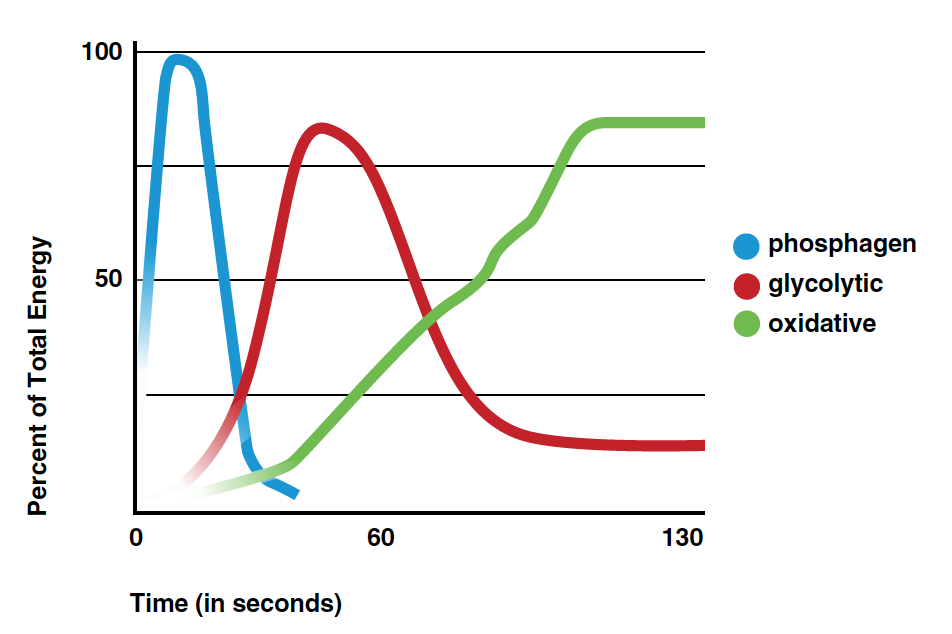
We’ve spent most of the semester discussing the aerobic energy system and its capacity
As well as strength/endurance/body composition/flexibility
We also have anaerobic energy systems that can produce large amounts of energy in a short span of time, but also fatigue quickly
These include:
ATP-PC system
Glycolysis
Assessing Anaerobic Output
Work →force applied over a distance
i.e., 𝐹𝑜𝑟𝑐𝑒/𝐷𝑖𝑠𝑡𝑎𝑛𝑐𝑒=𝑊𝑜𝑟𝑘 or 𝑁/𝑚 × 𝜃 =𝐽𝑜𝑢𝑙𝑒𝑠 (𝐽) 𝑜𝑓 𝑤𝑜𝑟𝑘
Power →the rate at which work is performed
i.e., 𝑤𝑜𝑟𝑘/𝑇𝑖𝑚𝑒=𝑃𝑜𝑤𝑒𝑟 or 𝐽/𝑆𝑒𝑐 = 𝑊𝑎𝑡𝑡𝑠(𝑊)
Horizontal power →rate at which work is performed over a horizontal distance 𝑓𝑜𝑟𝑐𝑒𝑘𝑔𝑥𝑑𝑖𝑠𝑡𝑎𝑛𝑐𝑒(𝑚)) / 𝑡𝑖𝑚𝑒(𝑠𝑒𝑐.) or 𝑓𝑜𝑟𝑐𝑒𝑘𝑔 𝑥 𝑑𝑖𝑠𝑡𝑎𝑛𝑐𝑒 (𝑚)/ time(sec)
Thus, if an individual's body mass (kg) is measured, and they are timed (s) as they sprint over a given distance (m), a total horizontal power can be calculated as follows:
70kg individual runs 200m in 27s
70x (200/27) (i.e., the force and the average velocity)= 70x 7.41= 518.52kg/m●s-1
OR(70x 200) / 27(i.e., the work over the time)= 14,000/27= 518.52kg/m●s-1
1kg/m●s-1=9.80665 Watts. SO…518.52kg/m●s-1 x9.80665= 5084.94 Watts
Sprinting power (horizontal power)
While calculating total power output over the course of a sprint may be informative, more information could be obtained.
If measurements were taken along the distance of a sprint, power output could be measured for each segment.
This would give an idea of acceleration
𝐴𝑐𝑐𝑒𝑙𝑒𝑟𝑎𝑡𝑖𝑜𝑛= 𝑆𝑝𝑒𝑒𝑑2−𝑆𝑝𝑒𝑒𝑑1 / 𝑇𝑖𝑚𝑒2−𝑇𝑖𝑚𝑒1 (𝑒𝑙𝑎𝑝𝑠𝑒𝑑 𝑡𝑖𝑚𝑒)
Sprinting power (horizontal power)
Lets look at an example
Example: Imagine a 70kg individual running a 100m dash
Their time is clocked at every 20m along the way.
They complete the total 100m in 18.5 Sec
70x(100/18.5)= total power of ~378.4kgm/sec (3,710.8W)
However, we could calculate power and speed for each 20m interval
Interval Timer power(kgm/s) speed(m/s)
0-20m 5.55 252.25 3.60
20-40m 7.8625 605.41 8.65
40-60m 11.47 388.08 5.54
60-80m 14.8 420.42 6.01
80-100m 18.5 378.38 5.41
Acceleration 20-40: 8.65-3.60 / 7.8625 - 5.55
5.05m/s / 2.3125s = 2.18m/s2.
𝐴𝑐𝑐𝑒𝑙𝑒𝑟𝑎𝑡𝑖𝑜𝑛= 𝑆𝑝𝑒𝑒𝑑2−𝑆𝑝𝑒𝑒𝑑1 / 𝑒𝑙𝑎𝑝𝑠𝑒𝑑 𝑡𝑖𝑚𝑒
Jumping power (vertical power)
Jumping is a movement that is required for many athletic performances and requires rapid force production in the lower extremities.
Therefore, jumping tests are useful for testing athletic performance as well as lower body power output.
How do you think we could measure this?

Vertical jump tests
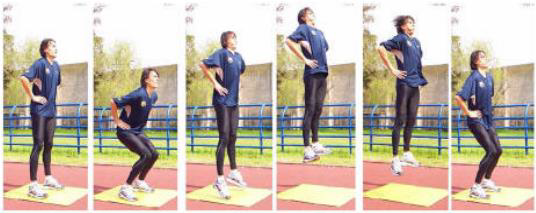
Countermovement Jump test
This test allows the activation of the stretch reflex resulting in ~10-20% greater vertical displacement than w/o
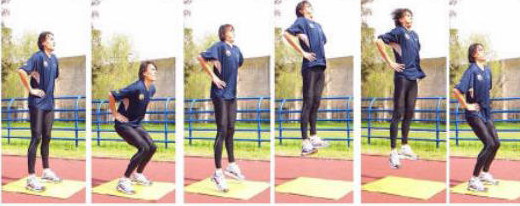
Static Jump test
This test requires the participant to squat ahead of the test to remove the additional force of the stretch reflex
eliminate 1/6
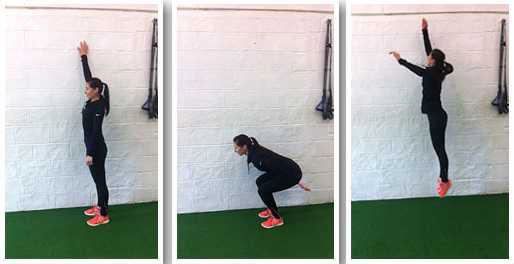
Jump and Reach test
Simplest vertical jump test that only requires a wall.
The difference between standing and jumping reach is considered the vertical displacement
Vertical power can be estimated from vertical displacement and body mass using the following equations:
𝐴𝑣𝑒𝑟𝑎𝑔𝑒 𝑝𝑜𝑤𝑒𝑟 (𝑊) =41.4 𝑥 𝑗𝑢𝑚𝑝 ℎ𝑒𝑖𝑔ℎ𝑡(𝑐𝑚)+(31.2 𝑥 𝑚𝑎𝑠𝑠(𝑘𝑔))−(13.9 𝑥 ℎ𝑒𝑖𝑔ℎ𝑡(𝑐𝑚))+431
𝑃𝑒𝑎𝑘 𝑃𝑜𝑤𝑒𝑟(𝑊) = (78.5 𝑥 𝑗𝑢𝑚𝑝 ℎ𝑒𝑖𝑔ℎ𝑡(𝑐𝑚))+(60.6 𝑥 𝑚𝑎𝑠𝑠 (𝑘𝑔))−(15.3 𝑥 ℎ𝑒𝑖𝑔ℎ𝑡(𝑐𝑚))−1308
Force Plates and Switch Mats
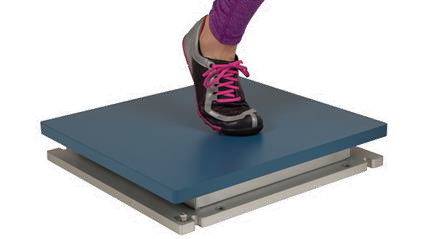
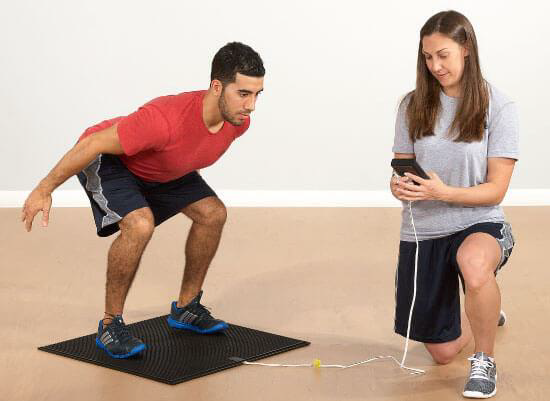
Both force plates and switch mats can be used for more accurate measurement of vertical power
The switch mat contains sensors to detect pressure
These can be used to accurately measure the duration of a jump (take-off to landing) – issues?
The force plate can detect the degree of pressure being placed on it (i.e., total force being exerted)
This can measure duration of a jump, but also the ground reaction forces being generated at both take-off and landing
Measuring the force produced over time allows the measurement of vertical power production
Jumping form needs to be monitored as it can skew the flight time calculations
Anaerobic Work more lab like testing
Peak Power, Mean Power, and Fatigue Rate can all be measured using cycle ergometry tests
Peak power → the highest power output that can be generated
Mean power → the average power output over some duration
Fatigue rate (fatigue index) → the fatigue rate describes the slope of the line between peak power and minimal power output (nadir)
The most common anaerobic power test is the Wingate anaerobic power test (WAnT), which is a 30 second all out sprint using ~7.5% of body mass as resistance
For shorter tests, a 10 second cycle test can be use with greater resistance
Additionally, a Margaria-Kalamen test or Quebec cycling test can be used for explosive power
In M-K test, individuals sprint up a flight of stairs as quickly as possible.
The known distance and mass are multiplied and divided by the time to calculate power
Wingate Anaerobic Power test (WAnT) (video)
Calculations from WAnT
After a brief warm-up, the participant cycles against 7.5% of their body mass as resistance for 30 seconds
During the 30 second sprint, RPMs are counted to determine power output over time (during each 5 sec period the RPMs should be noted)
Thus, power (W) can be calculated for each 5 sec period by multiplying Kg resistance x revolutions x 11.765 (this value comes from 1.62m wheel that turns 3.7x each pedal multiplied by 9.80665 to convert kg to N and divided by 5 seconds)
This procedure can be done for every 5 second period to generate a power curve for the 30 second test
The mean power can be calculated as well by multiplying Kg resistance x (average revolutions) x 11.765
Average revolutions is simply cumulative Revolutions divided by 6 (six 5sec periods = 30 sec.)
The power can be expressed as absolute values (as calculated above), or as relative values by dividing the absolute power by the individual’s body mass
A fatigue index can also be calculated by dividing the difference between peak and minimum power by peak power :
𝐹𝑎𝑡𝑖𝑔𝑢𝑒= (𝑝𝑒𝑎𝑘 𝑝𝑜𝑤𝑒𝑟−𝑚𝑖𝑛𝑖𝑚𝑢𝑚 𝑝𝑜𝑤𝑒𝑟) / 𝑝𝑒𝑎𝑘 𝑝𝑜𝑤𝑒𝑟 𝑜𝑢𝑡𝑝𝑢𝑡
Final Exam and Logistics
Availability: Opens Wednesday (5/13) at 6:00 am; closes Monday (5/18) at 11:59 pm.
Format: 58 questions (Multiple choice and True/False).
Total Time: 160 minutes.
Content: Includes calculations similar to lab exercises.
Policy: No make-ups or late attempts permitted.
Grades: Finalized by 5/20.
Upcoming Activity: Optional lab for power tests and VO2max.