Biology: Endocrine System
Endocrine System
- Its function is to secrete hormone into the blood and control activities throughout the body such as metabolism, reproduction, growth, and development.
^^Hormones and Endocrine Glands^^
@@Hormones:@@
Chemical messengers
Secreted by endocrine glands or tissues into blood
Travel everywhere the blood
goes
Affect only target cells, cells with receptors
May affect very distant organs or cells
\ @@Glands:@@
It is an organ which secretes particular chemical substances for use in the body or for discharge into the surroundings.
- There are three types of glands in our body: Endocrine glands, Exocrine glands, Heterocrine glands.
@@Exocrine Glands:@@
These are glands that secrete products into ducts.
- Sweat glands
- Salivary glands
- Mammary glands
- Stomach
- Liver
@@Endocrine Glands:@@
These are glands that secrete their product (hormones) directly into the blood rather than through a duct.
- Pituitary gland
- Pancreas
- Thyroid gland
Adrenal glands
@@Heterocrine Glands:@@
These are glands that perform both exocrine and endocrine functions.
Pancreas
\
^^Endocrine System^^
Consists of glands and groups of capillaries which facilitates diffusion of hormones to blood stream. They are commonly referred as the ductless glands, because the hormones secreted directly into the bloodstream.
It consists of a number of glands: Pituitary gland, Thyroid gland, Parathyroid gland, Adrenal gland, Pancreas, Thymus gland.
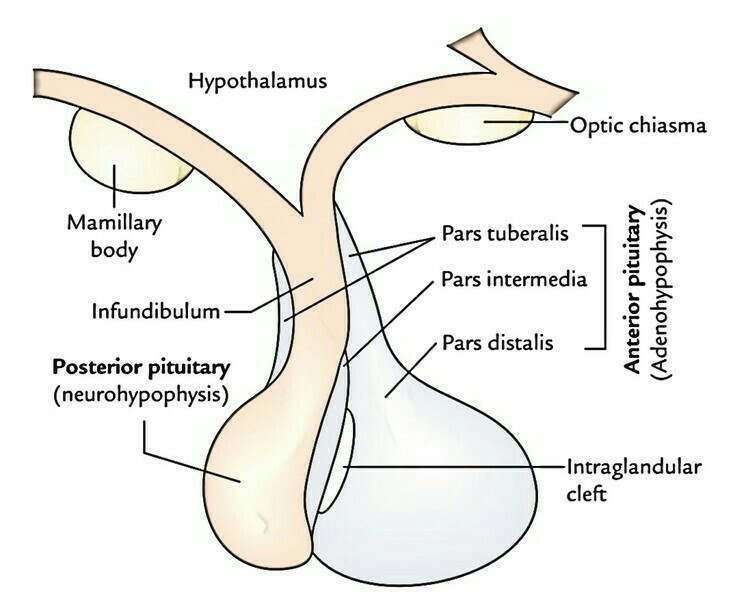
==Pituitary Gland:== The pituitary gland consists of Adenohypophysis and Neurohypophysis.
- Anterior lobe. It is influenced by hormones which come from the hypothalamus
- @@Neurohypophysis:@@ Posterior lobe. It is influenced by neurons which convey hormones directly from hypothalamic nuclei for storage of posterior lobe
^^Growth Hormone (GH)^^
Action of Growth Hormone:
- Stimulating of growth of bones, cartilage and connective tissue
Somatomedins are synthesized in the liver, in response to stimulation by the GH.
The effects of GH on skeletal growth are mediated by somatomedins.
- Effect on Protein and Mineral Metabolism
On protein metabolism: GH is protein anabolic hormone.
On mineral metabolism: Increase calcium absorption from GIT. Decrease sodium, potassium, calcium and phosphorus excretion from kidney
- Effect on Carbohydrate and Fat Metabolism
On Carbohydrate: GH is diabetogenic, because it produces hyperglycemia.
On Fat Metabolism: GH has catabolic effect. It increases mobilization of fats from adipose tissues.
^^Diseases Related to Growth Hormone^^
- %%Gigantism:%% It is due to the overproduction of GH during adolescence.
- It is characterized by tall stature, bilateral gynecomastia, large hand and feet.
- %%Acromegaly%%: It is due to excessive section of GH during adulthood.
It is characterized by broad and thick nose, thickening of the skin, prominent brow.
- %%Dwarfism%%: Deficiency of GH secretion.
- It is characterized by shortness of stature, small genitalia, delicate extremities
Prolactin plays an important role in the development of the mammary gland and in the milk synthesis.
It stimulates the thyroid gland to produce: Thyroxin and Triiodothyronine.
It is secreted by the anterior pituitary gland. It is often produced in response to biological stress. Its principal effects are increased production and release of corticosteroids.
It is synthesized and secreted by anterior pituitary gland, FSH regulates the development, growth, pubertal maturation and reproductive processes of the body.
It is a hormone produced by the anterior pituitary gland.
- In females, an acute rise of LH triggers ovulation and development of the corpus luteum.
- In males, it stimulates the production of testosterone.
Anti-diuretic Hormone (ADH)
^^Anti-diuretic Hormone (ADH)^^
It is a hypothalamic hormone synthesized in the cells of the supra optic nucleus. It is stored in the posterior pituitary.
- Functions of ADH: It retains water in the body and constricts blood vessels
- ==Diseases Related to ADH:==
- Diabetes Insipidus: It is a condition characterized by excessive thirst. Excretion of large amounts of severely diluted urine.
- Polyuria: It is the excessive or abnormally large production of urine
^^Oxytocin^^
It is synthesized in the hypothalamus. It is stored in the posterior lobe of pituitary gland.
- @@Action of Oxytocin:@@ It stimulates contraction of mammary gland to produce milk. It stimulates contraction of the smooth muscles of the uterus.
^^Thyroid Gland^^
^^The thyroid gland is situated in the neck in front of the larynx and trachea and it weighs about 25g. It consists of two lobes and they are joined by a narrow isthmus.^^
^^Thyroid Hormones^^
- ^^Triiodothyronine: It affects almost every physiological process in the body.^^
- ^^Thyroxin: It controls development and maturation. Excess thyroxin results in rapid development. Deficiency of thyroxin results in delayed development.^^
- ^^Calcitonin: It is a hormone secreted by the C cells of the thyroid gland. Its main actions are to increase bone calcium, and to decrease blood calcium levels.^^
^^Regulation of Thyroid Stimulating Hormone^^
^^Thyroid Stimulating Hormone (TSH)^^
- ^^It controls the regulation of the thyroid hormones.^^
- ^^The release of TSH by the anterior lobe of the pituitary is regulated by the hypothalamus via negative feedback mechanism.^^
- ^^It is a reaction that causes a decrease in function. It occurs in response to some kind of stimulus^^
^^Diseases Related to Thyroid Gland^^
- @@Goiter:@@ Any enlargement of the thyroid gland is called goiter, it is caused by iodine deficiency.
- Swelling in the neck
- Breathing difficulties
- Cough
- Hoarseness
- Swallowing difficulties
- @@Hypothyroidism:@@ It is the condition resulting from reduced circulating levels of T3 and T4.
- Goiter
- Puffiness of face
- Periorbital swelling
- Loss of scalp hairs
- Ptosis
- Dry, thickened, rough and yellow skin
- @@Hyperthyroidism/Graves Disease:@@ It is the condition resulting from increased circulating level of T3and T4.
- Moderate enlargement of the thyroid gland
- Exophthalmos (Lid retraction)