Study Questions
Week 1:
Lecture 1:
1. Give examples of/ explain how other disciplines (areas of study) attempted to study the mind- before “contemporary/modern psychology” existed as a discipline.
For Influence of Evolution: 1800s
Evolution by natural selection; due to evolution by natural selection, “survival of the fittest”, behaviors are shaped by natural selection.
For influence of Medicine: 1800s
Localization of brain function was studied using Phrenology
An example would be the case study of the brain injury that Phineas Gage suffered; He went front being able to be independent and business'-like to haveing child-like behavior.
study cases of traumatic brain injuries and studied cases of brain injuries and studied how injuries to certain part of the brain change the way they thought or their behaviors
2. Why is Phineas Gage important in the history of psychology? What can we (as scientists) learn from cases of brain injury?
Phineas Gage was important to the history because he suffered a severe head injury and survived, and after that brain injury, he went from being hard-working and dependable to having a childlike behavior, having difficulties sticking to a plan. There were some overall changes to his demeanor and personality. There was damage to the frontal lobe and saw those changes in his behavior after.
3. Describe the schools of thought discussed in class. How are they
similar/different from each other?
Structuralism:
attempt to analyse conscious experience by breaking it down into basic elements
Wilheml Wundt was a big proponent of structuralism, along with Edward Titchener, his student.
trying to answer how is the mind structured; what are the different aspects of somebody’s experience (perceptual experience) and can we break down those experiences into basic elements
they used technique called Introspection
trained people to be an observer and to observe their own experiences
Functionalism:
the study of the purpose and function of behaviors and mental processes
purpose and function; why do we show particular behaviors as humans? Why do we show certain types of mental processes? What is the purpose?
Purpose of certain behaviors was adaptive purpose
One big proponent was William James
Behaviorism:
study only observable behavior
argued it is less subjective and more scientific
if there is a stimulus, what is the behavioral response?
Cognitive Psychology:
argued that those mental processes, whats happening in the brain like language, memory, problem-solving, play a role in psychology
how do we think? What type of decisions do we make under certain circumstances?
study mental processes and highlight the importance of these mental processes
Brenda Milner and Elizabeth Loftus
Psychoanalytic:
Sigmund Freud
more in the area of clinical psychology
attempts to explain how behavior and personality are influenced by unconscious processes
unconscious mind important to study
might influence your behaviors, but also different types of mental health issues
Cross-Cultural Psychology:
a field that draws comparisons about individual and group behaviors across cultures
WEIRD: describing participants
Western population, Educated participants, Industrialized countries, Wealthy participants, Democratic nations
4. What does it mean to say that psychology is WEIRD? What are the implications?
What is meant to say that psychology is WEIRD is that studies done in psychology are mostly done on or from Western population, are educated, from industrialized countries, are rich, and from democratic nations. The implications are that 96% of the samples tested are from western industrialized countries, which only makes up 12% of the world population, which the studies are making a generalization obased on the 12% and applying it to the rest of the population in the world.
Iclicker Question:
Who would you associate with structuralism?
a. Sigmund Freud
Psychoanalysis
b. Phineas Gage
Popular Traumatic brain injury (rod through head - survived); went from business-like and independent to childlike after head trauma
c. Edward Titchner (& Wilhelm Wundt)
Structuralism
d. Charles Darwin
Theory of Evolution/Natural Selection
e. None of the above
Lecture 2:
1. What is hindsight bias? How can it impact our interpretation of
research findings?
Hindsight bias refers to the tendency to perceive past events as more predictable than they actually were, often leading to the belief that one knew the outcome all along.
It can impact research findings by distorting perceptions of findings, leading to overconfidence, and hindering learning from mistakes.
2. What makes a good theory? Hypothesis?
A good theory is falsifiable; you can collect evidence to support or refute the theory.
A good hypothesis has to have 2 variables, and predict the relationship between the two variables and how they affect each other.
3. What does it mean to operationalize your variables? (You should be able to do this!) Give an example of how you could operationalize the variable “sleep quality”
It means being able to define your variable in a way that allows specific and measurable observations and data collection
an example of how I could operationalize the variable sleep quality is having participants self-report how many hours they slept and rate how tired they were throughout the day.
4. What is the difference between a “correlational” and an “experimental” research design. Give an example (real or one you made up) of a study that uses a correlational design and a study that uses an experimental design.
A correlational design measures how closely two variables vary together; how well you can predict a change in one variable from observing change in the other variable
A experimental design is when the investigator systematically manipulates a variable (IV) under carefully controlled conditions and observes whether any changes occur in the second variable (DV) as a result
5. In your own words, what is the difference between random assignment and random selection?
Random assignment is assigning participants randomly to experimental conditions, which increases the chance that characterisitics will be equally distributed across groups.
Random sampling is when every person in the population has an equal chance of being selected
6. What is the difference between experimenter bias and demand
characteristics? Give an example of each.
Experimenter bias is when the experimenter’s expectations influence the outcome of the study while demand characteristics is when the participants form interpretations of the experiment’s purpose and subconsciously change behavior to fit interpretation.
Week 2:
Iclicker: What is the IV in the Bobo doll study?
a. The number of aggressive behaviors exhibited by the child
b. Whether the child watched aggressive behavior at home
c. The number of times the model kicked/punched the doll
d. Whether they watched the adult model aggressive behavior or not
Lecture 2:
1. Label the structures on the diagram below. For each of the structures describe it’s corresponding function?
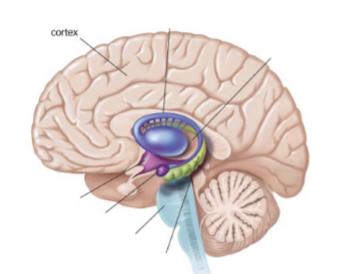
2. Label the lobes of the brain. What is the function we described in class for each of the lobes?
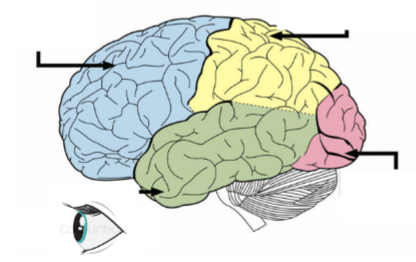
3. How is contralateral organization/control at work in the brain?
Each hemisphere of the cerebrum and thalamus mainly controls or receives sensory information from the opposite side of the body. This means that the left hemisphere generally controls the right side of the body and the right hemisphere controls the left side.
4. What do split-brain patients respond to stimuli presented in the left versus the right visual field?
Stimuli in the right visual field are processed by the left hemisphere and can be verbally and accurately identified with the right hand. Stimuli presented to the left visual field are processed by the right hemisphere and can be identified with the left hand, but the patient cannot identify it verbally.
5. Identify the structures and functions of each of the parts of the neuron we discussed in class.
Neurons: a cell that specializes in receiving and transmitting information
Cell Body: coordinates information-processing tasks and keeps cell alive
Dendrites: receive information from other neurons and relays it to the cell body
Terminal Buttons: are found at the end of the axon, below the myelin sheath, and are responsible for sending the signal on to other neurons
Axon: carries information to other neurons, muscles or glands
Synapse: the region between the axon of one neuron and the dendrites (or cell body) of another
Myelin Sheath: fatty sheath that insulates axons resulting in increased speed of and efficiency of neural communication
6. Describe the action potential.
Action potential is an electrical signal that is conducted along the length of a neuron’s axon to a synapse. It begins with depolarization where the membrane potential becomes less negative, due to an influx of positive ion like sodium, and reaches a threshold of -55mv (resting is -70mv). Action potential is then initiated as there is a rapid increase in membrane potential, followed by a rapid descrease back to resting potential. Repolarization the begins folling the peak of the action potential, as it involes the oitflowof positive ions like potassium, restoring the original ionic balance.
7. Describe transmission across the synapse.
Transmission is the process by which a neuron communicates with another cell (neuron/muscle cell) at a synapse. Synaptic transmission, the process by which neurons communicate, involves four main steps: synthesis and storage of neurotransmitters, release of neurotransmitters, binding of neurotransmitters to receptors on the postsynaptic neuron, and inactivation of the neurotransmitter
8. What is the difference between an agonist and an antagonist?
Agonist are drugs that increase action of neurotransmitter
Antagonist are drugs that diminish the function of neurotransmitter
Quiz 1:
There are a number of ethical principles that govern psychological research. Participants must______________ which means that they must agree to participate in studies and are informed of any potential risks. This _______________ explicitly telling participants the hypothesis of the study.
give informed consent; does not include
give informed consent; includes
debriefing; does not include
debriefing; includes
A professor wonders whether multiple choice or True/False practice questions are better for students’ learning. She asks half of her students to answer 10 multiple choice questions related to course content. The other students answer a similar set of questions in True/False format. Then two weeks later she gives her students a final short answer test on the content. What is the independent variable?
whether they practiced or not
whether the practice questions were multiple choice or True/False
the performance on the final test
students’ prior knowledge about the content
Jordan wants to study how much sleep high school students get on school nights. To do this, he obtains a complete list of all high school students in his state. He then uses a random number generator to select 100 students from the list to participate in his survey. Jordan is using ________________.
Random assignment
Random sampling
Generalization
Variability
The purpose of operational definitions in science is to____________________
increase ecological validity.
make sure you can control for other factors that might influence your results.
carefully define terms and variables so they can be objectively studied.
keep participants from knowing which treatment group they are in.
Behaviorists would have been skeptical of research results obtained from _____________, a methodology used primarily by _____________.
observation; Structuralists
observation; Functionalists
Introspection; Functionalists
introspection; Structuralists
What was the independent variable in the Bobo doll experiment we discussed in class?
The amount of time that passed before the child became aggressive
There was no independent variable, it was a correlational design
Whether the child watched an aggressive or unaggressive model
The number of times the child hit, punched, and was verbally aggressive towards the doll
How aggressive the child was in everyday life (prior to visiting the lab)
If a student was accepted for training in the psychology laboratory of Edward Titchener. It is likely that the student would have been trained to_______________.
analyze how to break down sensations into their most basic elements.
carefully feel the bumps on a person's head in order to determine his or her character traits.
investigate the function or purpose of particular human behaviors.
condition participants to fear certain types of stimuli
listen intently while individuals describe the symptoms of their depression or nervousness.
Maya is participating in a psychological experiment for one of the graduate students at her university. She knows she was recruited to participate in the experiment because she is bilingual and the lab is interested in the cognitive benefits of being bilingual. During the experiment, she is asked to complete a variety of cognitive tasks. Maya tries extra hard to do well on the tasks because she wants to show that there are cognitive benefits to bilingualism. A common pitfall in experiments, Maya may be falling prey to ______________.
intentionality
deception
experimenter bias
the placebo effect
demand characteristics
Tyler surveyed 50 undergraduate students and found that the students who ate more servings of leafy greens per day also reported getting sick for fewer days during the past month. What is the best conclusion to draw from this study?
Eating more greens causes students to get sick less often.
Being sick less often makes students want to eat more greens.
An overall focus on healthy living causes students to both eat healthier and get sick less.
Eating greens and days being sick are negatively correlated in this population.
All of these conclusions are equally valid based on this study.
Professor Linda was interested in establishing whether students who took their quiz with a red crayon would do better than students who took their quiz with whatever pen they happened to bring to class that day. She had 30 red crayons and handed them out to the first 30 students who arrived to class. The 30 remaining students who arrived to class after that completed the quiz with their own pens. This process would most clearly violate the principle of:
Random assignment
Correlational research
Variability
Generalization
Dr. Hernandez predicts that the group of rats that receives “medication A” will see a greater reduction in anxiety symptoms compared to “medication B”. He administers the medications to the rats every day for 3 months by adding liquid medication to their water each day. Dr. Hernandez never directly handles or holds the rats, but he does know which rats receive which medication. After the rats have been on their assigned medications for 3 months Dr. Hernandez performs a behavioral assessment of their anxiety levels. In rats, anxiety can be measured by “freezing behavior” and reduced exploration of new spaces. A research assistant places each rat in a transparent cage and Dr. Hernandez rates each rat’s freezing behavior on a 7-point scale and their exploration on a 7-point scale by watching them for 20 minutes. Given the design of the experiment there is a possibly that ______________ may impact the results.
demand characteristics
deception
the placebo effect
experimenter bias
Dr. Sanchez is interested in the impact of sugar consumption on children's sleep. He surveys a group of parents and asks them to document how many sugary snacks their children eat per day and the number of hours per night they sleep. Which research method did Dr. Sanchez use?
a case study
an experimental design
a correlational design
a variable study
A professor is interested in increasing the amount that parents read to their children. She randomly assigns parents to one of two conditions. Half of the parents watch a 1-hour video on the importance of reading to their child. The other half watch a video about parenting that does not talk about reading and its importance. Which research design did this professor use?
a correlational design
an experimental design
a case study
a variable study
Which of the following is true regarding phrenology?
It was developed in the 1960’s.
It was an early approach to brain localization
It examines the relationship between traumatic brain injuries and loss of function in those areas.
It was developed by Wilhelm Wundt.
None of the above are true
Dr. Lorna wants to know how to help people do well on spelling tests. She randomly assigns participants to either practice their words for one hour on a learning website or practice their words for one hour with a friend. After participants completed their assigned conditions, they returned to the lab three days later to take a final spelling test. What is the dependent variable?
The performance on the final test
The delay between study and test
The assigned study technique
The control group
The spelling test all participants took before signing up for the experiment to see whether they had prior knowledge about the words
Week 3 Lec 2:
1. Define absolute threshold and JND. Give an example of how you might devise a test to assess someone's absolute threshold.
Absolute threshold is the smallest amount of stimulation needed for detection by a sense
You can test to assess someone’s absolute threshold by audio, to see how loud a noise needs to be before a person can hear it
Just Noticeable Differencec/Difference threshold is the minimum difference between two stimuli needed to detect a difference between them
You can test to assess' someone’s difference threshold by playing a music at a certain volume for a certain period amount of time and then gradually increase it until the participant has notice a change in volume.
2. What is the difference between top-down and bottom-up processing. Give an example of each.
Top-down processing is when our perceptions are influenced by our expectations or by our prior knowledge
example of this is recognizing a song even if some of the notes are missing or distorted
Bottom-up processing occurs when we perceive individual bits of sensory information (e.g., sound) and use them to construct a more complex message
3. What is signal detection theory? Give an example of a hit, miss, false alarm and a correct rejection.
response to a stimulus depends on person’s sensitivity and on a person’s decision criteria
SDT Outcomes:
Hit: The signal is present, and the observer correctly identifies it.
Miss: The signal is present, but the observer incorrectly says it's not.
False Alarm: The signal is absent, but the observer incorrectly says it's present.
Correct Rejection: The signal is absent, and the observer correctly says it's not.
Hit:
You hear a distinct "pop" and correctly recognize it as the signal you were expecting, according to the psychology website of Hanover College.
Miss:
You hear a "pop" but, due to noise, you don't recognize it as the signal.
False Alarm:
You hear a "pop" but it's actually a noise from the environment, and you mistakenly think it's the signal.
Correct Rejection:
You hear a "pop" but you correctly realize it's just noise, not the signal, according to Oxford Reference.
4. What is the difference between change blindness and inattentional blindness Give an example of each.
Change blindness is the failure to detect changes to the visual details of a scene and has to do with pre and post. It involves memory and they have to remember what is was before it changed
Inattentional blindness is the failure to perceive objects that are not the focus of attention
5. Describe how we go from sensation to perception in the visual domain.
Light enters through cornea, then through pupil (can expand/contract depending on light), then hits lens (focuses light onto retina), and lens can change shape to focus image back on eye (inverted on retina (top becomes bottom, left becomes right)). Photoreceptors on retina transform light into a neural signal (transduction), Ganglion cells gather information from photoreceptors, and the message is sent to brain via optic nerve to hypothalamus leading to the visual cortex
6. Describe the two ‘complimentary’ theories of how we see color.
Trichromatic color theory: 3 different cones each sensitive to different wavelengths of light (short, medium, long) short sees blue, medium green, and long red, Additive color mixing (with light), red/green colorblind, etc. deficiency in green cones = yellow green = reddish, Does not explain negative after images (where there was green, there is now red)
Opponent process theory: we perceive color in terms of opposing pairs: red/green, yellow/blue, white/black, Cells that are stimulated by red are inhibited by green - when red is no longer perceived a rebound effect occurs - the previously inhibited cells are free to fire, Happens at higher levels (retina,nucleus,etc.), level of ganglion cells, LGN, visual cortex
7. What are the dorsal and ventral pathways responsible for? Which of these pathways do prosopagnosia and visual agnosia relate to?
They are responsible for the different aspects of visual processing: the dorsal pathway is primarily responsible for spatial awareness and action ("where" something is), while the ventral pathway is responsible for object recognition ("what" something is).
Prosopagnosia, which is the inability to recognize faces, and visual agnosia, which is a broader impairment in object recognition, are both thought to be related to the ventral pathwa
8. What is the difference between monocular depth cues and binocular depth cues? Give an example of each.
Monocular Depth cues help us perceive depth using one eye while Binocular depth cues uses coordination between the eyes to tell you how far away something is.
An example of a monocular cue is linear perspective, where parallel lines appear to converge in the distance. A binocular cue example is convergence, where the eyes turn inward to focus on nearby objects.
INCLUDE ICLICKERS
Transduction of light happens in ______. Transudction of sound happens in the ______.
photoreceptors; cochlea
A researcher is interested in whether children who watch more violent cartoons on TV are more aggressive. He brings a group of children into the lab that watches at least 2 hours of violent cartoons on TV and another group that rarely watches violent cartoons. He presents children with a bobo doll and counts the number of kicks, hits, punches, they show in the first 10 minutes. The researcher tests the participants himself and starts to interpret the behavior of the children who watched the violent cartoons as more aggressive. This most clearly illustrates ______.
experimenter bias
The ____ lobe contains the motor cortex. The _____ lobe contains the primary visual cortex.
frontal; occipital
Which of the following best represents a structuralist approach to studying perception.
They would ask participants to reflect on the components of their perceptual experience
In the ______ phase of the action potential, the cell becomes more positive because ______.
depolariztion; NA+ rushes in
What’s your intuition? If you can identify which dumbbell is heavier then you “win”. Which comparison would it be better to make?
10 lbs to 11 lbs
Dale world at LAX airport. He wants to increase the airport’s detection of liquids or banned substances in people’s suitcases. In terms of signal detection theory, he thinks that security should increase the number of bags screened, which will reduce the number of _____ of banned substances/liquids
False alarms
Kyra likes listening to music before going to sleep, but she gets in trouble if she plays her music after 10pm. Kyra knows that if her parents can’t hear the music, she will not get into trouble. But, even though the music is playing very softly, her parents can detect the music 75% of the time. The point at which Kyr has the volume set is ______.
above her parent’s absolute threshold
In a famous case study Phineas Gage had damage to his frontal lobe. After the accident he _____.
became more impulsive
Katie, a split-brain patient, is shown two pictures simultaneously: the right side of her visual field is presented with an apple, and the left side of her visual field is presented with a cup. When Katie is asked what she sees, what will she say?
“an apple”