Pendulum Motion
1. What a Pendulum Is
A pendulum consists of:
A cord or string of fixed length
A mass at the end called the pendulum bob
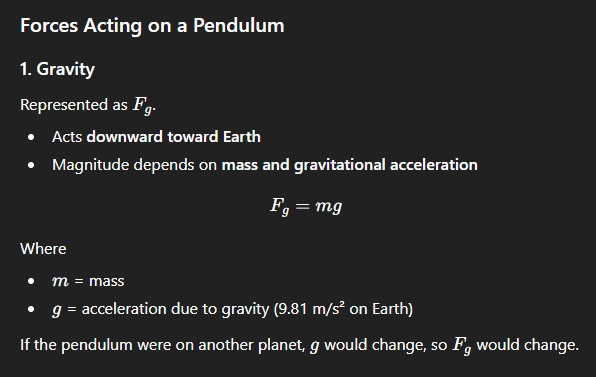
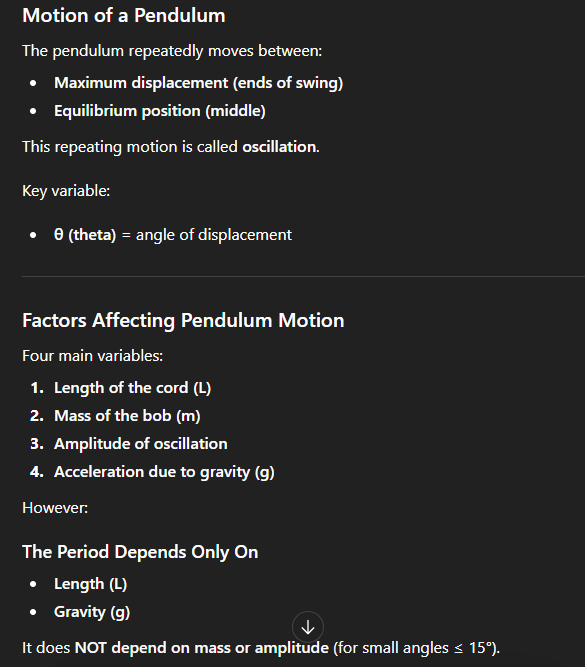
When displaced from equilibrium and released, the bob swings back and forth in oscillatory motion.
2. Tension in the Cord
Represented as FtF_tFt.
Properties:
Acts along the cord toward the pivot
Keeps the bob moving in an arc
Depends on:
mass
angle of displacement
gravitational acceleration
Independent of cord material
Restoring Force
The net force from gravity and tension produces a restoring force.
Restoring force:
Always points toward the equilibrium position
Opposes displacement
Example:
If the pendulum moves right, restoring force pulls it back toward center.
Because the bob has momentum, it passes the center and continues to the opposite side.
Energy in a Pendulum
A pendulum constantly exchanges kinetic energy and potential energy.
At the Middle (Equilibrium)
Velocity: maximum
Kinetic Energy: maximum
Potential Energy: zero
At Maximum Displacement (Ends of Swing)
Velocity: zero
Kinetic Energy: zero
Potential Energy: maximum
Energy Conversion
Downward swing:
Potential energy → kinetic energy
Upward swing:
Kinetic energy → potential energy
Energy continuously transfers between the two forms during oscillation.