Forensics Unit One: Eyewitnesses and Crime Scenes
Police and Eyewitnesses
After the Event
Factors that will affect witness memory and confidence
Time delay before questioning
Number of times questioned
method of questioning
Before the Interview
Get statement as close to time of the event as possible
If possible, place witness in the event environment
Before asking questions, ask the witness to recreate the scene in their mind
During the Interview
Start with unprompted recollection
Witness does the talking
Record both questions and answers
Witness tell the story from beginning to end
Follow up with specific questions
Avoid
Leading questions
Asking questions too quickly
Asking the same question more than once
Multiple choice questions
Interrupting the witness
Nonverbal cues indicating your opinion
Suspect Lineups: Foils/Fillers/Distractors
Should look like description not the suspect
Put the most similar foils next to the suspect
Pictures of foils and suspect should be similar quality, same clothing, same background, etc.
Securing a Crime Scene
Classifying Crime Scenes
Primary Crime Scene - Location where the crime occured
Secondary Crime Scene - Location where accessory event took place\
Planning
Transportation
Burial site for a body
Role of the police
Section off (isolate) the scene
This may grow or shrink under the direction of the CSI crew and/or detectives
Detain any witness or relevent bystanders
Securing the scene
Ensure no one enters or leaves
All first responders
Provide medical assistance
Case Study: JonBenet Ramsey
Case Details
Case took place December 26, 1996 in Boulder Colorado
Victim was 6-year-old JonBenet Ramsey
On the morning of December 26, JonBenet’s mother, Patsy, got up early to get ready for a trip the family was leaving for that day.
After waking up she discovered a ransom note
two page long ransom note - which is long for a ransom note
demanded $118,000 - strange amount
the note and draft of the note was written on a pad and using a pen that were inside the home
Securing the Scene
People were allowed to enter and leave the scene
People were allowed to roam around the house search the scene
They searched only the main living areas (kitchen and living roam)
They searched JonBenet’s room
Finding JonBenet Ramsey
Father and a friends decided to search the entire house
Found JonBenet dead in the basement
Picked her body up and took her upstairs to show the police
Photographing a Crime Scene
CSI Role: Document and Collect Evidence
Documenting Evidence
Sketch
Photo
Take photos on the way in and out of the scene
Don’t touch the scene
Set down evidence flags
List the numbers and label the evidence on the case file
Long Range Shots
Medium Range Shots
Shows evidence in proximity to each other
Close up Shots
Shows evidence up-close and size of the evidence (Measurement device is placed next to the evidence to give scale)
Sketching a Crime Scene
A crime scene sketch depicts the overall layout of the scene and the relationship to other relevant items and surroundings. Large things around the scene such as trees, streams, and big boulders.
Before the sketch
Obtain an overall view of the scene
Determine the sketch limits what is included
Sketches
Rough sketch is done at the scene and is basic shapes and measurements.
Elevation Sketch shows bullet trajectories
Perspective sketch is a 3d sketch of the space.
Crime Scene Reconstruction
Used to support a likely sequence of events based on the analysis of physical evidence and sometimes witness statements.
Scene reconstructions could be done to test the hypothesis for the events
Often done to walk juries through the most likely set of events at a scene
Objectivity - Personal detachment from the event to avoid bias in reconstruction
Falsifiability - Working with the notion that a hypothesis or theory can be disproven if given the proper evidence
Leaves the person open to new information
If you try to disprove the hypothesis or theory still stands, it becomes stronger
Limits in Reconstruction
Fallacy of Bifurcation - trying to give a simple ‘yes’ or ‘no’ to a complex question
Not all information will give a clear cut answer so don’t make it
Generalizations - helpful, but must be willing to give them up
False Linkage - Assuming a link between two items
Reconstructions for Juries/Investigation
Reconstruction needs to be clear and focused.
There may be more than one reconstruction - to show how events progressed.
Media used photos, drawings, computer reconstructions, models, diorama, etc.
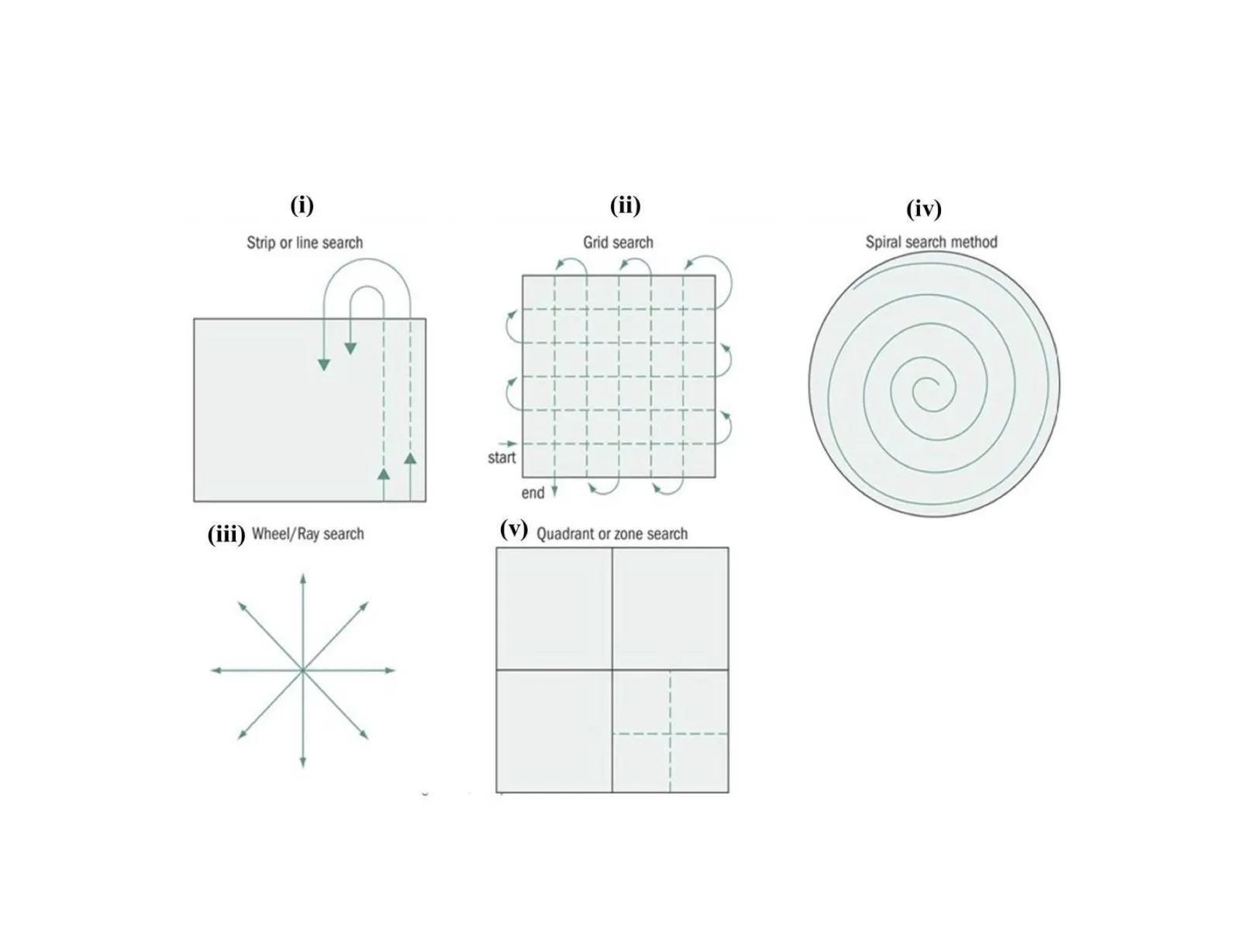
Search Patterns
The first step after securing and defining the dimensions of a scene.
Evidence can be found on the ground, walls, and ceiling
As evidence is found: It is marked with a number and recorded on an evidence list
Collecting Evidence
Avoid contamination (wear gloves)
Collection techniques and storing of evidence depends on the type of evidence.
Biological evidence is dried and placed in a paper bag
Arson evidence is placed in a sealed can
May have to vacuum
Evidence Classification
Individual Characteristics
Evidence with unique properties
Can be linked to a source with a high degree of certainty
Examples: DNA and fingerprints
Class Characteristics
Lacks unique properties
Evidence associated with a group
Examples: Tire treads, ink, fabric
Legal Stuff
Legal search and seizure
Maintain a chain of custody
Presenting evidence in court
Presenting Evidence in Court
Two methods for the court to accept evidence for a trial/hearing
Frye Standard - evidence whose collection, classification and examination technique is well known or whose methods are widely accepted by the scientific community
Daubert Ruling - the judge acts as a gatekeeper for evidence