5.5: Contemporary Views of Operant Conditioning
Cognitive Aspects of Operant Conditioning
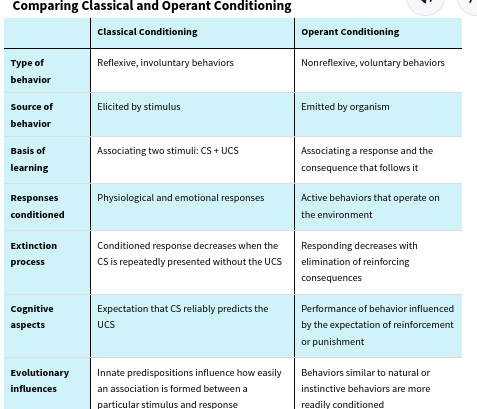
Edward C. Tolman (1898-1956) firmly believed that cognitive processes played an important role in the learning of complex behaviors — even in the laboratory rat
He believed that although such cognitive processes couldn’t be observed, they could still be experimentally verified and inferred by careful observation of outward behavior
Much of his experiments involved rats in mazes. The “goal” box had food
The rats had learned a sequence of responses such as “first corner—turn left; second corner—-turn right,” and so on
However, Tolman argued that the rats had learned more than simply the sequence of responses. He believed that they built up a cognitive map of the maze
Cognitive map: Tolman’s term for the mental representation of the layout of a familiar environment
Tolman concluded that reward—or reinforcement- is not necessary for learning to take place
Learned Helplessness: Expectations of Failure and Learning to Quit
Learned helplessness: a phenomenon in which exposure to inescapable and uncontrollable aversive events produces passive behavior
Learned helplessness was discovered by accident
Psychologists were trying to find out if classically conditioned responses would affect the process of operant conditioning in dogs
In the setup, the dogs were unable to escape or avoid shock. But the next part of the experiment involved a procedure in which the dogs could escape the shock.
However, when the conditioned dogs were placed in the box and became elctrified, they didn’t try to jump over te barrier. They just laid down and whined.
Martin Seligman explained that the dogs had learned that shocks were inescapable. No matter the behavior they engaged in such as whinimg, barking, would allow them to avoid the shock.
How can it be overcome?
Seligman discovered if they forcibly dragged the dogs over the barrier when the floor became electrified, the dogs would eventually overcome it and jump
Operant Conditioning and Biological Predispositions: Misbehaving Chickens
Psychologists studying operant conditioning found that an animal’s natural behavior patterns could influence the learning of new behaviors
Instinctive Drift: the tendency of an animal to revert to its instinctive behaviors that can interfere with the performance of an operantly conditioned response