ECON 102 Notes
Chapter 5
Economics: the study of how to manage the problem of unlimited needs & scarce resources
- Microeconomics- behavior of each individual economic unit (eg. one consumer, one supplier, one specific market)
- Macroeconomics- behavior of the whole economy, uses Aggregates (totals). Studies topics like inflation rates, unemployment rates, exports of an entire country
Output Gaps: Actual output (Y) - Potential output (YNR)
- Recessionary Gap: Y<YNR, unused resources
- No Gap: Y=YNR, full employment
- Inflationary Gap: Y>YNR, by putting pressure on resources we can produce more than our normal full capacity (eg. making workers work more hours). This causes a “Boom” (eg. during the war every factory increased its capacity because everyone was working harder than normal)
Measuring Actual Output:
- Mathematically
- Expenditure Method
- Income Method
- Value Added Method
- Graphically
- Where aggregate demand & supply intersect (Y axis)
Closing Output Gaps:
- Self Correction Mechanism- where the economy closes the gap on its own without govt. intervention, think invisible hand BUT it’s very slow
- Intervention Policies
| Fiscal Policy | Monetary Policy | |
|---|---|---|
| Implemented by: | Govt. | Central Bank |
| Instruments: | 1. Government Spending2. Taxes | Management of money supply |
Main Economic Goals of a Country:
- Full employment
- Price & Economic stability- no uncertainty
- Economic Growth- as the population increases the economy must produce more
Textbook sections not done:
Working Age Population:
- Not participating in the labour force- eg. someone focusing on having a family, full time students, discouraged workers (no longer searching for a job)
- Pariticipating in the labour force- working or searching
- Employed
- Unemployed (must be searching)
- New entrants
- Rentrants
- Job losers (fired)
- Job leavers (quit)
Types of Unemployment:
- Frictional Unemployment- normal turnover in the economy
- People who left their jobs to find better ones
- People moving one place to another
- Just joined the labour force
- Structural Uemployment- a mismatch between ones skills and what is required
- People not working because they lack skills required by available jobs
- Cyclical Unemployement- People not working due to a recession
- Businesses gone bankrupt, no job opportunities
So i can say there is full employment in an economy where natural unemployment still exists? There just cant be any cyclical?Natural Unemployement- natural unemployment will ALWAYS exist, full employment means there is no gap (cyclical unemployment) but we still have natural unemployment
- Natural Unemployment**=** Frictional + Structural (add cyclical to natural for total if there is a recession)
Labour Force= employed + unemployed
Participation Rate= labour force/working age pop *100
Unemployment Rate = number of unemployed/labour force *100
Employment Rate = number of employed/labour force *100
Costs of Unemployment:
- Lost output
- Okun’s Law- for every 1% increase in Cyclical Unemployment here is a decrease in output by 2%
- Poverty
- Crime
- Low levels of consumption
Official Unemployment Rate: not an accurate measure of unemployment because it ignores:
- Underground economy- the government counts people as unemployed but they are actually working “under the table” so the official rate may overstate the extent of unemployment
- Part time workers- half of the time they are employed, half they are unemployed but they are officially considered employed
- Discouraged workers- officially treated as out of the labour force even though they are technically unemployed
- Underemployed people- people overqualified for their jobs, officially counted as employed even though they are signically overqualified and may be considered unemployed
Economic Stability:
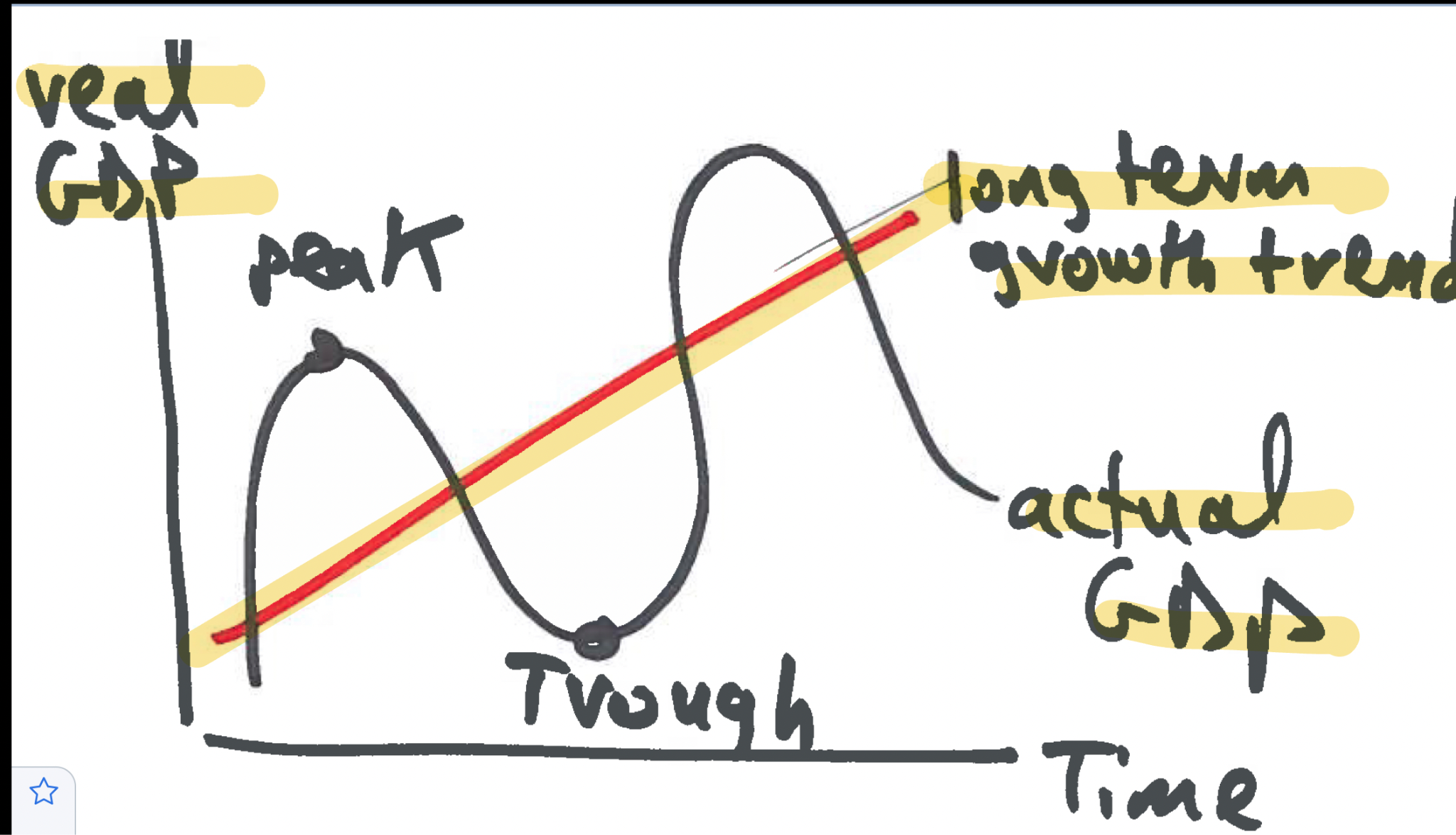
Business Cycles: short term fluctuations in the level of economic activity where the actual output fluctuates around the potential output (consists of 1 up & 1 down)
- Fluctuations of real GDP around the long term growth trend
- Peak: the highest point where output reaches the maximum level
- Trough: the lowest point where output reaches it’s minimum
- Contraction: a drop in output & employment
- Recovery: an increase in output & employment
- Expansion: period where there is a recovery
- Recession: a period where there is a contraction
- Depression: prolonged recession
- Boom: prolonged expansion

Leading Indicators: Macroeconomic variables that give an indication of what part of a business cycle the economy is entering
- Sales of durable goods (eg. cars, homes), decrease = recession
- EI applications, increase = recession
Price Stability:
Inflation: continuous increase in the price level
Deflation: continuous decrease in the price level
Measures of Price Level:
- Consumer Price Index (CPI) = current cost of basket bought by avg. consumer/ cost of this basket in base year (relative)
- When CPI is 100 in a year, it is the base year
- GDP Deflator- average price of ALL goods and services
Inflation Rate: measures by what % the price level changes each year
- Inflation Rate = (CP2-CP1)/CP1 *100
- Inflation Rate = (P2-P1)/P1 *100
- P1 is the price level determined by either CPI or GDP Deflator? So its literally just that number?
- P2 is current price
Costs of Inflation:
- Reduces purchasing power or “value” of money
- Harms people with fixed incomes
- Harms creditors (lenders)- people who lend their money get it back but it is worth less now does this have to do with opp cost or just lost interest?
- If inflation is expected then lenders protect themselves by asking for higher interest rates
- If it is unexpected this harms lenders
- Menu cost- cost of sellers having to reprint menus with updated prices
- Shoe Leather cost- we keep money in banks to benefit from interest but everytime you need cash you have to go to the bank which wastes time or may have a transaction cost associated with it
Indexing: salaries increase every year in many county by a certain percentage to compensate for inflation
Hyperinflation: very high rates of inflation for a long period of time in a specific country
Real Interest Rate: takes into account what happens to the value of the money when it adjusts for inflation
- Real Interest Rate = nominal interest rate (not adjusted for inflation, reported rate) - inflation rate (reduces value of money)
Chapter 6
GDP: Gross Domestic Product- value (price*quantity) of all final goods and services produced domestically during a certain time period, can be -
- Does not include buying used items, foreign bought goods, and only includes final items are the value of additions on a house part of gdp or just the act of paying for the paint when remodeling and then selling a house?
Measuring GDP:
- Value Added Method: calculating GDP by summing up all added values at different stages of production, all are equal
- Final goods already include the value of ALL intermediate goods- DO NOT readd the value of intermediate goods because this will cause a double counting problem (the same item being counted more than once)
- Value added = Value of Output- Value of ONLY THE PRECEDING Input
- GDP = sum of all added values or the value of all final goods
- Expenditure Method: How much is spent on final domestic goods & services
- GDP = C + I + G + X - M
- C: Consumer Expenditures- only on domestically produced goods
- Goods (tangible)
- Durable: used repeatedly for more than a year (eg car)
- Semi-Durable: used more thna once within a year (eg pen)
- Non-Durable: used only once (eg apple)
- Services (intangible)
- I: Investment Expenditures- only on domestically produced goods *Does not mean buying a stock, bond, or saving money (this is called saving) how do we know consumer vs investment, is it company for investment?
- Gross Investment = net investment (new machines bought to increase productivity) + replacement investment (replacing depreciated items)
- I: Investment Expenditures- only on domestically produced goods *Does not mean buying a stock, bond, or saving money (this is called saving) how do we know consumer vs investment, is it company for investment?
- Fixed Investment: capital goods like machines
- Residential Investments: new houses built
- Additions to Inventory: “unsold” items
- G: Government Expenditure- domestic only *does not include transfer payments (financial assistance), this is later included in consumer expenditure once it is spent on goods and services
- X: Exports
- M: imports
- Income Method: how much the owners of the inputs make
- Factors of production (inputs) -> Owners
- Labour -> Wages
- Capital -> Interest
- Land -> Rent
- Entrepreneurship -> Profit
- GDP = net domestic income at factor cost (wages + interest + rent + profit + any other income to owners) + net indirect taxes (+ indirect tax (why do we add tax and subtract subsidy? Does govt income count in GDP? - subsidies) + depreciation allowance (included in expenses but is actually just savings, not taxed, used for eg. replacing old machines)
Stages of Production: *goods can be both or either depending on situation
- Intermediate Goods: used as inputs to produce another good
- Final Goods: goods used for final consumption
Per Capita GDP: GDP/Population = income/person thus it takes into account the size of the population
- When comparing standards of living, we must use per capital
GDP vs. GNP:
- GDP: produced domestically whether by our citizens or foreigners in our country, made in Canada
- Gross National Product (GNP): value of all final goods & services produced by our citizens no matter where they live, made by a Canadian
Is GDP an accurate measure of happiness?
- No, it ignores the following factors:
- Weather
- Leisure time
- Distribution of income
- Externalities (benefits or damages to others)
- non market transactions (do it yourself activities eg. fixing own car or painting own house)
- Underground economy (anything unreported whether legal or illegal eg drugs)
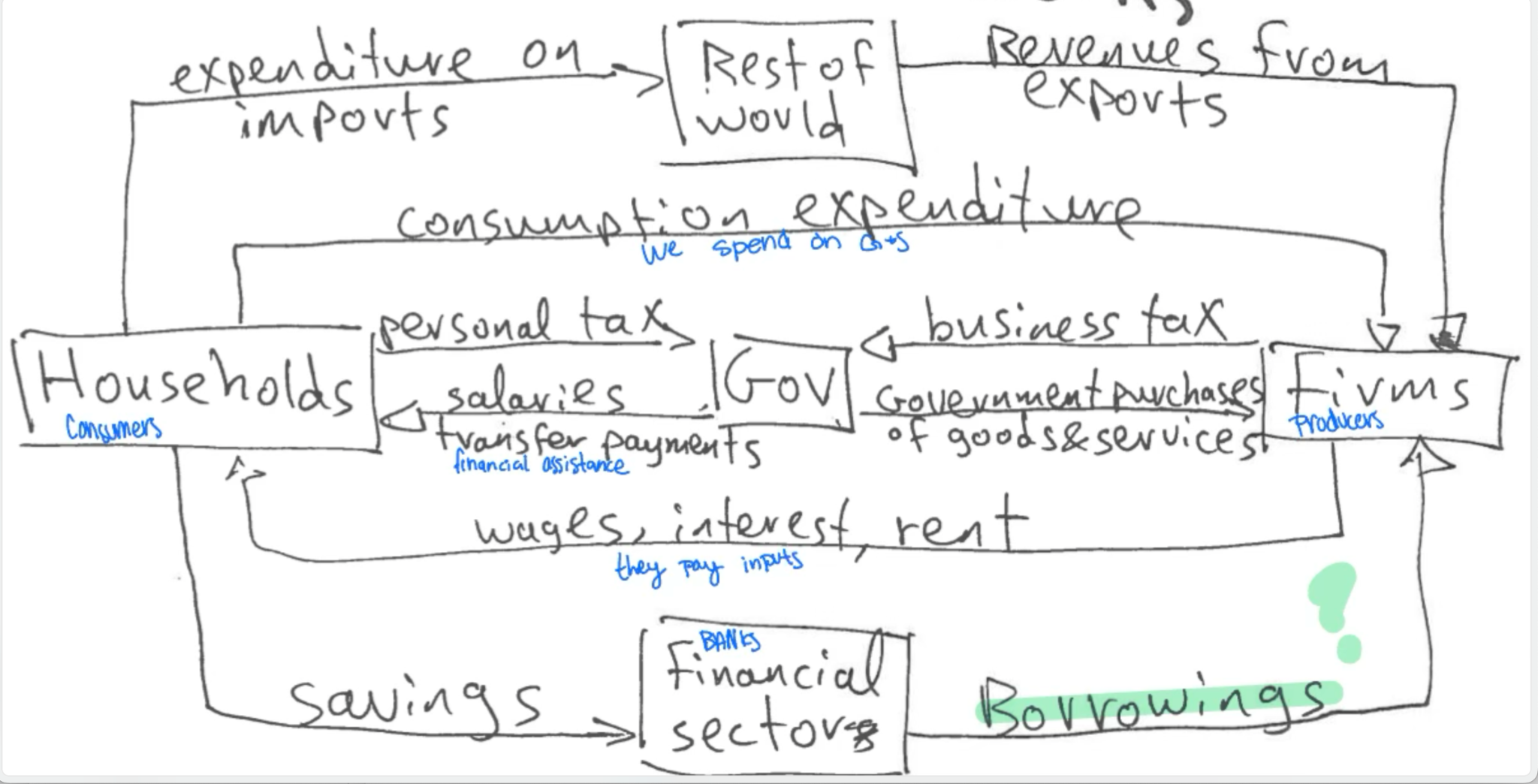
Circular Flow Model: shows the flow of income and expenditure between different sectors in the economy
Real Salary vs. Nominal Salary:
- Real Salary = Nominal Salary/Price Level
- Real Salary- physical items, eg number of coffees you can buy
- Nominal Salary- measured in money
- Price Level- price of a good eg. price of coffee
Disposable Income: After tax income
- Yd = consume + save
- Yd = y (personal income before tax)-personal tax
Nominal GDP: uses current prices
- Change in nominal GDP can be due to a change in P or Q or both
- Misleading, if only P increases then the GDP goes up but Q could remain stagnant and economy is not growing
Real GDP: uses base year rice (more accurate)
- Change in real GDP is only due to change in Q (production)
GDP Deflator: average price of all goods & services, “general price level”
- When Nominal GDP = Real GDP, Deflator = 100 and it is the base year
- Nominal GDP/Real GDP *100
- More comprehensive price level measure compared to CPI
Chapter 7
Economic Growth: refers to the long term growth trend in real GDP
- Business cycles happen around the long term growth trend are these business cycles aka short term shifts in ability to produce (production)
- Occurs when quantity & quality (productivity, the amount of G&S that a worker can produce/hour) of resources increases
Production Possibility Curve (PPC): frontier shows the different bundles from two goods that the economy can produce using all our resources
- Economic growth causes PPC to shif outward to the right, enabling higher levels of production
Economic Growth Rate: Measures by what % our per capita GDP changes every year
- (Y2-Y1)/Y1*100
- Y2= percapita real GDP current
- Y1= percapital real GDP last year
Rule of 70: tells us how long it takes a country to double its GDP (income)
- 70/annual economic growth rate
Determinants of Economic Growth:
- Land & Minerals- eg new minerals, clearing land once not able to be used
- Capital
- Human- knowledge and skill we get from education & training
- Thus why the govt should subsidize education and health
- Physical- machinery, infrastructure (public facilities, eg bridges and roads)
- Thus why the govt should invest in infrastructure
- Labour- eg. immigration of skilled workers
- Technology-
- Requires research and development
- Thus why the govt should give incentives & enforce property rights to protect firms
- Innovation
- Application of new knowledge to improve an existing product/create new product
- Invention
- Creating something that doesn’t exist
- Free trade- specialization in comparative advantage (lowest opportunity cost to produce) allows for more production