Na Balance
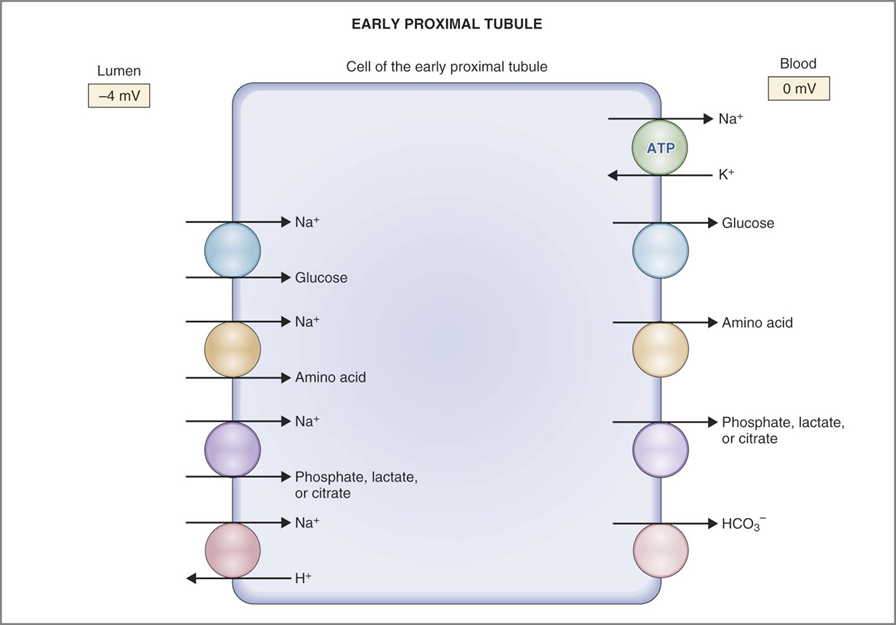
Early PCT
basolateral side = primary active transport
3 Na+ out, 2 K+ in via ATPase
Forms osmotic gradient to pull water
Forms a Na+ gradient due to lack of apical channels in early nephron
this Na gradient drives secondary active transport
Transcellular: secondary active, paired w other solutes
100% of glucose, most of our bicarb and AA are reabsorbed here. Since Na+ reabsorption is coupled to these process, the bulk of our Na+ is also reabsorbed here.
Na/H exchaner on apical side
Late PCT
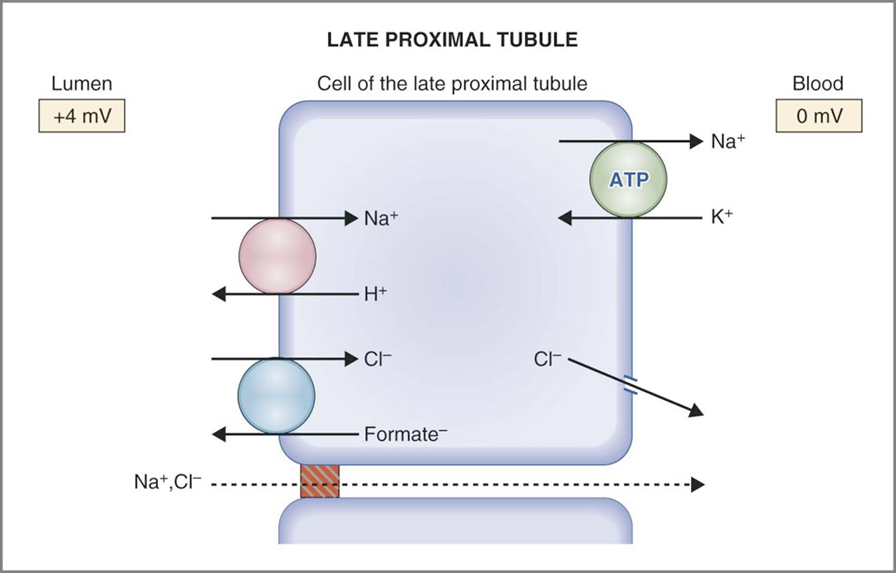
Paracellular transport across junctions in response to tubular fluid charge
Now Na is co transported w Cl
MAJOR CL REABSORPTION HERE
Chlorine reabsorbed paracellularly
when anions are secreted/exchanged for Cl-
anions Binds H+ and neutralizes charge (Bicarb)
Lack of filtered bicarbonate = hyperchloremia
Thin descending limb
permeable to water, impermeable to solutes
hyperosmotic interstitium
water is pulled out of ultrafiltrate (reabsorbed) to dilute interstitium
decreases tubular fluid vol = increased osmolarity
solute amount stays same
Thin ascending limb
Permiable to solutes, impermiable to water
NO VOL CHANGES
Na and Cl passively reabsprbed due to concentration diff
Thick ascending limb
impermiable to water
solutes are active, passive, paracellular and transcellular transported
solute concentrations is lower in ultrafiltrate = solutes are activley transported and reabsorbed
generate hyperosmotic tissue gradient
Paracellular transport in response to voltage difference
Reabsorption of most positively charged ions
Na-K-2Cl symporter
reabsorbes Na, K, and 2 Cl
Active transpoerter : NKCC
Activity dependent on tubular K+ levels
K+ enters cell but leaks back out to keep lumen positively charged
loop diaretics (lasix) block this and cause diuresis and loss of potassium, blocks 25% of Na reabsorption @ loop so its reabsorbed later in nephron
DCT
Impermiable to water
Active, passive, paracellular and transcellular transport
macula Densa and juxta-glomerular apparatuses
Na-Cl symporter
active transporter : NCC
Thiazide block this, potent antihypertensive, block 5% of Na reabsorpsion @ DCT causes Na+ to be reabsorbed via CHANNEL = neg grad
Not responsive the tubular K+ levels
Major fine tune action on sodium reabsorption
Late DCT and Collecting ducts
Variably permeable to water
Responds to ADH
Tubular fluid is negative
Reabsorbs NaCl and water isosmotically
Secretes K+ and acid or bicarbonate if needed
Principle Cells
regulating NaCl, K+ and water transport
Lots of active transport
Na-K pump is VERY sensitive to Na+ levels
Apical Na+ (ENaC) and K+ channels are present
Cl- follows Na+
Aldosterone increases Na-K pump
opens apical Na+ channels
ROMK electroneutral converse to Enac
BK or Maxi-K affected by volume, cilia, kaluresis
Spironolactone blocks aldosterone from binding
Amiloride blocks ENaC
PCT reabsorption of Cl
almost all transcellular transport
Most Na+ is reabsorbed with Cl- to balance charges.
Tubular fluid is negatively charged and Na+ is being actively brought into the interstitial space
causes water to move in and Cl goes w it
Water reabsorption
Most water is reabsorbed passively and secondary to solutes Due to osmotic or pressure forces
Starling Forces
Pressure drops from glomerulus to peritubular capillary
Peritubular oncotic pressure is high
Net filtration from tubule INTO peritubular capillary
Osmosis
Transport of OTHER solutes from tubule into capillaries will osmotically pull water along with it
‘Water follows salt’
Regulation of Sodium & Chloride Transport
Glomerulo-tubular balance mechanism
increasing tubular Na increases reabsorption
Effective Circulating Volume mechanisms
RAAS, ADH, SNS, ANP
Humoral agents
dopamine, Ca and bradykinin
Glomerulo-tubular balance
Increasing tubular sodium increases reabsorption Due to increased re-absorptive starling forces
Increasing filtration fraction by increasing GFR (same RBF)
Increases filtrate in tubule
Increases peritubular oncotic pressure
Reduces peritubular hydrostatic pressure
Increases reabsorption of water and solutes from tubule
Increased tubular flow bends cilia on tubular cells and increases Na+ reabsorption
Effective Circulating Volume
Low ECV = SNS = activates RAAS = inc aldosterone
inc Na/K ATPase @ cortical collecting duct
inc ENaC = inc Na reabsorption = K secreted =neg electrochemical gradient = inc perfusion pressure
low ECV inc ADH
ADH bind to V2 receptors @ collecting duct to increase free water and urea reabsorption
ADH binds to V1receptos to increase vasoconstriction
High ECV = inc ANP
causes natriuresis = inc Na and water excretion
causes vasodilation