Chromosomes
GENERAL OVERVIEW + SKILLS:
Prokaryotes have one single circular DNA molecules as a chromosome.
Some prokaryotes also have plasmids but eukaryotes don't.
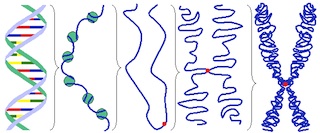
Eukaryote chromosomes are linear DNA molecules associated with histone proteins.
In a eukaryote species there are a characteristic number of different chromosomes each carrying different genes.
Pairs of chromosomes with the same sequence of genes (not necessarily the same alleles) are "Homologous chromosomes"
Diploid nuclei have pairs of homologous chromosomes.
Haploid nuclei have one chromosome of each pair.
Sister chromatids are the two DNA molecules formed by DNA replication before cell division
two separate chromosomes are formed at the splitting of the centromere at the start of anaphase.
A karyogram (a chart) shows the chromosomes of an organism in homologous pairs of decreasing length. (Karyotype is the number and type of chromosomes present in the nucleus)
Sex chromosomes determine the gender of an individual and autosomes are chromosomes that do not determine sex.
SKILLS NEEDED:
Understand Cairns’ technique for measuring the length of DNA molecules by autoradiography.
Compare genome size in T2 phage, Escherichia coli, Drosophila melanogaster, Homo sapiens and Paris japonica. (selected for points of interest.Genome size comparative activity
Use karyograms to compare diploid chromosome numbers of Homo sapiens, Pan troglodytes, Canis familiaris, Oryza sativa, Parascaris equorum.
Use karyograms to deduce sex and diagnose Down syndrome in humans.
Use of databases to identify the locus of a human gene and its polypeptide product