BIOTECH_INHERITED-DEFECTS
INHERITED DEFECT
LESSON 7: Inherited Defects
-It refers to a medical condition or abnormality that is caused by changes or mutations in an individual's DNA.
Example of different types of mutation:
- Autosomal dominant: a single copy of a mutated or defective gene on one of the non-sex chromosomes.
- Autosomal recessive: the presence of two copies of a mutated or defective gene (homozygosity) is required for an individual.
- X-linked disorder: caused by a mutation or abnormality in a gene located on the X chromosome.
INHERITANCE OF RECESSIVE MUTATIONS
- A defective mutation usually occurs in only one copy of a gene.
- Therefore, most affected individuals will have one regular copy (A) and one mutated copy (a) of the gene.
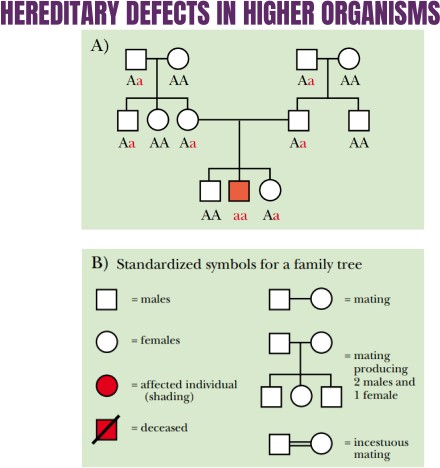 When two people carrying a recessive mutation in the same gene have children, 25% of the children will inherit both mutant copies and exhibit the disease.
HOMOZYGOUS RECESSIVE FROM INBREEDING
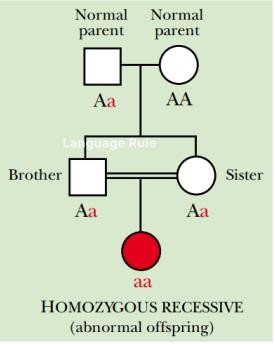
- A brother and sister may inherit a mutant gene
(a) from their one parent (their father in this illustration), but they will not be affected because they each have a normal gene from their mother.
- If the brother and sister have offspring, their child may inherit two copies of the defective gene and then exhibit the symptoms of the defect.
HEREDITARY DEFECTS DUE TO MULTIPLE GENES
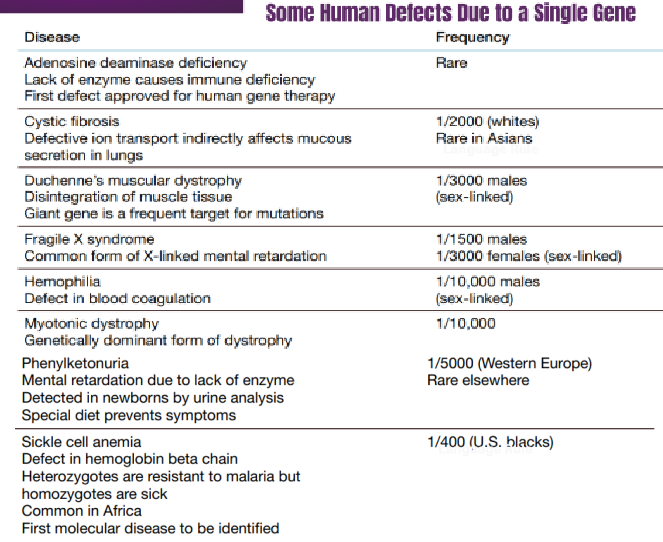
- Several well-known hereditary defects are missing from table above because they involve more than one gene.
These may be subdivided into two types:
- Some multigene defects are due to the interacting effects of several individual genes.
- Some examples are cleft palate, spina bifida, certain cancers, and diabetes.
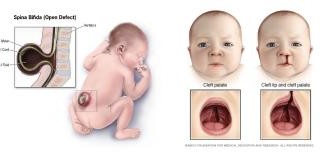
- Other multigene defects are due to the presence of an extra copy of an entire chromosome.
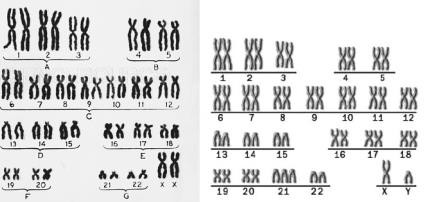
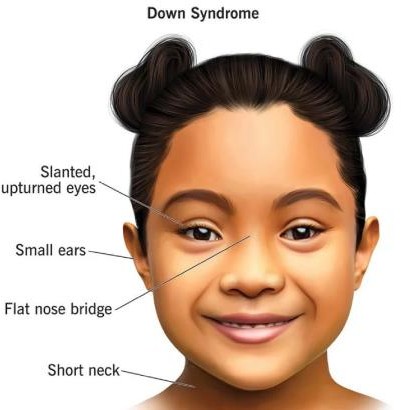 Down syndrome is a genetic disorder that occurs when an individual has an extra copy of chromosome 21.
DEFECTS DUE TO HAPLOINSUFFICIENCY
- Haploinsufficiency is a genetic condition in which a single functional copy of a particular gene is insufficient to maintain normal cellular function.
Three main reasons explain most cases where gene dosage is important:
- Some proteins may be needed in very high amounts in certain tissues.
- Some proteins interact with other proteins in strict ratios.
- Some regulatory networks respond in a quantitative manner.
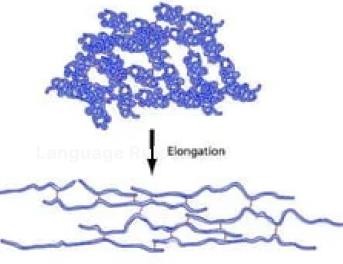
- Elastin haploinsufficiency refers to a condition where an individual has only one functional copy of the elastin gene (ELN) instead of the normal two copies.
- Elastin is found in the elastic tissues of skin, lung, and blood vessels.
- People with one copy of ELN are unable to make sufficient elastin for this tissue, resulting in a narrowing of the aorta that sometimes requires surgery and is referred to as congenital supravalvular aortic stenosis (SVAS).
DOMINANT MUTATIONS MAY BE POSITIVE OR NEGATIVE
- Dominant Negative Mutations
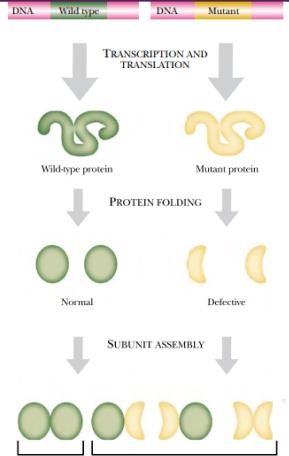
- occur when the defective copy of a gene interferes with the functional copy.
For example, the defective protein may bind to and
interfere with the normal protein.
In this scenario, the proteins function as dimers. If the mutant protein is defective but still forms dimers, then three-fourths of the complexes will be defective.
 DOMINANT NEGATIVE MUTATIONS
- Achondroplasia is a genetic disorder that affects bone growth and leads to dwarfism.
- The specific mutation in achondroplasia is typically a G380R substitution, where a glycine
(G) is replaced with an arginine (R) at position 380 in the FGFR3 protein.
DELETERIOUS TANDEM REPEATS AND DYNAMIC MUTATIONS
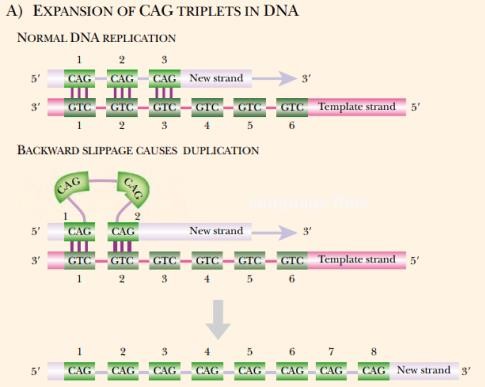
- Several genetic disorders are known where the defect is due to a tandem repeat of three bases within a protein-coding region.
- The three bases are usually CAG (in the coding strand), which encodes glutamine.
- Polyglutamine tracts, often called polyQ tracts or polyglutamine expansions, are a specific type of tandem repeat sequence within genes that consist of multiple consecutive glutamine (Q) amino acids in a protein's primary structure.
- Dynamic mutations are a type of genetic mutation characterized by the instability and expansion or contraction of a repeated sequence of DNA within a gene.
HUNTINGTON'S DISEASE (HD)
-HD is characterized by progressive motor dysfunction, cognitive decline, and psychiatric symptoms.
SPINOCEREBELLAR ATAXIAS (SCAS)
-It is a neurodegenerative disorder that primarily affects coordination and balance due to progressive damage to the cerebellum and its associated pathways in the brain and spinal cord.
FRAGILE X
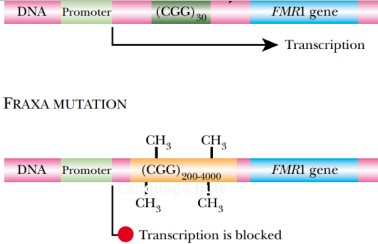
- Between the promoter and gene for FMR1 is a series of about 30 CGG repeats.
- These are usually present in the mRNA transcript but are not translated into protein.
- During replication, DNA polymerase errors cause the number of repeats to expand.
- When more than 200 repeats occur, the CG sites become highly methylated. RNA polymerase is unable to transcribe the gene, and the protein is not produced.
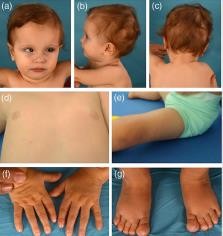
- Fragile X syndrome is a genetic disorder that causes a range of developmental and intellectual disabilities.
MITOCHONDRIAL DEFECTS
- Mitochondrial defects refer to abnormalities in the structure or function of specialized organelles that generate energy in the form of ATP.
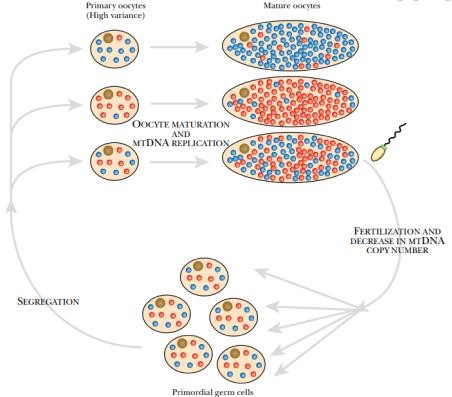
MITOCHONDRIAL DNA BOTTLENECK
- In primordial germ cells (bottom), about 50% of the mitochondria have a mutation (red). As they develop into primary oocytes, only a few mitochondria are passed on. Therefore, some oocytes will have just a few affected mitochondria (top oocyte), some will have a majority of defective mitochondria (middle), and others will have an equal proportion (bottom). As the primary oocytes develop into mature eggs, the number of mitochondria increases, but the ratio of mutated to normal remains constant in each cell line.
GENETIC SCREENING AND COUNSELING
- Genetic screening and counseling are essential components of modern healthcare that focus on identifying, understanding, and managing genetic conditions or predispositions.
PHENYLKETONURIA
- Phenylalanine hydroxylase catalyzes the conversion of phenylalanine to tyrosine. If the enzyme is absent, phenylalanine accumulates and is toxic to the nervous system.
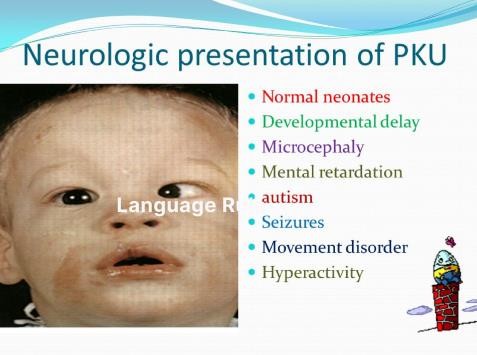
- Phenylketonuria (PKU) is a rare genetic disorder that affects an individual's ability to metabolize the amino acid phenylalanine.
 The absence of phenylalanine hydroxylase will lead to the accumulation of phenylalanine in the blood and tissues. This can have severe consequences for brain development and function.