Dev. Countries Notes
Week 7:
Authoritarian Setting and Types
Authoritarian Regime: Fails to elect its legislature and executive in free and competitive elections
Hybrid Regimes
“Competitive authoritarian regimes” → Leaders or ruling parties are elected!
Leader/Party over institutions
Absolute Monarchies → Monarch = Unlimited Power
Personalist Dictatorships → Centered around an individual leader → Personal power
Military Government → Gov. run by military leaders
Single-party Dictatorships → Rule by a single, dominate party → Monopolized control of authority
Challenge of Authoritarian Classification → Features spill over across regime types
Two Key Challenges to Authoritarian Regimes
The Problem of Authoritarian Power-Sharing
Dictators rarely rule alone → ruling coalition
Dictators’ constant desire for more power!
Types of Power-Sharing:
Contested Autocracy → Allies can use position and rebellion threat to check leader
Established Autocracy → Monopolized power → limited to no ability of allies to check leader
The ability to control the dictator depends on allies ability to remove the dictator
The Problem of Authoritarian Control
Dictators face constant pressure from the population toward their rule → 1) Repression 2) Co-optation
Co-Optation → Upward Mobility of Elites → Political rivals
Repression → Military → Political Rivals
Dictators need to use repression → Lack popular consent and need to rely on military support
Selectorate Theory and Authoritarian Regimes
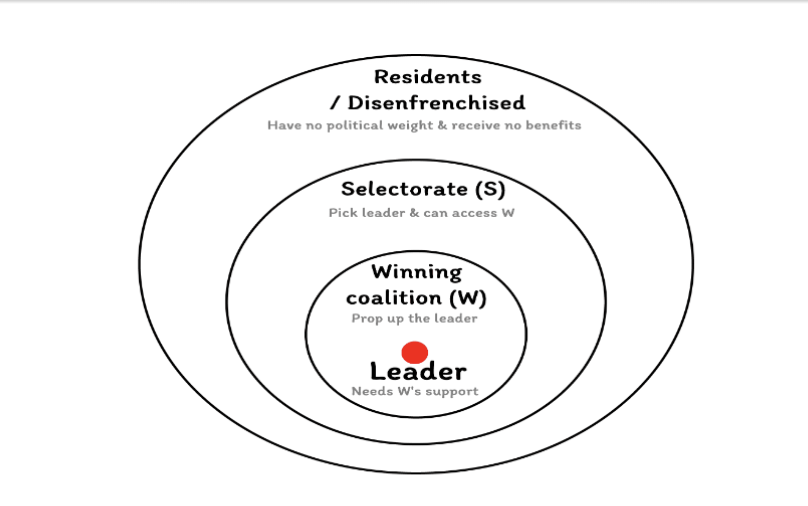
Selectorate Theory & Public Goods
Larger Winning Coalitions → More Public Goods → More individuals to keep happy
Winning Coalition (W) & Selectorate Sizes (S):
Democracy: Large W and Large S
Single-Party Dictatorships: Small W but Large S
Monarch & Military Dictatorships: Small W and Small S
Environmental public goods require sophisticated regulations and enforcement and sufficient state capacity
What influences whether a regime provides environmental public goods?
Winning Coalition Size + State Capacity + Expected Durability
Winning Coalition Size
Regime W needs to be large enough to incentive large-scale public good
State Capacity
Environmental public goods are costly and expensive
Low state capacity → W will have no effect on providing environmental public goods
Expected Durability
If the regime’s lifespan is short/unpredictable → Little incentive to provide costly public goods
Limits cooperation and buy in from other actors → Angle for next regime
Urbanization and Redistribution
Cities create a challenge for dictators:
creates a population density → Increasing and ease of communication → Spread of grievances
Close to the seat of power (if capital)
Taxing the rural population to redistribute to cities → Farmers leave agriculture and move to cities → Increasing urbanization and straining resources
Urban concentration threatens authoritarian survival
Redistribution to appease urban populations - Selectorate, Winning Coalition, or Residents/Disenfranchised?
Redistribution pushes rural population into urban centers
Urban citizens have more political influence than rural citizens → Govs. may try to limit urban concentration and shift
Govs. May try to limit urban concentration and shift populations back to rural areas or promote urbanization but try and limit concentration
Week 6:
Types of Military Regimes
Following a military coup, what are the types of military regimes?
Personalistic Military Regime:
Regime is centered around a single, charismatic officer with a personal following
Focused on personal gain; not economic or political reform lack ideology or legitimacy → Need to share spoils with military and civilian supporters
Institutional Military Regime:
Rule through a military council or junta
Goals extend beyond a single leader’s interests
President/Leader usually resigns from military before taking office
Motivations for Institutionalized Military Power Justification:
Previous Government corruption
Military’s own interest
Restore order and stability
Economic concerns
Bureaucratic Military Regime:
Extensive bureaucracy, include civilians (bureaucracy and civil society), Corporate connections and repressive
Repress left-wing parties and opponents
Limiting Military Intervention
Strong political institutions
Engrained political parties and broad support from political parties
Robust civil society, labor unions, and business organizations
Political Culture Values
Respect for civilian authority
Military training is focused on external threats rather than internal
Economic Development
Struggling economic growth and high inflation → Military Intervenes
Stable economic growth and development can prevent military coups
Coup-Proofing
Strategies and policies aimed to prevent coups
Reducing military size, selective promotions of regime supportive officials, military purges
Military Coups
Military Governance:
Intervene to limit corruption → tend to become corrupted
Defending military interests → internal fight over military expenditures
Political stability → limited political party development and institutions for long-term stability
Promote economic development → No difference or worse economic performance
Military withdrawal
Most likely when military legitimacy is threatened
Political pacts to limit punishments for military abuses
Reassign the military new roles and focuses
What Influences Military Spending?
Active military involvement
Neighborhood effect → Compete with spending of neighbors
Continuation of military spending into peace
Internal rebellion or civil war
Military interests in sustaining high spending
Consequences of High Military Spending:
Limited funds for public good and investment spending
Need to import military equipment → No additional economic benefits for a growing military
Resurgence of Military Post-Withdrawal
Military started withdrawal in 2011
2015 Election: Daw Aung San Suu Kyi’s party won a significant victory
2020 Election: Aung San Suu Kyi’s party won an even large victory
Withdrawal created a power struggle between Aung San Suu Kyi and the military
No political pact to protect the military → Zero-sum game for power
Aung San Suu Kyi tried to consolidate power in her party
Aung San Suu Kyi tried to limit the military’s seats in the legislature
Military grew concerned about increasing Chinese influence
Military overthrew Aung San Suu Kyi’s government in 2021 over concerns about its political influence and direction of Myanmar’s foreign policy
Week 5:
What is a Democracy?
What do you think it means to be considered a democracy?
Gold Standard: Dahl’s Polyarchy aka “Liberal Democracy”
1) Elected officials; 2) Free, fair, frequent elections; 3) Universal suffrage (adults); 4) Freedom of expression; 5) Alternative sources of information; 6) Associational autonomy; 7) Inclusive citizenship
“Electoral Democracy” or “Semi-Democracy”
Civil and minority rights are less protected and prioritized
Potentially free and fair elections
“Illiberal Democracy” or “Hybrid Regime”
Competitive elections
Limited mechanism to hold gov’ts accountable between elections
Authoritarian Starting Point
Authoritarian controls various demands (labor, representation) to advance development
Economic Development:
Raises incomes — Increases literacy — Expands middle class
Wealth theory of democracy — Democracy becomes more viable after development exceeds a certain point
Countries that exceed a per capita income of $2,500 are a democracy of some variety
Expands mass communications
Class structure
Expanding the political influence of the middle class
Presence of labor unions to advocate for workers’ interests
Political Culture
Belief in political participation, minority rights, institutional respect/authority, etc.
Armed forces and police defer to civilian authority & Gov. must protect and tolerate dissident beliefs
Military Coups
What are “coups”? → Unconstitutional and overt attempts by officers from regular armed forces to replace sitting executive incumbents. Two types of coups:
“From Above” Coups → Elite officers in the military with/without existing political involvement
“From Below” Coups → Lower and middle military officers — Outside of the existing political structure
Coup Occurrence:
Increasing number of From Below Coups but lower success
From Below Coups lack the soft power to stick
Coup Effects on Democratiziation?
How do coups affect Democratization?
From Above
Limit Democratization — Restructure authoritarian rule
Consolidate their political power → Remove others from power
Intervene to prevent political liberalization and curtailing military power
From Below
Not part of the political elite → Grievances may be more aligned with population rather than elites
May not inherently support democracy → Create uncertainty if successful → Create openings to democratization
View military as profession rather than governing
Solidifying Democracy
Democratic Consolidation → Democratic rules of the game are accepted by all politically influential actors and no actor seeks a return to authoritarianism
< $6,000 income per capita → Democracy is considered stable
Neighborhood effect: Democratic neighbors make a democratic transition more likely as well as remaining a democracy
Independent judiciary: Restricts executive power
Election Observers and Democracy
Inviting Election Observers → Signaling democratic legitimacy — Both Democrats and autocrats
Election observers gained a reputation for calling out election issues
Motivations for Inviting Election Observers
Credibly signal election quality & democratic commitment
Pseudo-democrats faced domestic pressure to invite observers → try to expose election cheating
Rise of Election Observer invites
Initiated in Latin America
Significant increase following end of Cold War
North Africa and Middle East have lowest invites
Norm of Election Observation Democracy
Early monitoring:
Democrats: indicate commitment to democracy in an uncertain enviornment
Pseudo-democrats: Gain benefits from democracy promoters without being caught committing election fraud
When are elections initially observed?
Previously observed election → More likely to invite monitors again
Competitive elections → Invite monitors
Consolidated democracy → Unlikely to invite monitors
Shift in Election Monitoring:
Mid-1990s: Pro-democracy leaders stopped justifying monitoring elections
Non-inviting countries now had to explain why they weren’t inviting monitors
Consolidated democracies began inviting monitors → Only non-democracies do not invite observers
Week 4:
Thinking about Economic Development
How economic development is measured → Affects policy objectives
Reducing poverty is a key priority → How to define poverty?
Household income
Life Expectancy
Infant Mortality
Literacy
Industrialization/Urbanization
Role of State/Governance
Implementing policy change requires state capacity & improved governance
State Capacity: Tax and Custom revenues → Used effectively
Governance: Capable, motivated, non-corrupted government
Policies to address economic development:
Land reform → Reduce rural poverty and diversify ownership
Industrial policy → Grow and develop domestic industries via state support → Import-Sub & Export Oriented
Urbanization Prioritization → Policies to benefit urban constituencies → May disadvantage rural populations
Liberalization → Comparative advantage in trade → Increase price of labor and capital investment
Developing under Globalization
Comparative Advantage → Limited Economic Diversification → Exposure to shock risks
Trade protectionism → Affect prices in the developing world → Locking in poverty levels
Developing countries often fail to act as a collective bloc to offset Western interests
Developing country debt (sovereign bonds) are in demand → low interest rates in the developed world are less appealing
Development & the Environment
Economic development → Environmental degradation
Population growth
Natural resource extraction
Industrialization
Environmental degradation side-effects:
Flooding, draughts, rising sea levels
Infections, illness, birth defects
Declining viable land → Declining comparative advantage → Declining state capacity & resources
Scarcity and the Environment:
Less land for farming → Less food production → Prices of food increases
Declining viable land → Potential to increase tension between countries for land
Migratory pressure to leave the developing world
Why not reduce emissions in the developing world? — Cost, governance, and limited direct benefits (free-riding problem)
What is the Resource Curse?
Resource Curse: Any negative political & socio-economic outcome from extracting and relying on natural resources
Dutch disease: natural resources strengthen the currency and make other sectors less competitive → Country becomes reliant on natural resources
So, what leads to the resource curse?
Economic mismanagement → Paradox of Plenty
Limits accountability → Only a few benefit
Price Volatility in natural resources → Difficult for long-term planning/stability
Limit investment in education and other services → Resource wealth > Education
Rent Seeking → Group of powerful elites
Conflict over control of resource extraction
Weak political institutions → Vulnerability to bribes and corruption
Institutions & the Resource Curse
Strong institutions can offset the resource curse — Rule of law, Institutional constraints, gov. efficiency, level of public goods, and murder rates
How can institutions offset the Resource Curse?
Centralized/Broad Plan — Include the population in determining how to use resource wealth → Increase transparency and accountability
Long-term development policy — limits future governments from changing priorities to benefit their supporters or themselves
Laws for fair resource wealth distribution — Wealth redistribution rarely or limitly makes it back to the regions with the natural resource → Creates grievances and conflict potential
Strong environmental regulation — Further destruction of land and neighborhoods → Potential for grievances and conflict
Laos and Chinese Investment
China is increasing its loans to developing countries — over $1T
China and Laos
Recently built a high-speed train from Laos capital to the Chinese boarder
China built hydroelectric dams and highways
$5B across 700+ projects
Laos Economy is struggling — 41% inflation and 43% currency depreciation
Total debt is 120% of GDP
Laos is struggling to repay the billions in Chinese Loans
Laos is providing China greater control over the economy and security
China cannot let Laos default but also cannot provide Laos too much Generosity
Chinese Rail in Laos
Not really a passenger trail — Freight
Only Chinese companies have used to export into China
Only companies connected to Chinese and Lao investors get access
Lao company that owns rail — no other income and needs to repay $3.5B in loans to China’s Export—Important Bank of China
Lao cities are being bypassed by travelers due to the rail line
Visitors are mainly Chinese — limited Lao travelers
Towns reflect Chinese society rather than Lao society and culture
Week 3:
Breaking Out Institutions
Why institutions? → Rules of the game
Types of institutions (democratic slant)
Executive:
Presidential: Separately elected President; Independent power from legislature
Parliamentary: Prime Minister connected to legislature; Power comes from legislature
Semi-Presidential: President & Prime Minister; President selects PM; PM responsible to legislature and president
Legislative:
Unicameral: a single chamber
Bicameral: two chambers - Upper & Lower
Electoral:
Plurality: most votes win!
Proportional: seats allocated based on win percentage
Two round (Presidential): 1st round → everyone runs; 2nd round: Top two from round 1 only
Applying Institutions to the Developing World
Varieties of Institutional Approaches:
Historical:
Institutions are the procedures, routines, norms that are part of the institutional structure
Path dependency is central - choices made at one time restrict future choices
Rational Choice:
Institutional rules constrain and direct actions
Logic of Consequences - Rules reflect the explicit intent and powers of individual actors
Sociological:
prioritize the role of norms and values of institutions to social actions → Logic of Appropriateness
Collective institutions form social control over actions
Colonizer Economic Models
Formal Institutions - The actual institutions and their rules
Presidential Executive
Plurality Electoral System
50% + 1 to pass legislation
Informal Institutions - Unwritten, share rules/norms created and enforced outside of formal instituions
Expectations around actions
Corruption/clientalism
Non-defined required actions
Overlap between formal and informal institutions
Competing - Informal and Formal are in competition
Substitive - Shared goals but informal supercede formal
Accommodative - Different goals but don’t undermine formal
Complementary - Informal reinforces formal institutions
Creating & Reforming Institutions
Creating Institutions:
Origination of institutions is debated
Sociological: Reflect the social context and dominant values
Rational Choice: Maximize utility - Reduce uncertainty and increase efficiency
Historical: Designed to address a current challenge and becomes locked in
Reforming England’s Parliament and Monarchy
Central problem: Monarchy couldn’t commit to not confiscate wealth
Parliament → Represents Wealth → Want to limit Monarch’s power
Treat to Gov’t survival: Short term gain to reneg is preferred
Monarch consistedly needed additional funds and had the power to change terms
Reforming England’s Parliament and Monarchy
To control the Monarch’s actions, Parliament also need to solve the financial problems
Institutional Changes Included:
Rise of Parliamentary supremacy - gained a central role in financial policies
Reduction in the Monarch’s solo powers
Power still exits but more restricted
Limits future reneging by the Monarch
Establishment of an independent judiciary - Further tied the Monarch’s hands
Parliament representing wealth interests → Rise of Parliament’s supremacy over financial issues → Parliament agreed to fund the Monarch due to new limitations on Monarch’s power
To Economically Change or Drag Our Feet?
Governments decide when and which economic innovations are adopted or not - Why wouldn’t all governments pursue beneficial economic change?
Governments want to retain power! → Economic changes could alter that power (i.E., 1680s England)
So, when do governments act to respond to changing economic environments?
Political Competition → Pressure to adapt or likely to lose power
Highly entrenched governments → Willing to adapt because no fear of losing power
So, when do governments not act?
Somewhat entrenched governments → Fears that adapting will disrupt current political alignments
Role of the State in Economic Policy
All governments have laws to regulate domestic sectors and International trade/finance
Command Economy - State owns and manages means of production and state planners determine supply
Limited insight into what and how much production is required/needed
Rewards are based on meeting output levels rather than quality
Latin American Statism & Import-Substitution
Private sectors exists — State owns important companies
Companies likely owned by foreign corporations and taken over via nationalization
Used these important sectors to provide subsized goods to remaining sectors
Important-Substitution — Replace imported goods with subsidized and protected domestic goods
State companies were often 1) over staffed 2) protected for too long
Role of the State in Economic Policy
East Asia Development State — Most sectors are private but the state intervenes in select, important industries
Intervention is to guide or promote specific development objectives
Qualified and well-trained bureaucracy to plan and guide interventions
Politically → Authoritarian/Soft- Authoritarian → Allowed repress/control labor and direct involvement
Neoliberal State
Governments have a very limited economic role → Market forces should drive supply/demand and prices
Deregulation of industries; limited trade protections; restrictions on government subsidies
World Bank and IMF push neoliberal economic policies as part of receiving loans
Week 2:
How to Govern Colonies?
Direct Colonial Rule: Colonial powers directly governed
Administrative structures based on formal rules
Centralized administration → links diverse actors to the central state
Establishment of complex political institutions such as courts to enforce rule of law
Goal: Create a state that mirrors the colonizer European state
Indirect Colonial Rule: Colonial powers took a hands off approach and governed through proxies
Governed via various patron-client relationships
Local leaders were selected based on their willingness to work with the colonizing power
Local leaders were given broad leeway over social, political, and economic decision-making
Colonial administration was small and centralized in the capital
Goal: Limit expense and maximize economic value
When to Directly or Indirectly Govern?
Competing ideas on why colonizing powers established direct or indirect rule:
Morality Rates/European Settlers:
Europeans could survive: Direct rule → Replicate European institutions
Europeans could not survive: Indirect rule → Establish extractive institutions
Colony Importance:
Geopolitical importance & Economic Potential for Settlers → Direct Rule
Existing Population:
Large existing populations → Limited space for colonizer settlement → Indirect Rule
Potential for Revolt: Existing populations were more likely to resist invasive rule → Indirect Rule
Colonizer Economic Models
Merchantilist Economy - Spain
National economic self- sufficiency
Trade restrictions and resource accumulation
Hierarchical structure → Winners & Losers
Merchantilst Colonial Interests:
Higher pre-colonial development
Densely settled populations
Hierarchical Societies
Political Institutions
High merchantlist colonization → Use existing labor force to extract resources
Limited Pre-colonial development areas
Merchantilist colonizers are less likely to become overly involved → Fewer opportunities and resources to tap into for resource extration
Liberal Economy - England
Profit maximization - Capitalist System
State provides foundation for economic exchange
Enforce rule of law and property rights
Liberal Colonial Interests:
Lower pre-colonial development
Limited population settlements
Dispersed populations with localized institutions
Limited economic networks
High liberal colonization → Build new institutional establishments with great ease
High pre-colonial development areas:
Liberal colonizers are less likely to establish robust institutions → Existing institutions and networks would need to be dismantled
Legacy of Colonialism on Development
Institutions established under colonialism continue to persist into independence → Path Dependency
Extractive Institutions:
New, Independent governments inherited the institutions
Changing from extractive institutions is costly and may want to exploit
Small group of power elites benefit from the extractive institutions
Indirect Rule:
Negative association with political development — Presence of rule of law, political stability, effective bureaucracy, and limited corruption
Merchantlist Colonizers:
High Colonization:
Economic Development: Trade restrictions, privileged actors, and resource extraction → Negative
Social Development: Focus on labor and limitations to education/health care → Negative
Political Development: Hierarchical society restricts protections for everyone → Negative
Low Colonization: Better position → Avoided entrenched merchantilist instituions
Liberal Colonizers:
High Colonization:
Economic Development: Establishes trade and economic competition → Positive
Social Development: Provides public goods such as clean water and education → Positive
Political Development: Establishes political, legal, and administrative institutions → Positive
Low Colonization: Establishment of indirect rule → Creates patron-client relationships, dependency, and limited application of the rule of law
01/14
What Goes into Developing?
Complex
Social
Education: how equal it is
how do different groups fit into society and cultures
Economics
The Change in GDP
how much a country trades
infrastructure development
Politics
Fair and free elections
Universal voting rights
legitimacy of leaders
System of checks and balances
Developing world → underdeveloped in one or all areas
Modernization Theory
Main Assumption: The developed West provide a blueprint for the developing world to follow — become more like the developed Western world in all areas
Socially
acquire new values and a political culture of authority, legitimacy, and community
Improve education, urbanization, and spread of mass media
Politically
Create specialized political institutions - parties, legislatures, courts, etc.
Revamp tribal and local institutions to national level institutions for decision-making
Economically
Industrialize
Establish a tax base
If you establish this then you create your citizens desire to be represented and it combines with the political side of things
Attract investments
Dependency Theory
Critique of Modernization Theory: Complete lack of international context in development
Developing countries are dependent on developed countries
Borrow Capital
Purchase advanced technology
Supply raw materials and food to developed world
Developing world is politically dependent on the developed world
Colonialism established many political institutions
Developed countries intervene politically and militarily in the developing world
Globalization and Other Factors
Globalization:
Increasing communication and economic integration that extends beyond national borders
Economic: Foreign Direct Investment (FDI); Trade; Foreign Aid
Social: Communicaiton and Information Technology → Culture engagement that spans borders
Political: Pressure from other countries; Increasing ties to the developed world
Institutionalist Approaches: — Political choices at one time constrain future choices due to context, structure, and historical legacies , i.e. Path Dependency
Conflict Trap:
Political violence hampers development
Firms would not want to invest in unable countries
Underdevelopment contributes to the potential for future violence
Pressing Challenges for Developing Countries
Declining levels of economic growth compared to historical levels
Lingering effects of the 2008-2009 Financial Crisis limited economic integration, investment, and trade
Impact: Inability to continue addressing poverty reduction and development goals — Extreme poverty, malnutrition, and hunger will affect around 622 million people by 2030
FDI to developing countries is not keeping pace with GDP
Increasing trade restrictions in hte developed world
Developing countries are becoming more dependent on each other — 40% of goods flow between developing countries
Increasing Debt levels
Cost of climate change
The Cost of Rising Debt
Central banks raising interest rates → Debt payments become more expensive as more money is needed to cover interest payments
World Bank and the International Monetary Fund (IMF) are working with lenders to restructure developing country debt
China — the world’s largest creditor is reluctant to restructure loan terms
The shift to interest payments + declining growth → halt to poverty reduction efforts
Foreign Aid: Good or Bad