Lesson 2 questions - Compounds with single-bonded functional groups
Question #1 (Alcohols):
1. What functional group does an alcohol contain? What is known as the “parent” alkane?
Alcohols have the -OH functional group connected to the longest identifiable chain of the hydrocarbon, known as the parent alkane.
2. Explain the difference between a primary, secondary and tertiary alcohol.
Primary alcohol has -OH group bonded to a C-atom which is only bonded to one another C-atom, Secondary means the bonded C-atom is also bonded to two other C-atoms, and Tertiary means bonded C-atom has three other bonds to C-atoms.
3. Using the steps given on page 26 on how to name an alcohol, name this alcohol. Identify if it is primary, secondary or tertiary.

4. For more practice, complete the Practice Problems given on page 26. The solutions are provided for you to check if you are correct.
Question #2 (Alky halides):
1. What is an alky halide?
an alkane in which one or more hydrogen atoms have been replaced with halogen atoms, such as F, Cl, Br, or I. Similar in structure, polarity, and reactivity to alcohols.
2 What is the functional group of alky halides?
A halogen atom attached to a carbon atom
3. Explain the steps used in naming an alky halide. Use these steps to name this compound.
Identify position number(s) of C-atoms bonded to halogen atoms, use the name of the atom in prefix but cut it off so it has -o at the end (flouro-, chloro-, bromo-, iodo-).
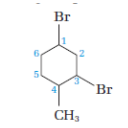
4. For more practice complete the practice problems given on page 28. Remember to check your answers.
Question #3 (Ethers):
1. What is an ether?
Compounds made up of 2 alkyl groups connected by an oxygen atom (O in the middle, root on one side and side group on the other.)
2. What makes an ether different from an alcohol?
H atom is removed from hydroxyl group attaches to alcohols.
3. Give the steps to name an ether. Using these steps name this ether.
Root is the longer chain bonded to O-atom, numbering starts with C-atom closest to O-atom. For prefix identify the length of the other, non-root alkyl group bonded to the other side of O-atom. This is known as the alkoxy group and its name will be changed to reflect the structure of the group.
Take the original name of the alkyl group (ethyl, propyl, etc.) and remove the -yl portion (leaving eth, prop, but, etc.)
Now add -oxy in replacement of the removed -yl (ethoxy, butoxy, propoxy)

4. For more practice complete the practice problems given on page 30. Check your answers.
Question #4: Amines
1. What functional group does an amine have?
2. Explain how to determine if an amine is a primary, secondary or tertiary amine?
3. Give the steps to naming an amine. Use these steps to name this amine.
4. For more practice complete the practice problems given on page 32. Check your answers.