The Working Memory Model
^^Alan Baddely^^
This model was made in opposition to the MSM as the MSM is reductionist in its lack of acknowledgement of structures and processes in memory
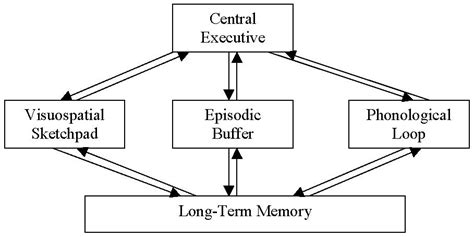
^^Central Executive:^^ coordinates activity of WMM, processes information and send it to the correct slave system to be processed
^^Phonological Loop:^^ Processes auditory information, consists of two parts:
- ^^Phonological Store:^^ The ‘echo’, processes sound
- ^^Articulatory Control System:^^ allows for maintenance rehearsal to take place
^^Episodic Buffer:^^ A temporary store for information of all kinds - visual and auditory
^^Visuo-Spatial sketchpad:^^ processes visual information and spatial information when required, can be divided into two parts:
- ^^Visual Cache:^^ Stores visual data
- ^^Inner Scribe:^^ Stores the arrangement of objects in the visual field
^^Evaluation:^^
^^+: Clinical Evidence -^^ In a case study in which an individual suffered from brain damage, they were not able to process auditory information, but could still process visual information. This proved the separation of the two in the brain.
^^+: Dual task performance -^^ A study conducted by Baddely himself showed that participants found it harder to perform two visual tasks at the same time than to perform a visual and auditory task at the same time.
^^-: Lack of clarity over the Central Executive -^^ Some psychologists argue that because Baddely hasn’t given much clarity of how the central executive actually works: it’s difficult to apply it to research and our everyday processing of information.