Module 4 CHEM100
Some clues that a chemical reaction has occurred:
Colour change
A solid forms (solid forms from 2 liquids reacting is called precipitation reaction)
Bubbles form
Heat and/or a flame is produced, or heat is absorbed
You can have a combustion reaction between KMnO4 and glycerol to produce a flame without a match. The chemical equation (unbalanced) for this reaction is:
KMnO4 + C3H5(OH)3 → K2CO3 + MnO3 + CO2 + H2O
KMnO4 gives the purple flame due to the presence of Mn7+ ion.
Balanced chemical equation is:
14 KMnO4 + 4 C3H5(OH)3 → 7 K2CO3 + 7MnO3 + 5 CO2 + 16 H2O
A balanced chemical equation is an equation where there are even amounts of each atom on each side of the equation. In the equation above there are:
K - 14
Mn - 14
O - 68
C - 12
H - 32
on each side of the equation. This is because atoms are preserved in a reaction, atoms cannot be created or destroyed.
We can also add in states of matter to the equation that provides us with information on the changes occurring and describes the type of reaction occurring:
14 KMnO4(s) + 4 C3H5(OH)3(l) → 7 K2CO3(s) + 7MnO3(s) + 5 CO2(g) + 16 H2O(g)
In a chemical reaction we have an arrow which indicates the direction of change from the reactants to the products and is often called ‘yields’ or ‘produces’.
Reactants → Products
A chemical equation provides us with 2 pieces of important information:
The identities of the reactants and products
The relative numbers of each
The Haber-Bosch process turns atmospheric nitrogen into ammonia which is a useful chemical, see the chemical equation below:
N2 + 3H2 → 2NH3
Physical states:
(s) - Solid
(l) - Liquid
(g) - Gas
(aq) - Aqueous solution, dissolved in water
Balancing chemical equations.

Always start with the most complicated molecule when balancing equations, this is the molecule with the greatest number of total atoms or the largest subscripts.
In this case above the most difficult molecule is KOH as it has the most atoms.
We will start with balancing the H atom, in this instance, we will add the coefficient ‘2’ to both sides to so we have 4 H atoms on the reactants and products sides.
Doing this has also balanced the O atoms in the equation.
Finally we need to balance the K atoms by adding the coefficient ‘2’' to the reactants side so we have 2 K atoms on both sides of the equation.
The final balanced chemical equation is:
2K(s) + 2H2O(l) → H2(g) + 2KOH(aq)
where on either side we have:
K - 2
H - 4
O - 2
When balancing chemical equations with polyatomic ions, you count the whole polyatomic ion as a single species of atom instead of each individual atom counting towards the total.
Acids-
Chemical property - Acids can form protons in an aqueous solution
Physical property - taste sour
Acids are substances that release H+ ions (protons) when dissolved in water, an acid can be viewed as a molecule with one or mor H+ ions attached to an anion.

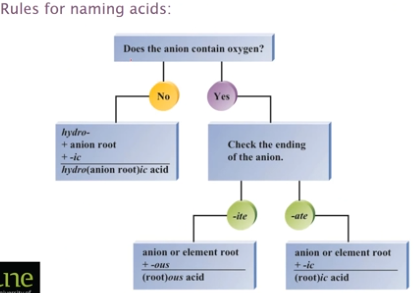
The rules for naming acids depends on whether the anion contains oxygen:
If the anion does not contain Oxygen, the acid is named with the prefix ‘hydro’ and the suffix ‘ic’ attached to the root name for the element. E.g.
Hydrochloric acid - HCL
Hydrocyanic acid - HCN
Hydrosulfuric acid - H2S
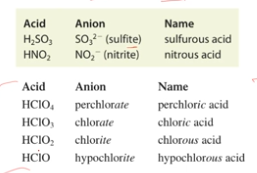
When the anion contains oxygen, the acid name is formed from the root name of the central element of the anion or the anion name, with a suffix of -ic or ‘ous.
When the anion name ends in -ate, the suffix -ic is used

When the anion ends in -ite-, the suffix -ous is used in the acid name
Reactions in Aqueous solutions -
Driving forces that favour chemical change:
formation of a solid e.g. precipitation reaction
formation of water e.g. acid-base reaction/neutralisation reaction
transfer of electrons e.g. when iron rusts
formation of gas e.g. metal in a solution of acid (magnesium)
Precipitation reaction-
If the driving force for a reaction is the formation of a solid, the reaction is called precipitation. The solid that forms is called the precipitate (ppt).
When 2 strong electrolytes are mixed, a solid is formed (precipitate).
What is a strong electrolyte?
A strong electrolyte is an ionic compound which dissolves readily in water to produce separated ions.
E.g. NaCl. When NaCl dissolves in water, the Na+ and Cl- ions separate and move around independently. Solutions containing ions conduct electricity.
What happens when an ionic compound dissolves in water?
E.g. K2CrO4 and Ba(NO3)2.
The formation of a yellow solid tells us a reaction has occurred.
To predict the possible products, we need to look at the species of the reactants dissolved in the solution mixture.
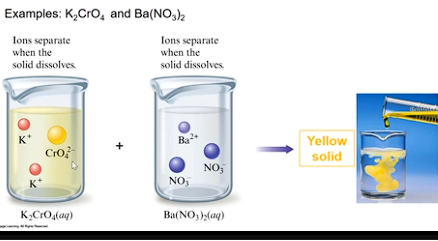

As the Ba(NO3)2 and K2CrO4 are reactants, they cannot be the products, so the products must be KNO3 and BaCrO4.
However one of these is the yellow solid.
Potassium nitrate is soluble in water, therefore the BaCrO4 is the precipitate.
The unbalanced chemical equation is:
K2CrO4(aq) + Ba(NO3)2 → BaCrO4(s) + KNO3(aq)
Solubility rules (important for determining what product will be the precipitate)

For rule 5 only, we write the state of matter as aqueous, this is because it is slightly soluble. Every other rule we would write as a solid state of matter.
(these rules will be provided in the exam).
How to predict precipitates with solutions of 2 ionic compounds.
1 - Write the reactants as they actually exist before any reaction occurs. Remember that when a salt dissolves, it’s ions separate.
2 - Consider the various solids that could form. To do this, simply exchange the anions of the added salts.
3 - Use the solubility rules to decide whether a solid forms, and if so, to predict the identity of the solid.
Examples:
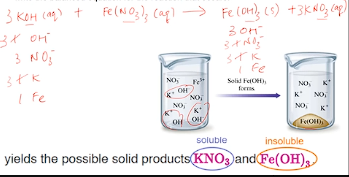
When an aqueous solution of KOH is added to an aqueous solution of Fe(NO3)3, a brown solid forms. Identify the brown solid and write the balanced chemical equation for the reaction that occurs.


Example 2:
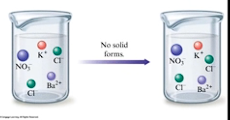
What will happen when KNO3 and BaCl2 are mixed?

After writing the chemical equation for the reaction, we discover that no precipitate has formed as both KCl and Ba(NO3)2 are both soluble. Therefore we say ‘no chemical change was observed’.
The balanced chemical equation for this reaction is:
2KNO(aq) + BaCl2(aq) → 2KCL(aq) + Ba(NO3)2(aq)
Describing reactions in aqueous solutions.
3 types of equations are used to describe reactions that occur in water.
1 - molecular equation
2- complete ionic equation
3 - net ionic equation
Molecular Equation shows the overall reaction but not necessarily the actual forms of the reactants and products in the solution.
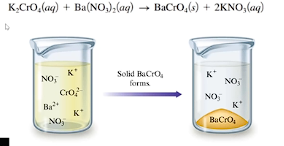
This equation does not show that in solution, soluble ionic compounds do not exist in their ionic forms. It only shows the identities of the reactants and products. Does not give a very clear picture of what actually occurs in solution.


The K and NO3 ions are ‘spectator ions’ as they do not participate directly in the reaction.
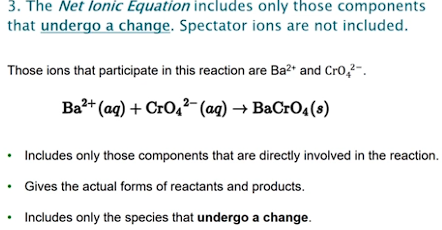
Example-
An aqueous solution of Lead(III) nitrate is mixed with an aqueous solution of sodium sulfate. Write the molecular equation, the complete ionic equation and the net ionic equation.
Molecular equation:
Pb(NO3)2(aq) + Na2SO4(aq) → PbSO4(s) + 2NaNO3(aq)
complete ionic equation:
Pb2+(aq) + 2NO3-(aq) + 2Na+(aq) + SO4(-2)(aq) → PbSO4(s) + 2Na(aq) + 2NO3-(aq)
Net ionic equation:
Pb2+(aq) + SO4(-2)(aq) → PbSO4(s)
Reactions that form water: Acids and Bases (Neutralization reaction)
An acid is a substance that produces H+ ions (protons) when it is dissolved in water.
Strong acids are strong electrolytes because when they are dissolved in water, virtually every molecule dissociates (ionizes) into their constituent ions (H+) plus an anion. Examples of strong acids include HCl, HNO3 andH2SO4.

Some examples of ionization reactions of strong acids in water:
HCl -(H2O)→ H+(aq) + Cl-(aq)
HNO3 -(H2O)→ H+(aq) + NO3-(aq)
H2SO4 -(H20)-< H+(aq) + HSO4-(aq)
Just like strong acids, strong bases are strong electrolytes because when they are dissolved in water, virtually every molecule dissociates (Ionizes) into their constituent ions: OH- plus a cation. Examples showing ionization reactions of strong bases in water:
NaOH(s) -(H2O)→ Na+(aq) + OH-(aq)
KOH -(H2O)→ K+(aq) + OH-(aq)
Basically strong acids ionize in water to form H+ cation plus an anion.
Strong bases ionize in water to form OH- anions plus a cation
How to write equations for strong acid/strong base reactions:
Consider the reaction of HCl and NaOH, write the equations for this reaction.
The products of the reaction between a strong acid and a strong base are salt and water
1 Balanced chemical equation:
HCl(aq) + NaOH(aq) → NaCl(aq) + H2O(l)
2 Net ionic equation
H+(aq) + OH-(aq) → H2O(l)
Na+ and Cl- are spectator ions and are not included in the net ionic equation
3 The complete ionic equation
H+(aq) + Cl-(aq) + Na+(aq) + OH-(aq) → H2O(l) + Na+(aq) + Cl-(aq)
Remember the reason why we don’t write H2O as H+ and O- is because the Na+ and Cl- ions are ionized in the water, the water is a molecule and the salt Na+ and Cl- ions are dissociated.
HCl and NaOH are strong electrolytes.
Reactions between metals and non-metals (Oxidation-Reduction)
A reaction that involves a transfer of electrons is called an oxidation-reduction reaction.
When a metal reacts with a non-metal, an ionic compound is formed. The ions are formed when the metal transfers one or more electrons to the non-metal.

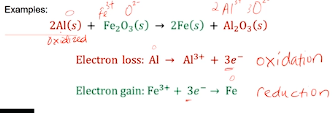
In a redox reaction, the number of electrons lost must equal the electrons gained.
2 non-metals can also undergo a redox reactions. O2 is usually the reactant, the compound formed is not ionic.
E.g.
CH4(g) + 2O2(g) → CO2(g) + 2H2O(g)
2SO2(g) + O2(g) → 2SO3(g)
If O2 molecules were to react with magnesium atoms:
O2(g) + 2Mg(s) → 2MgO
How many electrons would each magnesium atom loose?
Products, Mg2+ ion, O2- ion.
Electron loss: Mg(s)→ Mg2+ + 2e-
Electron gain: O + 2e- → O2-
Answer- 2
How many electrons would each oxygen atom gain?
2
How many magnesium
atoms would be needed to react with each oxygen molecule?
1
What charges would the resulting magnesium and oxide ions have?
Mg2+
O2-

In a redox reaction, the reactants start as neutral atoms that appear in their elemental form (this is a dead giveaway of a redox reaction), and then there is loss and gain of electrons which drives the reaction and chemical change.
In this reaction above, the Sodium has lost electrons (oxidation) and the Chlorine has gained electrons (reduction).
In the following reactions, identify which element is oxidised and which element is reduced.
a) 2Mg(s) + O2(g) → 2MgO(s)
Oxidised element = Mg2+
Reduced element = O2-
b) 2Al(s) + 3I2(g) → 2AlI3(s)
Oxidised element = Al3+ (more positive)
Reduced element = I1- (Al3+, I1-(3 of them to bond with Al)) (more negative)
c) Sn2+ + 2Fe3+ → Sn4+ + 2Fe2+
Sn gains electrons - Oxidised (more positive, goes from 2+ to 3+)
Fe looses electrons - Reduced (more negative)
Some redox reactions are less obvious, such as in the case of the combustion of methane in the presence of oxygen.
CH4(g) + 2O2(g) + 2H2O(g) + energy
This is a non-ionic reaction but it does involve the transfer of electrons.
Ion Oxidation state
Na+ +1
Cl- -1
Mg2+ +2
O2- -2
Elements in their uncombined and elemental forms are neutral. Their oxidation state is zero, they have no charge. This is also true for diatomic molecules.
For the purpose of oxidation states, we assign ‘imaginary’ charges to covalent compounds even though that’s not what happens in a covalent compound. Remember that ionic bonds transfer electrons to form ions, and covalent compounds share electrons to complete valence shells.
Essentially treat covalent compounds the same as ionic compounds with oxidation states.
E.g. H2O - H+, O-2 (remember there are 2 H atoms in the compound)

Sometimes a redox reaction is less obvious, eg:
CH4(g) + 2O2(g) → 2H2O(g) + energy
This is a non-ionic reaction, but involves the transfer of electrons.
Use the rules above to calculate the oxidation states of each element in the reaction and determine which elements have transferred electrons.

By using the rules, we know the charge of H in CH4 is +1 and there are 4 of them. This means we can determine that C has a charge of -4 as the overall charge of the molecule needs to equal zero.
Using a similar process, we can determine that C in CO2 is +4 as O is usually -2 charge (rule 7 above) and there are 2 O2 atoms present.
So the oxidation states of both C and O have both changed, this defines a redox reaction.
C - Oxidised -4 → +4 (lost 8 electrons)
O - Reduced 0 → -2 (gained 2 electrons)
REMEMBER:
OXIDATION - LOSS OF ELECTRONS (net + charge)
REDUCTION - GAIN OF ELECTRONS (net - charge)
Calculating oxidation states is just basic algebra, make sure you apply the rules above though otherwise you could be finding the incorrect answer. Below are some worked examples for calculating oxidation states with different rules applied above.

i) Rule 3
ii) Rule 4
iii) Rule 5, Rule 3
iv) Rule 4


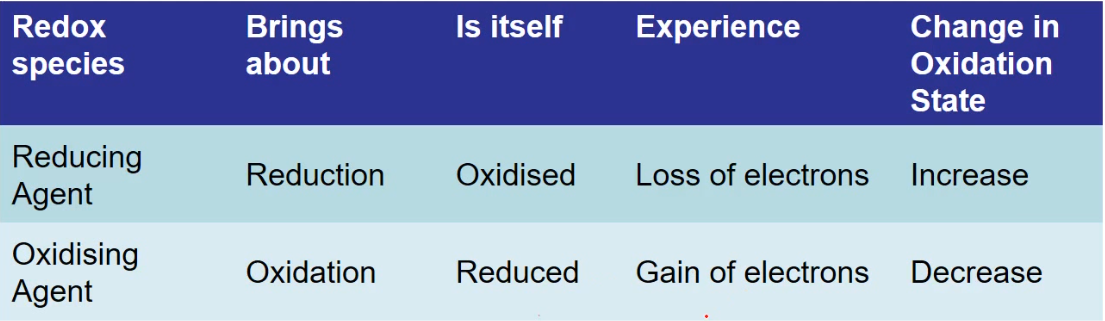
In the reaction above, CH4 contains C the C that is oxidized, so CH4 is the reducing agent.
O2 is the reactant that contains O atoms which are reduced. So the O2 is the oxidizing agent. O2 accepts electrons.
In the chemical reaction:
2Al(s) + 3I2(g) → 2AlI3(s)
Al: goes from 0 charge, to +3, it’s increased and is oxidised. We would therefore call Al the Reducing agent. It will bring about reduction of the Iodine gas.
I: goes from 0 charge to -1, it’s decreased and is reduced. Therefore we would call Iodine the oxidizing agent, it brings about oxidization of the Aluminium.