02.07 Market Disequilibrium and Changes in Equilibrium
Market Disequilibrium: Detailed Notes
Introduction
Definition: Market disequilibrium occurs when the market price does not equalize quantity supplied and quantity demanded.
Cause: Imbalance in the market that moves it away from equilibrium.
Causes of Disequilibrium
Underestimation or Overestimation of Demand: Producers misjudge consumer demand.
Sudden Shifts in Supply or Demand: Viral social media posts or unexpected events.
Government Intervention: Price floors, price ceilings, or quantity regulations.
Market Power: A producer with a large market share sets prices to drive out competition.
External Shocks: Changes or shocks to the market.
Consequences of Disequilibrium
Market Shortage: Quantity demanded exceeds quantity supplied.
Market Surplus: Quantity supplied exceeds quantity demanded.
The Return to Equilibrium
Market Forces: The laws of supply and demand drive price and quantity back toward equilibrium.
Example:
A restaurant experiences a sudden increase in demand after a news anchor raves about their dessert on television. The demand curve shifts to the right, creating a shortage.
Key Objectives
Interpreting Scenarios: Understand how various events impact the determinants of supply and demand.
Drawing Curves: Practice drawing supply and demand curves to illustrate changes in equilibrium price and quantity.
Elasticity and Impact: Determine how elasticities influence whether consumers or producers are more affected by disequilibrium.
AP Pro Tip
Market Surplus: More is supplied than demanded (inefficient).
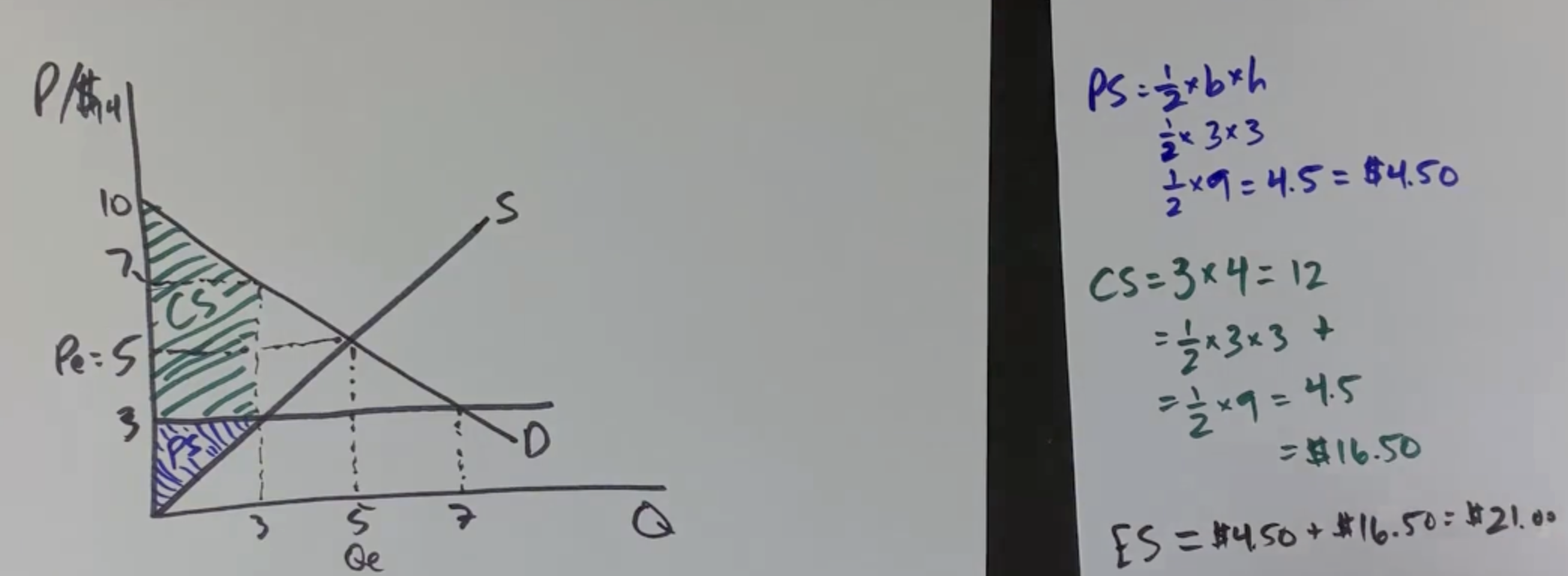
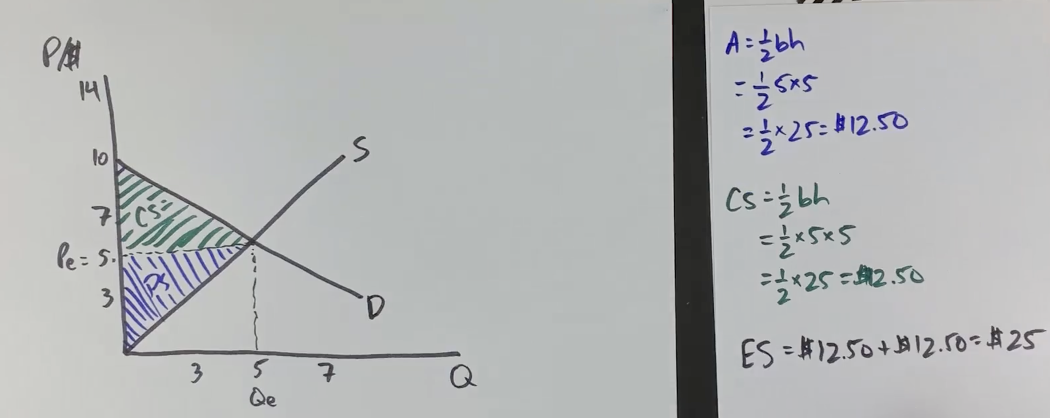
Economic Surplus: The difference between the actual price and consumers' and producers' willingness to buy or sell.
Productive Efficiency: Any point along the PPC where all productive resources are being used.
Allocative Efficiency: The point where total economic surplus is maximized (equilibrium).
Elasticity's Role in Disequilibrium
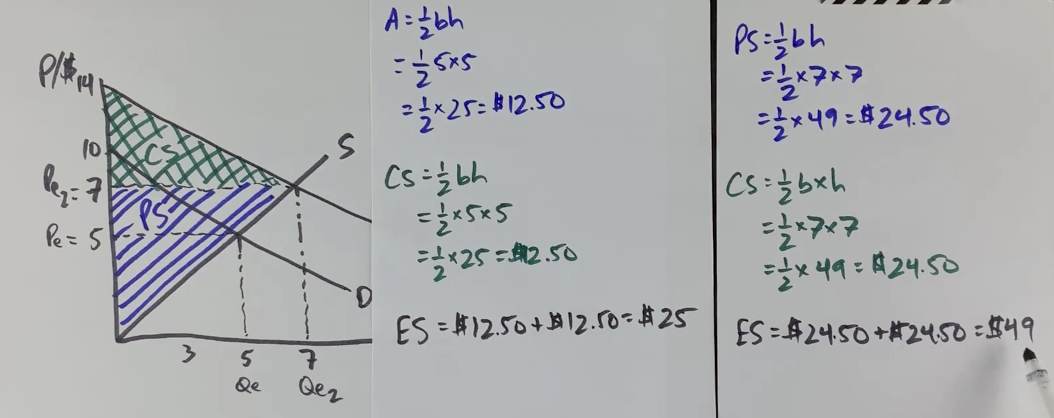
Impact on Equilibrium: Changes in supply or demand affect equilibrium price and quantity, as well as consumer and producer surplus.
Elasticity's Influence: The magnitude of these effects depends on elasticity.
Example: If a good has a perfectly elastic supply curve (horizontal line), there is no producer surplus.
Concepts to Nail Down (Ceteris Paribus)
The more price-elastic the demand for a good, the smaller the consumer surplus. This means consumers are closer to the maximum price they'd pay.
At equilibrium:
If supply is more elastic than demand, consumer surplus will be greater than producer surplus.
If demand is more elastic than supply, producer surplus will be greater than consumer surplus.
If supply and demand are equally elastic, consumer and producer surpluses will be equal.
These principles reveal who has more to lose when prices change from equilibrium due to taxes or other events.
Total economic surplus is maximized at equilibrium, even if consumer surplus (CS) and producer surplus (PS) are unequal.
A normative economist might view the lack of balance as a problem.
Effects of Shifts in Supply and Demand
Supply Decrease (Shift Left):
Consumer surplus decreases.
Price increases, quantity decreases.
Impact on producer surplus is indeterminate.
Supply Increase (Shift Right):
Consumer surplus increases.
Price decreases, quantity increases.
Impact on producer surplus is indeterminate.
Demand Decrease (Shift Left):
Consumer surplus decreases.
Producer surplus decreases.
Price and quantity both decrease.
Demand Increase (Shift Right):
Consumer surplus increases.
Producer surplus increases.
Price and quantity both increase.
When only one curve shifts (supply or demand), the impact on consumer surplus matches the direction of change.
With a shift in supply, the impact on producer surplus may be indeterminate.
Double Shifts (Shifts in Both Supply and Demand)
With a double shift, there is uncertainty.
Either the new equilibrium price or quantity will be indeterminate.
Thus, the impact on economic surplus will also be indeterminate.