Topic 7: Periodic Trends
T7VA: Atomic Size
3 periodic trends to keep track of
atomic/ionic size
ionisation energy
electron affinity
Trends show us how physical properties change as we move left to right, bottom to top in the periodic table
Atomic size: the radius of an atom
measure the bond length and divide by 2
Atomic size trend: atomic size increases from R → L and U → D
Atomic size can be understood through Coulombs Law:
Coulombs Law describes the force of attraction and repulsion between two charges (electrostatic force).
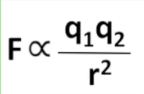
If the two charges are equal and positive, they will repell
if the two charges are equal and negative, they will attract
if one charge is 3x as positive and the other is 1x as negative, the positive charge will attract the negative one with a much stronger pull
As we move to the right on the periodic table, protons attract the electrons more. As the number of protons in an atom increase, the radius decreases because the attractive pull of the many protons on the electrons is stronger the more protons there are. However, the radius of the atom also is affected by the electrons’ repelling as they are moved close and closer by the attraction of the protons. Therefore, the radius of an atom is the result of a balance between the attractive force between the protons and electrons, and the repulsive force between the electrons.
As we go down the periodic table, we increase the number of atomic orbital energy levels that surround the nucleus, and so the overall size of the atom increases.
T7VB: Ionic Size
Ions increase in size the more negative their charges are
Cations are always SMALLER than the atoms they come from
Anions are always LARGER than the atoms they come from
as
REMEMBER: an ion can be isoelectronic with an atom if they have the same amount of electrons
For example, K+1 and Cl-1 are isoelectronic with Ar
T7VC: Ionisation Energy Part 1
Ionisation energy is the energy it takes to remove an electron from an atom
ionisation energy increases as you keep removing electrons (second ionisation energy is greater than first ionisation energy, etc)
first ionisation: removal of the first electron, notated as I1
second ionisation: removal of the second electron, notated as I2; etc…
as you remove electrons, ionisation energy increases because the atomic radius decreases due to there being less and less electron repulsion
fewer electron-electron repulsions result in overall lower energy, so as ionisation continue, the energy of the inner shells is lower and lower
Where there is a big jump in ionisation energy, you can tell the ionisation process has moved from stripping valence electrons to stripping core electrons
Inner shell electrons: core electrons
Outer shell electrons: Valence electrons
Trend: ionisation energy increases moving L → R, D → U
IE increases in a period moving Left to Right
NOTE: there are some exceptions
T7VD: Ionisation Energy Part 2
There are some exceptions to the general trend of IE increasing L → R, D → U
Exception 1:
Why is the ionisation energy for Mg higher than that for Al ?
Al is more to the right side of the periodic table than Mg, right ?
this is because of their electron configurations:
Mg: [Ne] 3s2
Al: [Ne] 3s23p1
The 3p orbital is higher in energy than 3s, so it is easier to remove electrons from it. The electrons in the 3p orbitals are shielded from the nucleus by the 3s orbital…
shielded electrons are less strongly attracted to the nucleus and are thus more easily removed
Therefore, the 3p1 electron is easier to ionise than the 3s2
Exception 2:
Why is the ionisation energy for P higher than that for S ?
this is ALSO because of their electron configurations:
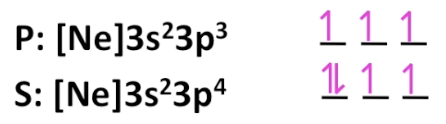
p: three unpaired electrons that all have the same spin
s: four electrons, two of which are paired, and three of which are unpaired with the same spin
NOTE: paired electrons are HIGHER ENERGY than unpaired electrons within the same suborbital
Therefore…
the Sulphur p electrons are at a higher energy than the Phosphorus p electrons
the Sulfur p orbital is at a higher energy than the Phosphorus p orbital
electron-electron repulsions in Sulphur are higher than those in Phosphorus because S’s electrons are closer together
SO, the 4th p electron in Sulfur is easier to remove and thus has a lower first ionisation energy than Phosphorus
Overview:
There are some exceptions to the general trend of IE increasing L → R, D → U
These exceptions are:
the electron - electron repulsion in the 4th p electron as you move from group 15 to 16 makes the 4th p electrons easier to remove than the 3rd p electrons
the shielding of the p electrons in group 13 by their s orbital electrons makes it so that the 1st p electrons are easier to remove than the 2nd s electron
T7VE: Electron Affinity
Electron affinity (EA): the readiness to accept electrons
the heat released when a gaseous atom gains an electron to create a negative ion
X(g) + e- → X-(g)
EA = -ΔH
-ΔH means that energy is released: exothermic
the more negative the ΔH value, the more heat is released, and the larger the electron affinity
if a lot of energy lost in the formation of the ion means that the ion is more stable than the atom
Group 17 atoms (halogens) have the largest electron affinities of their respective periods. Why ?
the halogens all have an eleconfig ending in 2p5. This means that it is more favourable for them to gain an electron and fill up that last shell than lose electrons.
However, as you move down the period, there are more and more shells, which means that the outermost 2p5 electrons are further and further away from the nucleus and so have less attraction to the protons of the nucleus. Therefore, the binding energy is weaker and so less heat is released in the process of gaining an electron
EXAMPLE: Cl
In the process of Cl gaining an electron, 349 kJ of energy are released. Therefore, its ΔH is -349 kJ/mol. That means the EA is |-349| = +349 kJ/mol.
This is a favourable process, and the Cl-1 ion is more stable compared to the Cl atom.
Trend: EA affinity increases from L → R, D → U
NOTICE:
halogens have the largest electron affinities
the metals have very small EA compared to the halogens because forming anions is not favourable
EXEPTIONS: atoms in the p block of period 2 have EA that are somewhat lower than the atoms in period 3
this this is because the electrons of the p block of period 2 are really small, and so the electron-electron repulsion is greater than in period 3
noble gases (and a few others) have no EA values listed because the formation of anions is not favourable either
Lower electron affinity = larger atomic size = lower ionisation energy
Electronegativity
Electronegativity increases going L → R, D → U