Compiled Prelim
FREQUENCY DISTRIBUTION AND GRAPHS
Steps:
Identify the class RANGE (by subtracting the lowest value and highest value)
Identify the class WIDTH (by dividing the class range with class intervals)
class interval formula: k = 1+3.3log(N
round off the value
make a TABLE in this order (C.I, TALLY, F, CB, <CF, >CF)
CI - CLASS INTERVAL (Adding the lowest value by the class width until it reaches the highest value)
D
TALLY - COUNTING (counting the values in that parameter)
F - FREQUENCY (counting the tally)
CB - CLASS BOUNDARY (substracting the lower-class value by 0.5 and adding the higher-class value by .5)
<CF - ASCENDING CUMMULATIVE FREQUENCY (Adding the lowest frequency to the f+1 frequency)
>CF - DESCENDING CUMMULATIVE FREQUENCY (substracting the total amount of class to the 2nd frequency to 3rd and so fort)
MIDPOINTS - Adding the upper and lower boundaries and diving by 2
MEASURES OF POSITION
Depending on the asked, The formula may change to 4,10,100
Steps:
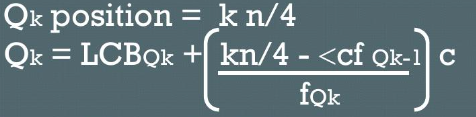
Solve for K n/4 (depending on the given it could be K n/4, K n/10, K n/100)
K = Position
N = Number of classes
Find the nearest higher value and box it so you wont get confused
Find the value of
LCBQk (lower class boundary of that class
<CQk-1 (Cummulative Frequency of the class before that class)
FQk (Frequency of that class)
C (Class Interval)
Solve for the formula
MEASURES OF CENTRAL TENDENCY
Mean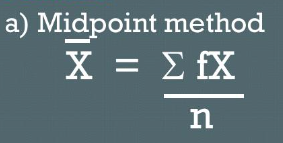
Median
Steps
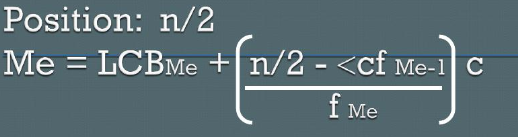
Find the position by n/2 formula
box the class with the nearest highest value
Find
LCBme (lower class boundary of that class)
n/2 (position)
<cfme-1 (value of the before cumulative frequency of that class)
fme (frequency of that class)
c (class interval)
Solve for
Mode'
Steps
Find highest frequency
box
Find
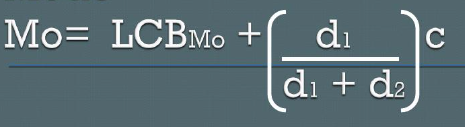
LCBmo (lower class boundary)
d1 (substract the frequency of the value in the lower class frequency)
d2 (substract the frequency of the value in the upper class frequency)
c (class interval)'
Solve for