The rate and extent of chemical change
Rates of reactions
The rate of a reaction is the speed at which reactants turn into products
Rates of reactions can be measured either through how fast reactants are used up, or by how fast products are formed
Rate of reaction = Quantity of products formed (or reactants used) / time taken
This shows the average rate, where in reality reactions start quick and slow over time
Factors affecting rates of reactions
Rates of reactions are dependent on temperature, surface area, pressure and catalysts
Collision theory is the idea that in order for particles to react, they have to collide with sufficient energy (activation energy)
If they don’t have this, no reaction will occur
The rate depends on the amount of energy particles have, and the frequency of collisions between particles
Temperature
As temperature increases, particles gain more kinetic energy
This causes particles to move faster, so they collide more frequently with more energy
This makes the reactants more likely to exceed the activation energy, and the higher rate of successful collisions increases the rate of reaction
Concentration/pressure
How many particles per unit of volume - concentration is usually solutions, pressure is usually gases
As concentration/pressure increases (lower volume, higher no. of particles per unit of volume), their are more particles per unit of volume
This causes more frequent collisions, and a higher rate of reaction
Surface area
A higher surface area to volume ratio creates a larger surface for collisions, so a higher frequency and therefore a higher rate of reaction
Catalysts
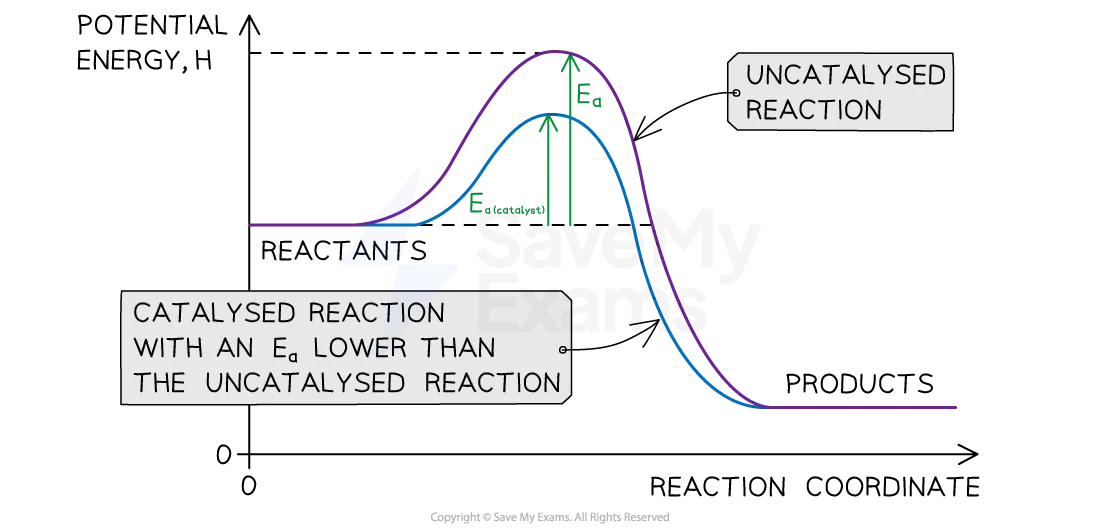
Catalysts are substances that speed up a reaction without being used up themselves
Transition metals, enzymes, etc.
They lower the activation energy required by providing an alternative pathway for reactants
Measuring rates of reactions

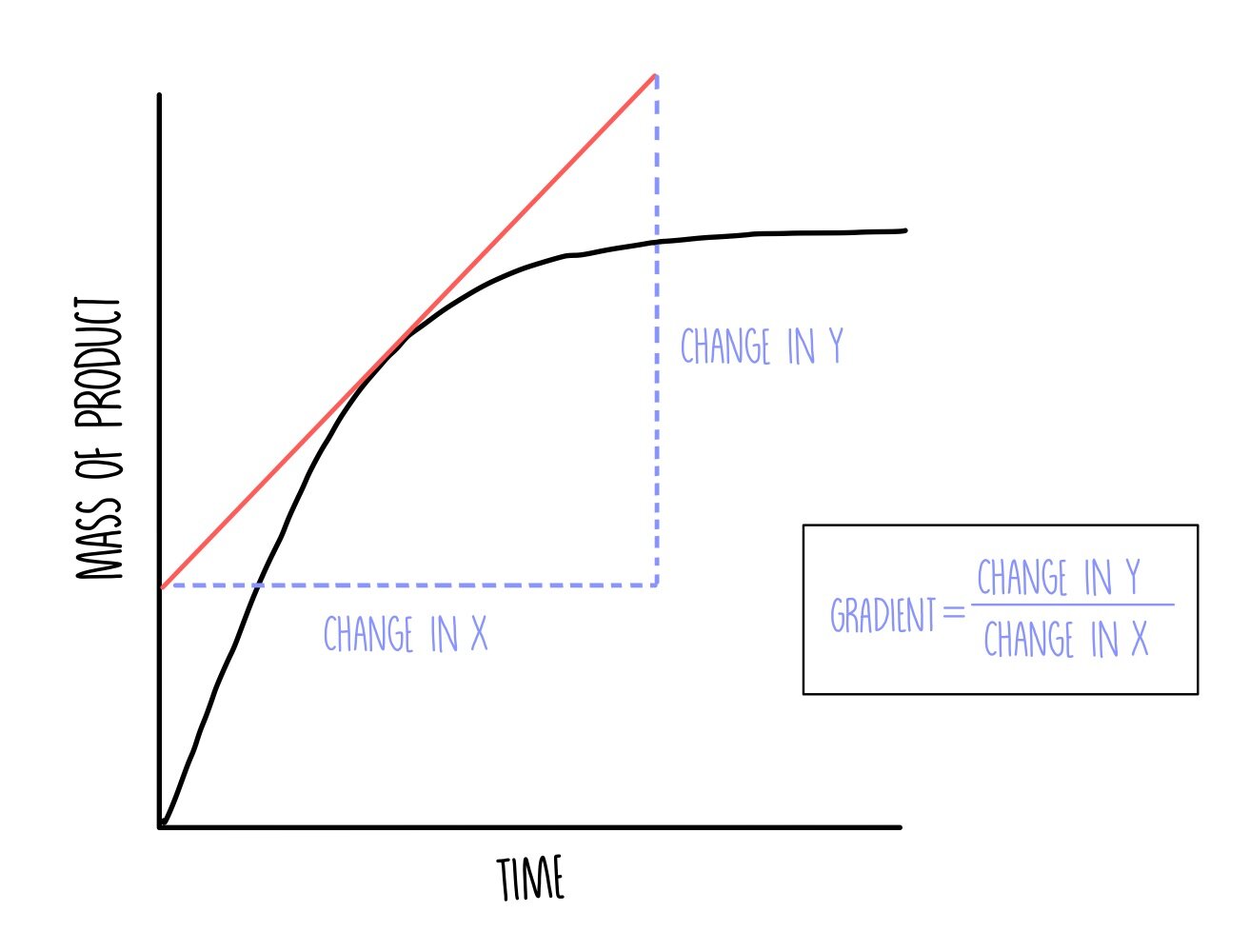
The mean rate in a set time is equal to to the gradient between two points
The actual rate at a specific time is equal to the gradient at that point’s tangent
Reversible reactants and dynamic equilibrium
In one way reactions, once products are formed they can’t change back to their reactants (break down into them)
In reversible reactants, reactants can form products and products can break down into reactants
NH4Cl ⇌ NH3 + HCl
Different directions of reactants can happen at different rates
When there are lots of reactants, the forward reaction is fast until products begin to form
Then the forward reaction slows, and the backwards reaction speeds up
Eventually, the forward and backwards reactions reach the same speeds - at equilibrium
Equilibrium is when both reactions are still happening, but there is no overall change in concentration (effectively cancel out)
The concentration of reactants and products don’t change, and there are equal speeds but NOT equal masses
If there are more products than products at equilibrium, the reaction lies to the right
If there are more reactants at equilibrium, the reaction lies to the left
This can change depending on conditions and the reaction
Equilibrium can only be reached in a closed system, where there is no energy loss to the surroundings
Reversible reactions are always exothermic in one direction, and endothermic in the other
La Chatelier's principle
La Chatelier’s principle states that changing the condition of a reversible reaction causes the position of equilibrium to try and counteract the change
This can be used to predict the outcome of the reaction
If equilibrium was in the centre of a reaction in a closed system, with the exothermic reaction forwards, and endothermic backwards:
Decreasing temperature causes the equilibrium to move in the exothermic direction to release heat
Increasing temperature causes a move left (endothermic)
Increasing pressure makes the equilibrium to want pressure to decrease, so the equilibrium moves to the side with the less molecules being produced
Decreasing pressure causes a want for an increase in pressure, so more molecules being produced
A higher concentration of one reactant/product causes the equilibrium to shift to the opposite side to reverse the concentration change
DONE!!!