Biology HN Unit 1 Test Study Notes: Bio Basics + Biomolecules
Section 0: Biology Basics
What is Biology?
Biology - The study of life and living organisms
Living things share characteristics that help define life
Characteristics of life
Living things…
Reproduce - Producing offspring
Adapt - Populations evolving over generations
Maintain homeostasis - Keeping internal conditions relatively stable
Cosume resources/use energy - Obtaining + using energy to carry out life processes
Respond to stimuli - Reacting to changes in environment
Grow + Develop - Changing over time
Are made of cells - Basic unit of life
Contain genetic information/material - DNA provides instructions for life
Levels of organization
From smallest to largest…
Cells → Tissues → Organs → Organisms → Population → Ecosystems → Biosphere
Section 1: Chemistry/Biochemistry
Atoms + subatomic particles
Atom - smallest unit of an element that still has the properties of that element

Picture by VectorStock
𐄙Proton → Positive charge (+)
▸ Located in the nucleus
𐄙 Neutron → No charge (0)
▸ Also located in the nucleus
𐄙 Electron → Negative charge (-)
▸ Found surrounding the nucleus
(Little reminder: Radioactive decay makes the new element because change of protons = change of atomic neutrons)
Counting subatomic particles
The rule:
Atomic number = Number of protons
Mass number = Protons + Neutrons
Neutrons = Mass number atomic number
Neutral atom → Protons = electrons
(Little reminder: Carbon has atomic number 6 and mass number 12
Protons = 6
Electrons = 6
Neutrons = 12 - 6 = 6)

Picture by Weebly (someone got the picture from a random website)
(Little reminder: Remember this: WE are carbon-based!)
Counting Atoms in chemical formulas
The rule:
A subscript tells you how many atoms of the element come before it
No subscript = 1 atom
To find the total number of atoms, add all the atoms together
Ex:
H2O
𐄙 H = 2
𐄙O = 1
𐄙Total: 3 Atoms
C6H12O6
𐄙C = 6
𐄙H = 12
𐄙O = 6
𐄙Total: 24 Atoms
A coefficient is the big number in front of a formula. It multiplies EVERY atom in the formula
(Little reminder: Remember:
𐄙 Look for parentheses/subscripts → multiply inside
𐄙 Look for the coefficient → multiply EVERYTHING
𐄙 Add all atoms together)
Coefficient:
3 H2O
𐄙H: 3 × 2 = 6
𐄙O: 3 × 1 = 3
𐄙Total = 9 Atoms
Parentheses
A subscript outside parentheses multiplies everything inside
Ca(OH)2
𐄙 Ca = 1
(Little reminder: notice there is no coefficient? pretend there is a 1 like the subscript mentioned)
𐄙 H: 2 × 1 = 2
𐄙 O: 2 × 1 = 2 (Same thing!)
𐄙 Total: 5 atoms
Coefficient and Parentheses
2CA(OH)2
(First, count one formula)
𐄙Ca = 1
𐄙O = 2
𐄙 H= 2
(Then multiply EVERYTHING by 2)
𐄙 Ca: 1 × 2 = 2
𐄙 O: 2 × 2 = 4
𐄙 H: 2 × 2 = 4
𐄙 Total = 10 atoms
Solutions
Solution - Mixture where a substance is evenly dissolved
Solute - Substance being dissolved
Solvent - Substance that does the dissolving
Precipitate - Solid that separates out if a solution during a reaction

Picture by Shutterstock
Ex: Salt + water (Salt → solute, Water → solvent)
pH, Acids, and Bases
pH - Measures the concentration of H+ (Hydrogen ions)
Acid - Increases H+
Bse - Decreases H+ or adds OH-
Buffer - Resists changes in pH
𐄙Helps keep pH stable
𐄙Supports homeostasis
𐄙Ex: Helps maintain safe blood pH

Picture by iStock
Water and Polarity
Water is polar
𐄙Has slightly both positive and negative ends
Because water is polar, it can attract and dissolvw many polar and charged substances
It is also an important solvent in living organisms
Section 2: Biomolecules
Four Biomolecule types
Carbohydrates (sugars/starches)

Picture by LabXchange
Carbohydrate monomer
𐄙 Monosaccharide (single sugar)
𐄙 Ex: Glucose
Carbohydrate polymers
𐄙 Polysaccharide (many sugars)
𐄙Ex:
▸ Starch
▸ Glycogen
▸ Cellulose
▸ Sucrose
▸ Glucose
Main role of carbohydrates:
𐄙 Quick energy and short-term energy storage
𐄙 Also used in cell recognition/communication
Carbohydrates + cell-to-cell communication
𐄙 Carbohydrates on the cell surface act like ID tags
𐄙 They help cells recognize other cells and send signals (often attacged to proteins/lipids)
(Sources: fruit, bread, potatoes)
Lipids (fats, oils, waxes)

Picture by LabXchange
Lipid “building blocks” (not true polymers like carbs/proteins)
𐄙 Often described as glycerol + fatty acids
Elements in lipids
𐄙 Mostly C, H, O (usually means less oxygen than carbs)
Main roles of lipids
𐄙 Long-term energy storage
𐄙 Cell membranes (phospholoids)
𐄙 Insulation/protection (fat)
𐄙 Ex: Fats, oils, waxes, phospholoids
(Sources: butter, olive oil, peanut oil, lard)
(Little reminder: Lipids are hydrophobic, meaning they do not mix with water due to their immunity of carbon-hydrgogen chains)
Proteins

Picture by LabXchange
Protein monomer
𐄙 Amino acid
Protein polymer
𐄙 Polypeptide/protein
Elements in proteins
𐄙 C, H, O, N (often N is the big “tell”)
𐄙 Enzymes (speed up chemical reactions)
𐄙 Structure (muscle, hair, etc)
𐄙 Transport, signaling, immune (depending on protein)
Ex: enzymes, structural proteins
(Sources: meat, nuts, beans)
Nucleic acids

Picture by LabXchange
Nucleic acid monomer
𐄙 Nucleotide
Nucleid acid polymers
𐄙 DNA + RNA
Elenents in nucleic acuds
𐄙 C, H, O, N, P (Phosphorus is important)
Main roles
𐄙 Store and transmit genetic information
𐄙 Directions for making proteins
Ex: DNA, RNA (and ATP is a nucleicotide used for energy transfer)
(Sources: Examples mentioned above)
Building vs. Breaking molecules (Dehydration vs. hydrolosis)
▸ Dehydration synthesis
Purpose: Builds bigger molecules from smaller ones
What happens: Water is removed/produced when monomers bond
Pattern: Monomer + monomer → Dimer/polymer + H2O
▸ Hydrolosis
Purpose: Breaks big molecules into smaller ones
What happens: Water is added to break the bond
Pattern: Polymer + H2O → Monomer + monomer (for smaller pieces)

Image by Purpose Games (Dehydration synthesis on top, Hydrolosis on bottom)
Fats: Saturated vs. Unsaturated
Saturated
𐄙 Meaning: No double bonds between carbons in the fatty acid chain
𐄙 The chain is “filled” with hydrogen → straight chain
𐄙 Packs tightly → usually solid at room temperature
𐄙 Ex: Butter, animal fat (common)
(Little reminder: For a fat to be saturated, each carbon must hold more than one hydrogen)

Example of how the fat is saturated (like the meaning, plus, my picture)
Unsaturated fat
𐄙 Has one or more double bands
𐄙 Causes a “kink” → doesn’t pack tightly → often liquid at room temperature
𐄙 Ex: olive oil, many plant oils
Section 3: Enzymes
Big Idea: Protein shape = Protein function
Proteins are made of long chains of amino acids
𐄙 These chains fold into a unique 3D shape
𐄙 The 3D shape is what lets the protein do its specific job

Picture by Qeios
Examples of protein jobs:
Digestion (digestive enzymes)
Immune defense (antibodies)
Muscle movement
DNA/RNA expression+regulation
Skeletal support/structure
Transport molecules
Metabolism/cell processes
Enzymes (A type of protein)
Enzymes are biological catalysts
𐄙 They speed up chemical reactions by lowering the activation energy
𐄙 They are not used up in the reaction → they get recycled
Enzyme + substrate interaction
𐄙 Substrate = the molecule the enzyme reacts with/binds to
𐄙Active site = the part of the enzyme where the substrate fits
𐄙 Enzyme-substrate complex = temporary combination while the reaction happens
𐄙 The enzyme works like a lock and key (substrate must fit the active site)

Picture by Dreamstime
Naming rule (common pattern)
𐄙 Enzymes are often named after the substrate they act on + -ase
▪ Lactose → Lactase
▪ Lipids → Lipase
Denaturation (why enzymes stop working)
Denaturation = when an enzyme loses/changes its shape
𐄙 Often caused by changes in pH or temperature
When the shape changes:
𐄙 The active site no longer fits the substrate → enzyme can’t bind → reaction slows/stops
Graph/conditions review
Enzymes have an optimal pH (best working pH)
𐄙 Examples from graphs:

Picture by Me (I drew this from my bio teacher’s review packet)
▪ Sucrose works best around pH ~ 6.5-7

Another picture by me, hehe
▪ Trypsin works best at around pH ~ 8
Enzymes have an optimal temperature
𐄙 Many human enzymes work best near 37°C (normal body temperature)
Too cold vs. too hot
𐄙 Too cold: reaction rate decreases (less movement/fewer collisions)
𐄙 Too hot: enzyme may denature (shape changes), so the reaction can drop sharply
Reaction rate vs. Substrate concentration (why it levels off
As substrate concentration increases, reaction rate increases until all enzyne active sites are busy
𐄙 Once enzymes are “maxed out” (saturated), adding more substrate doesn’t increase the rate much
Section 4: Nucleic acids & DNA structure + replication
Big idea: Nucleic acids store and use genetic information
Nucleic acids = Molecules that store and pass on genetic information
Main types:
𐄙 DNA (Deoxyribonucleic acid) = stores genetic instructions (the “blueprint”)
𐄙 RNA (Ribonucleic acid) = helps use DNA’s instructions to make proteins
𐄙 ATP (a nucleotide) = main energy molecule cells use
DNA vs. RNA comparison:
DNA
Stores genetic info
Double-stranded (double helix)
Sugar is deoxyribose
Location: Nucleus
RNA
Helps make proteins (uses DNA instructions)
Usually single-stranded
Sugar is ribose
Bases: A, U, C, G (U replaces T)
Location: made in nucleus, works in cytoplasm (like ribosomes
DNA Structure (what it’s made of)
Nucleotide = building block of DNA/RNA
𐄙 Nucleotide has 3 parts:
Phosphate group
Sugar

Picture by ResearchGate
DNA “sides” = sugar-phosohate backbone
𐄙 The sides of the DNA ladder are made of repeating sugar + phosphate = sugar-phosphate backbone
DNA “rungs” = base pairs
𐄙 Bases pair in the middle to form the “rungs”
𐄙 DNA bases:
▸ A = adenine
▸ T = thymine
▸ C = cytosine
▸ G = guanine
(Little reminder: A → T, C → G)
Double helix + antiparallel
𐄙 DNA shape = double helix (twisted ladder)
𐄙 The two strands run in opposite directions (antiparallel)
▸ One strand is 5’ → 3’
▸ The other is 3’ → 5’
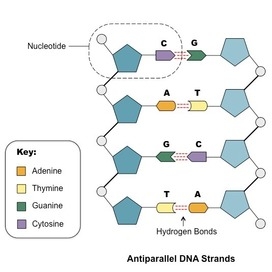
Idk where I got that image from…
DNA Replication (why+when+what)
When?
𐄙 During interphase (before cell division)
What?
𐄙 Makes an identical copy of DNA
Why?
𐄙 So new cells get the same DNA to make new cells
GO ACE THAT BIO TEST!!
✎ᝰ.📓.♡ ̆̈✧˖°🗒