1.3 - Investigation of Newton’s 2nd law
Definition of Newton’s 2nd law:
The rate of change of momentum of an object is proportional to the resultant force acting on it, and takes place in the direction of that force.
Theory:
The gravitational force of the slotted masses attached via the pulley causes the entire mass of the system to accelerate. That is the mass of the rider, M, and the total mass of the slotted masses, m. Newton’s second law, therefore, can be written as:
𝑚g = (𝑀 + 𝑚)𝑎
and so the acceleration of the system is:
𝑎 = 𝑚g / (𝑀 + 𝑚)
We can use this to test Newton’s second law. If the total mass of the system (M + m) remains constant then the acceleration, a, should be proportional to the gravitational force, mg.
Apparatus/Diagram:
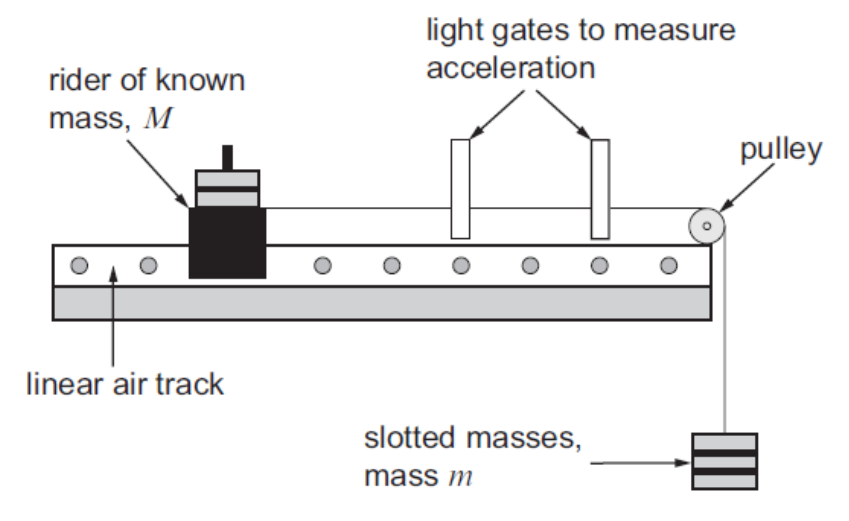
Experimental Method:
Fix the thread to the rider and attach five slotted 5 gram masses to the other end as shown in the diagram. Set the light gates to record the acceleration and allow the slotted masses to fall to the ground. Record the gravitational force, mg and acceleration, a. Remove one of the slotted masses and place it on the rider (so keeping the total mass of the system constant).
Repeat the experiment until all the different accelerating masses have been removed. Plot a graph of acceleration (y-axis) against gravitational force, mg (x-axis). This should be a straight line through the origin