The Inter-War Years
The Inter-War Years
Treaty of Versailles, June 28, 1919
- Germany (and Austria) responsible for WW1
- Had to pay reparations and cut down the military
- Reduce army to 100,000
Allied Reparations Commissions
- April 1921
- Set a sum of $33 billion for German reparations, $2.5 billion for installments to be paid annually
- Germany made first payment, then claimed it couldn't afford to pay any more reparations
- France moved into Ruhr Valley (Germany’s industrial and mining region
- German economic resistance to France’s occupation led to massive inflation, which devalued their money.
The Dawes Plan (Economic Settlement)
- August 1924
- Reduced German reparations
- Granted an initial $200 million loan for German recovery
- Germany would use tax revenue from American loans to pay war reparations
- Americans began investing heavily in European markets
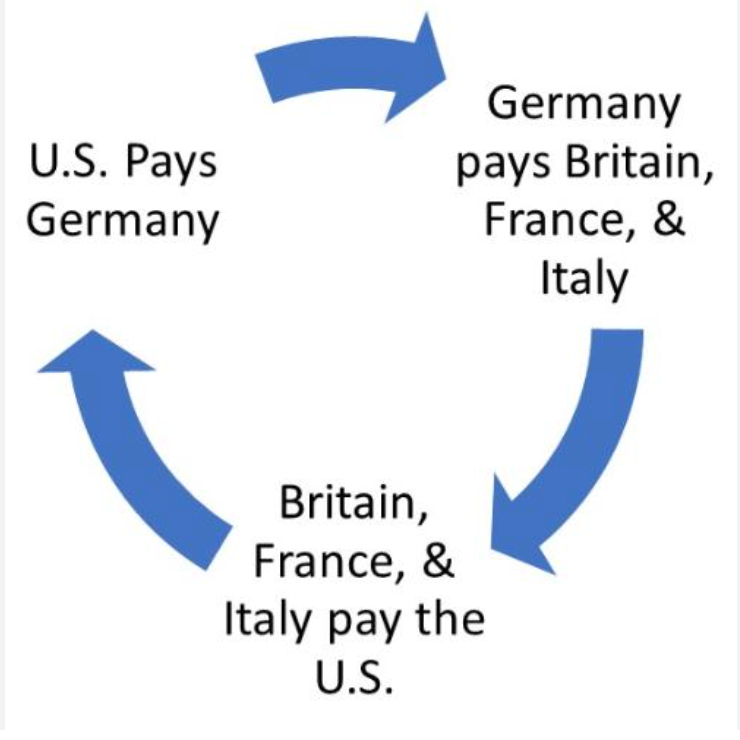
- A new era of European prosperity emerged from 1924-1929
- The European economy seemed to be on the mend
Treaty of Locarno (political settlement)
- 1925 guaranteed Germany’s new western borders with Belgium and France
- Separately, Germany joined the League of Nations in 1926
- 15 countries signed the Kellogg-Briand Pact in 1928 agreeing to settle disputes peacefully
- The treaty of Locarno and K-B pact were unenforceable
- Future border disputes and international conflicts seemed to be under control
Democratic States (domestic settlements)
- In 1919, most European states, both major and minor, had democratic governments
- New political parties emerged
- In a number of states, women could now vote
- In the 1920s, maintaining these democratic governments was not easy, but there was optimism in these democratic institutions.
The Great Depression (Roughly 1929–1933)
- The economic crisis and period of low business activity
- Roughly beginning with the stock-market crash in October 1929
- Shattered the fragile stability and optimism of the 1920s
- People will look to leaders who would “do something” to fix economic problems
- WWII will essentially bring an end to global depression
- Much of European prosperity has been built upon US bank loans to Germany
- When the stock market crashed, panicky investors started to withdraw funds from Germany and other European countries
- By May 1931, trade was slowing, production was declining, and unemployment was rising
- Brief summary
- Investments in stock market speculation soared in the 1920s ($27 - $87 billion) - mostly investments in the “hope” of post-WWI rebuilding
- “Real” investment - factories, farms, equipment, etc. - dipped ($3.5 to $3.2 billion)
- People panicked and stopped buying goods
- As a result, the price of goods dropped
- Much of the speculated investments were borrowed, so when prices started to drop, people had to pay off their stocks to pay back lenders
- Prices fell, production slowed, and unemployment rose
- The US panic had a ripple effect worldwide - the US began recalling loans to foreign countries making it difficult for European investors to borrow money
- Internationally - prices also fell, production slowed, and unemployment rose
- World output of goods fell by an estimated 38%
- Stats
- 25% of British workers were unemployed
- 40% of Germans were out of work
- Industrial production in the United States fell by 50%
- Industrial production in Germany fell by 40%
Response to The Great Depression
- By 1939, only two major European powers remained democratic
- Great Britain
- France
- The rest of Europe adopted dictatorial regions
- Totalitarian States
- Centralized control by a dictator or authoritarian
- Controlled the political, social, intellectual, and cultural lives of its citizens
- The individual was expected to be involved in achieving the state’s goals… as dictated by the leader
- Fascism - promotes the nation and race over the individuals; stifles opposition
France(left)
- France did not begin to feel the full effects of the Great Depression until 1932.
- During a 19-month period in 1932 and 1933, six different cabinets were formed as France faced political chaos.
- In June 1936, a coalition of leftist parties–Communists, Socialists, and Radicals–formed the Popular Front government.
- The Popular Front started a program for workers that some have called the French New Deal.
- The French New Deal gave workers the right to collective bargaining, a 40-hour workweek in industry, and a minimum wage.
Great Britain(right)
- 1929 Great Britain faced the growing effects of the Great Depression
- The Labour Party failed to solve the nation’s economic problems and fell from power in 1931
- A new government led by the Conservatives claimed credit for bringing Britain out of the worst stages by using the traditional policies of balanced budgets and protective tariffs
- Political leaders in Britain largely ignored the new ideas of a British economist, John Maynard Keynes, who argued that unemployment came from a decline in demand, not from overproduction
- Keynes believed governments could increase demand by creating jobs
- His ideas are different from those who believed that depressions should be left to resolve themselves without government interference
Russia - Joseph Stalin
- Vladimir Lenin - founder of the Russian Communist Party - died in 1924
- Joseph Stalin gained complete control of the Communist Party in 1927
- 1928 - Stalin launched the first Five Year Plan to move Russia from an agricultural to an industrial economy (Russia began producing “capital goods” - goods used to produce other goods, like heavy machinery)
- The plan quadrupled the production of heavy machinery
- By 1937, Russia was producing 15 million tons of steel per year
- Production came at a cost:
- Few provisions were made for caring for the expanding workforce
- Despite the increase in production between 1932 and 1940, housing actually declined after 1929; wages declined by 43%; and strict laws limited where people could move
- Propaganda was used to stress the need for sacrifice to create a new socialist state
- Those who opposed the state were sent to labor camps in Siberia (known as the Gulag)
- It is estimated that 8 million diplomats, union officials, party members, intellectuals, and ordinary citizens were sent to labor camps during Stalin’s regime, from which they never returned
The United States
- By 1932, U.S. industrial production fell by almost 50 percent form its 1929 level
- By 1933, there were more than 12 million unemployed
- Democrat Franklin D. Roosevelt won the presidential election in 1932 by a landslide
- He pursued a policy of active government economic intervention known as the New Deal
- The New Deal included an increased program of public works. The Works Progress Administration (WPA), established in 1935, was a government organization employing about 3 million people at its peak. Workers built bridges, roads, post offices, and airports.
- 1935 - the Social Security Act created a system of pensions to be collected at age 65 by those no longer working
- It also supplied unemployment insurance to workers who had lost their jobs
- Finally, the legislation also provided small welfare payments to others in need, including those with disabilities
- These reforms helped the United States but didn’t end its unemployment problem
- Only World War II and the growth of weapons industries brought US workers back to full employment
Spain - Francisco Franco (right. 1939-1975)
- Political democracy failed in Spain too
- Spanish military forces revolted against the democratic government in 1936 - led by Franco - and overthrew the government.
- In exchange for access to Spain’s ports and natural resources, Germany (Hitler) and Italy (Mussolini) supported Franco by applying his forces with money, arms, and men
- Hitler used the Spanish Civil War to test new weapons
- The United States, Great Britain, and France agreed to not intervene in Spain’s revolution
Guernica
- Famous painting painted by Picasso
- The destruction of Guernica, Spain on April 26 1937 by German bombers
- Germans weren’t allowed to keep their air force
- Franco’s forces captured Madrid on March 28, 1939, ending the Spanish Civil War
- He established a dictatorship that lasted until 1975
- His dictatorship favored large landowners, businesspeople, and the Catholic clergy
Italy - Benito Mussolini
- Party: Fascio di Combattimento (league of combat)
- 1922 Mussolini’s fascist party grows in popularity after WWI
- Italians wanted more land from Treaty of Versailles
- “March on Rome” Mussolini threatened civil war if his party wasn’t given more power
- King Victor Emmanuel III made Mussolini prime minister
- By 1925 Mussolini rose to head of state; ruled Italy as Il Duce (The Leader or The duke)
- OVRA - Organization for Vigilance and Repression of Anti-Fascism (Italian: Organizzazione per la Vigilanza e la Repressione dell’Antifascismo); secret police; watched citizens’ political activities.
- Acerbo Law
- Law that gave Mussolini complete control
- Decree on head of powers of government
- Made prime minister the head of the government
- Stated that only the king could get rid of the head of government
- Pact of steel
- Agreement with Germany to support each other in times of war
- Mussolini - and other fascists - controlled media and used it for propaganda
- Promoted facts ideals through youth groups (66% of Italians aged 8-18 were involved in pro-Mussolini youth groups)
- Women were relegated to roles as homemakers, wives, and mothers
Germany
- Imperial Germany ended in 1918
- A German democratic state known as the Weimar Republic was then created
- The Weimar Republic was plagued by serious economic problems
- Germany experienced runaway inflation in 1922 and 1923
- In 1930, unemployment had grown to 3 million people by March and to 4.38 million by December
- The Depression paved the way for fear and the rise of extremist parties
- Adolf Hitler
- 1921, Austrian and WWI veteran, Adolf Hitler, took control of the Nazi Party (National Socialist German Workers Party)
- By 1923, the party had grown to 55,000 followers with a militia of 15,000 (Called Sturmabteilung)
- Beer hall putsch
- November, an over-confident Hitler tried to stage an armed uprising against the German government
- The uprising was quickly put down and Hitler was imprisoned
- There Hitler wrote an autobiographical book about the Nazi movement
- Mein Kampf (“My struggle” in English)
- The book defended extreme German nationalism and anti-semitism
- Hitler stressed the right of superior nations - Germany - to expand and authoritarian leaders like himself, to rule over others
- By the end of 1929, the Nazi Party had grown to 178,000
- By 1932
- The party had grown to 800,000 members and was the largest party in the German parliament, called the Reichstag
- Unemployment in Germany had ballooned from 4.35 to 6 million, making extremism more attractive to its people (common theme, no?)
- 1933
- Nazis grew even more popular in the Reichstag
- Hitler rose to the ranks of chancellor
- After a fire broke out in parliament on February 27, Hitler convinced the president (Paul Von Hindenburg) to issue a decree giving the government emergency powers, which suspended all rights of the citizens “until further notice”
- On March 23, the Reichstag passed Enabling Act, by a two-thirds vote, which gave Hitler lawmaking power without the consent of parliament or the president
- Hitler was essentially voted in as dictator
- By 1932
- The Nazi party acted quickly
- Civil service was purged of all Jews and democratic elements
- Concentration camps
- Trade unions were dissolved
- All political parties were abolished
- By the end of 1933, the Nazi’s had established a totalitarian state
- When President Hindenburg died on August 2, 1934, the office of president was abolished
- Hitler became the sole ruler of germany
- Public officials and soldiers were required to take a personal oath of loyalty to Hitler as the “Leader of the German Reich (realm) and people”
- Mass demonstrations and spectacles were used to promote hitler’s policies
- Nuremberg Rallies
- In the 1920s and 1930s, the German city of Nuremberg was host to massive and lavish rallies for the Nazi Party. The film footage ot the right, produced in 1937, shows saluting crowds in the Nuremberg stadium watching groups parade past Adolf Hitler
- The Economy
- Hitler made use of public works projects and grants to private construction firms to put people back to work and end the depression
- A massive rearmament program provided more help to the unemployment problem:
- 1932: 6 million unemployed
- 1934: 2.6 million unemployed
- 1937: less than 500,000 unemployed
- The economic turnaround was an important factor in leading Germans to accept Hitler and the Nazis
- Schutzstaffein (SS for short)
- The foremost agency of security, surveillance, and terror within Germany and German-occupied Europe
- Hitler Youth
- All german children were expected to join the Hitler Youth and pledge their allegiance and lives to Hitler
- Nuremberg laws
- Forbade jews from German citizenship and separated Jews from the Germans politically, socially and legally
- November 9-10, 1938 - Kristallnacht (‘night of shattered glass)
- 7000 jewish businesses were destroyed, synagogues were burned, at least 100 jews killed and 30,000 jews were sent to concentration camps
- Barred from all public buildings and prohibited from owning or working in retail stores