The Post-Main-Sequence Phase and Electron Degeneracy (Part 3)
When core hydrogen fusion slows down, a main-sequence star with mass greater than 0.4 becomes a giant
This transformation occurs due to several processes:
Core Changes
Main Sequence Definition: Fusion of hydrogen into helium in a star’s core.
Helium Convection:
Stars with mass > 0.4 M⊙ do not transport helium out of their cores by convection.
This leads to chemical composition differences between their cores and outer layers throughout their lives.
Core Fusion Slows:
When core hydrogen is largely converted into helium, fusion in the core drastically slows down.
The core's temperature is not high enough to enable its helium to fuse into other elements.
Expansion and Hydrogen Shell Fusion
Loss of Support:
As the rate of core fusion decreases, a star can no longer support the crushing weight of its outer layers.
The hydrogen-rich gas just outside the core is compressed inward and heated.
Hydrogen Shell Fusion:
This compression causes the hydrogen to begin fusing into helium in a shell a few thousand kilometers thick surrounding the core.
The proton-proton chain is the major source of energy in this process.
Expansion Mechanism:
Photons created in shell fusion are generated closer to the star’s outer layers than core photons.
These shell photons have more energy to push the outer layers outward, causing significant expansion.
Physical Characteristics of Giants
Surface Cooling:
Expanding far from the fusing shell, the surface gases cool.
The temperature of the star’s bloated surface decreases between 3000 K and 6000 K, depending on the star’s total mass.
Increased Luminosity:
Despite cooler surfaces, a giant is more luminous because it has much more surface area, emitting more photons each second.
As a full-fledged giant, our Sun will shine 2000 times more brightly than it does today.
Solar Example:
In about 5 billion years, our Sun will have a helium core and swell into a giant with a radius of about 0.5 AU.
This will vaporize Mercury and perhaps cause Venus to spiral into the Sun, scorching Earth to a cinder.
Mass Loss in Giants
Continuous Gas Leakage:
The outer layers of giant stars constantly leak gases into space; this mass loss is often significant.
A typical mass loss rate for a giant is roughly per year.
Spectroscopic Evidence:
When studied spectroscopically, the escaping gases exhibit narrow absorption lines.
Lines from gases coming towards us are slightly blueshifted due to the Doppler effect, corresponding to expansion velocities of around 10 km/s.
Comparison to Main-Sequence Stars:
For comparison, in a main-sequence star, such as the Sun, mass-loss rates are only around per year.
Helium fusion begins at the center of a giant
Initial Core State:
When a star first becomes a giant, it’s hydrogen-fusing shell surrounds a compact core of almost pure helium, initially too cool for helium fusion.
Helium produced by the shell settles onto the core.
Evolution based on Stellar Mass:
For Low-Mass Giants ( to ) - Helium Flash:
Electron Degeneracy:
Helium atoms in the core are squeezed into a crystal-like solid, ionizing into nuclei and electrons.
Electrons are crowded, influenced by the Pauli exclusion principle, forcing faster motion to avoid being identical.
This creates electron degeneracy pressure, supporting the core and preventing collapse.
Abnormal Pressure-Temperature Relationship:
Unlike ordinary gas, pressure in a degenerate core does not increase with temperature.
Without this 'safety valve', the core cannot expand and cool when overheated; it just gets hotter.
The Helium Flash:
Eventually, the core temperature reaches ~100 million K, initiating core helium fusion.
Due to degeneracy, the core doesn't expand, leading to a dramatic increase in temperature and fusion rate over a few hours.
Degeneracy Lifted:
At ~, the degenerate helium transforms into an ordinary gas.
The 'safety valve' operates: increased temperature raises pressure, causing the core to expand and cool, moderating fusion.
Post-Flash Consequences:
The expanding core cools the hydrogen-fusing shell, decreasing its fusion rate.
The outer regions contract, and the star shrinks to a new hydrostatic equilibrium.
The helium-fusing giant becomes smaller, dimmer, and hotter than before the flash.
For Higher-Mass Giants (>2M_{\odot}) - No Helium Flash:
Non-Degenerate Core:
Gravitational pressure smoothly compresses and heats the core to helium fusion temperature without becoming degenerate.
Normal Pressure-Temperature Relationship:
If helium fusion overheats the core, increased pressure causes it to expand, cooling gases and slowing fusion.
If too little energy is produced, gravity compresses the core, increasing temperature and fusion rate.
This 'safety valve' of changing pressure with temperature prevents collapse or explosion.
Evolutionary Path:
These stars evolve smoothly across the giant region on the H-R diagram, getting larger until core fusion begins.
They then contract slightly, but less than stars undergoing a helium flash.
Life in the giant phase has its ups and downs
Helium Fusion Processes:
Triple-alpha process (Dominant):
Three helium atoms fuse to become a carbon atom ().
Two steps:
Two helium nuclei fuse to create beryllium4He+4He→8Be4He+4He→8Be.
If a third helium nucleus collides with beryllium within , stable carbon is formed.
Otherwise, beryllium decays back into two helium atoms.
Releases energy as photons ().
Carbon-oxygen fusion:
Carbon fuses with another helium nucleus to produce oxygen ( ).
Energy released as gamma rays.
Duration of helium fusion:
About 10% as long as the hydrogen fusion phase on the main sequence (e.g., Sun: 10 billion years on main sequence, 1 billion years as a giant).
Core's further gravitational contraction ceases during helium fusion.
Variable Stars (Instability Strip):
Post-core helium fusion evolution:
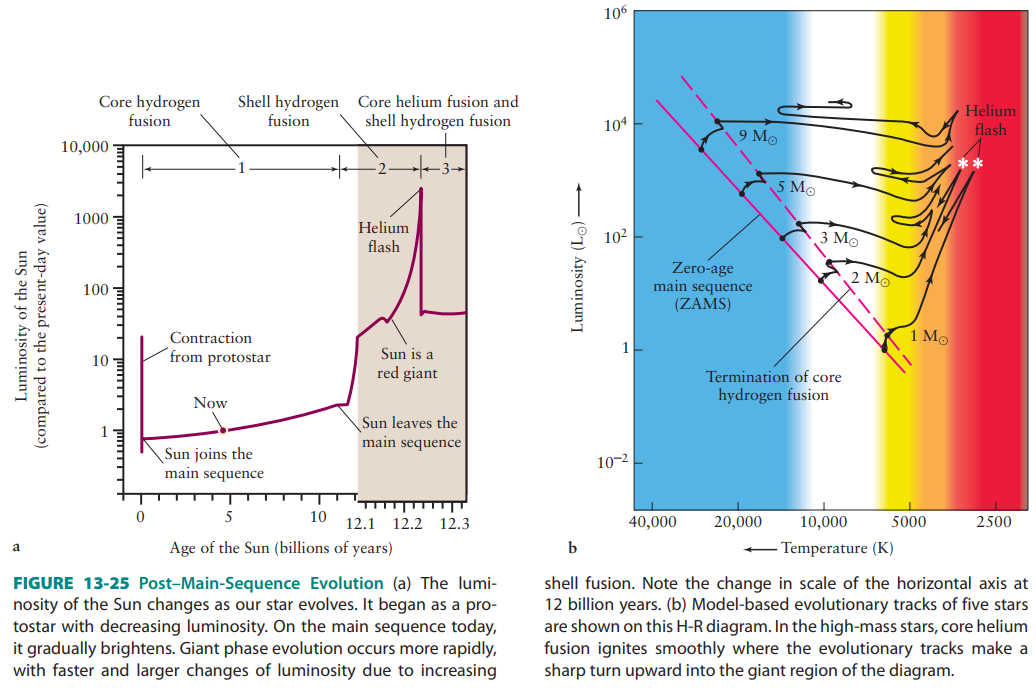
Stars move partly back towards the main sequence on the H-R diagram (right to left).
Pulsations:
Pressure-temperature 'safety valves' are imperfect, causing stars to overheat, expand, then cool, contract, and overheat again.
This leads to instability and pulsation.
Instability Strip: Region on the H-R diagram where these pulsating variable stars are found.
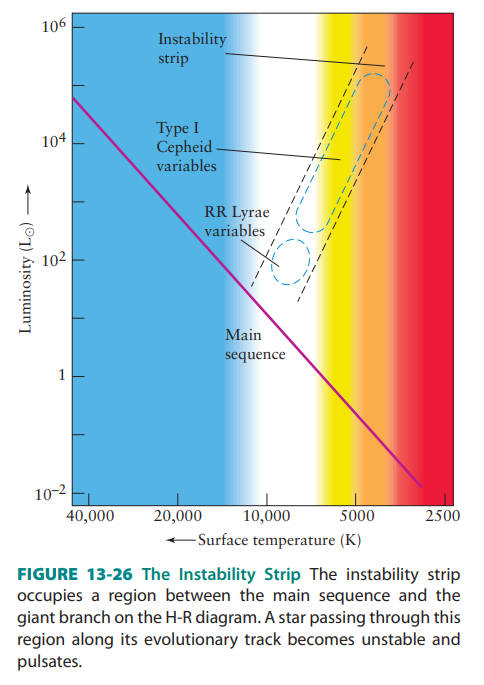
Types of Variable Stars:
RR Lyrae variables:
Lower-mass, post-helium-flash stars passing through the lower end of the instability strip.
Periods shorter than 1 day.
Type I Cepheid variables (Cepheids):
Higher-mass stars passing back and forth through the upper end of the instability strip.
Note: Type II Cepheids formed earlier with fewer metals.