Content 4
Learning Objective
What is the difference between the 3 theories of working memory and their hypotheses of short term memory stores?
Explain the main result of the Ranganath study and the interpretation of that result
Short term vs long-term memory
Short term: memory for info currently held "in mind"
Limited capacity
Predominately involves the frontal lobes
Long term: refers to info that is "stored"
Unlimited capacity
Predominately involves interactions between the temporal lobe and the cortex
The difference between short-term memory and working memory
Short term: passive retention of info temporarily held in mind
Working: is the system for the manipulation of info currently in short term memory
Working memory
Most working memory models assume the main storage site of info is long term memory
The long term memory system is not in the frontal lobes
The prefrontal cortex is mostly responsible for working memory
It keeps info active and/or manipulates the active info according to current goals
Limited capacity
Single - unit recording and spatial working memory in non-human primates
Atkinson and Shriffrin: Modal Model of Memory
Once info enters the brain, it must either be stored or maintained and the info which is stored goes into 3 distinct memory systems
Info is processed in a serial manner
3 distinct memory systems:
Sensory store: sensory info enters memory
Short term store (working memory): info from the sensory store and long term store is received and held
Long term store (long term memory): where info that has been rehearsed in short-term store is stored indefinitely
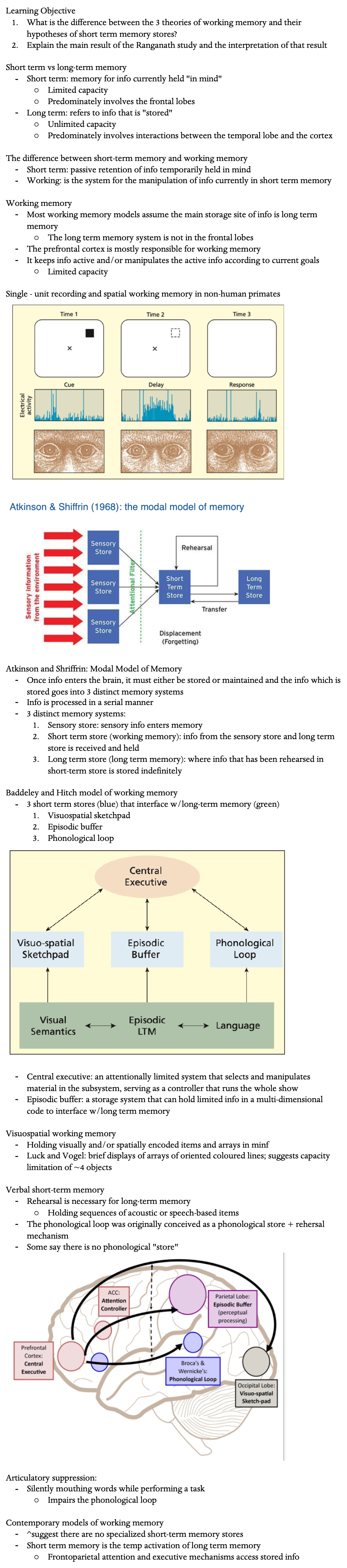
Baddeley and Hitch model of working memory
3 short term stores (blue) that interface w/long-term memory (green)
Visuospatial sketchpad
Episodic buffer
Phonological loop
Central executive: an attentionally limited system that selects and manipulates material in the subsystem, serving as a controller that runs the whole show
Episodic buffer: a storage system that can hold limited info in a multi-dimensional code to interface w/long term memory
Visuospatial working memory
Holding visually and/or spatially encoded items and arrays in minf
Luck and Vogel: brief displays of arrays of oriented coloured lines; suggests capacity limitation of ~4 objects
Verbal short-term memory
Rehearsal is necessary for long-term memory
Holding sequences of acoustic or speech-based items
The phonological loop was originally conceived as a phonological store + rehersal mechanism
Some say there is no phonological "store"
Articulatory suppression:
Silently mouthing words while performing a task
Impairs the phonological loop
Contemporary models of working memory
^suggest there are no specialized short-term memory stores
Short term memory is the temp activation of long term memory
Frontoparietal attention and executive mechanisms access stored info
Background Visual Working Memory
What is it
Baddeley's model
Memory performance is worse with more items
Correct decreases as numbers of items increase
Continuous report delayed estimation
More errors are farther away from the color as you see more items
LO
What is novel about this research?
Delayed estimation of color (continuous report)
Color space is constructed to be perceptually uniform (color wheel is the same so they can measure exact error of color)
Bias: a systematic shift of responses away from the true value
Biases in delayed estimation of color
Stimulus-specific biases: there is a bias depending on the specific color
Memories for color are biased by prior knowledge/color categories
Small effect sizes make biases difficult to measure
The Current Work
Method: serial reproduction (iterated learning)
Long-term memory and linguistics to understand how prior knowledge influences memory
Used in visual working memory to study visuospatial priors
Why is this research novel?
Here we have each chain of responses measured within a single individual (rather than by different individuals) and have the starting value of each chain be the same across individuals
This lets us look at group level, item level, and individual level differences
Questions about this data
Group level: across participants and colors
Item-level: across participants, specific colors
Individual level: across colors, specific participants
Experiment 1: stimulus specific biases
Some colors are reported more frequently than other colors, even when the distribution of colors shown is uniform
There are biases that vary in magnitude and direction depending on the specific color
The iterated design amplifies this bias
What are group level properties ?
What are the item-level properties ?
Slope measures bias
Slope distribution show stimulus-specific variability
What are the individual level properties?
Different clusters
Most have at least 3 attractors
Experiment 1 conclusions
Inidivudal serial reproduction amplifies bias
Group level, item level, and individual level patterns
There are 3 group level "attractors" that responses drift toward across iteration
Psychology Long-Term memory
LO
Memory is constructive, not a video camera
Why might the brain prioritize encoding some things over others
Learning as "preparation for retrieval"
The best way to think about learning is as preparation for retrieval. Your mind is trying to predict when you'll need information again, and make it accessible then
This means memory is context based
Memory is context dependent (Baddeley)
Memorize something in the same location you learned it
Produces better recall
Mood also is important,
You perform better if test sad when you memorized something sad
But how does this help us?
What process best explains this?
Spreading activation: travels from one concept to another via associative links
Helps explain context effects, and also why partial information helps in retrieval
Spreading activation
This kind of activation spreading seems to happen automatically. Explains repetition priming
If words are connected, response time is faster
Items shown in similar conditions are recalled better than dissimilar conditions
LO
What was the general experimental setup and conclusions made from Kandel's Aplysia experiments?
What is a memory trace and how does it relate to the stages of LTM
Be able to explain which brain regions are important for declarative memory and the different types of declarative memory
What is long-term memory (LTM)?
Stored information that does not need to be presently accessed or consciously accessible
Virtually unlimited capacity
All info from minutes, hours, days, and years ago is in LTM, unless its presently brought into working memory
Eric Kandel (Nobel Laureate)
Measured the gill-siphon-withdrawal reflex by recording single neurons in Aplysia California
Learning produces changes in behavior by modifying the strength of connections between nerve cells at the synapse
Aplysia as a model organism
Advantages
Relatively few neurons ~20,000
Large neurons seen with the naked eye
Easy to measure AP of single neurons and synapse structure
Implicit memory for reflexes
Habituation: decreased response to repeated exposure to stimulus
Sensitizing: enhanced response by giving an aversive stimulus
Stages of LTM
Memory trace: a bio change in the brain which reflects the storage of memory
Encoding: creation of the memory trace
Consolidation: stabilization of the memory trace
Retrieval: accessing the LTM
2 categories of LTM
Declarative memory (explicit): memories that can be consciously accessed and, hence, can typically be declared
Non-declarative memory (implicit): memorie sthat cannot be consciously accessed
Medial Temporal Lobe (MTL)
Contains the primary structures which support encoding, consolidation, and retrieval
Hippocampus
Adjacent cortices
Parahippocampal
Entorhinal
Perirhinal
Hippocampus
The hippocampus consists of subfields, some with more defined roles
Dentate gyrus
CA1
CA2
CA3
Subiculum
Damage to the hippocampus profoundly impairs declarative long-term memory
The remembering brain: long-term memory
Diencephalon
Substructures of the diencephalon most implicated in memory
Mammillary bodies of the hypothalamus
Anterior and dorsal nuclei of the thalamus
Damage causes severe impairment in learning new info
Korsakoff syndrome (wet brain) (in severe alcoholism)
Stroke
Types of declarative LTM: episodic
Episodic memory: memory for an event that is tied to a specific time and place (what, when, where)
Autobiographical: an event in reference to yourself
Non-autobiographical: an event tied to a time and place but not in reference to yourself
Learning happens once at the time of the event (single trial learning)
Semantic memory: conceptually based knowledge about the world, including knowledge of people, places, and the meaning of objects and words
Facts
Schema/semantic memory structures
Personal semantics
Learning happens over repeated exposure across different contexts
Nondeclarative (implicit)
Skills are supported by basil ganglia
Types of longer term memory
Non-declarative memory: retrieval of info from long-term memory through performance rather than explicit/conscious remembering
Often learned gradually over time
Procedural- learning piano
Muscle memory for scales
Motor memory
Priming
Classical conditioning
Non-associative learning
Amnesia
Deficits in long term memory that cannot be explained by other cognitive deficits
Anterograde: impairment in memory for the 'future'
Cant retain new info
Retrograde: impairment in memory for the past
Observed in a variety of clinical disorders
Dementias
Brain injury
Medications
Drugs/alcohol
Case Study: patient H.M
After being knocked off a bike at age 9, he began to have seizures
Despite heavy and varied anti-epileptic meds, his seizures increased in frequency and severity
By age 29, he unable to work and had an extremely low quality of life due to seizures
Scoville offered to conduct an experimental surgery he carried out in psychotic patients
He would cut out parts of the temporal lobe, lobotomy
In 1953, and with his consent, HM underwent a temporal lobectomy to remove;
Both left and right hippocampi
Amygdala
Nearby medial temporal lobe cortex
HM Neuropsychological testing
Underwent neuropsychological testing in '55
On the day of the test, he said the date was march '53
Presented w/ intact IQ and cognition except for memory impairments
HM performance on memory tests
He could complete the digit span - not impaired on working memory
Star mirror trace test - procedural memory (learning skill or habit)
HM
First trial, many errors
w/ practice, his errors decreased
Motor skills intact!
Implicit memory spared
BUT, he had no memory of ever completing the tracing task before
His declarative memory was damaged
Medial temporal lobe and diencephalon damaged -> declarative memory damaged
Basal ganglia intact -> nondeclarative intact
Could complete semantic memory tests at a similar level of performance as controls
Temporally-graded retrograde amnesia
Could accurately remember remote episodic memories (age 16 and younger)
Could not remember episodic memories from 3 years before surgery to date of testing
No Hippocampus
Impaired recent memory
Intact remote memory
What can we infer about the role of the hippocampus in declarative long-term memory retrieval?
Some responsibility for retaining long term memories
Consolidating memories: helps stabilize memories so you don't lose them
Temporally graded retrograde amnesia
Declarative memories acquired just before lesion (recent memory) are impaired
Declarative memories acquired in the distant past before the lesion (remote memory) are spared 4
Conclusion: the hippocampus is necessary for retrieving recent but not remote declarative memories -> evidence
The phenomenon of TGRA predicts theres a neural mechanism which stabilizes memories over time so that they are eventually remembered without the hippocampus
Long-term memory consolidation
Memory consolidation: the process by which a temporary, unstable memory trace is transformed into a more stable, long-lasting form
Systems Consolidation Theory
All declarative memory retrieval eventually becomes independent of the hippocampus
At encoding, the hippocampus and cortex are highly connected
As time pass after encoding, the memory reorganizes and becomes represented in the cortex
Systems consolidation theory suggests that the complexity distribution, and connections of the memory trace change with the age of the memory
Functional magnetic resonance imaging (fMRI)
MRI scanner
Processed fMRI data
Indicates which areas of the brain have more "functioning' (oxygenated blood) during an experiment
fMRI study of standard systems consolidation theory
Can the predictions of systems consolidation be observed for episodic memory in healthy adults?
Functional Connectivity
^ decreased between the hippocampus and parahippocampal place area across 1 month
functional increased between the vmPFC and the parietal lobe across 1 month
fmRI study of standard systems consolidation theory
They replicated their findings
Hippocampal brain activity decreased across 1 month
Frontal brain activity increased 1 month
Different Accounts of MTL and Memory
Is there a jennifer aniston neuron?
Researchers believ ethey discovered individual hippocampal neurons that code for a single, complex memory (grandmother cell)
Memory Coding Schemes
Local: a single hippocampal neuron codes for a single memory (grandmother cell)
Sparse distributed: each memory is coded by the activity of a small proportion of hippocampal neurons, and each neuron contributes to the representation of only a few memories
Fully distributed: each memory is coded by a pattern of activity across many neurons