Molecular Biology Techniques
Molecular Biology Techniques Exam 2
- Genomics
- Gene Transfection: inserting intact genes
- Eg. GFP linked to gene of interest
- Editing genes: Adding/removing genes or single bases
- CRISPR/Cas 9 (62 pig retroviruses removed)
- Controlling gene expression
- Knockin and knockout transgenic animals and cells
- siRNA, shRNA, antisense RNA
- DNA sequencing: determining the exact order of base pairs in a segment of DNA
- “$1000 human genome” - Oxford Nanopore Technologies minION system uses bacterial pores (nanopores)
- Nanopore sequencing: drawing individual strands of DNA through protein pore in membrane, identifying unique shape of base pairs to obtain a readout of the DNA
- Transcriptome: the set of all the RNA molecules transcribed in a cell/cells
- Proteomics: the study of the entire genome
- Epigenetics: inheritable non-base changes in DNA due to environment
- Potential epigenetic influences: died, disease, microbiome, psychological state
- Cancer cells and the metabolome
- If we can understand metastatic cancer cells decision-making process (in how they spread in the body) then attacking them may be easier
- Vanderbilt U researchers discovered metastatic cancer cells take the lowest energy route -> targeting metabolome may be important
- Prefer large spaces (they are lazy)
- Secretome: secreted proteins, cfDNA, exosomes and vesicles from cells
- biomarkers for cancer (cfDNA -> Galleri Test)
- Stem cells secrete factors in exosomes that are important to tissue repair and other physiological changes -> clinical trials
- Replace stem cells
- Calm cytokine storm of covid 19 via inhalation
- Advantage: stem cells are forever, exosomes have half life
- Mutations: change in DNA sequence that affects genetic information
- Can be caused by UV light, chemicals …
- Absolutely critical in molecular genetics
- Mutagen: a chemical or physical agent that interacts with DNA and causes a mutation
- Yeast cell characteristics
- Can be diploid or haploid
- Temperature sensitive mutants
- Easy to grow -> simple basic solution
- Studying mutations using yeast cells process
- Yeast in liquid culture -> add mutagen, distribute into smaller aliquots
- Incubate at permissive temp (23 C)
- Plate out individual aliquots
- Grow one in permissive temp (23) and other in non growth temp (36)
- Permissive temperature: 23 C
- Yeast will grow
- The temperature at which a temp sensitive mutant allele is expressed the same as the wild type allele
- Nonpermissive temperature: 36 C
- Temp sensitive mutants will not survive
- The temp at which a TD mutant allele does not express itself
- What permissive temperature experiments tell us about involved genes
- Temp sensitive genes are essential for cell growth (cell does not grow in a different environment that inhibits activity)
- Complementation analysis
- Determines if recessive mutations are in the same gene
- Test for determining whether two mutations associated with a specific phenotype represent two forms of the same gene (alleles)
- Complementation analysis procedure
- Mate haploids of opposite mating types and carrying different temp sens cdc mutation
- Plate and incubate one at permissive temp and replica at nonpermissive temp
- Testing for TS cdc phenotype
- Interpretation of complementation analysis
- Growth at nonpermissive temp: mutations are on different genes; respective wild-type alleles provide normal function
- Absence of growth: mutants are on same gene; both allele nonfunctional
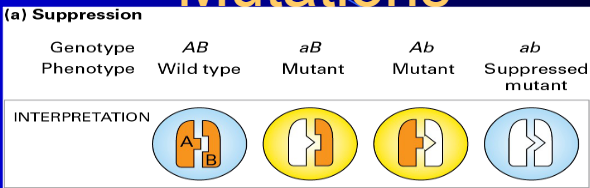
- Suppression - rare
- Suppressed mutant has wildtype
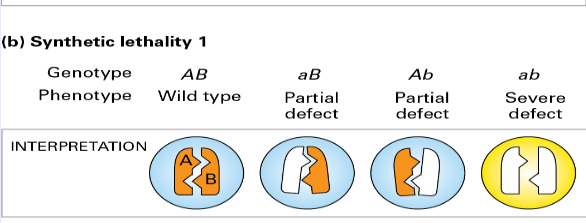
- Synthetic lethality 1
- Severe defect -> cannot bind
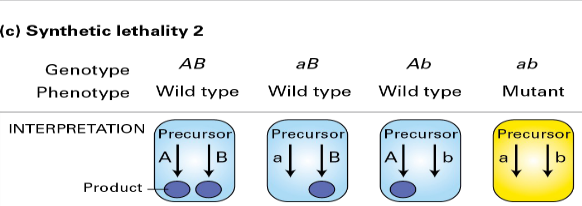
- Synthetic lethality 2
- Restriction enzymes/nucleases
- Bacterial enzyme that cuts DNA at a specific sequence of nucleotides
- Blunt and sticky ends
- EcoRI
- Gene splicing: uses restrictive enzymes to insert DNA sequence into vector or plasma
- Nucleic acid hybridization: base pairing between a gene and a complementary sequence on another nucleic acid molecule
- FISH, antisense DNA/RNA
- Nucleic acid hybridization procedure
- Probe put into cell
- Binds to select mRNA
- Ribosome does not bind to doubly bonded mRNA
- DNA engineering: technology that involves manipulating DNA to insert in another organism
- Native gel electrophoresis types
- Polyacrylamide GE: small sequence of DNA (10 - 200 bases)
- Agarose GE: larger DNA (200 - 20 Kb)
- Native Gel electrophoresis applications
- Restriction enzymes: band/gel shift assay (DNA binding proteins)
- Apoptosis vs necrosis
- Band/gel shift assay
- Objective: search for protein that binds to gene of interest
- Apoptosis vs necrosis native gel electrophoresis
- Control: will not go anywhere
- Apoptosis: ladder (nonrandom DNA cleavage)
- Necrosis: smear (random DNA cleavage
- Northern Blot
- Analyze RNA expression (gene expression)
- Qualitative (molecular weight) and quantitative (relative abundance)
- LIMIT: only one mRNA species can be assessed at a time
- Southern Blot
- EG technique designed to detect gene sequence (DNA)
- VNTR -> parental/forensic analysis
- SNP -> helps to predict diseases
- Personalized medicine
- Bone marrow transplant example
- Southern Blot and bone marrow transplant
- Expectation is for donar bands to match patients after surgery - no residual cancer
- They now express the donor’s bands, and not their own
- VNTR (Variable Number of Tandem Repeats): distinguish DNa from multiple samples (forensic and parental analysis)
- SNP (Single Nucleotide Polymorphism): one base-pair variation in the genome sequence
- Usually occur in junk DNA, bt can occur in coding DNA
- Predict symptom of severity of autism spectrum disorder
- Helps predict diseases, side effects, doses, construct genetic maps
- Molecular beacon probe
- Gene expression -> look for specific DNA/RNA strand
- Better than FISH
- Molecular Beacon probe’s fluorescence is quenched (not fluorescent) unless bound to target RNA or DNA strand
- Fluorescent dye on one end and quencher on other end of oligonucleotide
- Only fluoresces when binds to DNA/RNA strand (in situ hybridization) because now quencher and fluorescent are separated
- cDNA microarray: analyze gene expression up to 8600 at once
- Alternative to northern blots
- Cluster analysis
- cDNA microarray procedure
- Two groups: one without serum (control), one with serum (insulin example)
- Isolate total mRNA of cells
- Reverse transcriptase to cDNA
- Label each with its own fluorochrome (red or green)
- Mix to hybridize on array
- Assess ratio of intensities of red, yellow, and green fluorescence
- Analysis of cDNA microarray
- Green: expression of gene decreases in cell after serum is add -> control (no serum) binds
- Red: expression of gene increases in cells after serum added -> insulin binds
- Yellow: gene expressed in both cells -> both present
- cDNA microarray applications
- What genes are expressed in x-type cells in response to Y?
- Subtyping two cancer cells to identify differences in genes
- Cryosurgery of prostate
- Cluster analysis: determining if groups of genes whose expressions are altered in response to the same conditions
- Single cell RNA sequencing: can identify individual cells at select points in types based on their unique RNA signatures
- Improvement over cDNA microarrays
- Application of single-cell RNA sequencing: compare RNA signature of one cell to another (comparing artificial heart cells vs real heart cells)
- DNA cloning
- Starting material is all genomic DNA
- Adv. Gene of interest is present,
- dis. huge library to search
- cDNA cloning
- Starting material is mRNA and not DNA -> (smaller library)
- Dis advantages
- Need to convert mRNA to DNA to clone E.coli using reverse transcriptase
- If gene is not being expressed, gene wont be cloned
- Issue with using prokaryotes to prompt DNA/protein synthesis
- Very little protein of interest secreted
- No post translational modification (glycosylation, phosphorylation, folding)
- Required for protein to function
ENBREL: a miracle biologic for Rheumatoid arthritis
- PCR (Polymerase Chain Reaction): methods to amplify amounts of DNA or mRNA using Tac polymerase
- Short tandem repeats
- Sections of a chromosome in which DNA sequences are repeated
- Can be detected by DNA sequencing and PCR amplifying
The Jackson Laboratory in Bar Harbor Maine has over 6000 transgenic mice strains
- Knock-in genetic modification: Genetic engineering to activate a particular gene
- Knock-out genetic modification: genetic engineering to disable a particular gene
- siRNA Huntington’s disease:
- No cure and causes breakdown of nerve cells in the brain
- People with HD over over abundance of huntington's toxin (siRNA) which is toxic to nerve cells and cancer cells
- People with HD have 80% fewer cases of cancer
- siRNA (short inhibitory RNA)
- Adv.
- Simple methodologies
- Fast and effective transfection
- Modifications are available
- Disadv.
- Not passed on to daughter cells
- Non renewable
- Only transient knockdown
- shRNA (short hairpin RNA)
- Adv.
- Renewable resource (passed down)
- Transient or stable knockdown
- Transfection or viral delivery
- Disadv.
- Technically challenging