Enzymes (2.5-2.6)
- Anabolic: Reactions that @@build@@ large molecules from smaller ones
- Require an input of energy
- Catabolic: Reactions that @@break down@@ large molecules into smaller ones
- Release energy
Enzymes
- Enzymes: Biological catalysts made up of proteins that speed up the rate of chemical reactions and remain unchanged
### Feautures of Enzymes
- Enzymes are biological catalysts made of proteins
- Needed in small amounts to catalyse large molecules
- Name after the suffix ‘-ase’
- Specific in action. Each enzyme can act on a specific substrate because of the enzyme-substrate complex; have active sites where substrates can fit
- Convert substrates into products
- Enzymes are necessary to all living organisms as they maintain reaction speeds of all metabolic reactions at a rate that can sustain life
- Substrate: The substance on which an enzyme acts on
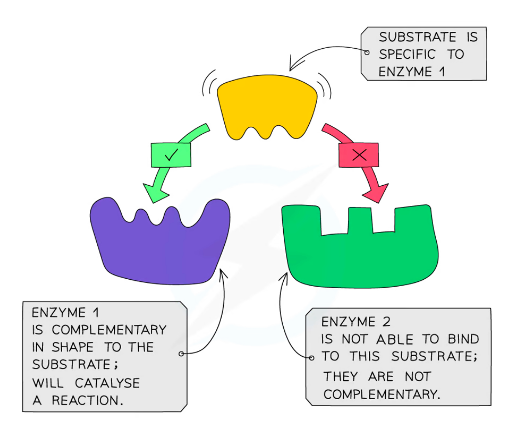
Types of enzymes
- Intra-cellular enzymes: Are formed inside the cell and working inside eg. Catalase
- Extra-cellular: Are formed inside the cell but work outside eg. Lipase, amylase
Enzyme Activity
- An enzyme is a protein folded into a complex 3D shape
- The Active site is the part of the enzyme that allows it to act as a catalyst
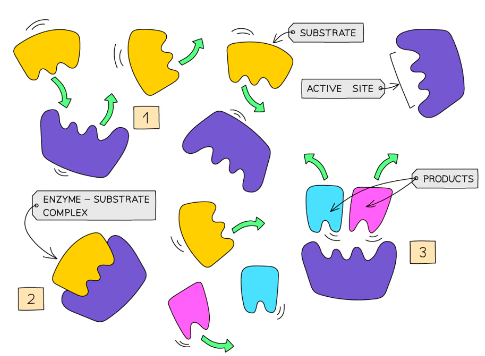
- Lock and key hypothesis- When the substrate moves into the enzyme’s active site they become known as the enzyme-substrate complex
- Substrate molecules fit exactly into the active site of the enzyme to form an enzyme substrate complex
- The active site brings the molecules closer to allow them to react
- The substrate reacts to form a product which leaves the active site
- The enzyme is now free to bind with more molecules
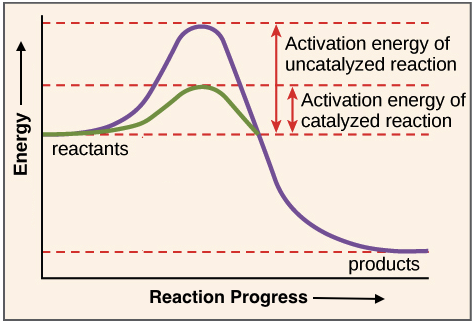
- Enzymes lower the energy needed for the reaction to take place
Factors affecting enzyme activity
- Temperature
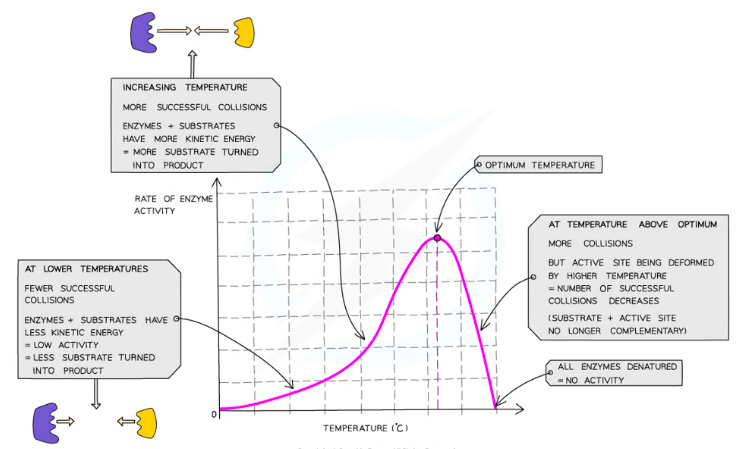
- Enzyme activity increases with a rise in temperature up to a certain point
- Higher temperatures speed up the movement of substrate molecules
- They will collide more often and with more energy and are more likely to bond to the active site
- Eventually the enzyme molecules vibrate so much that they become denatured (lose their shape)
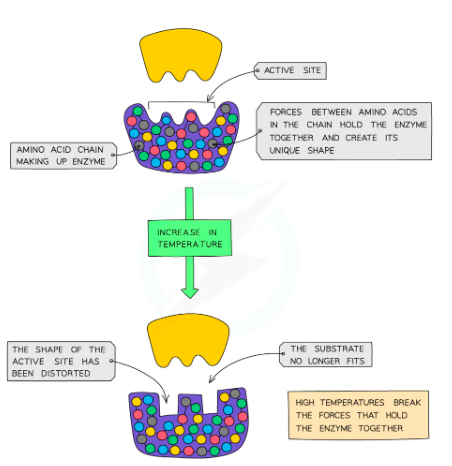
- Each enzyme has an optimum temperature
- Temperature at which enzyme activity is highest
- Human enzymes - 37C
- Plant Enzymes- 25C
- pH
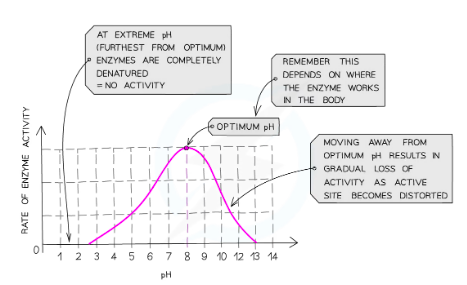
- Each enzyme has its own optimum pH
- pepsin - pH 2.0 (acidic)
- Amylase - pH 7.5 (slightly basic)
- Activators: make binding more likely. eg. chloride ions are essential for the activity of amylase
- Inhibitors: Make bindidng more difficult by covering the active site of the enzyme. eg. Cyadine ions, block respiratory enzymes
Uses of enzymes
- Snake venom can break down blood clots
- Lactase can break down lactose to make lactose free milk
Experiment
- Catalase catalyses the breakdown of hydrogen peroxide
- Hydrogen peroxide→ Oxygen + Water
- Discs of potato are put into a solution of hydrogen peroxide
- The catalase in the potatoes breaks down the hydrogen peroxide into oxygen and water
- The oxygen passes into the manometer which shows how much oxygen is being produced
- This gives a measure of enzyme activity